




Abstract
Abstract
Background:
Lymphedema is a chronic, progressive disease consisting of tissue swelling resulting from excessive retention of lymphatic fluid. Measuring upper limb volume is crucial in patients to detect disease progression and to study the effects of treatment. The aim is to assess the validity and reliability of a newly developed system, Peracutus Aqua Meth, for measuring the upper limb volume compared with the gold standard water volumetry device. (In this study, the Bravometer was used).
Methods and Results:
Healthy volunteers were recruited in October 2017. Three measurements were performed per device. The obtained data were recorded per measurement, device, and researcher. Primary outcome was to determine the validity and reliability of the Peracutus Aqua Meth. Secondary outcomes were intra- and interrater reliability, measurement time, self-reported participant satisfaction, and influence of body mass index (BMI). Thirty-nine healthy volunteers were included. Mean differences in the validity in the Peracutus Aqua Meth and Bravometer were 47.26 and 78.16 mL, respectively (p = 0.04), with a Pearson's r of 0.99. Intra- and interrater reliability of the Peracutus Aqua Meth were both 0.99, in the Bravometer 0.96 and 0.97, respectively (p < 0.01). The Peracutus Aqua Meth required more time to measure and obtained lower scores in the participant satisfaction questionnaire. BMI was statistically associated with the measurements (p < 0.01).
Conclusions:
The first prototype of the Peracutus Aqua Meth is proven to be an accurate and reliable device for measuring the volume of the arm. Further improvements are needed in case of usability, time management, and participant satisfaction.
Introduction
Lymphedema is a chronic, progressive disease consisting of tissue swelling resulting from excessive retention of lymphatic fluid caused by impaired drainage. Depending on the etiology, it is classified in primary lymphedema, caused by developmental lymphatic system anomalies and secondary lymphedema, mostly due to surgery, systemic diseases, and infections. 1
Breast cancer treatment is one of the main causes of secondary lymphedema in the upper limb affecting 3%–60% of breast cancer survivors.2,3 The classical lymphedema symptoms (pain, heaviness, swelling) may occur in the hand, arm, and/or breast. These symptoms may limit physical and social functioning and affect negatively the body image and quality of life.4–6
Measuring upper limb volume is crucial in patients to detect disease progression and to study the effects of treatment. 7 Different methods are described for this purpose: circumference measurement, 3D imaging with VECTRA imaging 8 ; three-dimensional stereophotogrammetry, 9 and perometry measurement with a portable infrared system. 10
The gold standard is the inverse water volumetry, or water displacement volumetry, in which the whole arm volume can be measured. 11
The aim of this study is to assess the validity and reliability of the first prototype of a newly developed system for measuring the upper limb based on a novel applied measuring concept in comparison with the gold standard water volumetry system.
Materials and Methods
Study population
Healthy adult volunteers were recruited in October 2017 for the current study. Demographic data from the volunteers were recorded. An approval of the IRB was obtained (METC17-4-063). Participants presenting with infections or open wounds in their hands or arms, contact allergy against the used materials, or wheelchair dependency were excluded from the study. All participants received information about the experiment and they signed an informed consent as agreement to participate.
Outcomes
The primary outcome was to determine the validity and reliability of the Peracutus Aqua Meth. Secondary outcomes were the intra- and interrater reliability of the Peracutus Aqua Meth, measurement time, self-reported participant satisfaction by means of a questionnaire, and influence of body mass index (BMI). The participants were asked to score each device on usability, time needed to perform measurements, and the ease of the instructions that were given on a scale from 1 to 10. Higher scores in the questionnaire mean a higher satisfaction. See the Supplementary Data for an example of the questionnaire.
Measurement strategy
Every volunteer was measured with both the Peracutus Aqua Meth and the Bravometer. Each measurement was repeated three times per participant and per device. Measurements 1 and 3 were performed by the first researcher (J.W.) and the second measurement by the second researcher (E.B.). Participants underwent all measurements of both devices on the same day.
Bravometer water displacement (Novuqare Hospital Equipment® Rosmalen, the Netherlands)
This device enables a straightforward use and it is painless for the patient. The water basin was filled up with lukewarm water by the researcher. Participants were asked to slightly immerse their hand and arm into the Bravometer and the water overflow was measured.12–18 Using a marker, dots were placed on the arm at the level of the water surface, thereby marking the edge of the measured arm volume. After each measurement, the water basin was refilled with fresh water before the next measurement (Fig. 1).
Bravometer water displacement device.
To compare the same length of the arm in both devices, the length of the measured part of the arm in the Bravometer was measured, with the arm and hand in full extension, from the tip of the longest finger till the marked dots. Furthermore, the circumference of the arm at the marked dots was measured. The mean of the length of the measured arms can be found in Table 1.
Descriptive Characteristics of the 39 Healthy Volunteers (16 Males and 23 Females)
Peracutus Aqua Meth (Peracutus B.V.® Roggel, the Netherlands)
The Peracutus Aqua Meth concerns a newly developed device, a first prototype is used in the current study. In contrast to the Bravometer, measurement with the Peracutus Aqua Meth is not based on water displacement. During filling (and subsequent emptying) of the cylinder, the height of the water column in the unit is measured continuously using a pressure sensor on the bottom. Furthermore, the flow rate of the pumped water is calculated at each specific height. Hence, the increase (or decrease) of the water level in the measuring unit at each time interval is a measure for the cross-sectional area of the arm at the specific height, i.e., position on the arm. The cross-sectional area of the arm at approximately each 0.7 mm is determined.
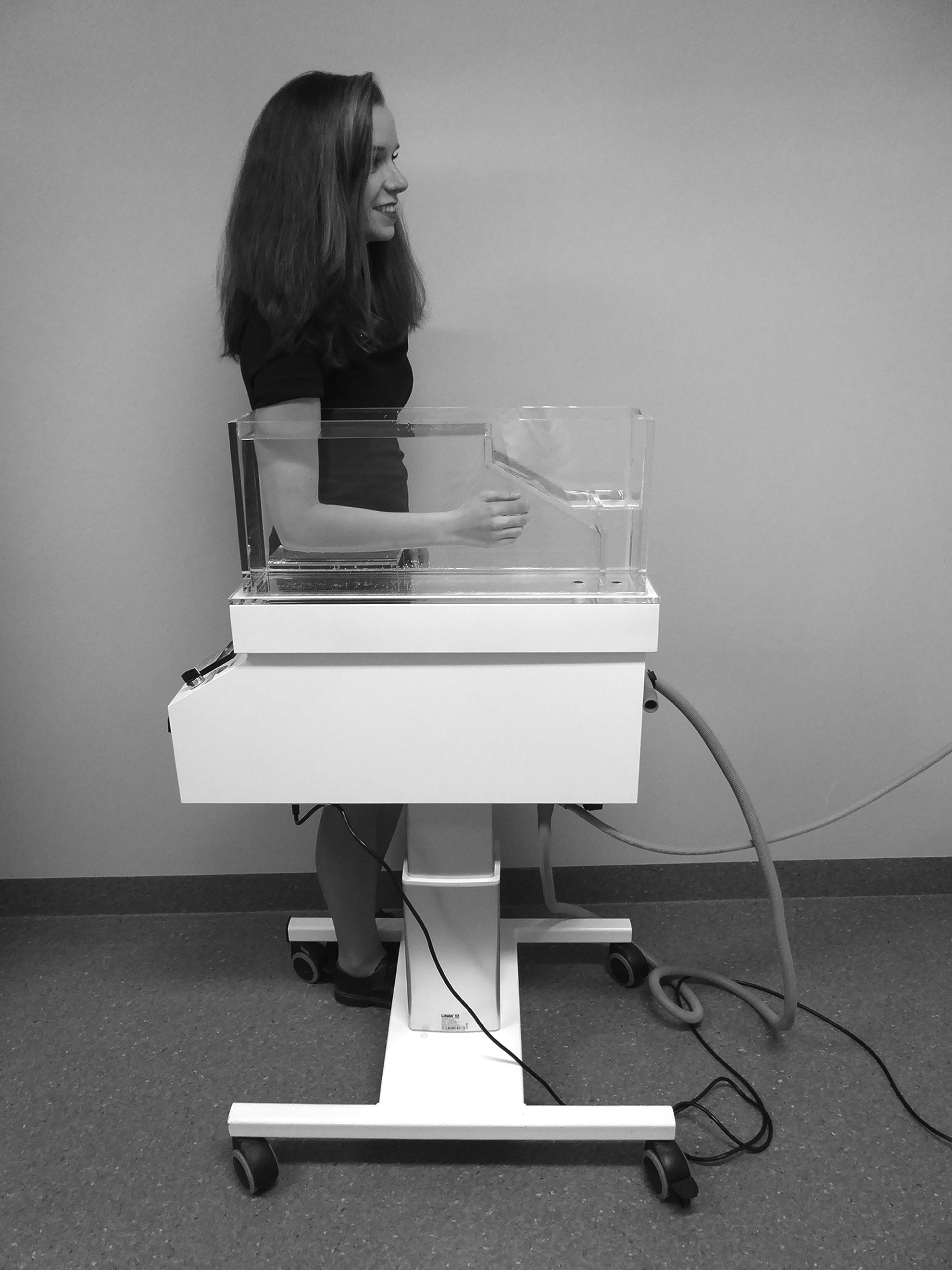
The Peracutus Aqua Meth measuring unit consists of a transparent plastic cylinder. The participant takes place sideways on a chair next to the measuring unit, leaning with the flank comfortably against the backrest of the chair. The hand and arm are placed in vertical position with the elbow in extension and the hand placed against the side of the cylinder (Fig. 2).

First prototype of the PAM. PAM, Peracutus Aqua Meth.
Water is pumped from the prewarmed (30°C) storage tank through plastic tubing and a three-way valve into the measuring unit. The measuring unit is filled upward from a calibration level at the bottom. The filling stops automatically at a predetermined height regulated by a sensor and the water is pumped out of the measuring unit through the same three-way valve to the drain. Water is not reused.
In the first prototype, only during emptying of the cylinder the volume is measured and registered. Data are automatically transferred to and processed in an Excel (Microsoft Office 2016®) chart. Integration of all values within the marked range renders the total volume of the arm.
In this study, before measuring the Peracutus Aqua Meth, the length of the arm from tip of the longest finger until the dots on the upper arm was filled in the software to compare the same lengths in both devices.
Statistical analyses
Results are presented as mean and standard deviation for numerical variables and percentage for categorical variables. In case of a clear aberration of normal distribution, the median (interquartile range, 25th to 75th percentile) are presented. Paired-samples t-test as well as Pearson correlation coefficient are performed to evaluate the accuracy of volumes measured by the Bravometer and Peracutus Aqua Meth.
A Bland–Altman plot is used to analyze individual measurement results. 19 The latter is performed to evaluate agreement between both techniques, systematic error measurements, and range of deviations. Considering the potential influence of BMI on the accuracy of arm volume measurements, a linear regression analysis is used.
Results
Thirty-nine healthy volunteers were included in the study. A total of 38 out of 39 healthy volunteers' measurements was used for statistical analyses. One participant was excluded due to limited capacity in total arm length of the Peracutus Aqua Meth in this study. No side effects were encountered during the measurements with both devices. Baseline characteristics are presented in Table 1.
Validity and reliability
Volume measurements obtained with the Peracutus Aqua Meth and the Bravometer are summarized in Table 2. The mean difference in measurements, highest minus lowest measurement of the three measurements, obtained with the Peracutus Aqua Meth, was statistically lower than the measurements obtained with Bravometer (p = 0.04). Mean volumes of three measurements obtained with the Peracutus Aqua Meth appeared to be significantly higher with a mean of 38.80 ± 62.69 mL (p = 0.001).
Measurement Results with the Bravometer and Peracutus Aqua Meth (N = 38)
Measurement 1 and 3 are done by researcher 1, measurement 2 by researcher 2.
In Figure 3 a high correlation is displayed between the two devices (Pearson's r = 0.99), which was statistically significant (p < 0.001).
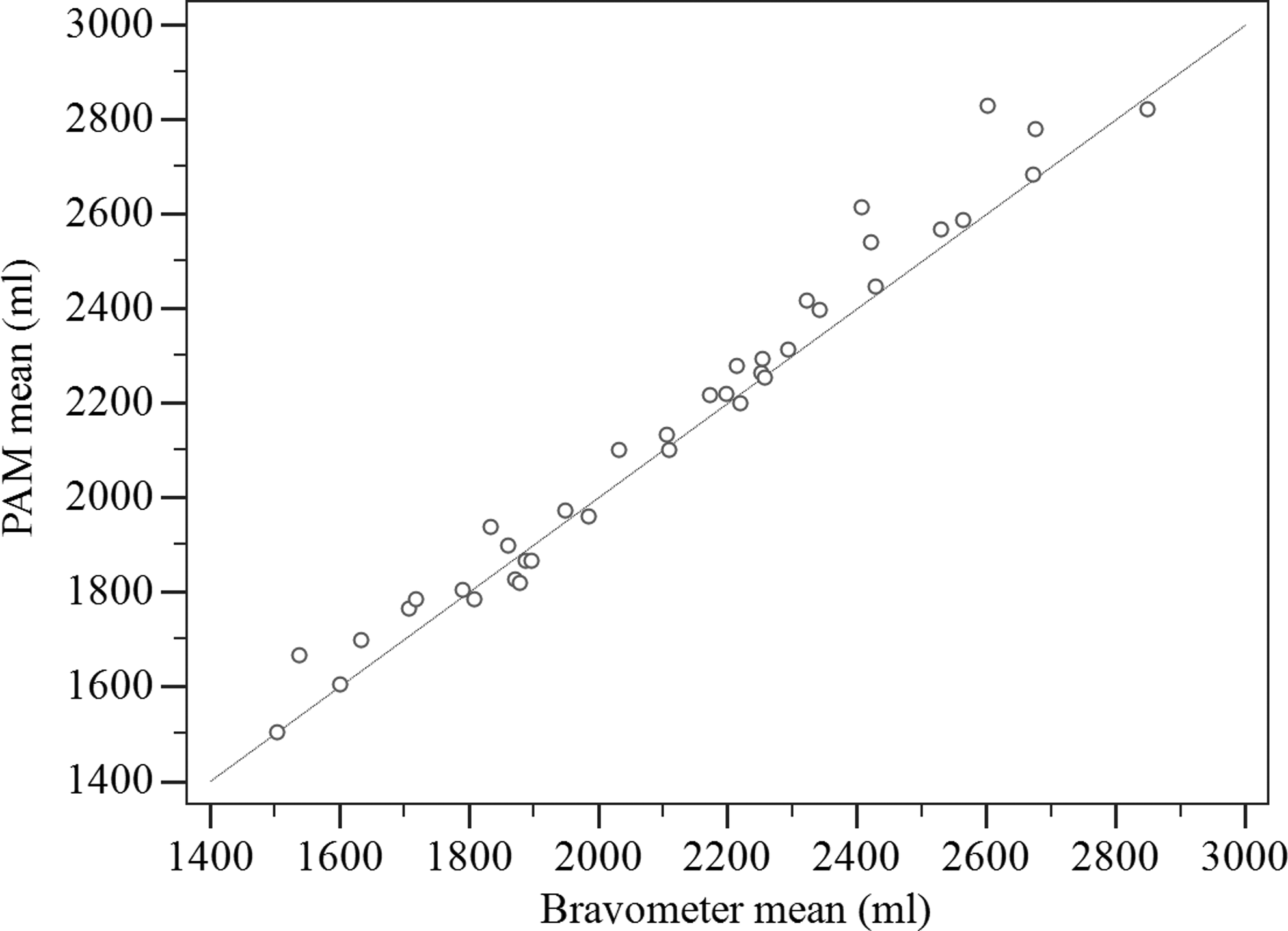
Measurement mean of the PAM and Bravometer. Each dot represents one volunteer. The line represents the line of identity.
Figure 4 presents a Bland–Altman plot of the differences between measurements against the mean of both devices with a bias of 38.80 as described above. No trend in differences was seen, as the dots are similarly distributed in lower and higher means.
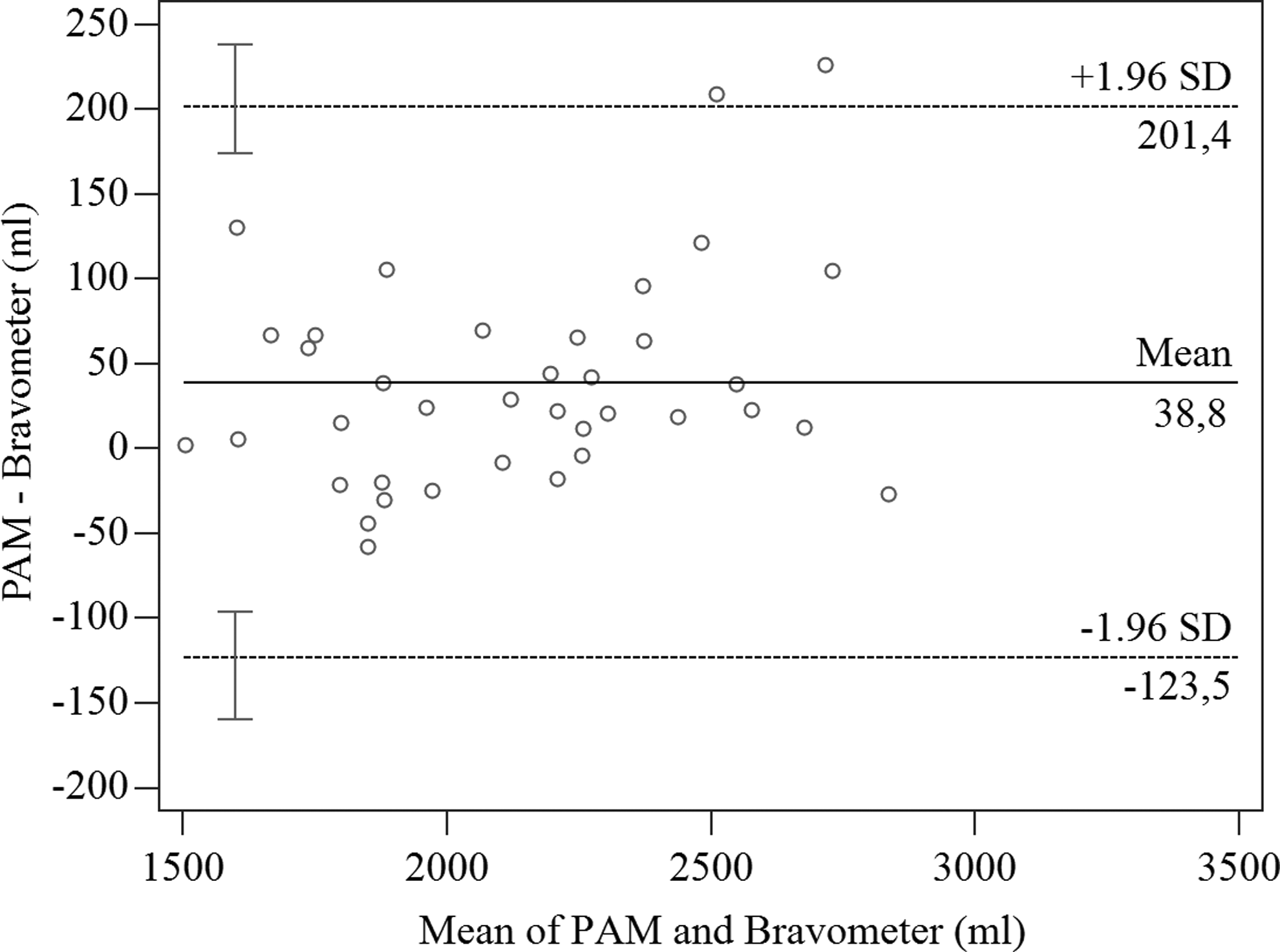
Bland–Altman plot of differences against mean of both techniques.
Intra- and interrater reliability
Intrarater and interrater reliability are depicted in Table 3. Only the intrarater mean difference of the Peracutus Aqua Meth was statistically significant (p = 0.38). All intraclass correlation coefficients (ICC) were statistically significant (p < 0.001).
Intrarater and Interrater Reliability in Both Devices
p < 0.001 in all ICC cases.
No. of measurement,
PAM, Peracutus Aqua Meth; ICC, intraclass correlation coefficient; SEM, standard error of measurement.
Time
The mean of total time needed for the 3 measurements with both devices were 739 ± 208.1 seconds for the Peracutus Aqua Meth and 411 ± 85.6 seconds for the Bravometer, respectively. This difference was statistically significant (p < 0.01).
Participant satisfaction
Statistically significant differences were found in usability and the time needed to perform measurements. The participants assessed the usability of the Peracutus Aqua Meth as 7.53 ± 1.54 and the Bravometer as 8.53 ± 1.00. For the time needed to perform measurements they scored 7.66 ± 1.58 and 8.50 ± 1.16, respectively.
Body mass index
A statistically significant association was found between BMI and the measurements obtained with the Peracutus Aqua Meth (R = 0.72) and Bravometer (R = 0.66), with both p < 0.01.
Discussion
According to the obtained results, the Peracutus Aqua Meth seems to be more accurate with a higher intra- and interrater reliability in comparison with the Bravometer. The intention of this device is to measure the upper limb volume before and after surgery, not to diagnose lymphedema, and therefore the mean difference of 38.8 mL between the devices is statistically significant, but may not be clinically relevant.
Different studies describe a reliability of inverse water volumetry in the upper limb lymphedema with ICC ranging from 0.90 to 0.99.12,13,20–22 Therefore, a definition of a good intra- and interrater reliability is set consisting an ICC above 0.90. Both the Peracutus Aqua Meth (ICC 0.99) and Bravometer (ICC 0.96 and 0.97) meet this definition, meaning a high degree of agreement among raters.
Measuring with the first prototype of the Peracutus Aqua Meth was more time consuming and participants assessed the Peracutus Aqua Meth with lower scores in terms of usability and time needed to perform measurements. The results of the question about the ease of the given instructions per device was not statistically significant.
Other volumetric methods, such as circumference measurements,23,24 intrarater and interrater ICC's ranged between 0.94 and 0.99.20,25 Another study showed an acceptable agreement between the Inverse Water Volumetry and the Herpertz method, a circumferential measurement method, but the ICC's were a bit lower between 0.89 and 0.91.12,26 The results of the Peracutus Aqua Meth are with ICC's of 0.99 comparable with these methods or even more reliable.
The studied Peracutus Aqua Meth device is the first prototype, presenting still some limitations that need to be overcome. Some of these limitations are due to the study setup, since the Peracutus Aqua Meth is designed to measure integral circumference at any level of the arm. In this study, only the total volume of the arm until the marked dots was compared between devices. As a result, there was a length limitation of the cylinder, causing no producible data with the Peracutus Aqua Meth in one participant. In this case, the length of the arm from the tip of the longest finger until the marked dots on the upper arm did not fit between the sensors of the Peracutus Aqua Meth cylinder. Additionally, the first prototype is more time consuming. There was no result producible if the arm was not held completely still, the arm was held too high or the cylinder was moved during the measurement, therefore a refill of the storage tank was required. Furthermore, lower scores on the usability with the Peracutus Aqua Meth might be due to inconveniency in the armpit, which was pressed against the edge of the cylinder, and different lengths of the participants, for which the setup could not be adjusted. These problems will be adjusted in the final version of the device.
Conclusions
In conclusion, the first prototype of the Peracutus Aqua Meth has proven to be an accurate and reliable device for measuring the volume of the arm. However, the differences with the Bravometer indicate that the measurements are not interchangeable. Hence, clinicians should not mix or substitute measurement methods within a single patient or in a single study. A next-generation device of the Peracutus Aqua Meth is needed to address the lower usability and the longer measurement time.
Devices
Bravometer
Novuqare Hospital Equipment BV
Kievitsven 42
5249 JJ Rosmalen
The Netherlands
Peracutus Aqua Meth
Peracutus BV
Schuttersveld 26
6088 EZ Roggel
The Netherlands
Footnotes
Author Disclosure Statement
No competing financial interests exist.
References
Supplementary Material
Please find the following supplemental material available below.
For Open Access articles published under a Creative Commons License, all supplemental material carries the same license as the article it is associated with.
For non-Open Access articles published, all supplemental material carries a non-exclusive license, and permission requests for re-use of supplemental material or any part of supplemental material shall be sent directly to the copyright owner as specified in the copyright notice associated with the article.
