




Abstract
Abstract
Aim and Hypothesis:
The standard volumeter is heavy and fragile, and using the same volumeter for different patients can result in hygiene problems. These disadvantages point to the need for the development of a new model of volumeter. The new volumeter put forward in this study is lighter, smaller, sturdier, and easier to clean, while also having its own scale. In this study, the validity of this newly designed volumeter is investigated.
Materials and Methods:
In the first step, the volume of standard cylinders was measured thrice using a standard volumeter and an easy-measurement volumeter, after which a total of 30 arm volumes of 15 volunteers were measured. In the final stage, the arms of 28 patients with breast cancer-related lymphedema were measured once with both volumeters and the mean results were compared.
Results:
There was a high degree of consistency between the measured volumes of cylinders of known volume when measured with a standard volumeter and the “Easy volumeter.” The measured mean volumes with the two volumeters were assessed with paired sample t-test, resulting in a significance (p value) of 0.927, indicating no difference between the measurements of the two volumeters. The variance of measurement of the devices was assessed with a Levene's test, and the significance (p value) was obtained as 0.981. Based on this result, the null hypothesis cannot be rejected, meaning that there is no difference in the variances of measurements of the two volumeters. Likewise, a paired sample t-test was used to evaluate the differences between the mean measurements of the healthy volunteers group, and no difference was detected between the mean arm volumes measured with each volumeter (significance=0.105). The measurements between the two volumeters were also consistent in the lymphedema patient group (involved arm significance = 0.842 and normal arm significance = 0.075).
Conclusion:
Our study revealed the validity of the newly designed “Easy Volumeter” for the measurement of arm volumes, indicating its appropriateness for use in daily practice.
Introduction
Breast cancer is the most common type of cancer among women. 1 Improvements in therapies applied in cases of breast cancer have reduced the rate of mortality associated with the disease, and the 5-year survival rate among breast cancer patients is today ∼89%. 2 Accordingly, the management of posttreatment complications has gained importance with the increase in survival time after breast cancer treatment. Lymphedema, developing secondary to breast cancer treatment, is one of the most significant treatment complications, being a clinical picture that is characterized by a retention of protein-rich interstitial fluid in the subcutaneous tissue. 3 Incidences of lymphedema after breast cancer vary between 8% and 56%. 4
As for the treatment of breast cancer itself, early diagnosis is a significant indicator of lymphedema treatment success, with a surveillance protocol that allows regular patient follow-ups being the most effective means of early diagnosis. Whenever possible, patient evaluations should be initiated in the preoperative period and maintained throughout the postoperative phase. Previous studies have demonstrated that the regular monitoring of breast cancer patients, starting at the preoperative term, allows early diagnosis and contributes to the success of lymphedema treatment. 5 Prospective patient surveillance is also known to lead to a reduction in upper extremity dysfunction. 6
The accurate evaluation of upper limb volume is crucial for an early diagnosis of lymphedema, with the water displacement method considered to be the most appropriate. 7 That said, standard arm measurement volumeters are not suitable for use at home, as inherent to their material composition, they are prone to breakage and leakage, and the disadvantages of volume measurement based on standard volumeters also include the requirement for an additional measured cylinder. Furthermore, the use of the same cylinder by multiple patients during measurements performed by standard volumeters comes with hygiene problems and the associated risks of infection.
Aside from aiding in early diagnosis, the identification of changes in volume in the affected extremities of patients developing lymphedema after breast cancer is also important for the monitoring of treatment response and determining the duration of treatment. While the water displacement method is still the optimum approach to the evaluation of such volume changes, the abovementioned disadvantages of the volumeters currently in use highlight the need for a new design. In this study, we propose a volumeter design that can both provide sensitive measurements, similar to a standard volumeter, and also contribute to the early diagnosis and patient follow-up as an easy-to-use tool that allows patients to perform self-measurements at home. The design combines two different components—a displacement volumeter for standard measurement and an additional measuring cylinder—in a single volumeter. This feature provides ease of use and reduces the space occupied by the instrument. The weight of the volumeter developed in this study is less than half that of a standard volumeter (6.8 kg vs. 3.3 kg), and it is also more durable, being produced from nonbreakable materials. This easy-measurement volumeter can be easily emptied and cleaned through a tilting platform (Figs. 1 and 2), which is one of the most important components of its design. We believe that these features will be beneficial both in terms of facilitating home use and in overcoming hygiene problems. In this study, we evaluated the validity of the measurements obtained by this novel volumeter.
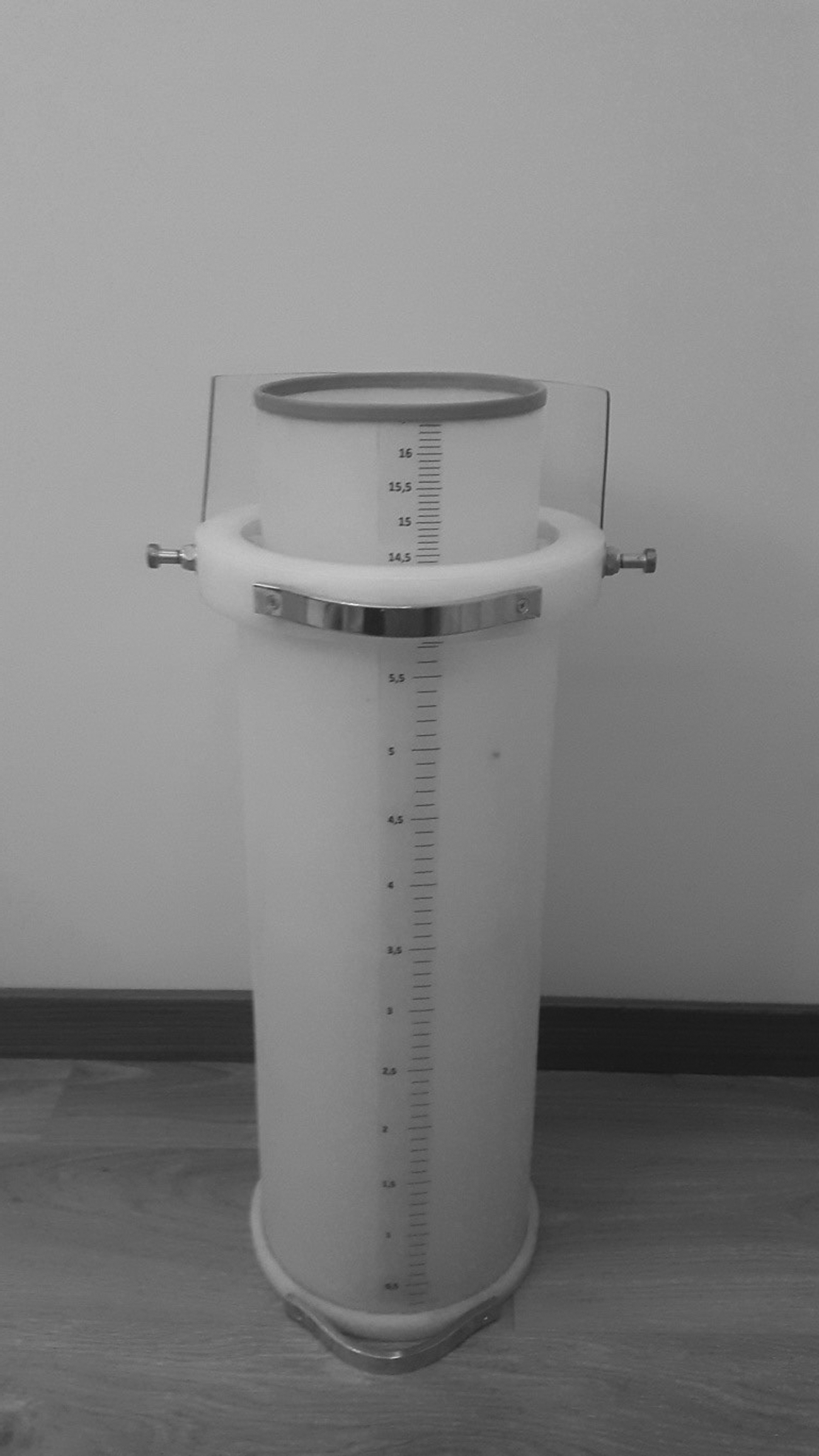
Easy volumeter.
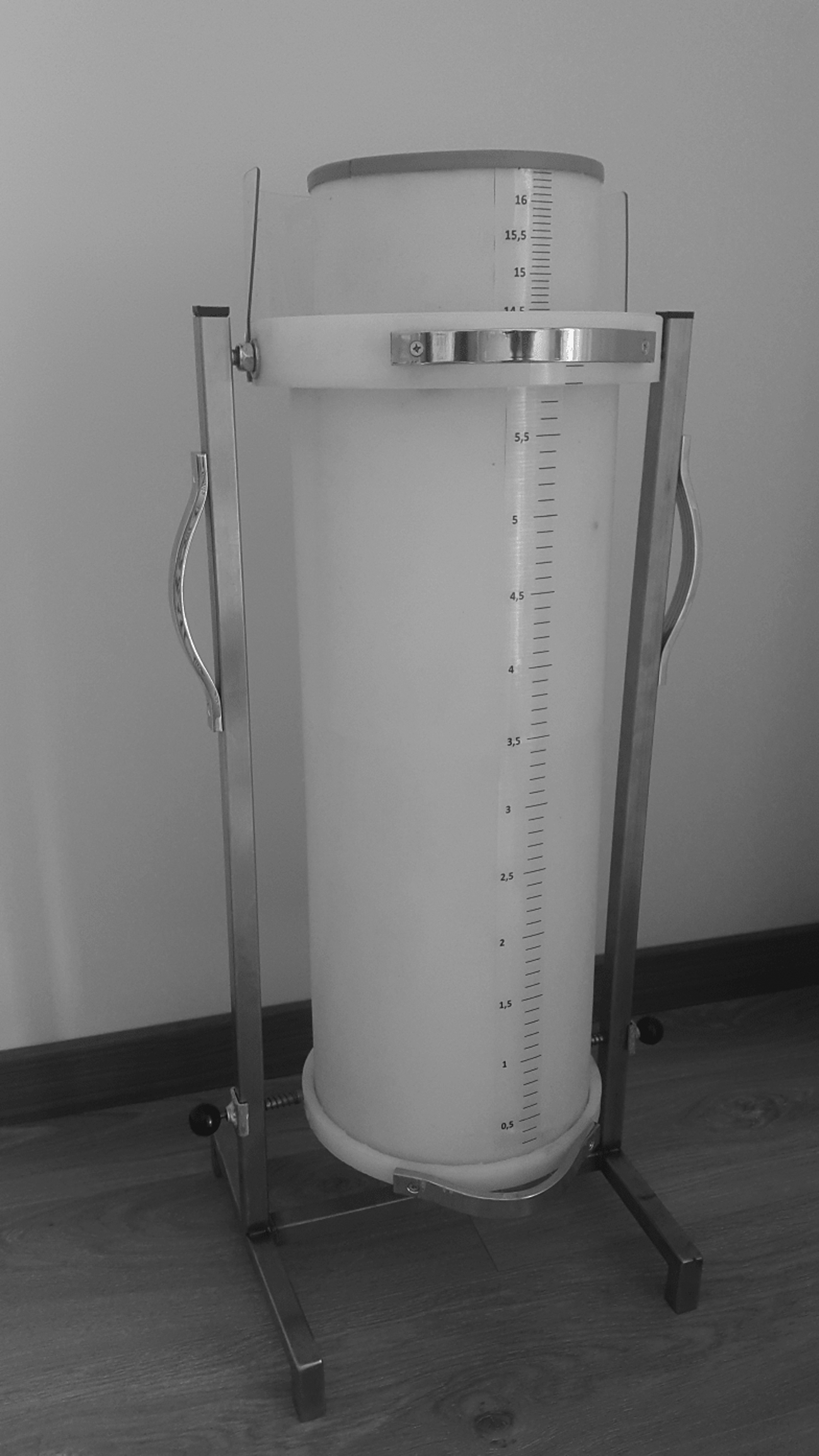
Easy volumeter with tilting platform.
Materials and Methods
Included in the study were healthy volunteers and patients who referred to the outpatient clinics of the Dokuz Eylul University Medical Faculty, Department of Physical Therapy and Rehabilitation, with a swelling in the arm after breast cancer treatment and who were diagnosed with lymphedema. The procedures followed were in accordance with the ethical standards of the responsible committee on human experimentation and with the Helsinki Declaration of 1975, as revised in 2008.
The study included patients between 25 and 75 years of age, who underwent surgery for the treatment of breast cancer, who had unilateral lymphedema, who had at least 200 mL difference between arm-hand volume measurements when compared to the normal side, when measured using a standard volumeter, who agreed to participate in the study, and whose sociocultural status allowed the measurements to be made.
The control group included subjects with no history of malignancy or clinically confirmed lymphedema, who agreed to participate in the study and whose socio-cultural status allowed the measurements to be made.
Patients who suffered a local or distant relapse of breast cancer and with bilateral breast cancer were excluded from the study. Patients with an active infection or deep venous obstruction, with a comorbidity or psychiatric disease that could affect measurements, those with bilateral breast cancer, severe shoulder pain, and movement limitation, and those with open skin wounds were excluded from both measurement groups of the study.
Data on age, height, weight, body mass index (BMI), level of education, dominant hand, history of previous surgeries, history of axillary lymph node dissection, history of receiving radiotherapy and chemotherapy, time from surgery until development of lymphedema, and duration of lymphedema were inquired and recorded. The data collected from the control subjects included age, height, weight, BMI, level of education, and dominant hand.
Arm-hand circumference measurements were obtained using a measuring tape at four different points, including the metacarpal circumference, the wrist, and 10 cm below and 10 cm above the lateral epicondyle. Arm-hand volume measurements were recorded using a standard volumeter and an easy-measurement volumeter, the validity of which was being investigated. The weight of the displaced water was measured by inserting the subject's arm into the volumeter up to the axilla. For both cups, the procedures were performed once in the patient group and repeated thrice in the control group. In addition, cylindrical objects with known volumes (12 different volumes, varying between 250 and 3000 mL) were measured using both volumeters to evaluate displacement. All measurements were then statistically evaluated to investigate validity.
Results
The data were analyzed with the SPSS 22.0 package program. A dependent samples t-test was used to evaluate the differences between the measurements obtained using standard volume cylinders, the easy-measurement volumeter, and a standard volumeter. A Levene's variance equality test was used to assess the level of variation in the measurements provided by each device.
A dependent samples t-test was then used to analyze the differences between the mean measurements obtained in the healthy control group, and a Levene's variance equality test was used to assess the variability in the measurements provided by each device in the group.
The mean values of the measurements recorded in the patient group were investigated separately for the healthy and affected arms. A dependent samples t-test was then used to compare the measurements obtained with the standard volumeter and the easy-measurement volumeter.
The demographic characteristics of the healthy subjects and the patients are presented in Tables 1 and 2, respectively. Table 3 provides a summary of the clinical characteristics of the patients.
Demographical Characteristics of Health Subjects
BMI, body mass index.
Demographical Characteristics of the Patient Group
Clinical Characteristics of the Patient Group
Of all the healthy subjects, nine (60%) were men and six (40%) were women, and all participants in the control group had a BMI below 30.
There were 27 (96.4%) women and a single (3.6%) man in the patient group. Lymphedema occurred in the dominant and nondominant extremities of 16 (57.1%) and 12 (42.9%) patients, respectively.
All the patients had a history of surgery due to breast cancer. Since the time between surgery until development of lymphedema and the duration of lymphedema were not normally distributed, the median values of these variables were used.
The results of a dependent samples t-test carried out to compare the measurements of the standard volumes obtained by the standard volumeter and the easy-measurement volumeter demonstrated that the differences between mean values were very low. The significance (p value) was found to be 0.927, and p-values higher than 0.05 show that the h0 hypothesis cannot be rejected. This finding indicates that no difference was identified between the measurements obtained using the standard and easy-measurement devices.
To compare the measurement variables obtained after the procedures carried out using standard and easy-measurement devices, a Levene's test was conducted to evaluate variance equality. A p-value being (significance = 0.981), α = higher than 0.05 indicates that the h0 hypothesis cannot be rejected. The variances in the measurements obtained using the standard and easy-measurement devices were found to be equal.
When the differences were investigated between the known volumes and the volumes from the measurements obtained using standard volume cylinders, the standard deviations with the easy-measurement device and the standard volumeter were found to be 6.702 and 8.134 mL, respectively. This value indicates that the easy-measurement device more accurately measured the volumes than the standard volumeter.
The upper extremities of the subjects in the volunteer group were measured bilaterally thrice using both volumeters. When the mean measurements obtained using the easy-measurement volumeter and those using the standard volumeter in the control group were compared with a dependent samples t-test, the difference between the mean measurements was found to be very low, with a p-value of 0.105. The fact that this value was higher than 0.05 indicates that the h0 hypothesis cannot be rejected, and that no difference was identified between the measurements obtained using the standard and easy-measurement devices.
To compare the measurement variables obtained after the procedures performed using standard and easy-measurement devices, a Levene's test was performed to evaluate variance equality and a p-value of 0.932 was identified, which being higher than 0.05 shows that the h0 hypothesis cannot be rejected. Thus, the variance in the values measured by the standard and easy-measurement devices is equal.
In the patient group, the healthy and affected extremities of the patients were measured once using both the standard volumeter and the easy-measurement volumeter, and the measurements provided by these two devices were consistent. A dependent samples t-test identified a p-value of 0.842 for the volume of the affected arm and 0.075 for the healthy arm. These values, being higher than 0.05, indicate that the h0 hypothesis cannot be rejected. Accordingly, in neither arm was a significant difference identified between the measurements provided by the two devices. The measurements obtained from both volumeters were comparable in all groups (Table 4).
Comparison of the Measurements Obtained Using the Standard Volumeter and the Easy-Measurement Volumeter According to the Measurement Groups (Dependent Samples t test)
Discussion
Treatment response in lymphedema is related directly to disease stage. As the edema collected in the early stages of the disease is fluid, treatment response is quite good. The development of fibrosis in the subcutaneous tissue in the later stages of the disease, however, can have a negative effect on treatment response.8,9 As the duration of the collection of protein-rich edema fluid in the subcutaneous tissue increases, this picture can be accompanied by chronic dermal changes and adipose tissue deposition. Reversing these tissue changes after they start to develop at the chronic stage of the disease can be quite difficult. 10 Accordingly, a diagnosis of lymphedema should be made even before these histological tissue changes occur and treatment should be initiated immediately. If left untreated, an extremity with lymphedema can experience frequent infectious episodes, functional disability, psychosocial morbidity, and, rarely, malignancy (lymphangioma carcinoma). 11
The effects of the early diagnosis and treatment of lymphedema on the course of this chronic disease are currently a leading source of interest in this field. In a study carried out by Stout et al., 5 96 patients were followed up preoperatively and postoperatively every 3 months. A diagnosis of lymphedema was made in the presence of more than a 3% increase in the upper extremity, as evaluated by a perometry, and patients were prescribed pressure clothes, and a statistically significant volume reduction was noted after the intervention in that study. 5 Another randomized controlled trial monitored 65 patients through circumference measurements and bioimpedance spectrophotometry at regular intervals (5th day and 1st/2nd/6th/12th/24th months). Lymphedema was found to develop in 11% of the monitored patients who were intervened, and in 30% of the patients who were monitored without an intervention. 12 These significant studies highlight the importance of the early diagnosis and treatment of lymphedema, but although the devices used for early diagnosis in these studies allowed for the identification of lymphedema in the very early stages, they are costly devices with limited availability, making it all, but impossible to reach every patient using these methods alone.
The accurate and practical assessment of lymphedema is not only important for early diagnosis but also for treatment monitoring. The first phase of complex decongestive therapy, as the standard treatment for lymphedema, involves daily manual lymph drainage and short-tension bandage therapy. Before proceeding to the second phase, this treatment is continued for 3–5 weeks until a plateau is reached, at which point the volume reduction in the patient's arm stops. Considering the highest level of volume reduction occurs between 7 and 14 days, accurate and practical volume measurements obtained at frequent intervals will provide information to the therapist on when a plateau has been reached.13,14 This will prevent both patients and therapists from spending excessive effort and time on therapy, and so underlines the need for a reliable measurement device that allows self-measurements at home, and that is easy to use in clinical practice, both for treatment monitoring and for the early diagnosis of lymphedema.
Measurements for the diagnosis of lymphedema and for the monitoring of treatment response are frequently made using a measuring tape. In this method, the arm circumference is measured at certain points. As measurements obtained using a measurement tape are subject to errors, the presence of at least a 2 cm difference between the two extremities is considered clinically significant. There are also methods that allow for the estimation of arm volume based on circumference measurements, although these methods are associated with high error margins since they consider the arm and hand to be cylindrical or frustoconical.
Apart from circumference measurements, various imaging methods may also be helpful in the evaluation of lymphedema, such as through computed tomography (CT) and magnetic resonance imaging (MRI),15–17 and there have been several studies demonstrating that methods such as bioimpedance, perometry, and indocyanine green infusions can be useful in early diagnosis.18–22 That said, despite the development of new methods, they tend to be expensive and not widely available.
Standardized and easy-to-use measurement devices are required to ensure early diagnosis and for the performing of accurate and practical daily monitoring. Although new methods are currently available for evaluation of lymphedema, the water displacement method is still the preferred method for the diagnosis of lymphedema and the assessment of treatment response, allowing for the detection of changes of as little as 10 mL. 23 However, we should take into account the fact that this method measures only “limb volume” and not the impact of compositional change over time.
Despite water displacement being the gold standard for evaluating limb lymphedema, the currently used standard volumeters have a number of disadvantages: being associated with hygiene problems, made of heavy materials, requiring an additional measurement cylinder for volume measurements, and the inability of patients to access volumeters outside health care centers. The volumeter designed in this study can facilitate both early diagnosis and monitoring by allowing self-measurement at home. As another advantage, the data obtained in this study have shown that the measurements made using this developed device can be as sensitive as the standard volumeter, as the measurement variances were the same as those made with a standard volumeter.
While there have been some studies in literature describing volumeters designed for this purpose, no such design has to date entered into use in daily practice. Lette 24 designed a cylindrical device with a base at the bottom and a groove in the upper part, and the validity of the device, measuring 15 cm in diameter and 60 cm in height, was evaluated through a comparison with cylinders of known volumes assessing 15 voluntary participants. High levels of correlation were noted between the measurements obtained using standard volumeter and the newly designed device for the measurement of known volumes; however, the newly designed volumeter consisted of multiple pieces, and so the configuration of the device required the support of a professional with the required equipment. In addition, the cutting and fixing of PVC with glue, while setting up the volumeter may result in the generation of noxious fumes, and this device was also harder to clean than the “Easy Volumeter,” which is compatible with a tilt table. Finally, the discussed volumeter also required a measurement cylinder like the standard volumeter.
In a study carried out by Damstra and Damstra, 25 a reverse water volumeter was compared with the Herpertz method, which is a relative measurement method used for unilateral lymphedema. 26 The circumferences of both extremities are measured at four different points, after which, the relative proportional swelling is calculated in comparison to the healthy side. The conventional water displacement method is based upon the calculation of the volume displaced after the patient inserts the extremity into the water. In the reverse measurement method, the cylinder is first filled in with water and the scale is calibrated, after which, the cylinder is emptied, the patient's arm is placed into the cylinder, and the tank is filled with water. The patient's arm is then taken out of the cylinder, and the weight of the displaced water is measured using a scale. As this method requires the measurement of missing water, it is called the “Reverse Water Volumeter” method. Studies have indicated that measurements obtained using reverse water volumeters had high levels of intraobserver and interobserver reliability; however, that study can be considered limited, as the volumeter was compared only with the Herpertz method rather than the standard volumeter, which is the current preferred method.
Another study performed by Beek et al. 27 on the “Reverse Water Volumeter” reported that the method provided reliable and reproducible measurements, and no significant intraobserver or interobserver differences were noted. The intraclass coefficient was estimated to be 0.99, being nearly perfect, and this result was considered to be consistent with previous studies.
In a 2009 study evaluating the validity of the “Simplified Water Displacement Device (SWDD), 28 the validity of a newly designed device was evaluated in comparison to CT and MR images. The SWDD is a cylinder produced from acrylic and steel, which also works based on the reverse water displacement method.
Volume measurements of 23 patients were obtained using the SWDD, after which, CT images of the patients' extremities were obtained, cross-sectional areas and tissue intensities in the HU unit were measured, and an MRI was performed. The findings of that study demonstrated that the measurements obtained using the SWDD were consistent with the data collected based on CT and MRI images. The fact that the SWDD was not compared with the currently preferred method represents a limitation of that study, and that the device requires an additional scale to evaluate the volume.
Similar to previous studies in literature, the aim in this study was to design a new device to overcome the disadvantages associated with standard volumeters. Reducing the cost of the newly developed volumeter and making it appropriate for home use will allow patients to carry out more frequent volumetric measurements, and these measurements will contribute both to early diagnosis and the self-monitoring of the volumetric response to therapy. In addition, patients will be able to detect volumetric increases in their extremities resulting from the effects of such factors as warm air or air travel.
While designing this new volumeter, factors such as ease of use, cost, use of easily accessible materials, integrity, volume and weight of the water required for measurement, appropriateness for different arm measurements, speed of measurement and ease of disinfection were all taken into account. The easy-measurement volumeter (3.3 kg) is lighter than a standard volumeter (6.8 kg), and is also more durable, having been produced from nonfragile materials. It can be easily emptied and cleaned through a tilt table, which is one of the most important components of its design. In addition, instead of requiring a measurement cylinder to measure the amount of displaced water, as is required with a standard volumeter, an interlace cylinder method was used, which combined different materials in a single volumeter. This feature ensures practicality in terms of use and the space occupied by the device, as it has reduced the device to a single piece. Moreover, this study has demonstrated that the measurements obtained by this newly designed easy volumeter are consistent with the measurements recorded using the highly sensitive and consistent standard volumeter.
In conclusion, we believe that the easy volumeter developed within this study can be considered appropriate for daily use in practice, and we aim to recommend it for home use by patients if the costs of production can be reduced.
Conclusion and Recommendations
The volumetric monitoring of extremities is important for the early diagnosis and follow-up of lymphedema.
Due to abovementioned disadvantages, the currently available standard volumeters cannot be used outside major health care centers; however, the new volumeter described in this study allows these obstacles to be overcome. We believe that it can contribute significantly to the early diagnosis and treatment monitoring, while also providing ease of use in daily practice in the home.
Footnotes
Acknowledgments
The authors wish to thank the people who participated in this study.
Author Disclosure Statement
No competing financial interests exist.