




Abstract
Background:
Assessing the circumference of the hand and fingers can be challenging. Therefore, we studied the reliability of jeweler rings and a revised figure-of-eight (figure-8) protocol for the clinical assessment of finger and hand circumference.
Methods and Results:
Thirteen patients residing in a rehabilitation center were recruited. Inter- and intrarater reliability of the jeweler rings as well as the revised figure-8 protocol were assessed. Jewelers rings were used to assess the circumferences of the middle and ring finger of both hands. The figure-8 method was used to assess the circumference of both hands. Reliability analyses were performed in Statistical Package for the Social Sciences 26 and demonstrated an excellent reliability for the jeweler rings as well as the revised figure-8 protocol, represented by single random measure intraclass correlation coefficient(2,1) values of at least 0.973 and Cronbach alpha of at least 0.99.
Conclusions:
Circumference measurements are valid to use; however, reliability issues do exist in clinical practice. Assessing the circumference of fingers with our new jeweler rings protocol and the circumference of the hand by means of a revised figure-8 protocol is highly reliable in a clinical setting.
Introduction
Swelling of the hand can be expected in many clinical conditions, for example, after hand trauma, 1 hand surgery, 2 burns, 3 lymphedema, 4 complex regional pain syndrome (CRPS), 5 and neurological conditions such as poststroke edema. 6
For the assessment of swelling, different evaluation tools can be used such as circumference measurements, water displacement methods, and more technical examinations (e.g., ultrasound, computed tomography scan).7,8 Although water displacement is regarded as the gold standard, it is not always possible to use this technique. An alternative assessment relies on circumference measurements of the hand and this is often performed by means of a figure-of-eight (figure-8) method. This figure-8 method is found to be valid and reliable.9–12 However, in clinical practice we do experience difficulties among different raters although assessments were executed according to the provided protocol. 10
Circumference measurement of the fingers are performed less frequently in clinical practice. Protocols using a tapeline (silk thread) or ring gauge are described.5,13 Using jeweler rings might be an easy alternative to tapeline measure. Although the jeweler rings have a fixed diameter (valid for circumference measurements), no information is available regarding the reliability of a single measure assessment protocol using jeweler rings. Therefore, this study aimed to assess the inter- and intrarater reliability of (1) a jeweler ring protocol for the ring and middle finger and (2) a revised figure-8 method for the measurement of hand circumference in subacute stroke patients.
Materials and Methods
The described study protocol was approved by the Ethical Committee of the Antwerp University Hospital (Belgian registration number: B300201318840). Patients were recruited at “De Mick” rehabilitation center in Belgium. All included patients were admitted for poststroke rehabilitation. After reading the information brochures, patients gave their written consent. Inclusion criteria were (1) patients residing in a rehabilitation center, (2) patients who were able to understand instructions given in Dutch, and (3) patients without amputated parts of both hands and fingers.
Jeweler rings (ring sizer; SHW, China) have a fixed diameter and corresponding circumference. They are readily available as a set of 30 different diameters (Fig. 1A). Therefore, it is an easy measuring tool to assess the circumference of any finger of interest. We used a standardized protocol to assess the circumferences of the ring finger as well as the middle finger of our participants. We determined the ring size that encircled the circumference of the middle part of the proximal phalanx without having any airspace between the skin and the jeweler ring (Fig. 2A, B). To do so, rings are tested from a bigger diameter toward a smaller one to select the appropriate one. To avoid too much pressure being executed by the assessor, the rings were held by the supporting bracket only (see the detail in Fig. 1B).
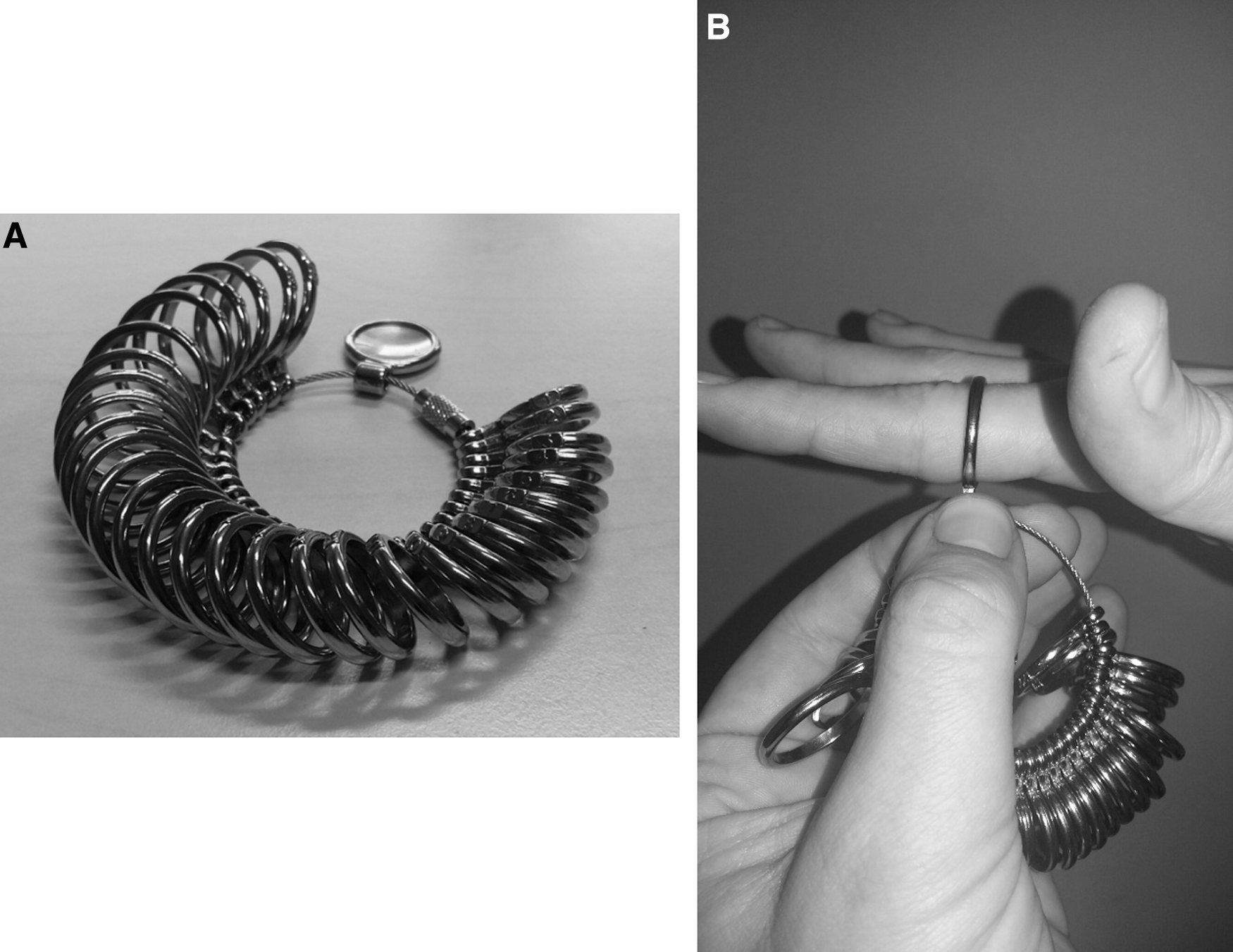
The jeweler rings
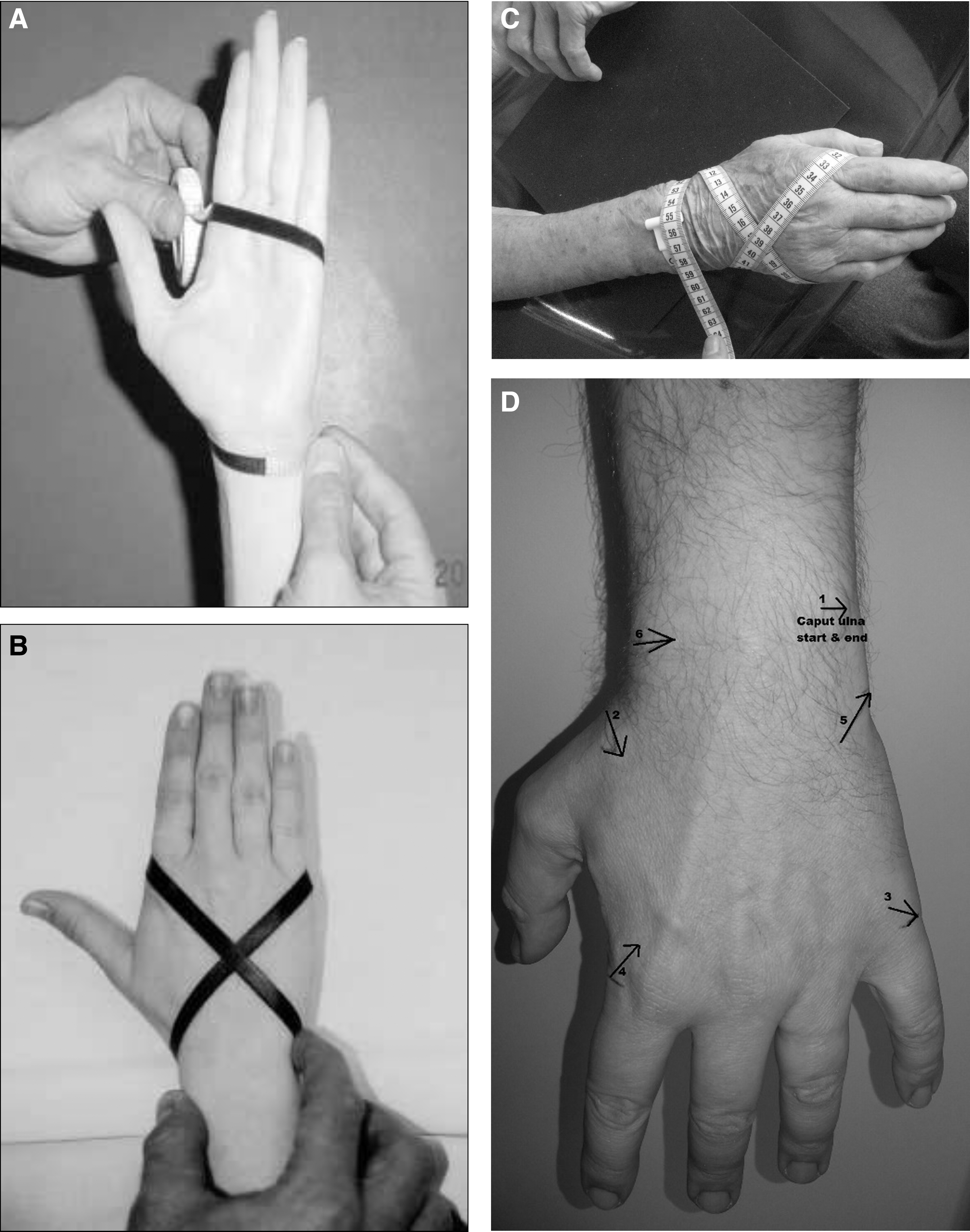
Example of a traditional
The revised figure-8 protocol was based upon the classic protocol of the figure-8 method.9,10 In a traditional figure-8 method measurement (Fig. 2A, B), the zero mark of the tapeline is placed over the distal aspect of processus styloideus ulnae, and the tape is drawn across the ventral surface of the wrist to the distal aspect of processus styloideus radii. Next the tapeline is drawn diagonally across the dorsum of the hand, thereafter brought over the ventral surface of the metacarpophalangeal joints, and finally, wrapped diagonally across the dorsum to return to the starting point (Fig. 2A, B).
In the revised figure-8 protocol the tapeline (SECA 201; SECA, Germany) measure starts at the caput ulna and is prolonged over the ventral part of the wrist to the base of the thumb; next over the dorsum of hand toward the base of the proximal phalanx V; by the palmar side toward the base of proximal phalanx II; diagonally over the dorsum of the hand to the os pisiforme and continued to the starting point. Performing the figure-8 method this way is hypothesized to provide a more accurate reading due to the better alignment of the tapeline measure with an increased reliability (Fig. 2C, D).
For both the revised figure-8 method as well as the jeweler rings, the inter- and intrarater reliability was assessed for a single random measurement. Two independent double-blinded raters (physical therapists) assessed the fingers (ring and middle) and hands of all the participants twice, bilaterally. Per patient all measurements were performed on the same day within a time span of 3 hours. All measurements were performed in random order to avoid recall bias by the raters; also a new score sheet was used for every new assessment.
Statistical analyses were performed using Statistical Package for the Social Sciences (SPSS) 26.0 (IBM SPSS, USA) for Windows. To demonstrate the inter- and intrarater reliability, an intraclass correlation coefficient [ICC(2,1)] (with 95% confidence interval) for a random single measure and the standard error of the measurement (SEM) [SEM = standard deviation × (1-ICC)1/2] were calculated. To investigate the internal consistency of both measurement methods, Cronbach alpha coefficients were computed. For the jeweler ring protocol, SEM was not calculated since the reliability was assessed using the ring size numbers.
Results
Thirteen patients with subacute stroke were included in this study. Therefore, 26 measurements were available for (1) the ring finger, (2) the middle finger, and (3) the figure-8 of the hand and wrist for reliability analyses. The demographic information concerning the recruited sample is provided in Table 1.
Demographics of the Recruited Sample of Subacute Stroke Patients (n = 13)
Handedness was assessed by the Edinburgh Handedness Inventory.
BMI, body mass index; figure-8, figure-of-eight; IQR, interquartile range; SD, standard deviation.
The results concerning (1) the reliability of the revised figure-8 method and (2) the reliability of the jeweler ring protocol are provided in Table 2. The results demonstrate an excellent inter- and intrarater reliability and consistency for both figure-8 and jeweler rings protocol.
Inter- and Intrarater Reliability of the Revised Figure-of-Eight Method for the Hand and Jeweler Rings Protocol for Ring- and Middle Finger
Raw data were registered in mm; SEM values are in mm.
CI, confidence interval; ICC, intraclass correlation coefficient; SEM, standard error of the measurement.
Discussion
This study aimed to investigate the inter- and intrarater reliability of a revised figure-8 method for hand circumference as well as of a protocol for assessing finger circumferences using jeweler rings. For both tools, an excellent inter- and intrarater reliability was established with ICC(2,1) values of at least 0.973. Consistency between consecutive assessments was also excellent with Cronbach alpha being 0.99 for every assessment. In addition, very low SEMs were demonstrated for the revised figure-8 protocol.
The jeweler ring protocol is a welcome addition to the assessment tools for finger and hand swelling. In hand trauma, stroke, and CRPS, swelling is often limited to the fingers and wrist.1,2,4–6,11 Often a water displacement method cannot be used due to clinical restrictions (wounds, spastic hand, hygiene, etc.). Therefore, we have demonstrated that jeweler rings can be an alternative method to assess finger circumference.
For the assessment of wrist and hand circumference/volume, it was already demonstrated that a figure-8 method can be used.7,11,12,14,15 In comparison with the available scientific literature, the revised figure-8 protocol demonstrated an equal or increased reliability.9–11,15 We believe that the improved alignment is responsible for the excellent reliability of a single measurement. It is important to mention that we used a single random measure analyses, whereas others have used an averaged random assessment. 10 Taking three or more measurements is simply not done in clinical practice; therefore, it is of great importance and reassuring to know that a single measurement is equally reliable for both the figure-8 as well as the jeweler ring protocol. Another advantage of the presented protocols is that both a tape measure and the jeweler rings are easy and fast to disinfect.
Although we report the data from a reliability study with sufficient power (>90%) some limitations need to be discussed. We recruited a sample of subacute stroke patients without swelling. Whether these protocols are sensitive to diagnose swelling or monitor alterations of swelling needs to be investigated in future research. In addition, generalization of our results is difficult, but we strongly believe that these protocols can be used in other etiologies as well like burns of the hand, hand trauma, and patients suffering from lymphedema.
Conclusion
The excellent inter- and intrarater reliability of the jeweler ring protocol as well as the revised figure-8 circumference protocol makes both assessments extremely useful in clinical as well as scientific settings to assess hand and finger circumference. Both tools have a standardized protocol and combine a low equipment cost with a fast and easy application.
Footnotes
Acknowledgments
The authors thank Katrin Mariën en Kelly Buys for their assistance in patient recruitment and data collection.
Authors' Contributions
All authors contributed to the study conception and design. All authors provided feedback on the final version of the article.
Author Disclosure Statement
No competing financial interests exist.
Funding Information
No funding was received for this article.