




Abstract
Background:
This study aimed to demonstrate the reliability and validity of the Korean version of the Lymphedema Quality of Life (LYMQOL) questionnaire.
Methods and Results:
This study was a multicentered cross-sectional survey of patients with breast cancer-related lymphedema. The LYMQOL-arm questionnaire was translated from English to Korean. This 28-item instrument contains the overall quality of life (QOL) and is categorized into four domains: function, appearance, symptoms, and mood. In addition, the demographics and characteristics of lymphedema were assessed by reviewing the medical records. The LYMQOL-arm, European Organization for Research and Treatment of Cancer Quality of Life Questionnaire Core 30 (EORTC QLQ-C30), and Breast Cancer Module 23 (EORTC QLQ-BR23) were administered. The internal consistency of the LYMQOL-arm was analyzed using Cronbach's α, and test–retest reliability was examined using the intraclass correlation coefficient (ICC). Concurrent validity was evaluated using Pearson's correlation test between the LYMQOL-arm and the EORTC QLQ instruments. A total of 62 participants were enrolled in the study. All domains of the LYMQOL-arm showed high internal consistency, and the ICC of each domain and overall QOL ranged from 0.836 to 0.956 (p < 0.001). All domains and overall QOL scores of the LYMQOL-arm significantly correlated with most of the EORTC QLQ-C30 and EORTC QLQ-BR23 scales. Furthermore, it revealed a significant association with the degree of perceived edema.
Conclusions:
The Korean version of the LYMQOL-arm questionnaire has proven its reliability and validity in assessing QOL in patients with breast cancer-related lymphedema.
Introduction
Lymphedema is a chronic, complex, and generally incurable condition that has major physical, psychological, and social implications on the health-related quality of life (HRQoL) of patients. 1 Breast cancer survivors with lymphedema have shown lower physical and mental HRQoL compared with women without lymphedema. 2 Practitioners who care for these people should access adequate measurement tools to evaluate the symptoms of lymphedema and its physical and psychosocial impacts.
Many patient-reported outcome measures are available for patients with lymphedema.3–6 The most commonly used general health questionnaire to evaluate HRQoL in lymphedema is the Short Form 36 (SF-36), a widely used general health status measure, but not specific to lymphedema.4,6 The European Organization for Research and Treatment of Cancer Quality of Life Questionnaire Core 30 (EORTC QLQ-C30), European Organization for Research and Treatment of Cancer Quality of Life Questionnaire Breast Cancer Module 23 (EORTC QLQ-BR23), and Functional Assessment of Cancer Therapy-Breast (FACT-B) are cancer-specific questionnaires. 6 These instruments comprise physical, emotional, social, and other functioning scales and symptom scales. However, only a few questions about lymphedema are included in the symptom scales.7,8
Several lymphedema-specific patient-reported outcome measures have been introduced. For example, the Lymphedema Functioning, Disability, and Health (Lymph-ICF), Lymphedema Quality of Life (LYMQOL) questionnaire, Lymphedema Symptom Intensity and Distress Survey (LSIDS), Upper Limb Lymphedema 27 (ULL-27), Lymphedema Life Impact Scale (LLIS), and Lymphedema Quality of Life Inventory (LyQLI).3–6 Among these instruments, Lymph-ICF, LYMQOL, and LSIDS have different modules for upper and lower limb lymphedema.9–13 The ULL-27 is an HRQoL measure for upper limb lymphedema, 14 and LLIS and LyQLI are evaluated using the same questionnaire for both upper and lower limb lymphedema.15,16
The LYMQOL-arm and LYMQOL-leg questionnaires developed by Keeley et al., 11 are condition and site-specific QoL tool for lymphedema and are known to have good feasibility, reliability, and validity. They measure the impact of lymphedema on a patient's QoL and are used as clinical outcome measure while monitoring changes in symptoms. 11 The LYMQOL has four domains: function, appearance, symptom, and mood, as well as overall QoL. It has already been translated and validated in Turkish,17,18 Swedish, 19 Dutch, 20 and Italian languages. 21
Therefore, this study aimed to demonstrate the reliability and validity of the Korean-translated LYMQOL-arm in patients with breast cancer-related lymphedema.
Materials and Methods
Study design and participants
The study was a multicentered cross-sectional survey of patients with breast cancer-related lymphedema. The inclusion criteria were patients with upper limb lymphedema after breast cancer treatment that could understand and fill-out the questionnaire and sign informed consent. Exclusion criteria were those with cardiovascular or renal diseases potentially causing limb edema and a history of chemotherapy or radiotherapy within 3 months before the study. The present study protocol was reviewed and approved by the Institutional Review Boards of each institution. Written informed consent was obtained from all the participants included in this study.
Procedures
The study was performed in the lymphedema clinics of three tertiary hospitals between November 2020 and January 2021. Demographic characteristics, including age, and body mass index and lymphedema-associated variables, were investigated. The extent of lymphedema, International Society of Lymphology (ISL) stage, visual analog scale (VAS) for edema of 0–10, and the severity of lymphedema were evaluated. The extent of lymphedema was evaluated by an examining physician, expressed as an area involved and categorized into upper arm, forearm, and whole arm. The anatomical boundary between the upper arm and forearm was the elbow crease. The staging of lymphedema was based on the ISL classification. 22 In addition, the degree of subjectively perceived edema was assessed using VAS of 0 to 10, where 0 represents an absence of edema and 10 represents the most severe degree of edema. For the assessment of lymphedema severity, limb volumes were measured on the affected and unaffected sides from wrist to 40 cm proximally using an optoelectronic volumeter (Perometer; Pero-System, Wuppertal, Germany) in two hospitals. 23 The percent excess volume (PEV) was calculated using the following formula. 24
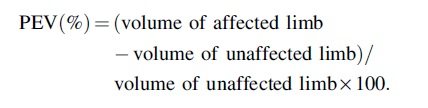
In the other hospital, arm circumference was measured by tape measurement at 5 points on the affected and unaffected sides: the metacarpophalangeal joints, distal radioulnar joints, 10 cm below the elbow crease, at the elbow crease, and 10 cm above the elbow crease. The difference between the circumference of both sides was calculated as the relative metric coefficient of arm lymphedema (RMCAL). 25

CAA = sum of circumferences of affected arm at the 5 measuring points; CUA = sum of circumferences of unaffected arm at the 5 measuring points
The LYMQOL-arm, EORTC QLQ-C30, and EORTC QLQ-BR23 questionnaires were administered. The participants were asked to complete the LYMQOL-arm 1 week later through a Google Forms survey on mobile.
Translation of LYMQOL
We have got formal permission from the copyright holder, Vaughan Keeley. The LYMQOL-arm questionnaire was translated forward and backward from English to Korean languages. Initially, the original LYMQOL was independently translated by two rehabilitation physicians. Then, they exchanged opinions with each other and reached agreement on the preliminary Korean version of the LYMQOL-arm. Next, a backward translation was carried out by a professional native English proof-reader. It was reviewed and discussed, and the final version of the Korean LYMQOL-arm was established by consensus (Supplementary Data).
Outcome measures
The LYMQOL is a condition-specific questionnaire that consists of two versions assessing the impact of lymphedema on HRQoL in individuals with upper (LYMQOL-arm) or lower limb lymphedema (LYMQOL-leg), respectively. 11 The LYMQOL-arm is self-administered and contains 28 items that cover four domains: function [items 1(a–h) – 3], appearance (items 4–8), symptoms (items 9–14), and mood (items 15–20), as well as an overall QoL (item 21). Each item is scored on a 4-point Likert scale: 1 = not at all, 2 = a little, 3 = quite a bit, or 4 = a lot. The total score for each domain was calculated by adding the individual scores and dividing the total score by the number of questions answered. If >50% of questions per domain were not answered, this could not be calculated and scored as 0. Higher scores indicated lower HRQoL. Overall QoL ranged from 0 (poor) to 10 (excellent).
The EORTC QLQ-C30 is a general QoL measure for patients with cancer.
7
It has been translated and validated into over 100 languages and is the most widely used QoL tool in research. It includes 30 questions and comprises 5 functional scales, 9 symptom scales, and global health status. The EORTC QLQ-BR23 is a breast cancer-specific QoL module with 23 items of 4 functional scales and 4 symptom scales. All items on the functional and symptom scales in both questionnaires were scored on a 4-point Likert scale: 1 = not at all, 2 = a little, 3 = quite a bit, or 4 = very much. Two items on global health status of EORTC QLQ-C30 were scored on a 7-point scale (1 = very poor, 7 = excellent). According to the EORTC scoring manual, raw scores were converted to 0–100 for each scale. Raw scores were calculated by adding the item scores and dividing it by the number of items on each scale. Linear transformation was applied to compute the final score for each scale using the following formula:
For functional scales and global health status, a higher score indicates a better level of functioning and QoL. For symptom scales, a higher score represents a greater symptom load.
Reliability
Reliability of the LYMQOL-arm was evaluated by measuring internal consistency and test–retest reliability. Internal consistency was evaluated using Cronbach's α to confirm the reliability of the LYMQOL-arm. A high Cronbach's α (>0.70) was considered adequate internal consistency. 26 In addition, test–retest reliability using intraclass correlation coefficient (ICC) was assessed. The ICC value between 0.75 and 0.9, and above 0.9 are regarded as good and excellent reliability, respectively. 27
Validity
Concurrent validity was measured by correlation analysis between the LYMQOL-arm and the EORTC QLQ-C30 and QLQ-BR23 instruments. In addition, the correlation between the LYMQOL-arm and the perceived degree of edema (VAS) was analyzed.
Statistical analyses
The data were analyzed using SPSS (version 17.0; SPSS, Inc., Chicago, IL, USA). Sociodemographic variables were analyzed using descriptive statistics. The internal consistency of each domain of the LYMQOL-arm was assessed using Cronbach's α coefficient. The test–retest reliability was examined using the ICC. Correlations between the LYMQOL-arm and the EORTC QLQ instruments were analyzed using Pearson's correlation coefficients. In addition, Pearson's test was performed to investigate the association between the LYMQOL-arm and VAS for edema. Statistical significance was set at a p-value <0.05.
Results
A total of 62 patients with breast cancer-related lymphedema participated in this study. Table 1 describes the demographic characteristics and lymphedema-related variables. The mean age was 53.2 ± 9.5 years. Two thirds of the participants showed whole arm lymphedema, and the ISL of 88.7% was stage 2. The mean VAS score for edema was 5.2 ± 2.2. Assessment of limb volume using a Perometer was performed in 40 patients, and PEV was 12.8% ± 8.4%. Circumference measurement was performed in the other 22 patients, and the RMCAL value was 4.9% ± 4.6%.
Demographics and Lymphedema Characteristics
BMI, body mass index; ISL, International Society of Lymphology; PEV, percent excess volume; RMCAL, relative metric coefficient of arm lymphedema; SD, standard deviation; VAS, visual analog scale.
Mean values of each domain and overall QoL from LYMQOL-arm are presented in Table 2. The symptom domain had the highest score (2.21 ± 0.70), which represents worse HRQoL. The overall QoL score was 5.85 ± 2.44.
Values and Internal Consistency of Lymphedema Quality of Life-Arm
LYMQOL, Lymphedema Quality of Life; QoL, quality of life.
Reliability
All domains of the LYMQOL-arm showed high internal consistency, as assessed by Cronbach's α (0.862–0.915) (Table 2). The LYMQOL-arm was reinvestigated 1 week later. The ICC value was used to demonstrate the test–retest reliability of the LYMQOL-arm (Table 3). All domains and overall QoL were found to have good-to-excellent test–retest reliability (0.836–0.956).
Test–Retest Reliability of Lymphedema Quality of Life-Arm
CI, confidence interval; ICC, intraclass correlation coefficient.
Validity
The correlations between the domains of the LYMQOL-arm and the EORTC QLQ instruments were used as indicators of concurrent validity. The Pearson's r values are shown in Tables 4 and 5. All domains and overall QoL were significantly correlated with most of the EORTC QLQ-C30 and EORTC QLQ-BR23 scales. In particular, we observed the highest correlation coefficients between the LYMQOL-arm overall QoL and the EORTC QLQ-C30 global health status (r = 0.735, p < 0.001), between the LYMQOL-arm mood domain and the EORTC QLQ-C30 emotional functioning (r = 0.766, p < 0.001), and between the LYMQOL-arm symptom domain and the EORTC QLQ-C30 pain scale (r = 0.736, p < 0.001). Among the associations of the LYMQOL-arm with the EORTC QLQ-BR23, the symptoms domain showed the highest correlation with the arm symptoms scale (r = 0.730, p < 0.001).
Correlation Coefficients Between Lymphedema Quality of Life-Arm and European Organization for Research and Treatment of Cancer Quality of Life Questionnaire Core 30 for Concurrent Validity
p < 0.05; **p < 0.01.
Correlation Coefficients Between Lymphedema Quality of Life-Arm and European Organization for Research and Treatment of Cancer Quality of Life Questionnaire Breast Cancer Module 23 for Concurrent Validity
p < 0.05; **p < 0.01.
In addition, all domains of the LYMQOL-arm (function: r = 0.380, p = 0.002; appearance: r = 0.358, p = 0.004; symptoms: r = 0.357, p = 0.004; mood: r = 0.387, p = 0.002) except overall QoL (r = −0.244, p = 0.056), were significantly associated with the degree of subjectively perceived edema (VAS).
Discussion
Lymphedema can cause physical, emotional, social, and financial burdens, and reduce HRQoL. There is a need for condition-specific QoL measures for lymphedema; Keeley et al. introduced LYMQOL-arm and -leg questionnaires. 11
The Korean version of the LYMQOL-arm showed high reliability and validity. Internal consistencies were all >0.8, and test–retest reliability by ICC was good to excellent for all domains of the LYMQOL-arm. In addition, the LYMQOL-sarm revealed significant correlations with functional and symptom scales of the EORTC QLQ-C30 and EORTC QLQ-BR23, which are well-established HRQoL measures in breast cancer. Therefore, the present study has proved the value of the Korean version of the LYMQOL-arm.
In this study, test–retest reliability of the LYMQOL-arm was evaluated with ICC by comparing two assessments at a 1-week interval. The first assessment was conducted with a self-administered paper questionnaire and the second with a mobile Google Forms survey. Currently, health care surveys are conducted by different modes, including paper, short message service, and mobile applications. Smartphone-based surveys improve data completeness and produce data equivalence to traditional paper-based surveys. 28 In this study, the mobile-based survey ensured a zero nonresponder rate. Therefore, difference in delivery modes between the two evaluations did not affect the results significantly.
In previous studies, the validity of the LYMQOL was examined by investigating relationships with the EORTC QLQ-C30, 11 Short Form Health Survey (SF-36),18–21 Lower Extremity Functional Scale (LEFS), 18 and Nottingham Health Profile (NHP). 17 In this study, the EORTC QLQ-C30 and EORTC QLQ-BR23 were used to verify the validity of the LYMQOL-arm. The EORTC QLQ instruments are the most widely used QoL measurement tool for cancer survivors. They have advantages of being cancer-specific, multidimensional, cross-culturally applicable, and easily administered. The LYMQOL-arm was compared with all functional and symptom scales of the EORTC QLQ-C30 and -BR23 and results showed significant correlations with most of the scales in this study, whereas Keeley et al. 11 analyzed only relevant domains of the EORTC QLQ-C30. These results reflect that the LYMQOL-arm has similarity with general QoL measurement tool, as well as condition-specific tool as the highest correlation coefficients were identified between relevant items.
Furthermore, all domains and overall QoL of the LYMQOL-arm correlated well with the perceived degree of edema. Comparable results have been reported in a study of 102 patients with lymphedema of the arm or leg after cancer treatment. 19 In this study, associations between the patient's reported perceived degree of swelling and LYMQOL scores were analyzed. All domains and overall QoL of the LYMQOL-leg showed significant relationships with the perceived degree of leg lymphedema. However, only the function and appearance domains were significantly correlated with the degree of perceived swelling in patients with arm lymphedema. The degree of lymphedema was categorized on a 4-point Likert scale (none, a little, quite a bit, or a lot) in their study, whereas a VAS scoring system of 0–10 was applied to our study.
In the original study by Keeley et al., 11 construct validity was examined by comparing the LYMQOL score with limb volume. However, no significant association between limb volume and LYMQOL scores was found. Similarly, a study of patients with peripheral lymphedema who underwent complex decongestive therapy (CDT) reported that edema volume reduction was not correlated with QoL improvement. 29 In addition, change in limb volume did not show association with change of HRQoL evaluated by Nottingham Health Profile Part 1 (NHP-1) before and after CDT in another study of patients with upper or lower limb lymphedema. 30 Two studies had investigated relationship between edema severity by volume difference and HRQoL using ULL-27 showed contradictory results.14,31 The physical dimension of ULL-27 revealed poorer outcome in severe stage of edema in one study, 14 while all domains and total scores of ULL-27 did not show significant difference in each of four grade of edema severity in the other study. 31 Therefore, with these results and our study, the HRQoL is considered to reflect a subjective degree of edema rather than objectively measured volume difference in patients with lymphedema.
Previously developed lymphedema-specific patient-reported outcome measures include Lymph-ICF, LSIDS, ULL-27, LLIS, and LyQLI.3–6 Among these, the Lymph-ICF has been most commonly used validated tool along with LYMQOL. Lymph-ICF also has two separate modules for upper limb (Lymph-ICF-UL) and lower limb lymphedema (Lymph-ICF-LL).9,10 It has five domains: physical function, mental function, household activities, mobility activities, and life and social activities. The Lymph-ICF-UL questionnaire is composed of 29 questions scored on a VAS ranging from 0 to 100 mm, while the Lymph-ICF-LL is a 28-item questionnaire with each of the questions scored on an 11-point scale (0–10). In the revised version of the Lymph ICF-UL, an 11-point Likert scale between 0 and 10 was used. 32 The original and revised versions of the Lymph-ICF-UL were developed in the Dutch language.9,32 Compared with Lymph-ICF, the LYMQOL has a consistent scoring system with a 4-point Likert scale for both arm and leg lymphedema. The use of a Likert scale is generally considered easier to administer and interpret than VAS, although both are not statistically superior to one another. 33 Furthermore, the LYMQOL was originally developed in English and required only 5–10 min to complete, similar to the Lymph-ICF questionnaire. 32
This study has some limitations. First, all participants were women with breast cancer-related lymphedema. Thus, generalizability of the results to other populations with upper limb lymphedema would be limited. Second, severity of lymphedema was evaluated with two different methods, volumetry and tape measurement, because one institution was not equipped with a Perometer. Third, association between the LYMQOL-arm and lymphedema severity was not analyzed. Finally, responsiveness of the LYMQOL-arm was not assessed.
Conclusions
The Korean version of the LYMQOL-arm questionnaire has proved its reliability and validity in assessing the QoL in patients with breast cancer-related lymphedema. This study demonstrated the usability of the LYMQOL-arm questionnaire as a simple HRQoL measure for lymphedema patients.
Authors' Contributions
K.E.U.: Conceptualization, data curation, formal analysis, investigation, and writing—original draft. S.M.Y.: Data curation, investigation, methodology, and writing—review and editing. J.S.Y.: Conceptualization, investigation, and writing—review and editing. J.H.H.: Conceptualization, methodology, project administration, supervision, and writing—review and editing.
Footnotes

References
Supplementary Material
Please find the following supplemental material available below.
For Open Access articles published under a Creative Commons License, all supplemental material carries the same license as the article it is associated with.
For non-Open Access articles published, all supplemental material carries a non-exclusive license, and permission requests for re-use of supplemental material or any part of supplemental material shall be sent directly to the copyright owner as specified in the copyright notice associated with the article.
