




Abstract
Background:
Measurements of local tissue water and circumferences are methods to evaluate lymphedema. Knowledge about reference values and reproducibility needs, however, to be determined for the head and neck (HN) area of healthy persons before it can be used in persons with HN lymphedema. The objective of this study was to evaluate the test–retest reliability including measurement errors of local tissue water and neck circumference measurements (CM) in the HN area in a healthy cohort.
Methods and Results:
Thirty-one women and 29 men were measured on 2 occasions, 14 days apart. The percentage of tissue water content (PWC) were calculated in four facial points and neck CM at three levels. Intraclass correlation coefficient (ICC), changes in mean, standard error of measurement (SEM%), and smallest real difference (SRD%) were calculated. Reliability for PWC was fair to excellent for both women (ICC 0.67–0.89) and men (ICC 0.71–0.87). Measurement errors were acceptable in all points in both women (SEM% 3.6%–6.4%, SRD% 9.9%–17.7%) and men (SEM% 5.1%–10.9%, SRD% 14.2%–30.3%). For the CM, ICCs were excellent both for women (ICC 0.85–0.90) and men (ICC 0.92–0.94), and measurement errors were low (SEM% for women 1.9%–2.1%, SRD% 5.1%–5.9%; SEM% for men 1.6%–2.0%, SRD% 4.6%–5.6%). Most of the lowest values were found close to bone and vessels.
Conclusion:
Measurements for PWC and CM in the HN area are reliable in healthy women and men, with acceptable to low measurement errors. PWC points close to bony structures and vessels should, however, be used with caution.
Introduction
Head and neck (HN) cancer is the sixth most common form of cancer worldwide and comprises tumors of the oral cavity, epi-, oro-, and hypopharynx, larynx, salivary glands, and sinonasal tract. 1 Curatively intended treatment includes surgery and/or (chemo)radiotherapy depending on tumor histology, subsite, and stage. 2 Secondary lymphedema is a common side effect of cancer treatment and occurs when the drainage pathways in the lymphatic system are impaired. 3 According to Ridner et al., 4 as many as 90% of the patients with HN cancer suffer from secondary lymphedema. The neck and the submental region are the most common locations for external HN lymphedema.5,6 Left untreated, it may result in chronic irreversible edema with long-term functional, cosmetic, and psychosocial consequences. 7
So far, lymphedema in the HN area is diagnosed by inspection and palpation. The MD Anderson Cancer Center Lymphedema Rating Scale was introduced to assess the degree of lymphedema and is frequently used in clinical settings and in previous trials.8–12 However, the scale is subjective and user-dependent10,13 and has not undergone any formal validity or reliability testing. Robust objective measures for the HN are therefore warranted.
Tape measurement is an objective method to measure circumferences and is widely used to assess lymphedema in limbs. 14 It can be used to measure progress of lymphedema over time but does not represent a volumetric measurement. Currently, there are few reliability studies on the tape measurement method in persons with HN lymphedema.8,12,15 A promising way to objectify the amount of local tissue water is the use of the MoisterMeterD device that provides an absolute value by means of the tissue dielectric constant (TDC) or a relative value by percentage of tissue water content (PWC). Normal reference values of tissue water by the TDC method have been established in the hands 16 and lower limbs.17,18 It has been used to detect breast cancer treatment-related arm lymphedema,19,20 lymphedema in the lower limbs, 18 and in the trunk as well as to evaluate effects of lymphedema interventions.21,22
Two previous studies have used the TDC method in the HN area. The ALOHA trial 8 demonstrated excellent intra- and interrater reliability, but only one measuring point was studied. Mayrovitz et al. 23 have studied a healthy cohort and have presented normal reference values for TDC values at three points in the HN area. These TDC values and neck circumferences need to be supplemented with test–retest reliability studies and analyses of systematic changes in the mean and measurement errors for the HN area in healthy persons. Only then it can be implemented as a reliable basis for further studies and in the clinical setting to assess lymphedema in HN cancer patients.
Methods
The study was approved by the Swedish Ethical Review Authority (Ref. No. 2020-01066). Informed consent was obtained from all participants before inclusion in the study.
Subjects
Sixty healthy volunteers evenly distributed according to gender and age were recruited to the study. Few HN patients are younger than 30 years at diagnosis, and accordingly, inclusion criteria were age older than 30 years, perceiving themselves as healthy, and understand written Swedish. Exclusion criteria were previous treatment for malignancy, surgery or Botox injections in the HN area, beard, cardiovascular diseases, pregnancy or other illnesses, or treatments that could affect the presence of lymphedema.
Data collection
Age, gender, smoking status, weight, and body length were recorded, and body mass index (BMI, kg/m2) was calculated.
A LymphScanner (Delfin Technologies Ltd., Kuopio, Finland) was used to assess local tissue water of the HN (Fig. 1). TDC is measured with a self-contained compact. It generates an ultrahigh-frequency electromagnetic wave of 300 MHz and projects it down through the skin to a depth of 2.5 mm when the probe is placed on the skin surface. The reflected electromagnetic wave contains information of the water content in the measured tissue21,24 and is calculated as percentage of tissue water content (PWC).
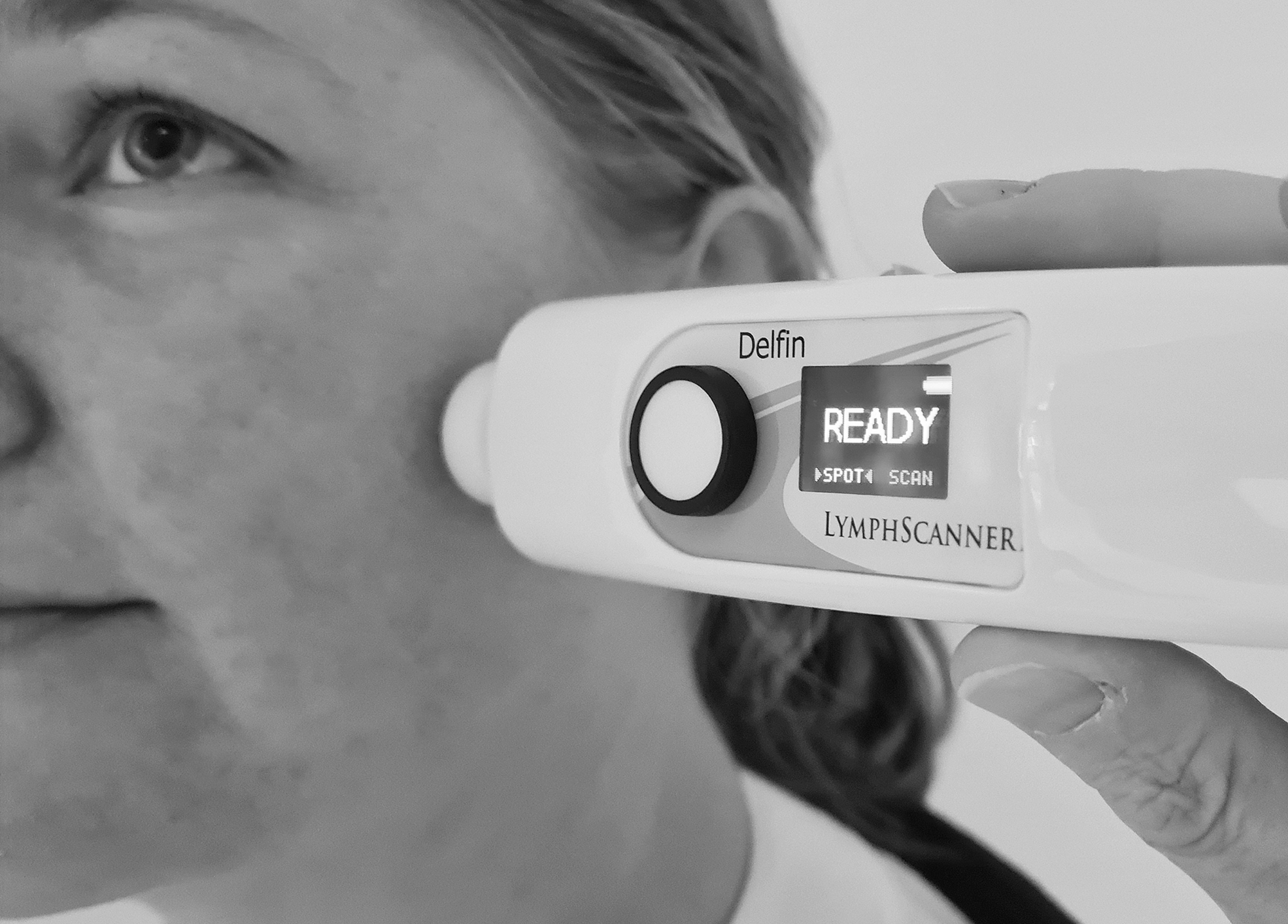
Illustration of the LymphScanner. Image used with subject's permission.
Procedure
Each participant was measured in the morning on two different test occasions ∼2 weeks apart. The participants followed written instructions to maintain the same morning procedure before each test occasion. Hot drinks and smoking were avoided 1 hour before the measurement. Face lotion or foundation was not allowed. Men shaved the evening before the measurement. A standardized setup positioning protocol was designed and used for the measuring. Neck circumferences were measured once, on each test occasion. Local tissue water was measured three times at each measuring point. The procedure was repeated on the retest occasion. One of the authors (A.H.) performed all measurements.
One submental, two facial, and four neck measuring points were chosen (Table 1 and Fig. 2). They were decided based on the knowledge of common locations of HN lymphedema. Colleagues with experience of clinical assessment of lymphedema at the Department of Oncology and the Department of Otorhinolaryngology, Head and Neck Surgery, Skåne University Hospital, were consulted. A measuring tape and a soft pen were used to identify and mark the measuring points, and the participant was placed in a sitting position with back support and with the head looking straight forward. Measuring points 1–3 were identified bilaterally. One of the measuring points (P4, the point 8 cm below the midline of the lower lip edge) has previously been used in the ALOHA trial. 8

Two facial, four neck, and one submental measuring point for measurements of local tissue water. Measuring points 1–3 are located bilaterally. Image used with subject's permission.
Summary of the Locations for the Measuring Points
The neck circumferences were measured with the participants in a sitting position, where the plastic tape measure was held flat against the skin of the participant at three neck levels:
Upper level (A): the highest possible circumferential level of the neck, inferior to the mandible. Middle level (B): the circumferential level right over thyroid cartilage. Lower level (C): the lowest possible circumferential level of the neck.
Statistical analysis
Data were analyzed using IBM SPSS Statistics version 28. Demographics, measurements of circumferences, and local tissue water (PWC) are presented as means, standard deviations (SDs), and ranges. A p-value <0.05 was considered statistically significant. The average of the three PWC values was used in the analysis. Test–retest reliability was analyzed using the agreement between the measurements, the systematic changes in the mean, and measurement errors. The agreement between the measurements was analyzed by the intraclass correlation coefficients (ICCs); two-way random effects, absolute agreement, multiple measurements (ICC2.k) for the PWC values, and ICC2.1 for the tape circumferences values. 25 Fleiss interpretation of ICC values was adopted, that is, below 0.4 is considered as poor, values between 0.4 and 0.75 as fair to good, and values above 0.75 as excellent reliability. 26
The changes in the mean were analyzed by calculating the mean differences (đ) between the two test occasions (test 2 minus test 1) and the 95% confidence interval (95% CI) for the đ. Standard error of measurement (SEM) and smallest real difference (SRD) were calculated to evaluate the measurement errors.27,28 The SEM was calculated by: SEM = SD(1 − ICC)0.5 and SEM% = (SEM/mean) × 100. The SRD was calculated by: SRD = 1.96 × SEM × √2, and SRD% = (SRD/mean) × 100. The relative values (in percent) are often easiest to interpret, and SEM% values <10% and SRD% values <30% are suggested to be acceptable measurement errors on group level and on individual level, respectively.17,29
Results
Subjects
In total 60 participants, 31 women and 29 men were included. They were equally distributed, with five to seven persons of each sex, in five age groups (30–39 years, 40–49 years, 50–59 years, 60–69 years, 70+). The mean age for women was 55 years (SD 12.7) and for men 56 years (SD 13.9). The mean BMI was 24.4 kg/m2 (SD 4.1) for women and 24.9 kg/m2 (SD 3.6) for men. One participant was a smoker.
Measurements
There were significant differences (p < 0.05) between women and men for the PWC values on several measuring points. For women, the lowest mean PWC value (36.9, SD 5.8) was found at P1 on the right side of the face. The highest mean PWC value (42.2, SD 4.1) was found at P3 at the left side of the neck. For men, the lowest mean PWC value (39.8, SD 8.6) was found at P1 on the left side of the face. The highest mean PWC value (45.5, SD 6.1) was found at P3 at the left side of the neck (Table 2).
Measurements of Local Tissue Water (Percentage of Tissue Water Content) in Two Facial, Four Neck, and One Submental Measuring Point and Neck Circumferences at Three Levels of Healthy Women (N = 31) and Men (N = 29)
Data are presented as mean ± SD (minimum–maximum).
CM, circumference measurements; L, left side of the face and neck; P, measuring point; PWC, percentage of tissue water content; R, right side of the face and neck; SD, standard deviation.
There were significant differences (p < 0.05) between women and men for the neck circumference measurements (CM) at all three levels. For women, the lowest mean value was at level B. For men, the lowest value was found at levels B and C. The highest value was found at level A for both women and men (Table 2).
Test–retest reliability
For women, there was on average 14.6 days (SD 4.9) between the two test occasions.
The ICCs for the PWC values ranged from 0.67 (95% CI 0.31 to −0.84) to 0.89 (95% CI 0.72 to −0.95). The đ ranged from −1.82 to 0.55, and there was a systematic difference in mean in two points (P1 right, P3 left). SEM% ranged from 3.6% to 6.4%, and SRD% ranged from 9.9% to 17.7%. For the neck CM, the ICCs ranged from 0.85 (95% CI 0.71 to 0.92) to 0.90 (95% CI 0.80 to 0.95). The đ ranged from −1.94 to 0.95. Thus, no systematic differences in the mean were observed. SEM% ranged from 1.9% to 2.1%, and SRD% from 5.1% to 5.9% (Table 3).
Reliability of Local Tissue Water (Percentage of Tissue Water Content) in Two Facial, Four Neck, and One Submental Measuring Point and Neck Circumferences at Three Levels of Healthy Women (N = 31)
đ, mean difference between test occasion 2 and test occasion 1; ICC, intraclass correlation coefficient; 95% CI, 95% confidence interval; SEM%, SEM in relative terms; SEM, standard error of measurement; SRD%, SRD in relative terms; SRD, smallest real difference.
For men, there was on average 14.4 days (SD 3.3) between the two test occasions.
The ICCs for PWC values ranged from 0.71 (95% CI 0.37 to 0.86) to 0.87 (95% CI 0.72 to 0.94). The đ ranged from −2.32 to 0.28, and there was a systematic difference in mean in two points (P1 left, P4). SEM% ranged from 5.1% to 10.9%, and SRD% ranged from 14.2% to 30.3% For the neck CM, the ICCs ranged from 0.92 (95% CI 0.83 to 0.96) to 0.94 (95% CI 0.88 to 0.97). The đ ranged from −0.26 to 0.28. As for the women, there were no systematic differences in the mean. SEM% ranged from 1.6% to 2.0%, and SRD% from 4.6% to 5.6% (Table 4).
Reliability of Local Tissue Water (Percentage of Tissue Water Content) in Two Facial, Four Neck, and One Submental Measuring Point and Neck Circumferences at Three Levels of Healthy Men (N = 29)
Discussion
To the best of our knowledge, this is the first study that has evaluated test–retest reliability including measurement errors of local tissue water in several measuring points on each side of the face and neck CM in a healthy cohort. The result demonstrated fair to excellent reliability for PWC values with low to acceptable measurement errors. Also, the neck CM showed excellent reliability with low measurement errors for both women and men.
Assessing local tissue water in the HN area can be difficult for several reasons. The HN area has neither a separated contralateral area for comparison nor a uniform shape. However, the reliability analysis showed that the ICCs for the PWC values were >0.75 for six and five out of seven points in women and men, respectively. In addition, the ICCs for the three neck CM were >0.85 in both sexes. According to Fleiss, values above 0.75 indicate excellent reliability. 26 Jönsson et al. 17 have used the TDC method to measure test–retest reliability of local tissue water in the lower limbs in healthy women and men and presented ICC values similar to our results.
The PWC values in this study were measured by a LymphScanner. To be able to compare tissue water levels between studies, the PWC values can be converted to TDC values and vice versa. In the study by Mayrovitz et al., 23 the converted reference values for 60 healthy individuals were 45.0 for the submental point (44.5 in women and 45.8 in men). In the ALOHA trial, 8 the corresponding submental PWC value (converted from TDC value) for 20 healthy individuals was 35.4. The authors found the TDC measurements at this point to be reliable and a diagnostic tool to assess changes within persons. Our cohort demonstrated a higher PWC value than the ALOHA trial, 8 which might be explained by our larger study sample, and that the cohort in the ALOHA trial had a somewhat higher mean age and BMI.
The values regarding neck CM also differed between our study and the ALOHA trial, 8 where the values in our study were lower. The differences might have the same explanation as the difference in PWC values.
We included analyses of SEM and SRD in our reliability analysis, which is recommended 28 and enables evaluation if the measurements represent clinically important changes for a group of persons and for individuals. The smaller measurement errors the more sensitive are the measurements to detect changes in lymphedema. 28 Regarding our PWC values, the measurement errors were low in all measuring points for women, both on group level (SEM% 3.6–6.4) and on individual level (SRD% 9.9–17.7). For men, the measurement errors were slightly higher but still acceptable at group level (SEM% 5.1–10.9) and at individual level (SRD% 14.3–30.3). These figures are comparable with other studies in healthy individuals 17 and within the suggested limits for all points for both genders. 29
For the neck circumferences, the measurement errors were low both at group level and at individual level for women (SEM% 1.9–2.1, SRD% 5.1–5.9) and men (SEM% 1.6–2.0, SRD% 4.6–5.6). Our results imply that neck CMs are reliable, which is in agreement with the ALOHA trial. 8
Methodological considerations
As previously described, assessing local tissue water in the HN area can be challenging since the cancer treatment sometimes affects the anatomic structures. Therefore, the manufacturer of the LymphScanner discourages measuring points situated close to bony structures, tendons, vessels, and on bearded areas, which is impossible to avoid completely in the HN area. Regarding the choice of the measuring points in our study, we considered it important to choose points easy to identify between key facial and neck landmarks. In addition, the submental point and the three PWC measuring points defined on each side of the HN corresponded to the most common locations of HN lymphedema.
Despite these challenges, the reliability of the TDC method was high. The lowest ICC value for women was at P2, the upper measuring point at the neck (ICC 0.67). This point is close to the facial artery and should therefore be used with caution. P1 had the lowest ICC value for men (ICC 0.71). Since this measuring point is located on the cheek, unpreventable differences in beard stubble might explain the lower ICC. Due to anatomical differences, that point was located close to the zygomatic bone in certain individuals, and as described above, measuring points close to bony structures should be avoided. 17
The location of the points is also possible reasons for the systematic change in the mean for PWC values at two measuring points for the women (P1 right and P3 left) and for the men (P1 left and P4). Overall, the mean difference was small for both PWC and the neck CM, indicating that the results are reliable and that the measuring points could be used in future studies. ICC values of neck CM have shown excellent reliability both in a mixed group with healthy persons and patients with HN cancer in a previous study by Chotipanich and Kongpit. 15 Notably, patients with severe deformities of the HN were excluded.
Strength and limitation
The study was performed according to a rigorous protocol and under standardized conditions. One researcher conducted all tests. The method to measure local tissue water is validated, 24 and the device is regularly calibrated by the manufacturer. Both sexes were analyzed separately because of significant differences in PWC values and CM between the groups. The time interval of 2 weeks between the 2 test occasions and a sample size of 30 individuals of each sex is considered sufficient in reliability studies.26,30 A limitation was that only healthy participants with normal BMI were included. It is still uncertain whether the PWC method can be used in the HN area for people with obesity or underweight. However, Mayrovitz et al. has shown that it is unlikely that obesity has a significantly impact on the values. 31 Whether this also applies to underweight people and people with lymphedema following HN cancer needs to be further studied.
Clinical implication
There is a need for valid and reliable measures to assess local tissue water in the HN area. The results from the present study show that the PWC method in the HN area and tape measurements of neck circumferences is reliable in healthy women and men. This knowledge is important as a prerequisite to proceeding to assess changes in lymphedema in the HN area over time. It is also of importance when evaluating effects of interventions of HN lymphedema to improve rehabilitation for patients with HN cancer.
Conclusion
Measurements of PWC and neck circumferences in the HN area of healthy women and men are reliable with acceptable measurement errors and can be used to assess changes of tissue water over time. We propose four PWC measuring points, carefully chosen due to the challenging anatomy of the face and neck. The methods are promising, and prospective studies of PWC measurements in patients with HN lymphedema are warranted.
Footnotes
Acknowledgments
The authors would like to thank all the participants and Michael Miller, PT, PhD, for language editing.
Authors' Contributions
Concept/idea/research design: A.H., K.J., C.B., J.S., and E.E.H. Writing: A.H., C.B., K.J., J.S., and E.E.H. Data collection: A.H. Data analysis: A.H., C.B., K.J., J.S., and E.E.H. Project management: A.H. and E.E.H. Fund procurement: K.J. and E.E.H. Providing subjects: A.H. Providing facilities/equipment: A.H. and K.J. Providing institution liaisons: C.B., K.J., J.S., and E.E.H. Consultation (including review of article before submitting): C.B., K.J., J.S., and E.E.H.
Author Disclosure Statement
No competing financial interests exist.
Funding Information
This study was supported by grants from the Swedish Cancer Foundation 19 0166 Pj 01 H, Academy of Health Care at Skåne University Hospital (2021) and Swedish Edema Society (2020). The funders had no role in the study design, data collection, or analysis.