




Abstract
A monoclonal antibody (MAb) was produced by immunization of a BALB/c mouse with a conjugated morphine C6-hemisuccinated derivative (MHS) to cationized bovine serum albumin (cBSA). The hybridoma clones were screened by indirect ELISA using MHS-BSA. The best hybridoma clone was subcloned thrice by limiting dilution. This hybridoma was found to be of IgG2b class and subclass and contained lambda light chain. The affinity of the MAb to morphine was obtained 2.8×10⁹ M−1. The titer of the cell culture supernatant was at least 1:800. The MAb was cross-reacted with codeine (100%) and apomorphine (16.5%), but not with heroin, naloxone, naltrexone, or papaverine. Morphine was conjugated to HRP using a mixed anhydride method and a direct competitive ELISA was designed using anti-morphine MAb. The assay was sensitive over the 50 ng/mL to 5 μg/mL concentration range. In conclusion, this MAb is useful for the development of immunoassays to measure morphine in urine.
Introduction
M
Over the years, antibody-based methods have been developed for either the identification or quantification of opiates.(3) There are two steps for toxicological analysis containing screening and confirmation. Usually screening is performed using an immunoanalysis that allows for a preliminary monitoring of a large number of samples in a short time, followed by a chromatographic method performed to confirm positive results. Several polyclonal and monoclonal antibodies (MAbs) against morphine have been reported. MAbs have enormous advantage over polyclonal antibodies since they are homogeneous (i.e., every immunoglobulin molecule is identical in antigen binding properties, allotype, heavy chain subclass, and so on). In addition, the hybridoma cells secreting the antibody are immortal, so there is an inexhaustible supply of antibody.(4) There are two methods to produce monoclonal antibodies, either by hybridoma(5–7) or recombinant techniques.(8) The most widely used immunoassay methods require “tracer” molecules. A tracer molecule is one of the immunoreagents that is labeled with a marker or tag to monitor the formation of the specific antibody-antigen complex. Enzymes are used as ELISA labels. One of the most common enzymes used in immunoassays is horseradish peroxidase (HRP). In this study we produced and characterized a new MAb against morphine, and using a mixed anhydride method, morphine-HRP conjugate was prepared to develop a direct competitive ELISA for measurement of morphine.
Methods
Preparation of morphine–cBSA/BSA conjugate
C6-hemisuccinate derivative of morphine (MHS) was conjugated to cationized bovine serum albumin (cBSA) or native BSA.
C6-hemisuccinate derivative of morphine
MHS was prepared by refluxing of morphine and succinic anhydride in benzene. After the removal of solvent under nitrogen gas, the product was purified by changing the pH and re-crystallization.
Preparation of cBSA
Cationization of BSA was carried out using 1-ethyl-3-(3-dimethyl aminopropyl)-carbodiimid hydrochloride (EDC, Sigma-Aldrich, Munich, Germany) and ethylenediamine dihydrochloride (EDA, Sigma-Aldrich). For this purpose, 1 μ mole of BSA (67 mg; Sigma-Aldrich) and 10 μ mole of EDC (∼2 mg) were dissolved in 2 mL PBS (20 mM, pH 7.2). After stirring for 1 h at room temperature, a solution of EDA (13.3 mg EDA in 1 mL distilled water) was added and the solution incubated overnight at room temperature with stirring. The product was dialyzed against distilled water and the aliquots were stored at −20°C.
Conjugation of MHS to cBSA/BSA using EDC
Five mg of MHS were dissolved in 200 μL DMSO (Sigma-Aldrich) and activated using 3 mg EDC for 1 h at room temperature. The solution of BSA (10 mg/mL PBS, 20 mM, pH 7.2) or cBSA (10 mg/mL bicarbonate buffer, 100 mM, pH 9.0) was prepared, and activated MHS was added to the above-mentioned solution separately dropwise with stirring and incubated overnight at room temperature. The product was dialyzed against three changes of distilled water. Molar ratio of morphine to cBSA/BSA was determined according to Erlanger's method.(9)
Immunization and preparation of monoclonal antibody
One BALB/c mouse (Razi Institute, Karaj, Iran) was injected intraperitoneally with 50 μg morphine-cBSA in 250 μL phosphate buffered saline (PBS) emulsified with an equal volume of Freund's complete adjuvant (Razi Institute). Three booster injections were given with a half of the first dosage of immunogen emulsified with an equal volume of Freund's incomplete adjuvant (IFA) (Razi Institute) at 2-week intervals. The immunized mouse was injected intravenously with immunogen (10 μg/200 μL PBS) without adjuvant. Hybridoma production was performed using a modified version of the method described by Kohler and Milstein.(5,6,10) In brief, 3 days after the final booster, the mouse was euthanized with CO2 in an appropriate chamber, and the spleen cells were fused with Sp2/0 myeloma cells (Pasteur Institute, Tehran, Iran) at a ratio of 2:1 in the presence of 50% polyethylene glycol 1500 (Sigma-Aldrich). The cells were cultured in RPMI supplemented with 20% FBS and HAT at 37°C in CO2 incubator. After 10 days, hybridoma culture supernatants of were screened for antibody production using indirect ELISA. Microtiter plates (Karizmehr, Iran) were coated with 100 μL of the antigen (10 μg/mL of morphine-BSA in PBS) and incubated overnight at 37°C. Nonspecific binding sites were blocked with 100 μL of PBS containing 5% skim milk (blocking buffer) for 1 h at 37°C and then 100 μL of each hybridoma supernatant was added to each well. The plates were incubated for 1 h at 37°C, washed thrice with distilled water, and further incubated with 100 μL of an appropriate dilution of peroxidase-conjugated anti-mouse immunoglobulin G (HRP-anti-mouse IgG, Sigma-Aldrich) for 1 h at 37°C. After five additional washings, 100 μL of substrate solution (0.64 mM tetramethylbenzidine dihydrochloride (Sigma-Aldrich) and 2.6 mM H2O2 in 0.2 M citrate buffer (pH 6.0) was added. The reaction was stopped after 15 min by the addition of 50 μL of 2 M HCl. All assay results were measured with a microplate reader at 450 nm. Positive hybrids were cloned thrice by limiting dilution.
Class and subclass of monoclonal antibody were determined by Isostrip test (Roche, Mannheim, Germany) according to the manufacturer's protocol. The monoclone was cultivated and supernatant of hybridoma cells purified by protein A affinity chromatography (Sigma-Aldrich) for further analysis of secreted antibody.
Affinity determination
Affinity was determined according to the method described by Beatty and colleagues.(11) Microtiter plates were coated with two concentrations (0.5 and 0.25 μg/mL) of morphine-BSA. The same concentrations of BSA were coated to measure non-specific binding (NSB). The wells were blocked and incubated 1 h with various concentrations (0.17, 0.33, 0.66, and 1.33 nM) of purified antibody. The percent of binding was determined and the association constant (Ka) of MAb to the morphine was calculated.
Specificity of MAb against morphine
To evaluate the specificity of MAb against morphine, the cross-reaction of MAb with some structurally related molecules to morphine (apomorphine, heroin, naloxone, naltrexone, papaverine, and codeine; obtained from Sigma-Aldrich) was determined using ELISA method.
Design of direct competitive ELISA using MAb
Preparation of morphine-HRP conjugate using mixed anhydride method
MHS solution (0.5 mg/200 μL DMSO/dioxane, 50%, v/v) was kept cold on ice-ethanol. Three μL triethylamine (Sigma-Aldrich) and 4 μL isobutylchloroformate (Sigma-Aldrich) were added to the hapten solution. After 30 min, the hapten solution was added drop-wise over 20 min to the HRP solution (0.2 mg/200 μL sodium bicarbonate buffer, 100 mM, pH 9.0; Sigma-Aldrich) with gentle stirring. The reaction was allowed to proceed for 90 min at room temperature and overnight in the refrigerator. The conjugate was purified using gel filtration G25 (Sigma-Aldrich). The immunoreactivity of the conjugate prepared was determined by checkerboard titration.
Checkerboard titration and ELISA standard curve
Different concentrations of antibody were coated onto the wells of the microtiter plate and titrated with different dilutions of tracer. Optimum titers were selected and the standard curve for different concentrations of morphine (0, 50, 100, 500, 1000, and 5000 ng/mL) was prepared.
Results
The hapten-protein molar ratios obtained for the conjugates morphine-cBSA and morphine-BSA were 30 and 10, respectively. Figure 1 shows the checkerboard titration of supernatant. At the least the titer of supernatant was more than 1:400. Isotype of this hybridoma was found to be IgG2b class, containing lambda light chain.

Checkerboard titration of supernatant of hybridoma cells. The titer of supernatant was more than 1:400.
Affinity of MAb to morphine was obtained 2.8×10⁹ M−1 (Fig. 2). Figure 3 shows the standard curve of morphine by indirect competitive ELISA. The indirect competitive ELISA has a sensitivity of 200 ng/mL. As shown in Figure 4, the cross-reaction of anti-morphine MAb with codeine, apomorphine, heroin, papaverine, naloxone, and natrexone using indirect ELISA was 100%, 16.5%, <0.05%, <0.05%, <0.05%, and <0.05%, respectively.
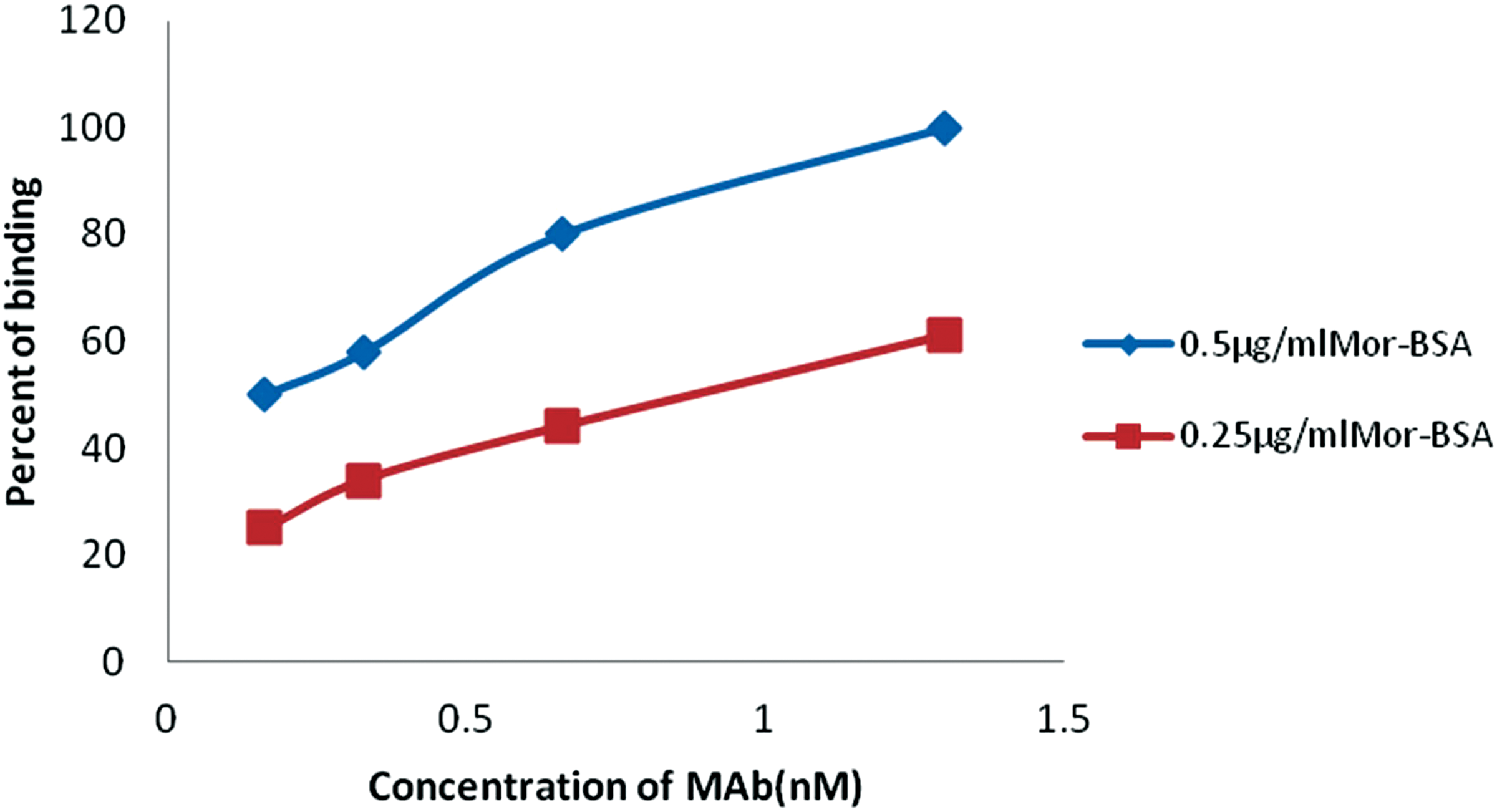
Affinity determination of anti-morphine MAb using noncompetitive ELISA. Affinity of MAb to morphine was obtained at 2.8×10⁹ M−1.

Standard curve of morphine in indirect competitive ELISA. Sensitivity of the assay was 200 ng/mL.
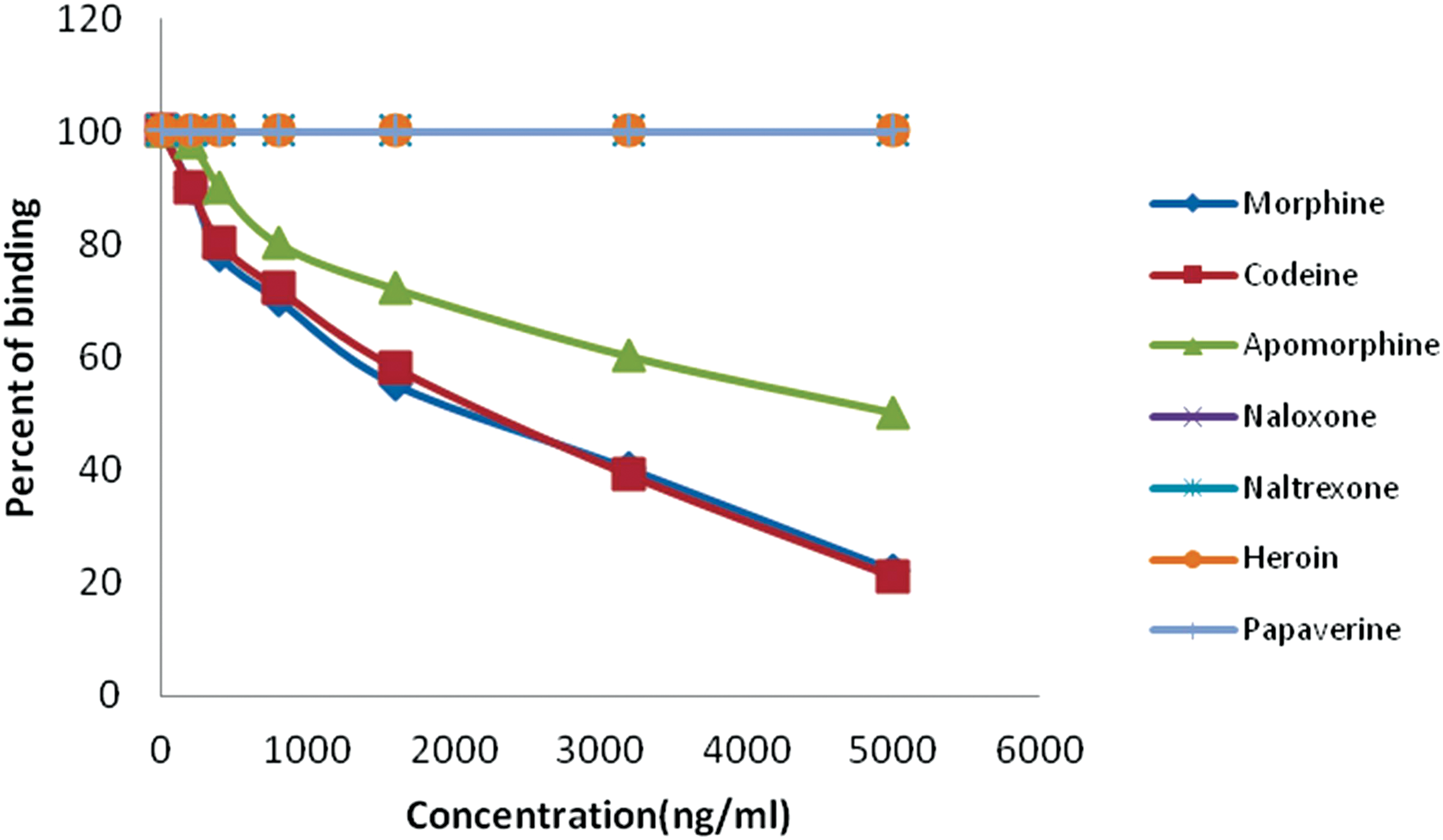
Cross-reactions of anti-morphine MAb with molecules structurally related to morphine. The MAb cross-reacted with codeine (100%) and apomorphine (16.5%), but not with heroin, naloxone, naltrexone, and papaverine.
The results of the checkerboard titration of MAb and morphine-HRP conjugate are shown in Table 1. The standard curve of morphine by direct competitive ELISA is indicated in Figure 5. The sensitivity of the assay was obtained at 50 ng/mL.

Standard curve of morphine in direct competitive ELISA. The assay has a sensitivity of 50 ng/mL.
BSA was used to measure NSB.
Discussion
Bovine serum albumin is a single polypeptide of 67 kDa and consists of 59 lysine residues, of which 30 to 35 have primary amines that can react with cross-linkers for the coupling of peptides or haptens. The cationized form of BSA stimulates a higher immunogenic response compared to normal BSA, and allows for a greater concentration of coupled peptides.(12) We used cBSA-morphine as immunogen, but this conjugate is not suitable for ELISA because the antibody nonspecifically binds to it; thus we were prompted to prepare morphine-BSA for ELISA. The hapten-carrier molar ratios for morphine-cBSA and morphine-BSA were 30:1 and 10:1, respectively. The yield of conjugation of morphine to carrier for cBSA is greater than that of BSA because the number of cBSA amino groups is greater than that of BSA. The titer of monoclonal antibody is 1:400, representing a good yield and affinity. Class and subclass of the MAb were IgG2b. As regards the isotype, the MAb was purified by protein A affinity chromatography free from IgG1 of FBS source.(13)
The MAb had significant cross-reaction with codeine. Some monoclonal antibodies against morphine have cross-reactivity with codeine as well.(14) In these situations a presumptive positive result would be obtained by an immunoassay for morphine, which could be confirmed by a TLC method. In this way, codeine and morphine could be distinguished specifically.(15)
Horseradish peroxidase is a 44 kDa glycoprotein with six lysine residues. The presence of few lysine residues in this enzyme leads to lower-than-desired hapten-HRP conjugate yields while applying an active ester method using carbodiimide (EDC) reagent. Our data showed the mixed anhydride was an efficient method for conjugation of morphine to HRP. In conclusion, considering the sensitivity of competitive ELISA and cut-off of morphine in human urine, this MAb is useful for the development of immunoassays to measure morphine in urine.
Footnotes
Acknowledgment
This study was supported financially by Tehran University of Medical Sciences.
Author Disclosure Statement
The authors have no financial interests to disclose.