




Abstract
A fluorescence immunoassay (FIA) has been developed for the detection of cocaine using norcocaine labeled with merocyanine dye and a monoclonal antibody specific to cocaine. Using this FIA, the detection range for cocaine was between 20.0 and 1700 μg/L with a limit of detection of 20.0 μg/L. Other cocaine derivatives did not interfere significantly with the detection when using this immunoassay technique with cross-reactivity values of less than 20%. Thus this FIA could be considered a useful tool for the detection of cocaine.
Introduction
D
Materials and Methods
Preparation and purification of monoclonal antibody
An anticocaine monoclonal antibody was prepared in our own laboratory and purified by affinity chromatography using a protein A Sepharose CL-4B (Pharmacia Biotech, Uppsala, Sweden).
Synthesis of n-(3-iodopropyl)-2,3,3-trimethylindoleninium chloride
Ten grams of 2,3,3-trimethylindolenine (Sigma-Aldrich, St. Louis, MO), 50 g of 1-chloro-3-iodo-propane (Sigma-Aldrich), and 30 mL of benzene were placed in a 100-mL round-bottomed flask. The mixture was heated under a nitrogen atmosphere at 80°C for 6 hours. After cooling the mixture to room temperature, the benzene was removed by decantation and the solid was washed three times with diethyl ether. The solids were filtered off and dried under vacuum to result in 20 g of n-(3-iodopropyl)-2,3,3-trimethylindoleninium chloride (yield: 87%).
Synthesis of 1-(3-iodopropyl)-2-(p-dimethylamino-benzoyl)-3,3-dimethylindoleninium chloride
Synthesis of 1-(3-iodopropyl)-2-(p-dimethylamino-benzoyl)-3,3-dimethylindoleninium chloride (IMC) was prepared following the method as described by Tiers et al. with some modifications.(9) From the previous procedure, 4.4 g of n-(3-iodopropyl)-2,3,3-trimethylindoleninium chloride was added to 1.81 g of p-dimethylaminobenzaldehyde (Sigma-Aldrich) and 200 mL of ethanol and placed in a 500-mL round-bottomed flask. The mixture was refluxed for 2 hours. After cooling the mixture to room temperature, the ethanol was removed by decantation and the solids were washed three times with diethyl ether. The solids were filtered off and dried under vacuum. The dried solids were dissolved in ethanol and recrystallized to result in 6.3 g of IMC (yield: 90%).
Synthesis of a norcocaine labeled with merocyanine dye (CCIMC)
One gram of cocaine (Shionogi & Co., Osaka, Japan) was dissolved in a mixture (55 mL) of acetonitrile and water (1:2). Acetic acid (1.0 mL) was added to the solution to adjust the pH to ∼5.0. Forty two milliliters of aqueous potassium permanganate was added dropwise to the solution for 3 hours, which was stirred overnight at room temperature. The solution was purified by silica gel thin layer chromatography (Merck KGaA, Darmstadt, Germany) using an eluent of ammonia-saturated chloroform to result in 422 mg of norcocaine.
For the synthesis (Fig. 1), 100 mg of IMC, 292 mg of norcocaine, 1 mL triethylamine (TEA), and 30 mL of chloroform were placed in a 100-mL round-bottomed flask. The mixture was refluxed under a nitrogen atmosphere for 8 hours. After cooling the mixture to room temperature, 1 L of diethyl ether was added. The solids were filtered off and washed three times with diethyl ether. The solids were dried under vacuum to result in 125 mg of CCIMC (total yield: 42%).

Synthesis of merocyanine dye-labeled norcocaine.
The proton NMR spectra were recorded in MeOH-d4 using a 400 MHz Fourier transform-nuclear magnetic resonance (FT-NMR) spectrometer (Nihondenshi, Tokyo, Japan). 1H NMR (d6-chloroform): δ 1.79 (6H, s), 1.92 (4H, t), 2.12 (2H, q), 2.30 (1H, broad), 2.45 (2H, broad), 3.13 (6H, s), 3.28 (3H, broad), 3.70 (3H, s), 4.17 (2H, t), 4.79 (2H, t), 5.46 (1H, broad), 6.79 (2H, d), 7.40–7.50 (4H, broad), 7.55–7.65 (4H, broad), 7.94 (2H, d), 8.01 (2H, d), 8.07 (1H, d).
Fluorescence analysis of CCIMC
Absorbance spectra of CCIMC were measured at 25°C on a UV-3000 spectrophotometer (Hitachi, Ibaraki, Japan) and quartz microcell (path length: 10 mm).
Fluorescence spectra of CCIMC were recorded at 25°C at maximum peak wave length (530 nm) using an F-4500 fluorophotometer (Hitachi) and quartz microcell (path length: 10 mm). The CCIMC was dissolved in a phosphate-buffered saline (PBS) to a final concentration of 1.0 × 10⁻⁶ M, and a 800-μL aliquot was placed in a microcell.
FIA Procedure
The CCIMC was dissolved in a PBS to a final concentration of 1.0 × 10⁻⁷ M and an 800-μL aliquot was placed in a microcell. One hundred microliters of anticocaine antibody solution (1.0 × 10⁻⁷ M) was added to the CCIMC solution. The mixture was stirred for 1 minute and the fluorescence intensity was measured at 25°C using F-4500 fluorophotometer. In addition, 100 μL of buffer solutions of cocaine containing different concentrations (10−10 to 10−5 M) was added to the mixture and then fluorescence intensity was measured. Excitation was performed at a wavelength of 530 nm (band pass 5 nm) and emission at 590 nm (band pass 10 nm). All experiments were performed in duplicate. The reaction curve was obtained by plotting fluorescence intensity values against the cocaine concentration.
Results and Discussion
Characterization of a synthesized fluorescent dye
The UV–visible absorption spectra of CCIMC in PBS were measured and showed a maximum absorption wavelength at 530 nm. The fluorescence emission spectra of CCIMC in PBS were measured at an excitation wavelength of 530 nm, the maximum fluorescence emission wavelength of CCIMC was around 590 nm.
Fluorescence immunoassay
The FIA was performed as described earlier. The result depicts a typical sigmoid reaction curve (not shown). Cocaine at concentrations between 20.0 and 1700 μg/L was detectable in this assay system (Fig. 2). The sensitivity in this immunoassay using CCIMC was 20.0 μg/L (Fig. 2), which was four times lower than the conventional enzyme-linked immunosorbent assay (ELISA) method (Table 1). The sensitivity may improve with optimization of system conditions (concentrations of antibody and CCIMC, pH, and ion strength). The specificity of the FIA was determined using cocanine, norcocaine, and ecgonine, which were dissolved in PBS. The cross-reactivities of these three cocaine derivatives were below 20% (Table 1). In contrast, a measurement time of the FIA was 100 times faster than that of ELISA (Table 1).
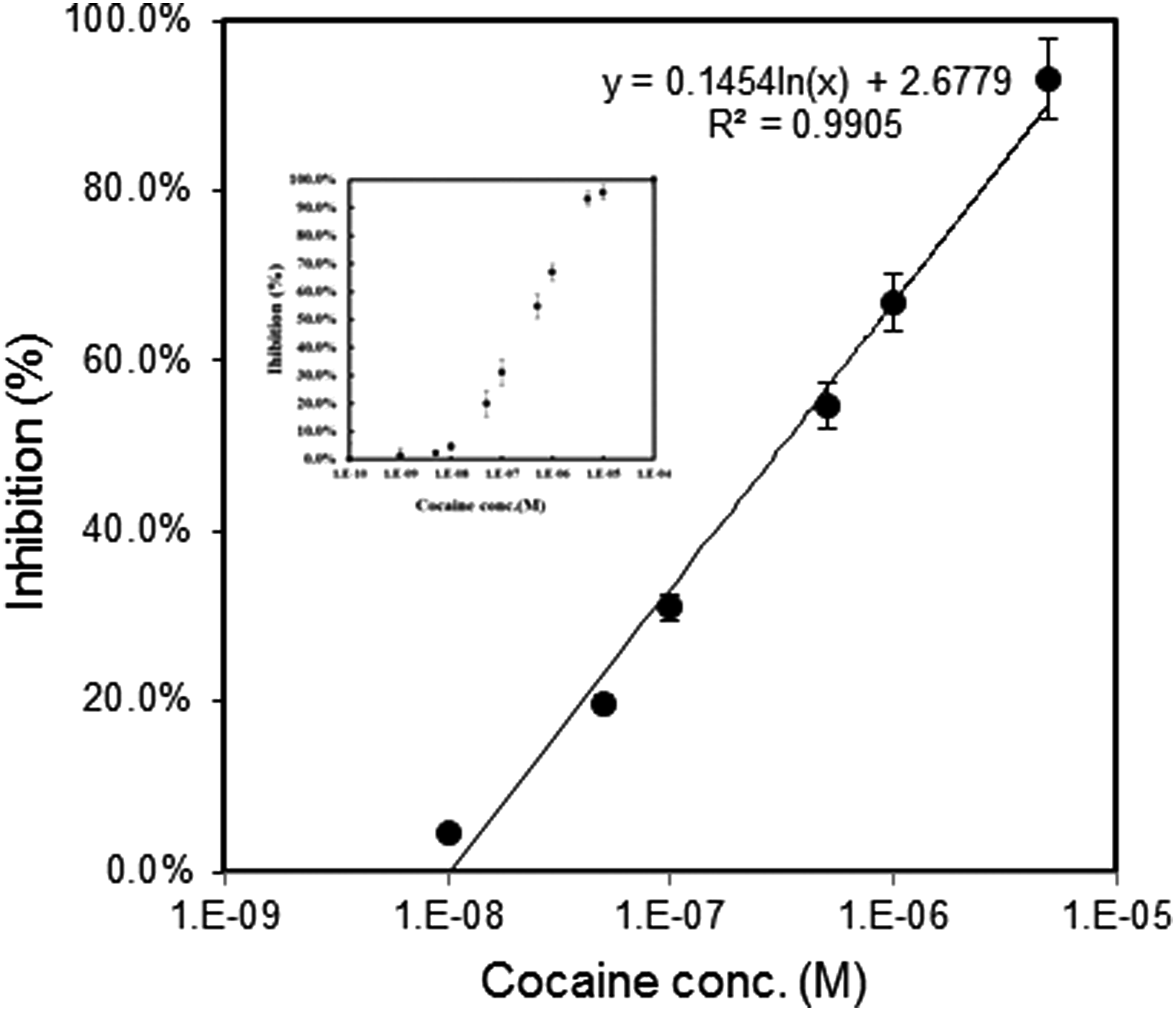
Calibration curve of the concentration-dependent effect of cocaine.
Symbols represent means of three measurements and bars represent ±standard errors. The correlation coefficient = 0.991.
ELISA, enzyme-linked immunosorbent assay; FIA, fluorescence immunoassay.
In this study, we developed a FIA method without B/F separation using an anticocaine antibody and a norcocaine labeled with merocyanine. In future studies, this method will be used as an immunoassay kit for the detection of cocaine within 10 minutes total time and evaluated using real samples such as urine and saliva.
Footnotes
Author Disclosure Statement
No competing financial interests exist.