




Abstract
Affinity tag systems, possessing high affinity and specificity, are useful for protein detection and purification. The most suitable tag for a particular purpose should be selected from many available affinity tag systems. In this study, we developed a novel affinity tag called the “RAP tag” system, which comprises a mouse antirat podoplanin monoclonal antibody (clone PMab-2) and the RAP tag (DMVNPGLEDRIE). This system is useful not only for protein detection in Western blotting, flow cytometry, and sandwich enzyme-linked immunosorbent assay, but also for protein purification.
Introduction
A
The most appropriate peptide tag system can be selected from many available peptide tags, such as FLAG tag,(5) TARGET tag,(6) PA tag,(7–16) and MAP tag,(17–20) among many others.(21–23) These systems sometimes have disadvantages, such as low specificity, low affinity, or difficulty in achieving protein elution. Therefore, we need to develop further affinity tag systems to overcome these disadvantages of established affinity tag systems.
We previously developed a mouse mAb (clone PMab-2) against the platelet aggregation-stimulating domain of rat podoplanin.(24) Podoplanin is a type I transmembrane protein, which is highly expressed in many normal cells and cancer cells, and is involved in tumor-induced platelet aggregation by binding to CLEC-2 on platelets.(3,25–33) Because PMab-2 possesses high affinity and specificity against rat podoplanin,(24) it was expected to be useful as an antitag antibody. Herein, we developed a novel affinity tag system, the “RAP tag” system, using PMab-2 mAb.
Results and Discussion
We first investigated the binding affinity between PMab-2 mAb and RAP tag (DMVNPGLEDRIE) using the BIAcore X100 system. Curve fitting showed the affinity for PMab-2–RAP tag interaction: ka = 2.0 × 10⁵ M−1 s−1, kd = 2.0 × 10⁻³ s−1, and KD = 9.7 × 10⁻⁹ M, indicating that PMab-2 showed moderate affinity toward the RAP tag. Next, we examined whether the RAP tag system is useful for several protein detection systems. As depicted in Figure 1A, PMab-2 showed a strong single band corresponding to the molecular weight of human epidermal growth factor receptor (EGFR) with RAP tag (∼170 kDa) in Western blot analysis. Transfectants of EGFR were established previously.(17) PMab-2 did not show any nonspecific bands in CHO-K1 and LN229 cells, indicating that PMab-2 is very specific to the RAP tag. PMab-2 reacted with the EGFR with the N-terminal RAP tag, which was expressed in CHO-K1 cells in flow cytometry (Fig. 1B, left). As a positive control, antihuman EGFR mAbs (EMab-51 and AY13) recognized CHO-K1/EGFR (Fig. 1B, middle and right). We further investigated whether the RAP tag system is useful in sandwich enzyme-linked immunosorbent assay (ELISA). PMab-2 was immobilized, and the soluble ectodomain fragment of EGFR (EGFRec) with RAP tag was added at a concentration from 3 ng/mL to 10 μg/mL and detected by biotinylated NZ-1. As shown in Figure 1C, EGFRec was detected in a dose-dependent manner. These results indicate that the RAP tag system is useful for Western blotting, flow cytometry, and sandwich ELISA.
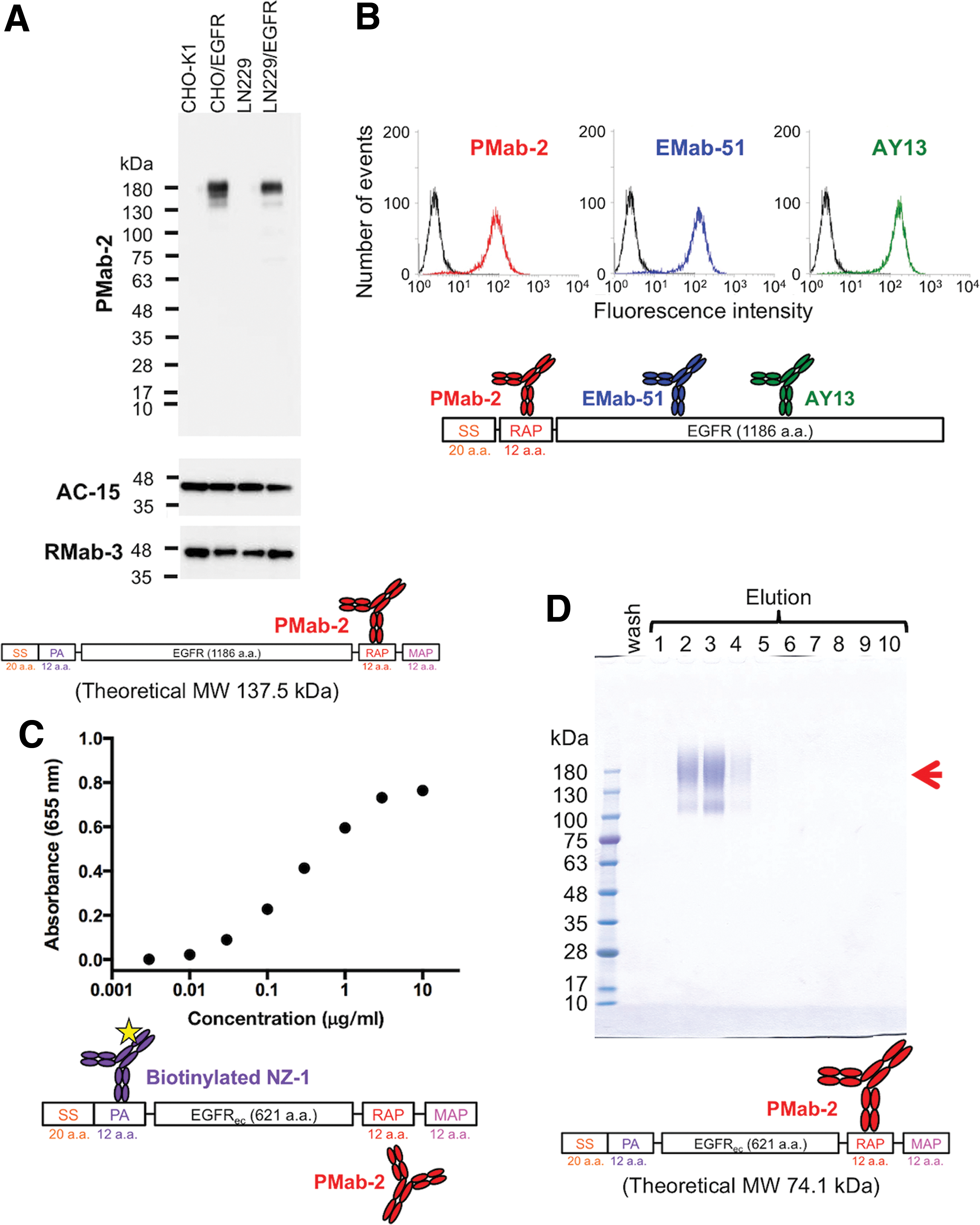
Detection and purification of RAP-tagged EGFR by the RAP tag system.
Next, we purified three different RAP-tagged proteins using the RAP tag system. The EGFRec and the soluble ectodomain fragment of human epidermal growth factor receptor 2 (HER2ec) were expressed in LN229 and were purified from the culture supernatant (Fig. 1D and Supplementary Fig. S1A). The fragment of α-thalassemia/mental-retardation-syndrome-X-linked (ATRXepi; ∼25 kDa) was expressed in Escherichia coli and purified from the soluble fraction of the bacterial lysate (Supplementary Fig. S1B). All RAP-tagged proteins were captured onto PMab-2-Sepharose and eluted from the resin by a solution containing 0.1 mg/mL free epitope peptide (GDDMVNPGLEDRIE). These proteins were efficiently eluted using the RAP tag peptide because of the high dissociation constant for PMab-2–RAP tag interaction. EGFRec and HER2ec were eluted in elution fractions 2–4 (EGFRec) or 2–3 (HER2ec) at a high concentration (Fig. 1D and Supplementary Fig. S1A). EGFRec and HER2ec are highly glycosylated(34,35); therefore, they were electrophoresed at a “heavier” position compared with that suggested by the theoretical molecular weight. ATRXepi was eluted in elution fractions 2–10 (Supplementary Fig. S1B). These purified proteins showed high purity and were ready for use in downstream experiments without further purification, indicating that the RAP tag system is a powerful protein purification tool.
In conclusion, we successfully developed a novel affinity tagging system, “RAP tag,” by employing a unique mAb PMab-2 against rat podoplanin. The RAP tag system could be advantageous for protein purification and detection in the field of protein science.
Footnotes
Acknowledgments
This work was supported mainly by the Basic Science and Platform Technology Program for Innovative Biological Medicine from Japan Agency for Medical Research and Development, AMED (Y.K.). This work was also supported in part by the Platform for Drug Discovery, Informatics, and Structural Life Science (PDIS) from AMED (Y.K.), by Project for utilizing glycans in the development of innovative drug discovery technologies from AMED (Y.K.), by Translational Research Network Program from AMED (Y.K.), by the Regional Innovation Strategy Support Program from the Ministry of Education, Culture, Sports, Science and Technology (MEXT) of Japan (Y.K.), by JSPS KAKENHI Grant Numbers 26440019 (M.K.K.) and 16K10748 (Y.K.). This work was performed, in part, under the Cooperative Research Program of Institute for Protein Research, Osaka University, CR-16-05. The authors thank Enago (
Author Disclosure Statement
No competing financial interests exist.
References
Supplementary Material
Please find the following supplemental material available below.
For Open Access articles published under a Creative Commons License, all supplemental material carries the same license as the article it is associated with.
For non-Open Access articles published, all supplemental material carries a non-exclusive license, and permission requests for re-use of supplemental material or any part of supplemental material shall be sent directly to the copyright owner as specified in the copyright notice associated with the article.
