




Abstract
Lung cancer is one of the leading causes of cancer-related deaths in the world. Regardless of the advances in lung cancer treatments, the prognosis is still poor. Podocalyxin (PODXL) is a highly glycosylated type I transmembrane protein that is expressed in normal tissues, including the heart, pancreas, and breast. It is also found and used as a diagnostic marker in many cancers, such as renal, brain, breast, oral, and lung cancers. We previously developed specific and sensitive anti-PODXL monoclonal antibodies, PcMab-47 (mouse IgG1, kappa) and its mouse IgG2a-type (47-mG2a), both of which were suitable for immunohistochemical analyses of oral cancers. In this study, we investigated the utility of PcMab-47 and 47-mG2a for the immunohistochemical analyses of lung cancers. PcMab-47 stained 51/70 (72.9%) cases of lung cancer, whereas 47-mG2a stained 59/70 (84.3%) cases, indicating that the latter antibody is more sensitive and is useful for detecting PODXL in lung cancers.
Introduction
L
Podocalyxin (PODXL) is a highly N-glycan- and O-glycan-glycosylated type I transmembrane protein with a molecular weight of 150,000–200,000.(9–12) It was originally discovered in renal podocytes and is expressed in many kinds of tissues, including the heart, pancreas, and breast. PODXL is also found in cancer tissues.(13) It has been reported to be a diagnostic marker and a prognostic indicator in some cancers, such as renal,(14) brain,(12) breast,(15) oral,(16) and lung cancers.(17,18) This protein is involved in tumor growth, invasion, and metastasis,(19) and its overexpression can cause undesirable outcomes. Furthermore, Kusumoto et al. reported that PODXL overexpression induces epithelial–mesenchymal transition in lung AC and contributes to tumor progression.(20) Therefore, more precise tools for detecting PODXL in lung cancer are necessary for optimal analysis and treatment.
Previously, we established specific and sensitive anti-PODXL mAbs, PcMab-47 (mouse IgG1, kappa), and mouse IgG2a-type (47-mG2a).(21) Herein, we investigated the utility of these two antibodies for immunohistochemical analysis of lung cancers.
Materials and Methods
Tissues
Cancer tissue microarrays of lung cancers were purchased from US Biomax (Rockville, MD) and Cybrdi (Frederick, MD).
Antibodies
PcMab-47 was developed as described previously.(21) Appropriate VH and VL cDNAs of mouse PcMab-47 and CH and CL of mouse IgG2a were subcloned into pCAG-Ble and pCAG-Neo vectors (FUJIFILM Wako Pure Chemical Industries Ltd., Osaka, Japan), respectively, to generate 47-mG2a. Antibody expression vectors were transfected into ExpiCHO-S cells using the ExpiCHO Expression System (Thermo Fisher Scientific, Inc., Waltham, MA). 47-mG2a was purified using Protein G Sepharose (GE Healthcare Bio-Sciences, Pittsburgh, PA).
Immunohistochemical analyses
Histologic sections (4-μm-thick) were deparaffinized in xylene and then rehydrated and autoclaved in citrate buffer (pH 6.0; Agilent Technologies, Inc., Santa Clara, CA) for 20 minutes. Sections were then incubated with 0.5 or 5 μg/mL primary mAbs for 1 hour at room temperature and then treated using an Envision+ kit (Agilent Technologies, Inc.) for 30 minutes. Color development was performed using 3,3-diaminobenzidine tetrahydrochloride (Agilent Technologies, Inc.) for 2 minutes. Sections were then counterstained with hematoxylin (FUJIFILM Wako Pure Chemical Industries Ltd.). Staining intensity was evaluated as −, 1+, 2+, or 3+.
Results and Discussion
To produce PcMab-47 (mouse IgG1, kappa), we previously immunized mice with recombinant PODXL purified from the culture supernatant of the extracellular domain of PODXL-expressing LN229 cells.(21) We further engineered PcMab-47 into a mouse IgG2a-type mAb (47-mG2a). This antibody exhibited a higher binding affinity than PcMab-47 for PODXL-expressing oral SCC (OSCC) cells. Immunohistochemical analysis of oral cancer tissues using these two antibodies revealed that 47-mG2a stained OSCC cells in a cytoplasmic pattern at a much lower concentration. PcMab-47 and 47-mG2a detected PODXL in 163/201 (81.1%) and 197/201 (98.0%) OSCC samples, respectively.
In this study, we performed immunohistochemical analyses using PcMab-47 and 47-mG2a against several types of lung cancers. Typical staining results of PcMab-47 and 47-mG2a against SCC, adenosquamous cell carcinoma (ASCC), small-cell carcinoma (SC), AC, bronchioloalveolar carcinoma (BC), and papillary carcinoma (PC) are shown in Figure 1 and Supplementary Figures S1–S5. Both PcMab-47 and 47-mG2a stained cancer cells of all types of lung cancer in a cytoplasmic staining pattern. Furthermore, both PcMab-47 and 47-mG2a stained endothelial cells in lung cancers (Fig. 2).
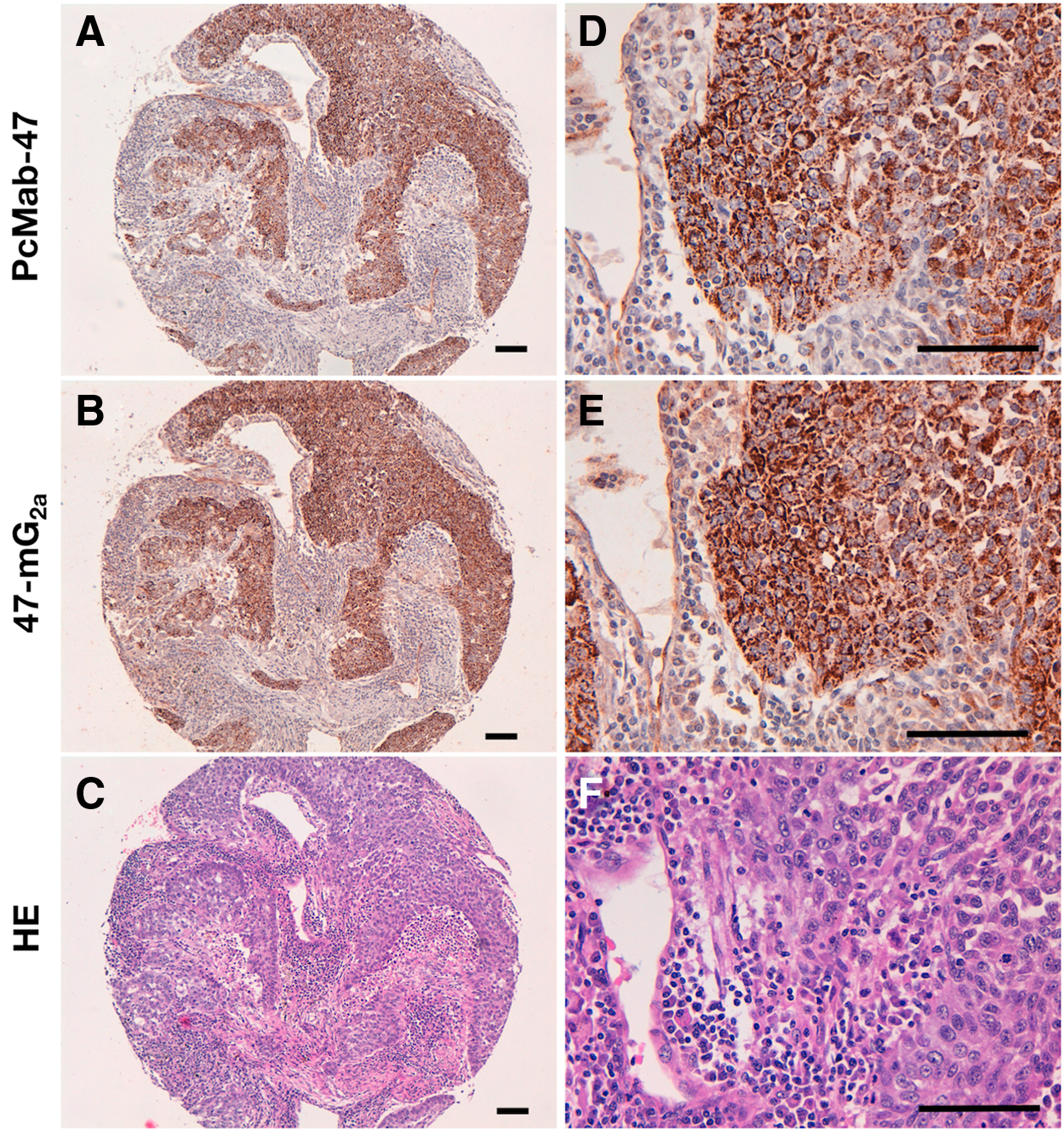
Immunohistochemical analysis by anti-PODXL antibodies against lung SCCs. Sections (Case-7) were incubated with 5 μg/mL of PcMab-47

Anti-PODXL antibodies detect endothelial cells in lung SCCs. Sections (Case-25) were incubated with 5 μg/mL of PcMab-47
As shown in Table 1 and Supplementary Table S1, PcMab-47 stained 51/70 cases (72.9%) of lung cancers. Among them, 35/41 cases (85.4%) of SCC, 6/10 cases (60%) of ASCC, 3/7 cases (42.9%) of SC, 4/5 cases (80%) of AC, 3/5 cases (60%) of BC, and 0/2 cases (0%) of PC were stained. In contrast, 47-mG2a stained 59/70 cases (84.3%) of lung cancers. Among them, 38/41 cases (92.7%) of SCC, 8/10 cases (80%) of ASCC, 4/7 cases (51.7%) of SC, 4/5 cases (80%) of AC, 4/5 cases (80%) of BC, and 1/2 cases (50%) of PC were stained.
SCC, squamous cell carcinoma; ASCC, adenosquamous cell carcinoma; SC, small-cell carcinoma; AC, adenocarcinoma; BC, bronchioloalveolar carcinoma; PC, papillary carcinoma.
The intensity of staining was evaluated as −, 1+, 2+, 3+.
In conclusion, our immunohistochemical results demonstrate that 47-mG2a is significantly more sensitive than the original PcMab-47 for the detection of PODXL in LSCCs and could be applied to other SCCs in the future.
Footnotes
Acknowledgments
We thank Takuro Nakamura, Miyuki Yanaka, Noriko Saidoh, Saori Handa, and Yoshimi Nakamura· for their excellent technical assistance. This research was supported by AMED under Grant Numbers: JP17am0301010 (Y.K.), JP17am0101078 (Y.K.), and JP17ae0101028 (Y.K.).
Author Disclosure Statement
The authors have no conflicts of interest.
References
Supplementary Material
Please find the following supplemental material available below.
For Open Access articles published under a Creative Commons License, all supplemental material carries the same license as the article it is associated with.
For non-Open Access articles published, all supplemental material carries a non-exclusive license, and permission requests for re-use of supplemental material or any part of supplemental material shall be sent directly to the copyright owner as specified in the copyright notice associated with the article.
