




Abstract
Telomerase reverse transcriptase (TERT) and mutations of the TERT promoter are significant in the pathogenesis of 1p/19q-codeleted oligodendrogliomas and isocitrate dehydrogenase gene wild-type glioblastomas, as well as melanomas and squamous cell carcinomas. We previously developed an antihuman TERT monoclonal antibody (mAb), TMab-6, which is applicable in immunohistochemistry for human tissues. However, the binding epitope of TMab-6 against TERT is yet to be elucidated. In this study, enzyme-linked immunosorbent assay and immunohistochemistry were utilized for investigating the epitope of TMab-6. The findings revealed that the critical epitope of TMab-6 is the TERT sequence PSTSRPPRPWD; Thr310 and Ser311 of TERT are especially significant amino acids for TMab-6 recognition.
Introduction
T
Chang et al. also reported that mutations in the TERT promoter frequently occur in patients with oral cavity squamous cell carcinoma (SCC)(5); somatic TERT promoter mutations could, therefore, play a vital role in the pathogenesis and progression of oral cavity SCC.
Recently, we developed an antihuman TERT monoclonal antibody (mAb), TMab-6 (IgM, kappa), which is useful for immunohistochemistry in human tissues.(6) This study utilized enzyme-linked immunosorbent assay (ELISA) and immunohistochemistry and point mutants of TERT for investigating the epitope of TMab-6.
Materials and Methods
Enzyme-linked immunosorbent assay
Synthesized TERT peptides (PEPScreen; Sigma-Aldrich Corp., St. Louis, MO) were immobilized on Nunc Maxisorp 96-well immunoplates (Thermo Fisher Scientific, Inc., Waltham, MA) at 5 μg/mL for 30 minutes. After blocking with SuperBlock T20 (PBS) Blocking Buffer (Thermo Fisher Scientific, Inc.), the plates were incubated with purified TMab-6 (10 μg/mL), followed by peroxidase-conjugated antimouse IgG (Agilent Technologies, Inc., Santa Clara, CA) diluted 1:2000. The enzymatic reaction was conducted using 1-Step Ultra TMB-ELISA (Thermo Fisher Scientific, Inc.). The optical density was measured at 655 nm using an iMark microplate reader (Bio-Rad Laboratories, Inc., Berkeley, CA). These reactions were performed in a volume of 50–100 μL at 37°C.
Immunohistochemical analyses
This study was approved by the ethical committee of Sendai Medical Center. One patient with glioblastoma who underwent surgery at the Sendai Medical Center was enrolled for analysis. Histological tumor sections (4-μm thick) were directly autoclaved in citrate buffer (pH 6.0; Nichirei Biosciences, Inc., Tokyo, Japan) for 20 minutes, incubated with 5 μg/mL of TMab-6 or 5 μg/mL of TMab-6 + 5 μg/mL of peptides for 1 hour at room temperature, and treated using an Envision+ kit (Agilent Technologies, Inc.) for 30 minutes. Color development was performed using 3,3-diaminobenzidine tetrahydrochloride (Agilent Technologies, Inc.) for 2 minutes. Sections were then counterstained with hematoxylin (FUJIFILM Wako Pure Chemical Industries Ltd., Osaka, Japan).
Results and Discussion
In our previous study, BALB/c mice were immunized against TERT by the intraperitoneal injection of human TERT synthetic peptide (hTERT; 302–321 amino acids: QHHAGPPSTSRPPRPWDTPC).(6) ELISA was utilized for screening culture supernatants for binding to synthetic peptides and recombinant proteins of hTERT purified from Escherichia coli. We developed cloned TMab-6 (IgM, kappa), which is useful for immunohistochemistry, using paraffin-embedded tissues. Until now, the binding epitope remains to be elucidated.
In this study, we synthesized a series of hTERT peptides from 302 to 320 amino acids in length using point mutations (Table 1). ELISA using TMab-6 detected Q302A, H303A, H304A, A305G, G306A, P307A, R312A, P314A, R315A, P316A, T319A, and P320A. On the contrary, TMab-6 did not react with T310A and S311A, moderately reacted with P308A, S309A, P313A, and D318A, and weakly reacted with W317A, which indicates that the TERT sequence PSTSRPPRPWD is a critical epitope of TMab-6.
Determination of TMab-6 Epitope by Enzyme-Linked Immunosorbent Assay
Bold “A” or “G” indicates the substitution from original amino acid.
+++, OD655≧0.7; ++, 0.4 ≦OD655 < 0.7;
+, 0.1≦OD655 < 0.4; −, OD655 < 0.1.
Next, we performed a peptide-blocking assay using immunohistochemistry against glioblastoma. TMab-6 reacted with glioblastoma tissues (Fig. 1); however, this reaction was completely neutralized by Q302A. In contrast, S311A did not block the TMab-6 reaction with glioblastoma tissues. These data confirmed the ELISA-generated map of the TMab-6 epitope, which is summarized in Figure 2.
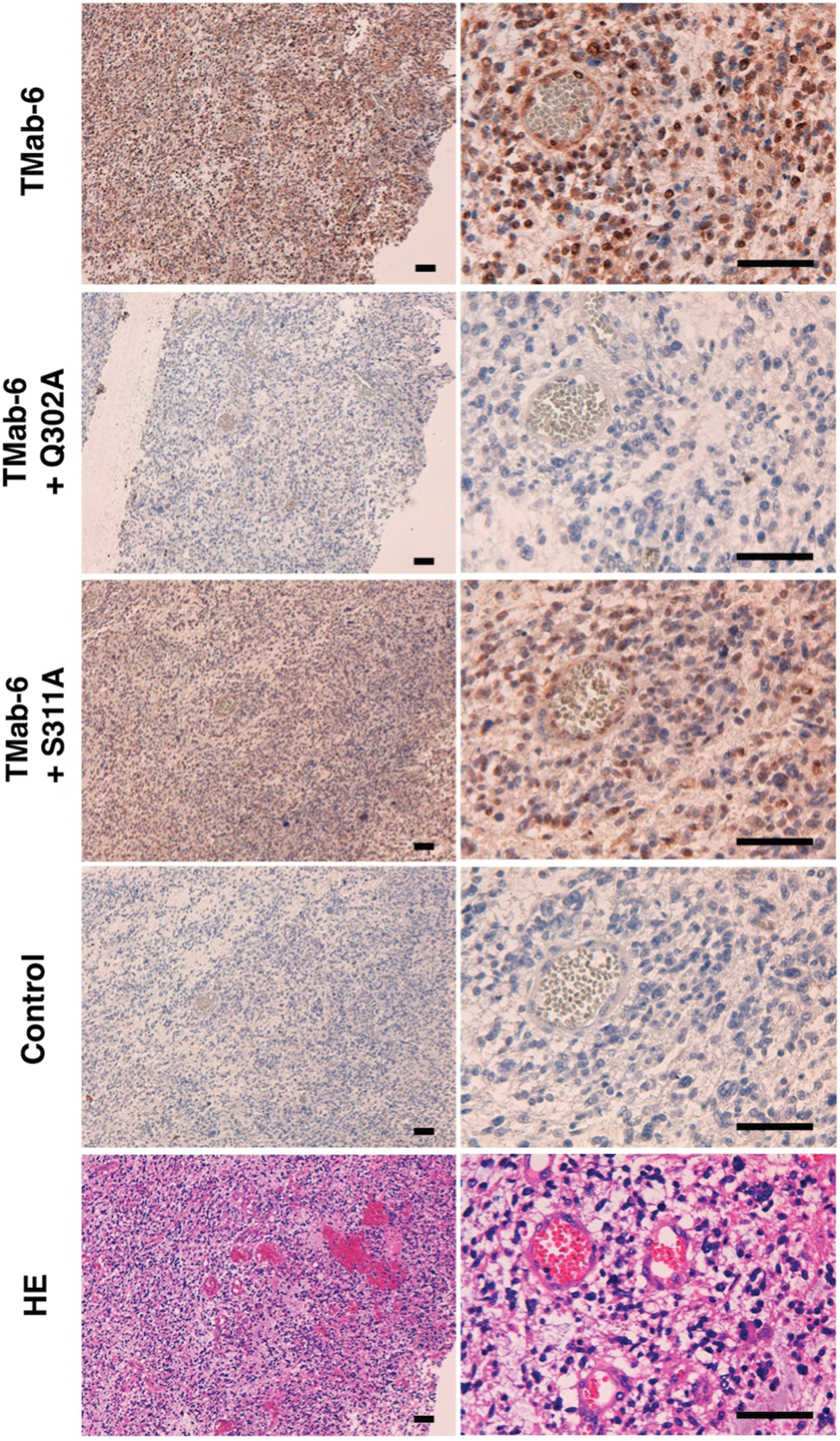
Immunohistochemistry using TMab-6 and point mutants of TERT. Glioblastoma tissues were autoclaved in citrate buffer for 20 minutes. Sections were then incubated with TMab-6, TMab-6 + Q302A, or TMab-6 + S311A, and treated using an Envision+ kit. Color development was performed using 3,3-diaminobenzidine tetrahydrochloride. Sections were then counterstained with hematoxylin. Scale bars = 100 μm. HE, hematoxylin and eosin staining; TERT, telomerase reverse transcriptase.
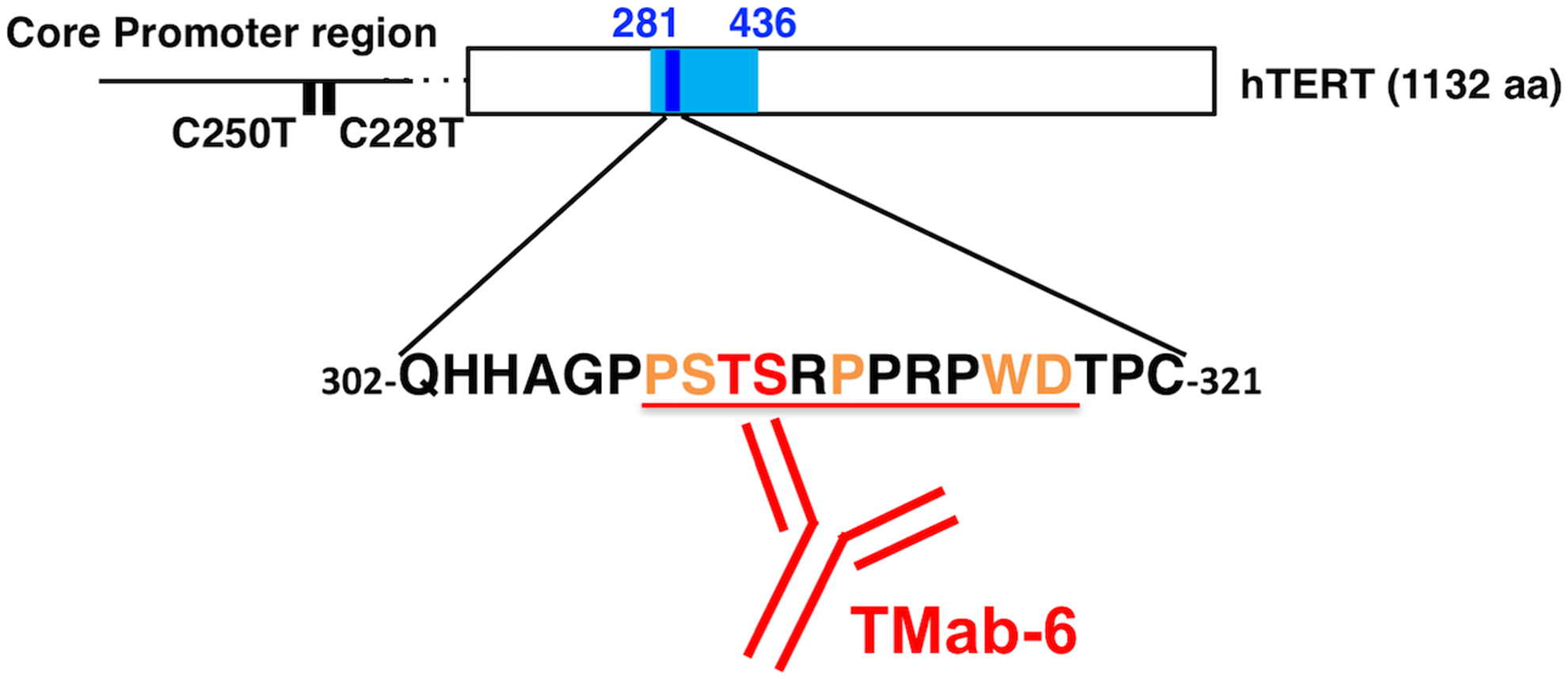
Schematic illustration of TERT and TMab-6-epitope. The critical epitope of TMab-6 is PSTSRPPRPWD. Thr310 and Ser311 of TERT are especially significant amino acids for TMab-6 recognition.
The information regarding the epitope of TMab-6 in this study could be valuable for the development of sensitive and specific mAbs against hTERT in immunohistochemistry.
Footnotes
Acknowledgments
We thank Noriko Saidoh, Saori Handa, and Yoshimi Nakamura for their excellent technical assistance. This research was supported, in part, by AMED under Grant Numbers: JP17am0301010 (Y.K.), JP17am0101078 (Y.K.), and JP17ae0101028 (Y.K.), and by JSPS KAKENHI Grant Number 17K07299 (M.K.K.) and Grant Number 16K10748 (Y.K.).
Author Disclosure Statement
No competing financial interests exist.