




Abstract
Podoplanin (PDPN) has been utilized as a lymphatic endothelial cell marker especially in pathological diagnoses. Therefore, sensitive and specific monoclonal antibodies (mAbs) targeting PDPN are needed for immunohistochemical analyses using formalin-fixed paraffin-embedded tissues. Recently, anti-PDPN mAbs against many species, such as human, mouse, rat, rabbit, dog, cat, bovine, pig, and horse were established in our studies. However, anticetacean (whale) PDPN (wPDPN) has not been established yet. In this study, we immunized mice with wPDPN-overexpressing Chinese hamster ovary (CHO)-K1 (CHO/wPDPN) cells, and screened mAbs against wPDPN using flow cytometry. One of the mAbs, PMab-237 (IgG1, kappa), specifically detected CHO/wPDPN cells by flow cytometry and immunohistochemistry. Our findings suggest the potential usefulness of PMab-237 for the functional analyses of wPDPN.
Introduction
Podoplanin (PDPN), a type I transmembrane sialo-glycoprotein, is expressed in many cell types, including pulmonary type I alveolar cells, renal epithelial cells such as podocytes, and lymphatic endothelial cells of every organ.(1) PDPN has been used to distinguish lymphatic endothelial cells from vascular endothelial cells in pathophysiological studies.(2) As an endogenous receptor of PDPN, C-type lectin-like receptor-2 (CLEC-2) was previously reported in our studies.(3,4) The PDPN-CLEC-2 interaction facilitates the separation of embryonic blood and lymphatic vessels.(5) The expression of human PDPN (hPDPN) has been reported in many malignant tumors, including oral squamous cell carcinomas,(6) lung squamous cell carcinomas,(7) esophageal squamous cell carcinomas,(8) malignant brain tumors,(9) and malignant mesotheliomas.(10) The expression of hPDPN is associated with malignant progression and cancer metastasis.(11)
We recently developed monoclonal antibodies (mAbs) against human,(9) mouse,(12) rat,(13) rabbit,(14) bovine,(15) dog,(16) cat,(17) pig,(18) and horse(19) PDPNs. An anti-cat PDPN (cPDPN) mAb (PMab-52) was shown to cross-react with tiger PDPN (tigPDPN).(20) An anti-bovine PDPN (bovPDPN) mAb (PMab-44) recognized not only bovPDPN but also goat,(21) sheep,(22) and alpaca(23) PDPNs. In this study, we immunized mice with CHO/whale PDPN (wPDPN) cells and established mAbs against wPDPN.
Materials and Methods
Cell lines
P3X63Ag8U.1 (P3U1) and CHO-K1 cells were obtained from the American Type Culture Collection (ATCC, Manassas, VA). Synthesized DNA (Eurofins Genomics KK, Tokyo, Japan) encoding wPDPN (accession no.: XM_007104824.2) plus an N-terminal RIEDL tag, which are recognized by an anti-RIEDL tag mAb (LpMab-7), was subcloned into a pCAG-Neo vector (FUJIFILM Wako Pure Chemical Corporation, Osaka, Japan). Plasmids were transfected using Lipofectamine LTX with Plus Reagent (Thermo Fisher Scientific, Inc., Waltham, MA). Stable transfectants were selected by limiting dilution and cultivation in a medium containing 0.5 mg/mL of G418 (Nacalai Tesque, Inc., Kyoto, Japan).
The P3U1, CHO-K1, CHO/wPDPN, CHO/hPDPN,(24) CHO/mouse PDPN (mPDPN),(24) CHO/rat PDPN (rPDPN),(13) CHO/rabbit PDPN (rabPDPN),(14) CHO/dog PDPN (dPDPN),(16) CHO/bovPDPN,(15) CHO/cPDPN,(17) CHO/pig PDPN (pPDPN),(25) CHO/horse PDPN (horPDPN),(26) CHO/tigPDPN,(20) CHO/alpaca PDPN (aPDPN),(23) CHO/bear PDPN (bPDPN),(25) CHO/Tasmanian devil PDPN (tasPDPN),(25) CHO/goat PDPN (gPDPN),(21) and CHO/sheep PDPN (sPDPN)(22) were cultured in a Roswell Park Memorial Institute (RPMI) 1640 medium (Nacalai Tesque, Inc.), supplemented with 10% of heat-inactivated fetal bovine serum (Thermo Fisher Scientific, Inc.), 100 units/mL of penicillin, 100 μg/mL of streptomycin, and 25 μg/mL of amphotericin B (Nacalai Tesque, Inc.). The cells were grown in an incubator at 37°C with humidity and 5% CO2 and 95% air atmosphere.
Animals
Female BALB/c mice (6 weeks of age) were purchased from CLEA Japan (Tokyo, Japan). The animals were housed under specific pathogen-free conditions. The Animal Care and Use Committee of Tohoku University approved all animal experiments.
Hybridoma production
We employed a Cell-Based Immunization and Screening (CBIS) method(17,27–29) to develop mAbs against wPDPN. In brief, two BALB/c mice were immunized with CHO/wPDPN cells (1 × 10⁸) intraperitoneally (i.p.) together with the Imject Alum (Thermo Fisher Scientific, Inc.). The procedure included three additional immunizations, followed by a final booster injection administered i.p. 2 days before the harvest of spleen cells. Subsequently, these spleen cells were fused with P3U1 cells using PEG1500 (Roche Diagnostics, Indianapolis, IN), and the hybridomas were grown in an RPMI medium supplemented with hypoxanthine, aminopterin, and thymidine for selection (Thermo Fisher Scientific, Inc.). The culture supernatants were screened by flow cytometry.
Flow cytometry
The cells were harvested after a brief exposure to 0.25% trypsin and 1 mM ethylenediaminetetraacetic acid (Nacalai Tesque, Inc.). The cells were washed with 0.1% bovine serum albumin in phosphate-buffered saline (PBS) and treated with primary mAbs for 30 minutes at 4°C. Thereafter, the cells were treated with Alexa Fluor 488-conjugated anti-mouse IgG (1:2000; Cell Signaling Technology, Inc., Danvers, MA) or Oregon Green anti-rat IgG (1:2000; Thermo Fisher Scientific, Inc.). Then, fluorescence data were collected using the SA3800 Cell Analyzer (Sony Corporation, Tokyo, Japan).
Determination of binding affinity by flow cytometry
CHO/wPDPN was suspended in 100 μL of serially diluted PMab-237. Then, Alexa Fluor 488-conjugated anti-mouse IgG (1:200; Cell Signaling Technology, Inc.) was added. Fluorescence data were collected using the EC800 Cell Analyzer (Sony Corporation). The dissociation constant (KD) was calculated by fitting the binding isotherms to built-in one-site binding models in the GraphPad PRISM 6 (GraphPad Software, Inc., La Jolla, CA).
Western blot analysis
Cell lysates (10 μg) were boiled in sodium dodecyl sulfate sample buffer (Nacalai Tesque, Inc.). Proteins were then electrophoresed on 5%–20% polyacrylamide gels (FUJIFILM Wako Pure Chemical Corporation) and transferred onto polyvinylidene difluoride membranes (Merck KGaA, Darmstadt, Germany). After blocking with 4% skim milk (Nacalai Tesque, Inc.), membranes were incubated with 1 μg/mL of PMab-237, 10 μg/mL of LpMab-7, and 1 μg/mL of anti-β-actin (clone AC-15; Sigma-Aldrich Corporation, St. Louis, MO), followed by incubation with peroxidase-conjugated anti-mouse IgG (diluted 1:1000; Agilent Technologies, Inc., Santa Clara, CA), and were finally developed using ImmunoStar LD (FUJIFILM Wako Pure Chemical Corporation) using a Sayaca-Imager (DRC Co. Ltd., Tokyo, Japan).
Immunohistochemical analyses
Cell blocks were produced using iPGell (Genostaff Co., Ltd., Tokyo, Japan). Histological sections of 4-μm thickness were deparaffinized in xylene, then rehydrated, and autoclaved in citrate buffer (pH 6.0; Nichirei Biosciences, Inc., Tokyo, Japan) for 20 minutes. Then, sections were blocked using the SuperBlock T20 (PBS) Blocking Buffer (Thermo Fisher Scientific, Inc.), incubated with PMab-237 (1 μg/mL) for 1 hour at room temperature, and treated with the Envision+ Kit for mouse (Agilent Technologies, Inc.) for 30 minutes. Color was developed using 3,3′-diaminobenzidine tetrahydrochloride (Agilent Technologies, Inc.) for 2 minutes, and counterstaining was performed using hematoxylin (FUJIFILM Wako Pure Chemical Corporation).
Results and Discussion
Two mice were immunized with CHO/wPDPN cells using CBIS method (Fig. 1). The developed hybridomas were seeded into 96-well plates and cultivated for 10 days. Wells positive for CHO/wPDPN and negative for CHO-K1 were selected by flow cytometry. The screening approach identified strong signals from CHO/wPDPN cells and weak or no signals from CHO-K1 cells in 71 of the 960 wells (7.4%). PMab-237 (IgG1, kappa) was finally selected.

Schematic illustration of the CBIS method. Stable transfectants expressing the protein of interest were used as an immunogen with no purification procedure. The selection of hybridomas secreting specific mAbs was performed by flow cytometry using parental and transfectant cells. CBIS, Cell-Based Immunization and Screening; mAbs, monoclonal antibodies.
PMab-237 recognized CHO/wPDPN cells, but showed no reaction with CHO-K1 cells, as assessed by flow cytometry (Fig. 2). PMab-237 cross-reacted with human, bovine, goat, sheep, alpaca, and tiger PDPNs (Fig. 3). Those expression levels were confirmed by each positive control mAb. In addition, kinetic analysis conducted by flow cytometry was employed to assess the interaction of PMab-237 with CHO/wPDPN cells. KD of PMab-237 for CHO/wPDPN cells was determined to be 4.6 × 10⁻⁹ M, indicating a high affinity of PMab-237 for CHO/wPDPN cells.

Detection of wPDPN by flow cytometry using PMab-237. CHO/wPDPN and CHO-K1 were treated with PMab-237 (red line) or anti-RIEDL tag (LpMab-7; blue line) at a concentration of 1 μg/mL or 0.1% BSA in PBS (gray) for 30 minutes, followed by incubation with secondary antibodies. CHO, Chinese hamster ovary; BSA, bovine serum albumin; PBS, phosphate-buffered saline; PDPN, podoplanin; wPDPN, whale PDPN.

Cross-reaction of PMab-237 to PDPNs of the other species by flow cytometry. CHO-K1 cells transfected with PDPNs of the other species were treated with PMab-237 (red line) or each positive control (blue line) at a concentration of 1 μg/mL or 0.1% BSA in PBS (gray) for 30 minutes, followed by incubation with secondary antibodies.
Western blot analysis performed using PMab-237 demonstrated that PMab-237 detects wPDPN as a 40-kDa band in CHO/wPDPN cells (Fig. 4). An anti-RIEDL tag mAb (LpMab-7) also detected a 40-kDa band in CHO/wPDPN cells. The immunohistochemical analyses revealed that PMab-237 strongly stained CHO/wPDPN cells (Fig. 5B), whereas it did not react with CHO-K1 cells (Fig. 5A).
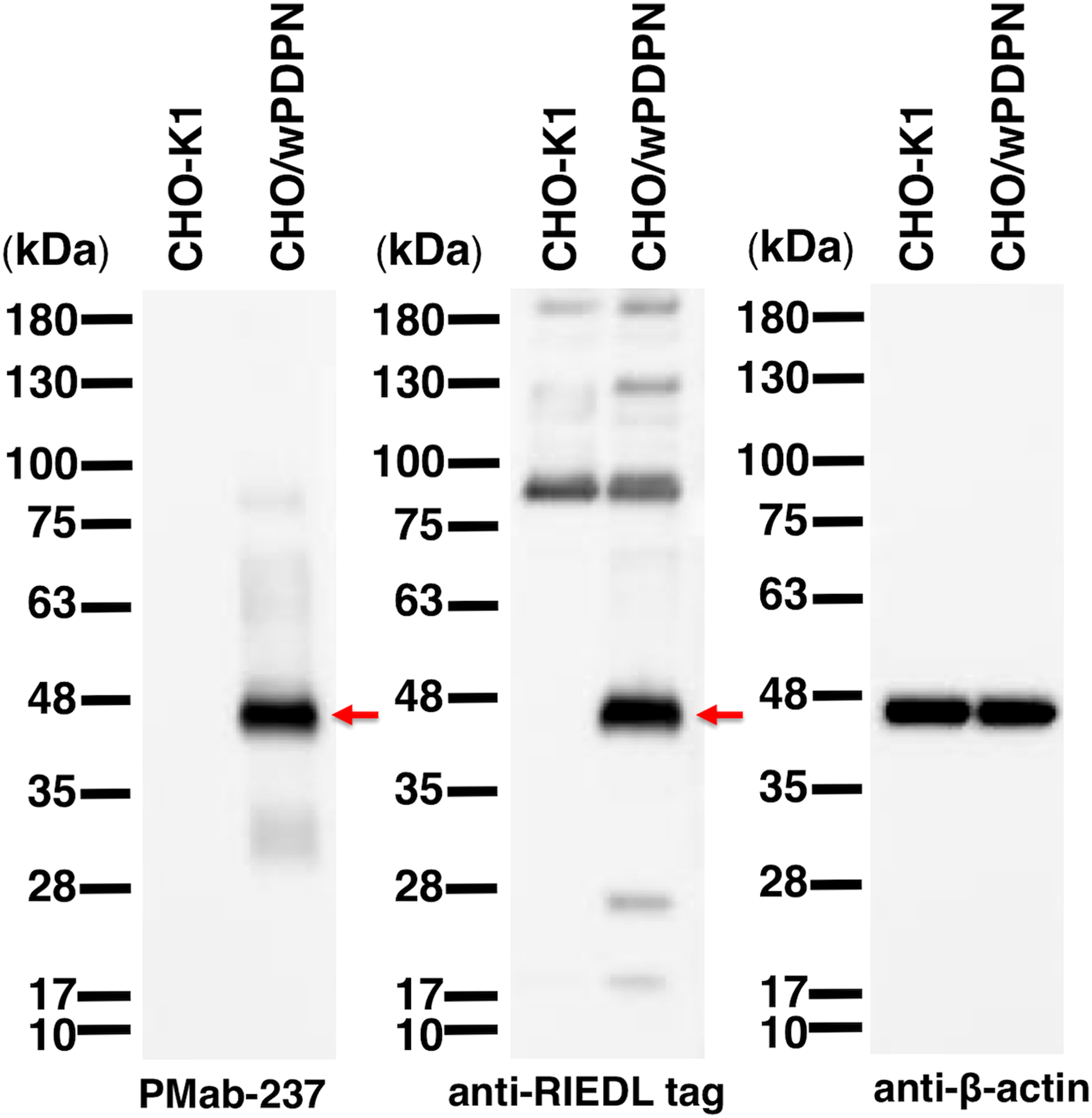
Western blot analysis. Cell lysates of CHO-K1 and CHO/wPDPN (10 μg) were electrophoresed and transferred onto PVDF membranes. The membranes were incubated with l μg/mL of PMab-237, 10 μg/mL of anti-RIEDL tag (LpMab-7), or 1 μg/mL of anti-β-actin and subsequently with peroxidase-conjugated anti-mouse IgG. Red arrow, wPDPN. PVDF, polyvinylidene difluoride.
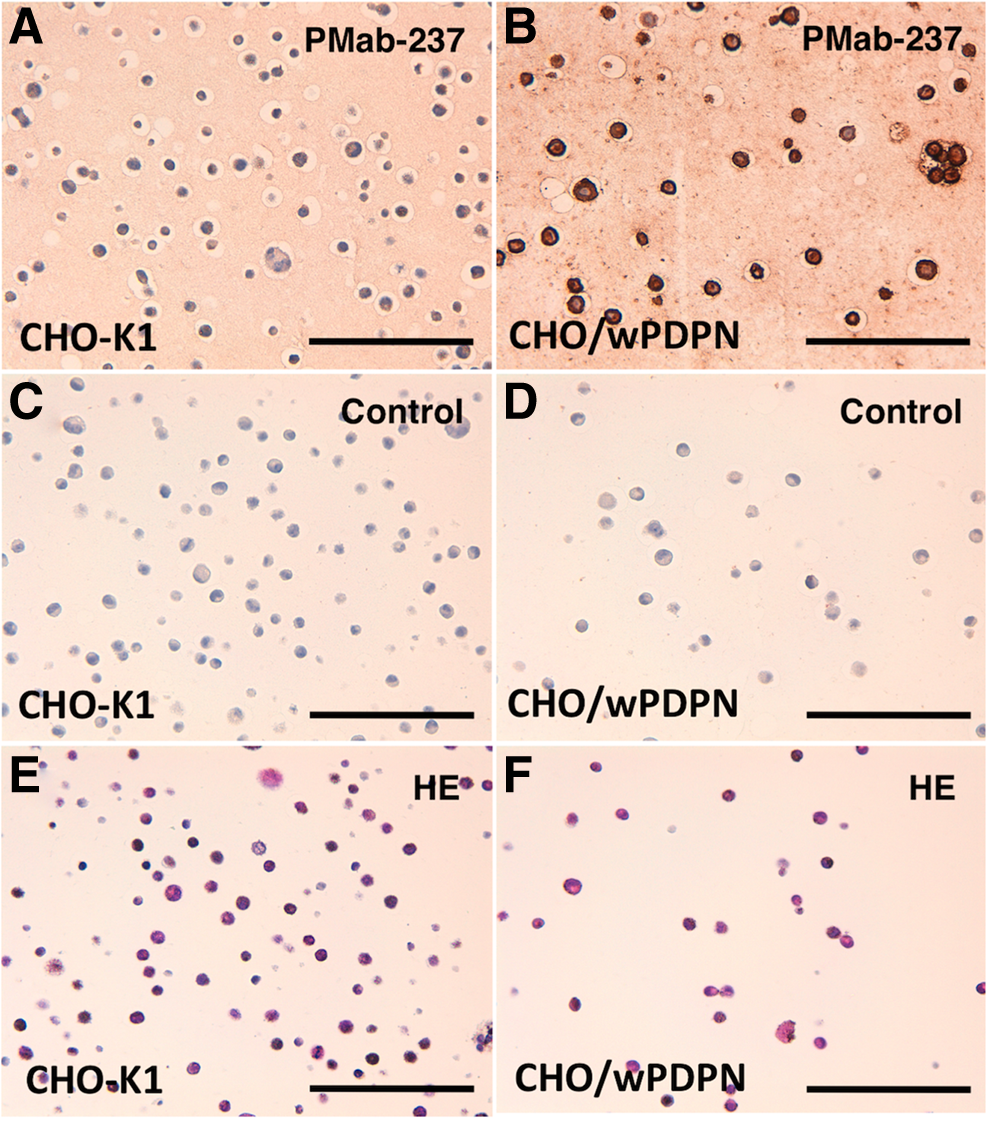
Immunohistochemical analyses for cell lines. CHO-K1 cells
In conclusion, we established PMab-237 against wPDPN, which is suitable for use in flow cytometry, Western blot, and immunohistochemical analyses using CBIS method. The epitope of PMab-237 needs further investigation to clarify the sensitivity and specificity of PMab-237 against wPDPN. We believe that PMab-237 should prove to be useful in elucidating the pathophysiological functions of wPDPN in future studies.
Footnotes
Acknowledgments
We thank Miyuki Yanaka, Kayo Hisamatsu, Saori Handa, and Yoshimi Nakamura for their excellent technical assistance. This research was supported in part by AMED under grant nos. JP18am0101078 (Y.K.), JP18am0301010 (Y.K.), and JP18ae0101028 (Y.K.), and by JSPS KAKENHI grant no. 17K07299 (M.K.K.) and grant no. 16K10748 (Y.K.).
Author Disclosure Statement
No competing financial interests exist.