




Abstract
The DNA fragment encoding predicted main antigenic region, aa 1–300 on Gp protein of Ebola virus (EBOV) was cloned into the vector pGEX-KG. The recombinant GST-tagged Gp-300 was expressed in Escherichia coli BL21 (DE3) by induction with 1 mM isopropyl-1-thio-b-
Introduction
Ebola virus disease (EVD), formerly known as Ebola hemorrhagic fever, is a severe zoonotic disease caused by Ebola virus (EBOV). Since it emerged in southern Sudan and the Ebola river region of the democratic republic of Congo in 1976, it has caused a total of 25 human outbreaks, with 21,031 infections and 8537 deaths.(1) Before 2014, the outbreak was mainly centralized in African countries. In the year 2014, the most serious EVD epidemic erupted in Western Africa.(2) Since then, the range and area of the epidemic was enlarged, which brought serious social problems and public health issues, and aroused world-wide attention.(3,4)
EBOV is a member of the family Filoviridae and belongs, together with the Paramyxoviridae, Bornaviridae, and the Rhabdoviridae, to the order of Mononegavirales.(5) It contains a single-stranded negative-sense RNA with ∼18 kb in length and multiple open reading frames that encode a total of one nuclear protein (NP), three glycoproteins (GP, SGP, ssGP), four virulence structural proteins (VP24, VP30, VP35, VP40), and viral polymerase L (Polymerase L).(6) Among them, Gp protein is the only surface envelope protein which is encoded by two coterminous open reading frames, as a result of nontemplate Adenosine inserting into mRNA during transcription editing.(7) Mature Gp protein can be digested by furin to form GP1 and GP2, which play an important role in virus adsorption and invasion. GP1 is related to receptor recognition and virulence, whereas Gp2 promotes the fusion of viral and cell membranes in the process of virus invasion. In addition, GP also has good immunogenicity and is the key protein of EBOV that can induce neutralizing antibody responses.(8)
Nowadays, function of all the proteins of EBOV is underongoing study; however, the mechanism of EBOV pathogenesis remains poorly understood. Currently, the EVD epidemic situation is still grim, while there are still no vaccines or specific drugs available, thence, effective treatment for EBOV is urgently needed. In this study, the main antigen region of Gp protein was selected to prepare monoclonal antibodies, which could be applied as useful tools for studying protein function of EBOV, and pathogenic mechanism and treatment of EVD.
Materials and Methods
Plasmid construction and protein expression
Through epitope prediction and hydrophilicity analysis, the 300 amino acids at the N-terminal of Gp protein (named Gp-300) was selected for amplification. The template EBOV-Gp expression plasmid (GenBank: AF086833) was donated by Professor Bu Zhigao, and forward primer: 5′-GCGGATCCATGGGCGTTACAGGAATATT-3′; reverse primer: 5′-CGAGCTCTCATTTTTCTAGTGAGGTT-3′. Subsequently, the target fragment was cloned into the pGEX-KG vector. The recombinant plasmid, named pKG-Gp-300, and the control plasmid (pGEX-KG) were then transformed into competent Escherichia coli BL21 cells and induced with isopropyl-b-thio-galactopyranoside (IPTG). After centrifugation, the bacterial pellet was resuspended and sonicated until a clear lysate was obtained. The target proteins were then purified as previously described and divided into small aliquots to be stored at −80°C.
Monoclonal antibody production
The mAbs against the Gp-300 protein were produced as previously described.(9,10) Briefly, 4-week-old female SPF BALB/c mice purchased from the Laboratory Animal Center of Huazhong Agricultural University were immunized subcutaneously with 100 mg of the purified Gp-300 protein at 2-week intervals. The procedure included three additional immunizations followed by a final booster injection. Then, mice splenocytes were harvested and fused with SP2/0 using PEG4000. Hybridoma culture supernatants were screened using enzyme-linked immunosorbent assay (ELISA). The positive hybridoma cells were cloned by a limiting dilution, and the stable hybridoma clones were injected into liquid paraffin-pretreated abdominal cavities of BALB/c mice. Subsequently, the mAbs were harvested and purified from the seroperitoneum with an antibody purification kit, according to the manufacturer's specifications (the NAbTM Protein A/G Spin Kit; Thermo Scientific, Fremont, CA). Their activity was characterized by western blot and indirect immunofluorescence assay (IFA). The Research Ethics Committee of the College of Veterinary Medicine of Huazhong Agricultural University approved the animal experiments described herein.
Indirect enzyme-linked immunosorbent assay
Indirect ELISA was conducted in the following manner. The 96-well ELISA plates were coated overnight at 4°C with 2 μg/mL purified Gp-300 protein diluted in bicarbonate coating buffer (pH 9.6) and then blocked with 2.5% bovine serum albumin (BSA) in PBS (PBSA) for 1 hour at 37°C. The wells were drained and incubated with 100 μL/well 2-fold mAb dilutions in PBSA (from 1:200 to 1:12,800) for 30 minutes at 37°C. After three washes with PBS containing 0.05% Tween-20 (PBST), 100 mL horseradish peroxidase (HRP)-conjugated goat anti-mouse IgG was added, and wells were incubated for 30 minutes at 37°C. After washing, 50 μL/well substrate solution A (0.1 M citrate/phosphate buffer [pH 5.0]) and 50 μL/well substrate solution B (0.04% o-phenylenediamine; 0.14% H2O2) were applied for 10 minutes at room temperature. Reactions were terminated by the addition of 50 μL/well 2 M H2SO4, and optical densities were measured at 630 nm using a microplate reader.
Immunofluorescence assay
For IFA, 293T cells were seeded into a 12-well tissue culture plate (Costar Corning, Corning, NY) and transfected with pcDNA3.1(+)-EBOV-Gp plasmid when the cells reached ∼70–80% confluence. At 36 hours posttransfection, the cells were fixed with absolute methanol and processed for indirect IFA using mAbs, followed by AlexaFluor 488-labeled goat anti-rabbit IgG. Fluorescent images were examined under a fluorescent microscope (Zeiss).
Western blot analysis
pGEX-KG and pKG-Gp-300 proteins were separated by SDS-PAGE and then transferred to nitrocellulose membranes. The membranes were blocked overnight with 2.5% BSA in TBST buffer (0.01 M Tris–HCl [pH 8.0], 150 mM NaCl, and 0.05% Tween-20) before being reacted with a 1:1000 dilution of mAbs for 1 hour. After washing with TBST buffer three times, the membranes were incubated with HRP-conjugated goat anti-mouse IgG (Southern Biotechnology, Birmingham, AL) secondary antibody (dilution of 1:3000 in blocking solution) for 1 hour at 37°C. After washing with TBST buffer three times, the blots were scanned and visualized using an enhanced chemiluminescent reagent (Thermo Fisher Scientific).
Identification of mAb isotype
The subtype identification kit (the Pierce Rapid ELISA Mouse mAb Isotyping Kit; Thermo Scientific) was used to identify the subtypes of the mAbs secreted by hybridoma cell lines, according to the manual instructions.
Results
Expression of recombinant EBOV-Gp protein
The recombinant vectors were transformed into competent E. coli BL21 cells and induced with different concentrations of IPTG and different temperatures to express the recombinant proteins. SDS-PAGE and western blot results showed that the expression efficiencies of Gp-300 protein were presented in the cell sediment (Fig. 1A) and reached the highest expression at 4 hours induced by 1 mM IPTG (Fig. 1B). The Gp-300 protein was purified by gradient urea dialysis. As shown in Figure 1C, the purified pKG-Gp-300 protein was of high purity and the molecular weight of recombinant proteins was about 59 kDa (Fig. 1C), which corresponded with the molecular weight of fusion proteins pKG-Gp-300.
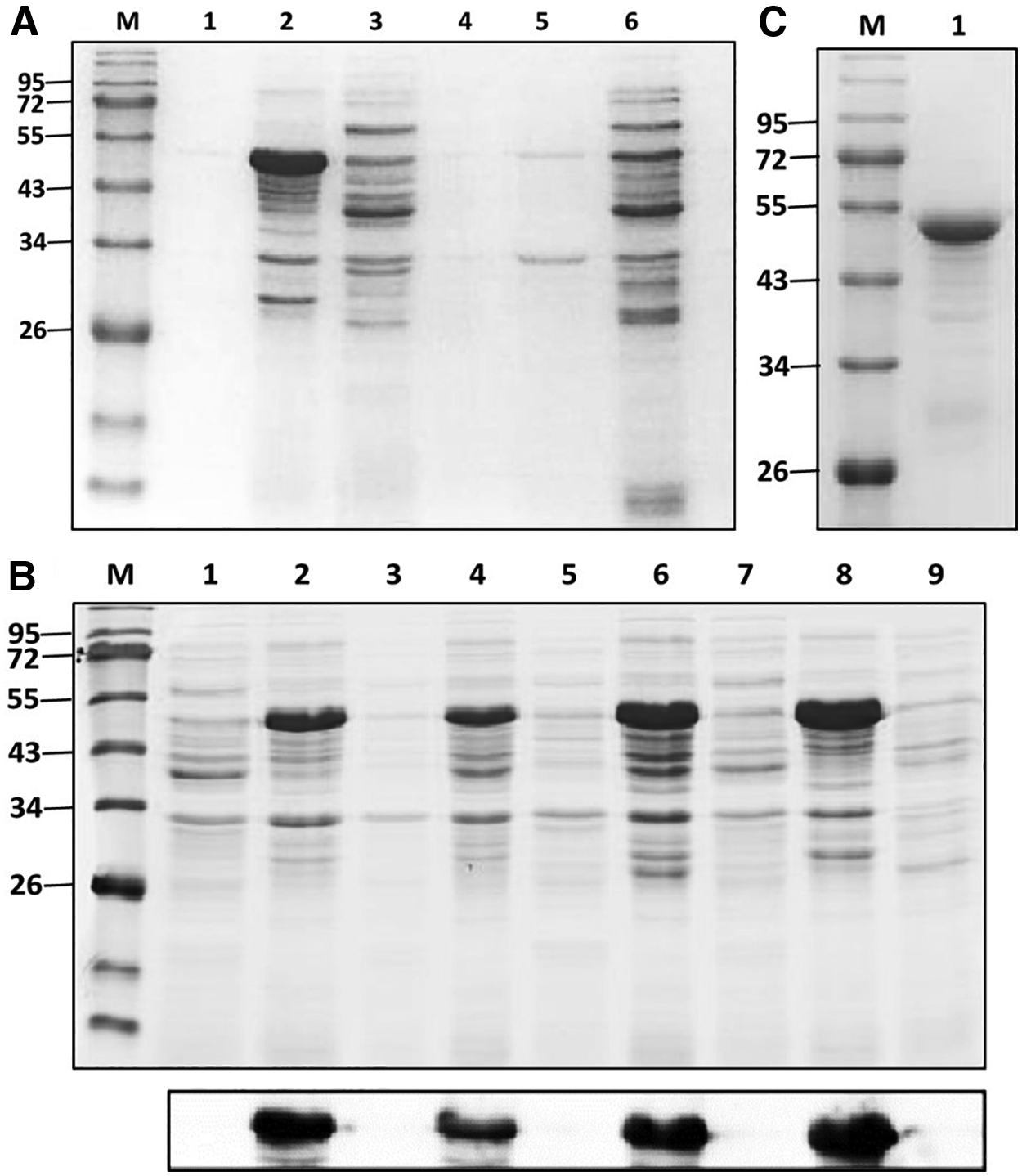
The expression and purification of recombinant protein Gp-300.
Generation of mAbs against EBOV Gp protein
After subcloning four times by limiting dilution and screening, four mAbs (1C4, 2A3, 2G7, and 2H9) against Gp-300 were eventually isolated, and expanded for further characterization.
Indirect ELISA and mAb isotype identification
The titer of mAbs purified from the ascites were determined by indirect ELISA. The mAbs (preprocessed by E. coli lysate) and the normal mouse serum were diluted from 1:1000 to 1:16,384,000. The ELISA titers of 1C4, 2A3, 2G7, and 2H9 were 1:2,048,000, 1:2,048,000, 1:2,048,000, and 1:4,096,000, respectively. The isotypes of these mAbs were all characterized to be IgG1 + Kappa subclass (Table 1).
Detection and Characterization of Monoclonal Antibodies
ELISA, enzyme-linked immunosorbent assay; mAbs, monoclonal antibodies.
Immunofluorescence assay
pcDNA3.1(+)-EBOV-Gp plasmid containing full-length Gp gene was constructed and transfected into 293T cells, four monoclonal antibodies were incubated as primary antibodies and AlexaFluor 488-labeled goat anti-mouse IgG as secondary antibody to conduct IFA. The result showed that all strains of monoclonal antibodies revealed specific green fluorescence, whereas negative control cells did not portray any fluorescence staining (Fig. 2).
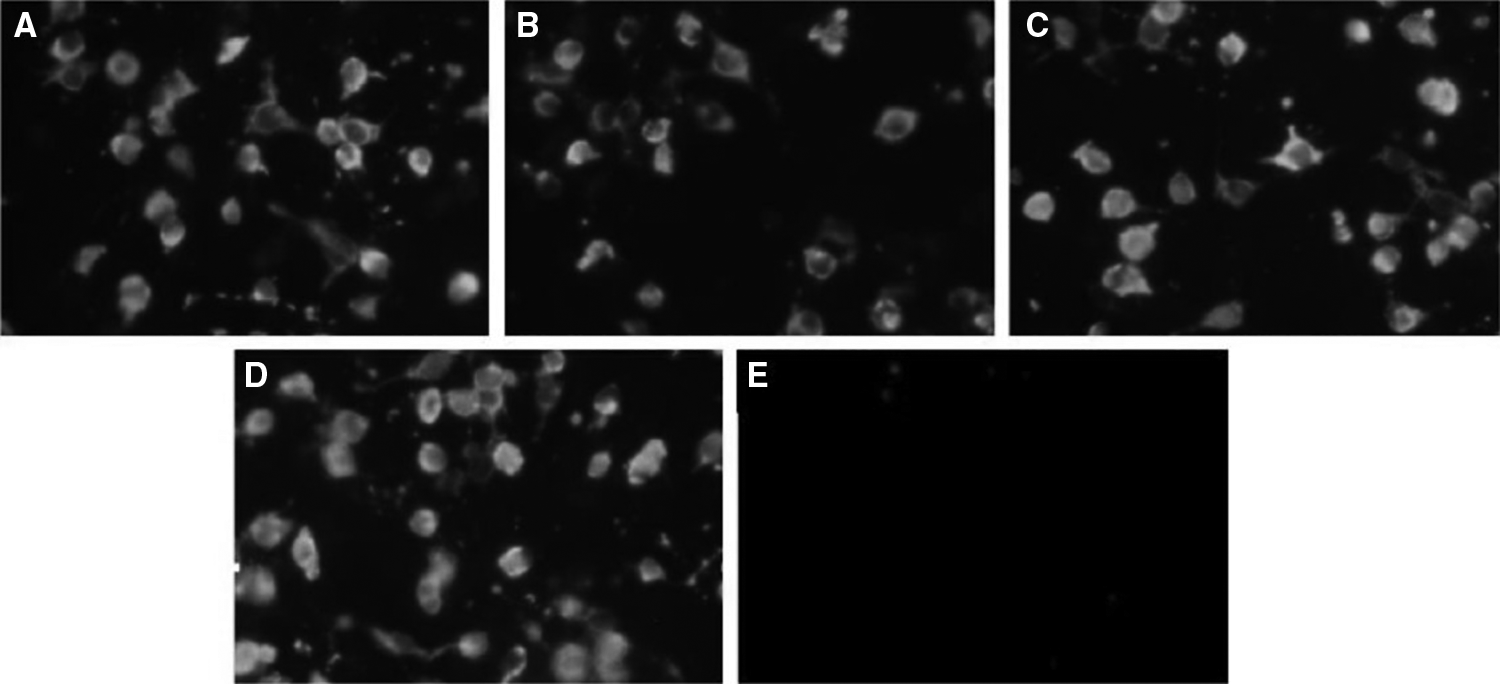
IFA of pcDNA3.1(+)-EBOV-GP plasmid transfected 293T cells with different mAbs. At 36 hours posttransfection, cells were washed with PBS three times and fixed with 100% paraformaldehyde for 10 minutes. After being blocked with PBSA for 30 minutes at 37°C, cells were washed with PBS, reacted with a 1:1000 dilution of mAb for 1 hour, and incubated with AlexaFluor-488 goat anti-mouse IgG (H + L) for another 30 minutes. Cells were then washed three times with PBS and photographed using a fluorescence microscope.
Western blot analysis
The western blot assay was applied to analyze the specificity of produced mAbs. The results showed that all strains of monoclonal antibodies specifically reacted with the pKG-Gp-300 protein, while no reaction was observed with pGEX-KG protein (Fig. 3).
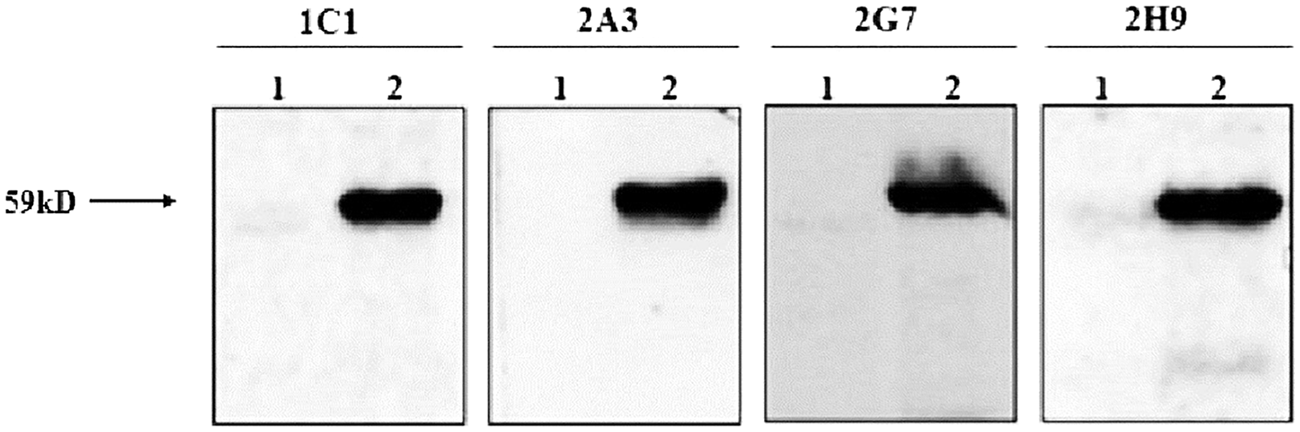
Western blot analysis of monoclonal antibodies against Gp protein. pGEX-KG and pKG-Gp-300 proteins were separated by SDS-PAGE and transferred to nitrocellulose membranes. The membranes were blocked overnight with blocking buffer, then reacted with a 1:1000 dilution of mAbs against Gp protein. Finally, protein bands were visualized by using ECL reagent followed by incubation with HRP-conjugated goat anti-mouse IgG secondary antibody. ECL, enhanced chemiluminescent; HRP, horseradish peroxidase.
Discussion
EVD is a serious infectious disease. It can cause human hemorrhagic fever and multiple organ failure, with a mortality rate from 50% to 90%, and has been listed as one of the most harmful viruses to human beings by the World Health Organization.(11) Although there is no report of EVD epidemic in China, there is still an introduction risk. Therefore, establishment of methods for early and rapid diagnosis of EBOV infection is very important. In this study, purified EOBV Gp protein was used to immunize mice for the production of monoclonal antibodies. Supernatants of hybridoma cultures were screened by enzyme-linked immunosorbent assay, and four mAbs against Gp protein were obtained. All the mAbs showed high specificity in indirect immunofluorescent assays and western blot, which can be used as powerful tools to establish a detection method for EBOV infection.
Gp is the enveloped glycoprotein of EBOV, which is considered to be the most important structural protein of the virus. GP contains the receptor-binding domain, which is responsible for binding to receptors. Gp possesses 54% of EBOV epitopes and has good immunogenicity that can induce the body to produce protective humoral immunity.(12) In addition, Gp can initiate virus invasion, cause vascular injury, and abnormal coagulation function, which was perceived to be involved in viral pathogenesis.(13–15) Although studies on Gp functionality have been widely reported, the in-depth mechanism of GP protein in mediating virus invasion and neutralizing antibody production is still not clear and remains to be improved. In this study, we produced mAbs against Gp of EBOV, which will be used as a powerful tool for studying the functions of Gp protein, and provide new insight into pathogenic mechanisms of EVD.
In this study, we obtained four Gp monoclonal antibodies, all of them can react with both prokaryotic and eukaryotic proteins, with good specificity and reactivity. However, due to the lack of strains and operational restrictions, we could not conduct virus infection experiments, and the reactivity between the obtained monoclonal antibodies and EBOV was still not clear. Meanwhile, whether the obtained antibodies can discriminate the other four subtype strains of EBOV also needs further exploration.
Footnotes
Acknowledgment
This work was supported by the National Program on Key Research Project of China (2016YFD0501102, 2017YFD0501800).
Author Disclosure Statement
No competing financial interests exist.
Funding Information
This article was supported by The National Program on Key Research Project of China (2016YFD0501102, 2017YFD0501803).