




Abstract
Overexpression of human epidermal growth factor receptor 2 (HER2) has been reported in breast cancer, gastric, lung, colorectal, oral, and pancreatic cancers. HER2 expression is associated with poor clinical outcomes. An anti-HER2 humanized antibody, trastuzumab, has improved survival rates in patients with HER2-overexpressing breast and gastric cancers. Previously, we established a novel anti-HER2 monoclonal antibody (mAb), H2Mab-19 (IgG2b, kappa). It has also been characterized for breast, oral, and colon cancers. In this study, we investigated the antitumor activities of H2Mab-19 in pancreatic cancer xenograft models. We selected MIA PaCa-2, a pancreatic cancer cell line which expresses HER2. H2Mab-19 showed high binding affinity (KD: 1.2 × 10⁻⁸ M) against MIA PaCa-2 cells. Furthermore, H2Mab-19 significantly reduced tumor development in a MIA PaCa-2 xenograft model. These results suggest that treatment with H2Mab-19 may be a useful therapy for patients with HER2-expressing pancreatic cancers.
Introduction
Pancreatic cancer is the 11th most common cancer worldwide, and there are an estimated 458,918 new cases and 432,242 deaths each year; it accounted for ∼4.5% of all cancer deaths in 2018.(1) Notably, pancreatic cancer is the seventh leading cause of cancer in both males and females due to the poor prognosis and increasing age of the population. Although surgery with adjuvant chemotherapy, including gemcitabine, is the only viable choice to prolong survival, only 10%–20% of patients with pancreatic cancer have operable cancers at their initial diagnosis, and the recurrence rate remains very high.(2–5) Therefore, the development of new therapeutic approaches is urgently required to improve the outcome of patients with pancreatic cancer.
Overexpression of human epidermal growth factor receptor 2 (HER2) has been reported in breast and gastric cancers and is associated with poor clinical outcomes.(6–8) Trastuzumab and pertuzumab, which are humanized anti-HER2 monoclonal antibodies (mAbs), have been used in the treatment of HER2-positive breast cancer.(9–11) Treatment with trastuzumab resulted in significantly improved survival rates.(12) In comparison to trastuzumab monotherapy, the combination of trastuzumab and pertuzumab with chemotherapy has led to significant improvements in overall survival.(13) Trastuzumab deruxtecan (DS-8201) comprises three components, a novel enzyme-cleavable linker, and a topoisomerase I inhibitor and exerts antitumor activity even in low-HER2-expressing tumors.(14) DS-8201 has several innovative features: (1) a high drug-to-antibody ratio, (2) a tumor-selective cleavable linker, (3) a stable linker-payload in circulation, and (4) a bystander effect.(15)
In our recent studies, a novel anti-HER2 mAb (H2Mab-19; IgG2b, kappa) was developed by immunizing mice with the purified recombinant extracellular domain of HER2.(16) H2Mab-19 showed both antibody-dependent cellular cytotoxicity (ADCC) and complement-dependent cytotoxicity (CDC) against BT-474 (a human breast cancer cell line) and HSC-2 or SAS (human oral cancer cell lines). Furthermore, H2Mab-19 exerted antitumor activities in BT-474, HSC-2, and SAS xenografts, respectively, suggesting that treatment with H2Mab-19 may be a useful therapy for patients with HER2-expressing breast and oral cancers. As HER2 has been seen to be expressed in pancreatic cancers,(17,18) we herein investigated antitumor activities in mouse xenograft models of pancreatic cancers.
Materials and Methods
Cell line
MIA PaCa-2 was obtained from the Cell Resource Center for the Biomedical Research Institute of Development, Aging and Cancer Tohoku University (Miyagi, Japan). MIA PaCa-2 was cultured in DMEM medium (Nacalai Tesque, Inc., Kyoto, Japan), supplemented with 10% heat-inactivated fetal bovine serum (Thermo Fisher Scientific, Inc., Waltham, MA), 100 U/mL of penicillin, 100 μg/mL of streptomycin, and 0.25 μg/mL of amphotericin B (Nacalai Tesque, Inc.) at 37°C in a humidified atmosphere containing 5% CO2 and 95% air.
Animals
All animal experiments were performed by following relevant guidelines and regulations to minimize animal suffering and distress in the laboratory. Animal studies for antitumor activity were approved by the Institute of Microbial Chemistry (Permit number: 2019-021). Mice were monitored for health and weight every 2–4 days. The experiment was conducted over three weeks. A bodyweight loss exceeding 25% and a maximum tumor size exceeding 3000 mm3 were identified as humane endpoints. Mice were euthanized by cervical dislocation, and the death was verified by respiratory arrest and cardiac arrest.
Flow cytometry
MIA PaCa-2 cells were harvested by being exposed briefly to 0.25% trypsin/1 mM ethylenediaminetetraacetic acid (EDTA; Nacalai Tesque, Inc.). After washing with 0.1% bovine serum albumin in phosphate-buffered saline (PBS), MIA PaCa-2 cells were treated with 1 μg/mL anti-HER2 (H2Mab-19) for 30 minutes at 4°C and subsequently with Alexa Fluor 488-conjugated anti-mouse IgG (1:1000; Cell Signaling Technology, Inc., Danvers, MA). Fluorescence microscopy data were collected using an EC800 Cell Analyzer (Sony Corp., Tokyo, Japan).
Determination of the binding affinity
MIA PaCa-2 cells were suspended in 100 μL serially diluted H2Mab-19 (6 ng/mL–100 μg/mL), followed by the addition of Alexa Fluor 488-conjugated anti-mouse IgG (1:200; Cell Signaling Technology, Inc.). Fluorescence microscopy data were collected using an EC800 Cell Analyzer (Sony Corp.). The dissociation constant (KD) was obtained by fitting binding isotherms to built-in one-site binding models using GraphPad PRISM 6 software (GraphPad Software, Inc., La Jolla, CA).
Antitumor activity of H2Mab-19 in the xenografts of pancreatic cancers
Sixteen 6-week-old female BALB/c nude mice were purchased from Charles River and used when they were 7 weeks old. MIA PaCa-2 cells (0.3 mL of 1.33 × 10⁸ cells/mL in DMEM) were mixed with 0.5 mL BD Matrigel Matrix Growth Factor Reduced (BD Biosciences, San Jose, CA), and 100 μL of this suspension (5 × 10⁶ cells) was injected subcutaneously into the left flank. After day 1, 100 μg H2Mab-19 and control mouse IgG (Sigma-Aldrich Corp.) in 100 μL PBS were given an intraperitoneal (i.p.) injection into treated and control mice, respectively. Additional antibodies were then injected on days 6 and 14. Twenty days after cell implantation, all mice were euthanized by cervical dislocation, and tumor diameters and volumes were determined using a method previously described.(19)
Statistical analyses
All data were expressed as mean ± standard error of the mean. Statistical analysis tests—ANOVA and Tukey–Kramer's test were performed using GraphPad Prism 6 software (GraphPad Software, Inc.). p < 0.05 was adopted as the level of statistical significance.
Results
Characterization of H2Mab-19 against a pancreatic cancer cell line
We first measured the surface expression of HER2 by human pancreatic cell line MIA PaCa-2. As expected, H2Mab-19 recognized endogenous HER2 of MIA PaCa-2 cells by flow cytometry (Fig. 1A). We next examined the binding affinities (KD) of H2Mab-19 to MIA PaCa-2, which showed 1.2 × 10⁻⁸ M (Fig. 1B), indicating that H2Mab-19 shows high affinity to HER2-expressing pancreatic cancer cell lines. These results suggest the possibility of targeting HER2 as an antigen for immunotherapy.
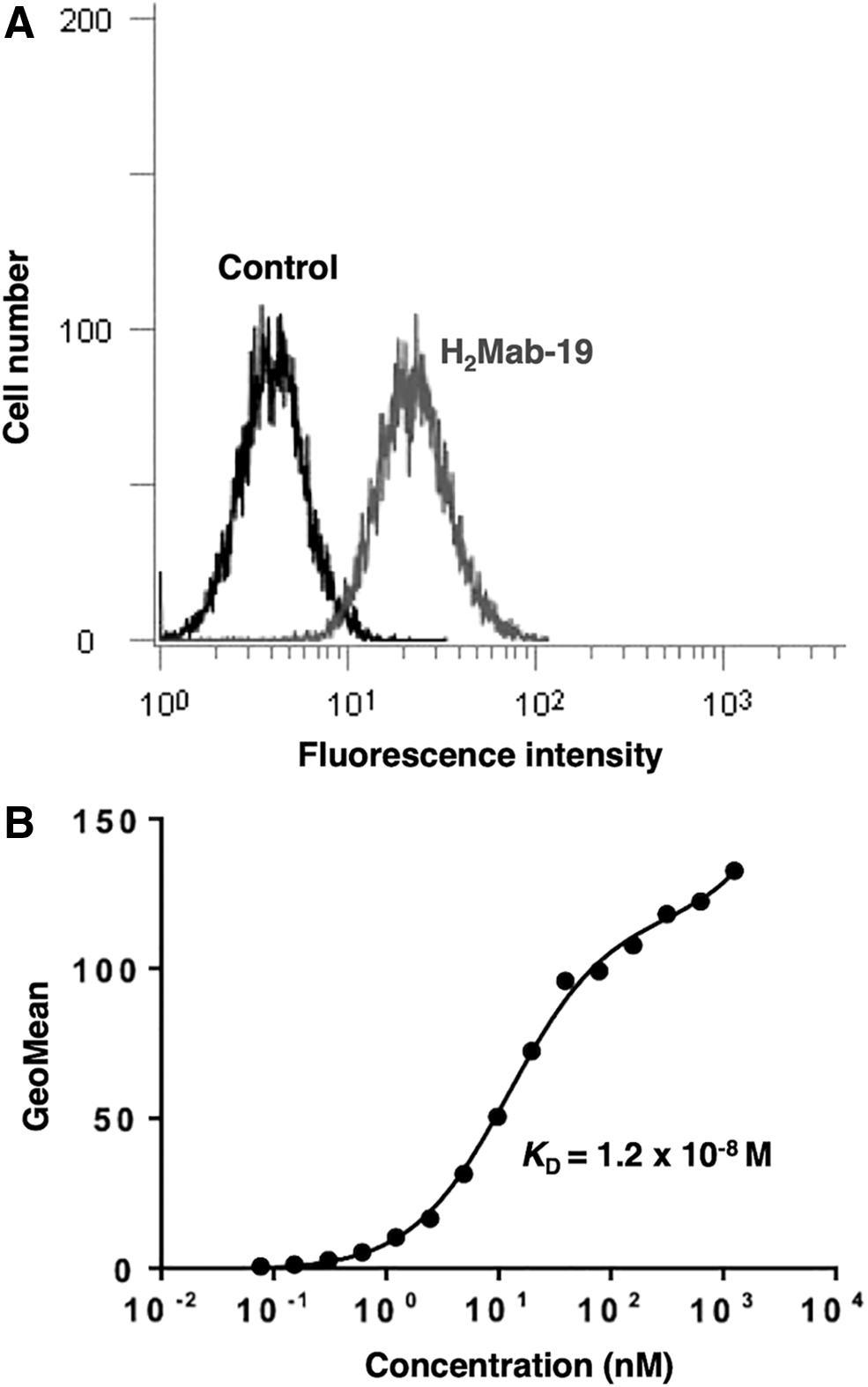
Characterization of H2Mab-19 using flow cytometry
Antitumor activity of H2Mab-19 in mouse xenografts of pancreatic cancers
Next, whether the cancer-cell surface binding of the H2Mab-19 could induce cytotoxic activity against pancreatic cancer was investigated. MIA PaCa-2 cells were implanted subcutaneously in the flanks of nude mice to study the antitumor activity of H2Mab-19 on cell growth in vivo. H2Mab-19 and control mouse IgG were injected (via i.p. administration) three times, on days 1, 6, and 14 (after cell injection) into treated and control mice, respectively. Tumor formation was observed in mice in both H2Mab-19-treated and control groups. H2Mab-19 treatment significantly reduced tumor development compared with tumor development in control mice on days 14, 17, and 20 (p < 0.01; Fig. 2A). Resected tumors are depicted in Figure 2B. Weights of tumors from H2Mab-19-treated mice were significantly less than for tumors from IgG-treated control mice (Fig. 2C). Mice of day 20 are depicted in Figure 3A. The total body weight was not significantly different between the two groups (Fig. 3B). These results indicate that H2Mab-19 exerts a significant antitumor effect against HER2-expressing pancreatic cancers.
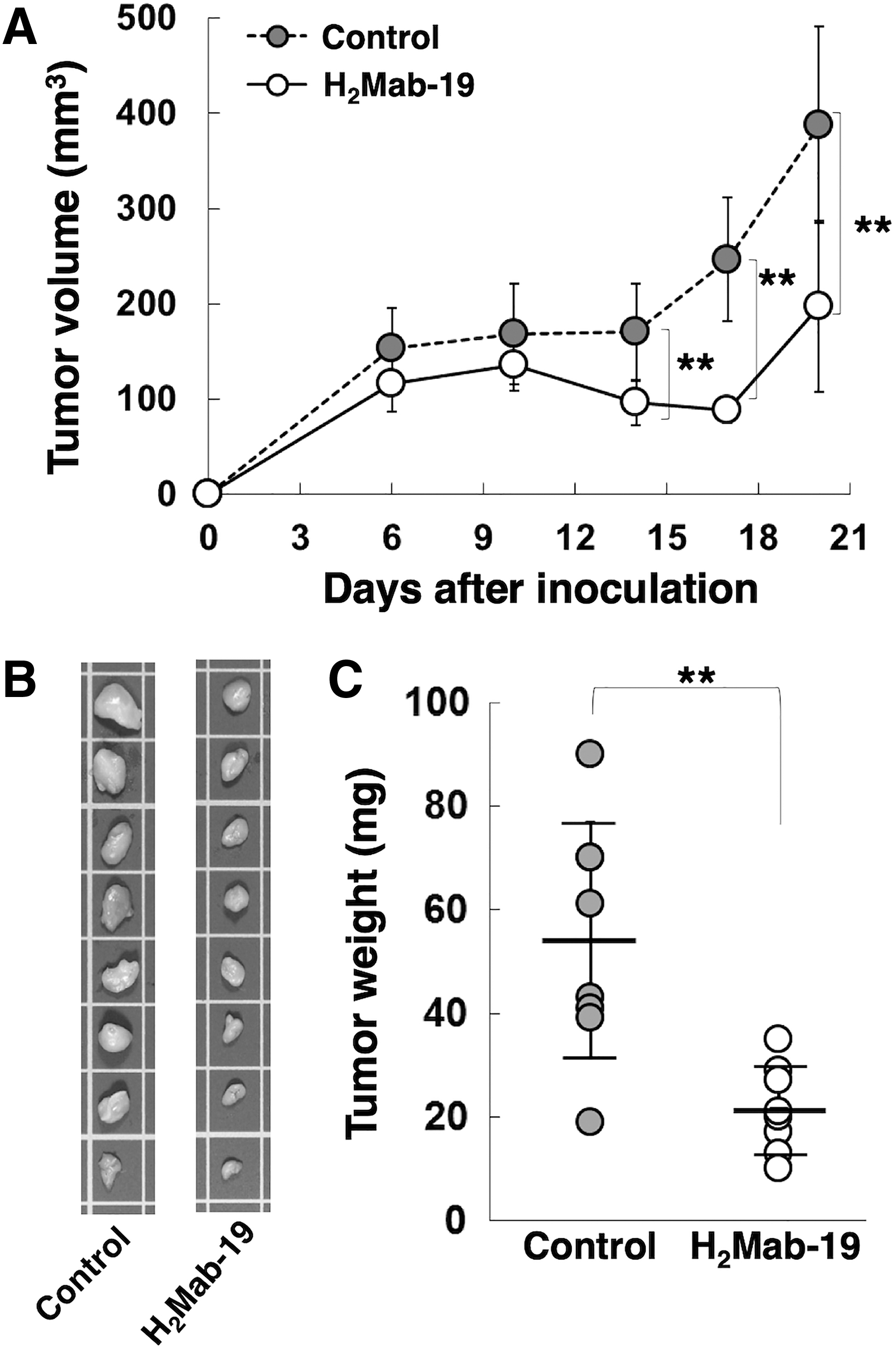
Evaluation of the antitumor activity of H2Mab-19.

Body weights of the mice with the MIA PaCa-2 xenografts.
Discussion
Antibody-based cancer immunotherapies that target tumor-associated antigens and trigger a patient's immune system to attack cancer cells have been developed in the past two decades and have become one of the most promising strategies to treat cancer patients.(20) The majority of antibody-based immunotherapies relies on antibody-mediated recognition of cancer cell surface antigens that are either overexpressed or selectively expressed, compared with healthy cells, to recruit immune effector functions, such as ADCC and CDC.(20,21)
We previously developed an anti-HER2 mAbs, H2Mab-119(18) using CasMab technology.(22) H2Mab-119 is useful for flow cytometry, western blot, and immunohistochemical analyses. The subclass of H2Mab-119 was determined to be mouse IgG1; therefore, H2Mab-119 does not possess ADCC or CDC. We further tried to develop an anti-HER2 mAb of IgG2b subclasses using CasMab technology as mouse IgG2b antibodies show ADCC and CDC activity.(23) A novel anti-HER2 mAb (H2Mab-19) of IgG2b was recently established.(16) H2Mab-19 possesses both ADCC and CDC against human breast cancer or human oral cancer cell lines. Furthermore, H2Mab-19 exerted antitumor activities in breast cancer or oral cancer xenografts. We, therefore, investigated whether H2Mab-19 demonstrates antitumor activities in mouse xenograft models of MIA PaCa-2 as HER2 has been reported to be expressed in pancreatic cancers.(17,18)
Antigen-antibody affinity is thought to be an important factor influencing the outcome of antibody-based therapy.(24) The binding affinity (KD) of H2Mab-19 to MIA PaCa-2 was determined to be 1.2 × 10⁻⁸ M using flow cytometry, indicating that H2Mab-19 shows high affinity to HER2-expressing pancreatic cell lines similarly with the KD of H2Mab-19 to BT-474 (2.3 × 10⁻⁸ M), HSC-2 (9.5 × 10⁻⁹ M), and SAS (5.5 × 10⁻⁹ M).(16)
In this study, we selected a MIA PaCa-2 cell line for in vivo investigation, which was detected by H2Mab-19 in flow cytometry (Fig. 1A). In our previous study, H2Mab-19 treatment significantly reduced tumor development of breast and oral cancer xenograft models compared with development in control mice.(16) H2Mab-19 also exerted the antitumor activity against MIA PaCa-2 xenografts (Fig. 2). Further studies using the other pancreatic cancer xenografts should be performed in the future to confirm that H2Mab-19 could be a useful therapy for patients with HER2-expressing pancreatic cancers.
Footnotes
Acknowledgments
We thank Takuro Nakamura and Akiko Harakawa for technical assistance.
Author Disclosure Statement
No competing financial interests exist.
Funding Information
This research was supported, in part, by AMED under Grant Numbers: JP20am0401013 (Y.K.), JP20am0101078 (Y.K.), and JP20ae0101028 (Y.K.), and by JSPS KAKENHI Grant Number 17K07299 (M.K.K.) and Grant Number 19K07705 (Y.K.).