




Abstract
In this report we provide a hypothesis of how intravenous immunoglobulin (IvIg) (pooled therapeutic normal IgG) mitigates the severe disease after infection with severe acute respiratory syndrome coronavirus 2 (SARS-CoV-2) virus. The disease is caused by an overreaction of the innate immune system producing a cytokine storm and inflicting multiple organ damage. Our interpretation of IvIg therapy hinges on a recent analysis of the immune dysregulation in Covid-19 infection. Previous infections with common cold coronavirus induce suppressor memory B cells that inhibit an immune response to Covid-19. The repertoire of natural antibodies (IvIg) contains suppressing antibodies in a symmetrically balanced network structure. When this repertoire interacts with the imbalanced network in the infected patient, it can neutralize the suppression of an antibody response against Covid-19. The described scenario for IvIg in Covid-19 infection may also apply in the therapy of autoimmune diseases.
Introduction
The experience with severe acute respiratory syndrome coronavirus 2 (SARS-CoV-2) infection has demonstrated a wide spectrum of disease manifestations. Although illness in young children is mild, elderly often develop severe disease with substantial mortality.(1,2) The finding that common cold cross-reacting antibodies are not neutralizing SARS-CoV-2(3) have been discussed earlier with respect to the symmetrical network hypothesis.(4) A variety of therapeutic strategies have been used with limited effectiveness.(5) Thus, it is imperative to better understand the pathology and to find new medicines and improve currently used therapeutics.
One of these approaches is injection of intravenous immunoglobulin (IvIg) to mitigate the disease,(6) supported by recent reports.(7–10) It is commonly accepted that the severity of disease is caused by an overacting immune response producing a cytokine storm.(11) To optimize the immune-modulatory effect a better understanding of how IvIg changes the immune response to the infection would be helpful.
Known Mechanisms of High-Dose IvIg Therapy
A recent review of using IvIg in Covid-19 patients discusses the known mechanisms responsible for the mitigating effect.(12) These studies found that IvIg has to be administered in high dose and early after infection to mitigate the disease. The mechanisms involved can be divided into Fc-mediated and F(ab’)2-meditated pathways. Both mechanisms are direct functions of antibody structures, that is, binding antigen and inducing antibody effector activity. IvIg can neutralize inflammatory mediators and block Fc effector sites.(13,14) (Fab’)2-binding to B cell receptors (BCR) can regulate B cell response and antibody production.(15) Unique structural sites on antibodies and BCRs have been described as “Individual Antigenic Sites,” in a mathematical Ig network and as part of a network of idiotypes.(16–18) In this hypothetical model, we will describe the adaptive immunity as a symmetrical network and how IvIg modulates this network.
Immune Network of Autoantibodies Against BCR
We recently offered a novel concept that describes the structure and function of the immune system.(1) It is based on earlier evidence that the humoral immune response consists of a binary symmetrical antibody response.(19–22) A primary response targets the antigen followed by a secondary wave of antibodies against the antigen-specific BCR of triggered B cells. These observations led to the concept of a symmetrical clonal immune response. The purpose of this system biology is to regulate the immune response preventing out-of-control overreacting immunity. We termed the clones of regulating B cells as Bidregs (B idiotype regulatory cells).(1) Bidregs make reverence to the original idiotype network terminology(23,24) and are different from B cells that have antibody-independent immunoregulating functions.(21,22) Interestingly, the symmetrical response involves also T-helper cells.(23,24)
The paradigm of symmetrical clonality was applied to understand the development of severe Covid-19 disease. The symmetrical control of responses to common cold coronavirus infections creates a memory of Bidregs. Regulating antibodies for common cold antibodies can also target B cells responding to infecting SARS-CoV-2 virus because of their cross-reactive nature. It is important to distinguish cross-reactivity of antinucleocapsid, shared by coronaviruses, and weekly neutralizing cross-reactive antibodies against the spike protein, which are the drivers in the Original Antigenic Sin effect. These were discussed in our earlier publication.(1) These regulating antibodies suppress the Covid-19 response (Fig. 1). Failure of inducing neutralizing antibodies together with antibody dependent enhancement (ADE) increase of virus uptake(25) allowing the virus to replicate. The innate immune system senses danger(21) and launches a cytokine storm. The observed relation of disease severity and strength of neutralizing antibodies(26) is dependent on the dose of infecting virus. Disease severity caused by a cytokine storm precedes the appearance of neutralizing antibodies that are regulated by symmetrical induced Bidregs, acting at elevated level.
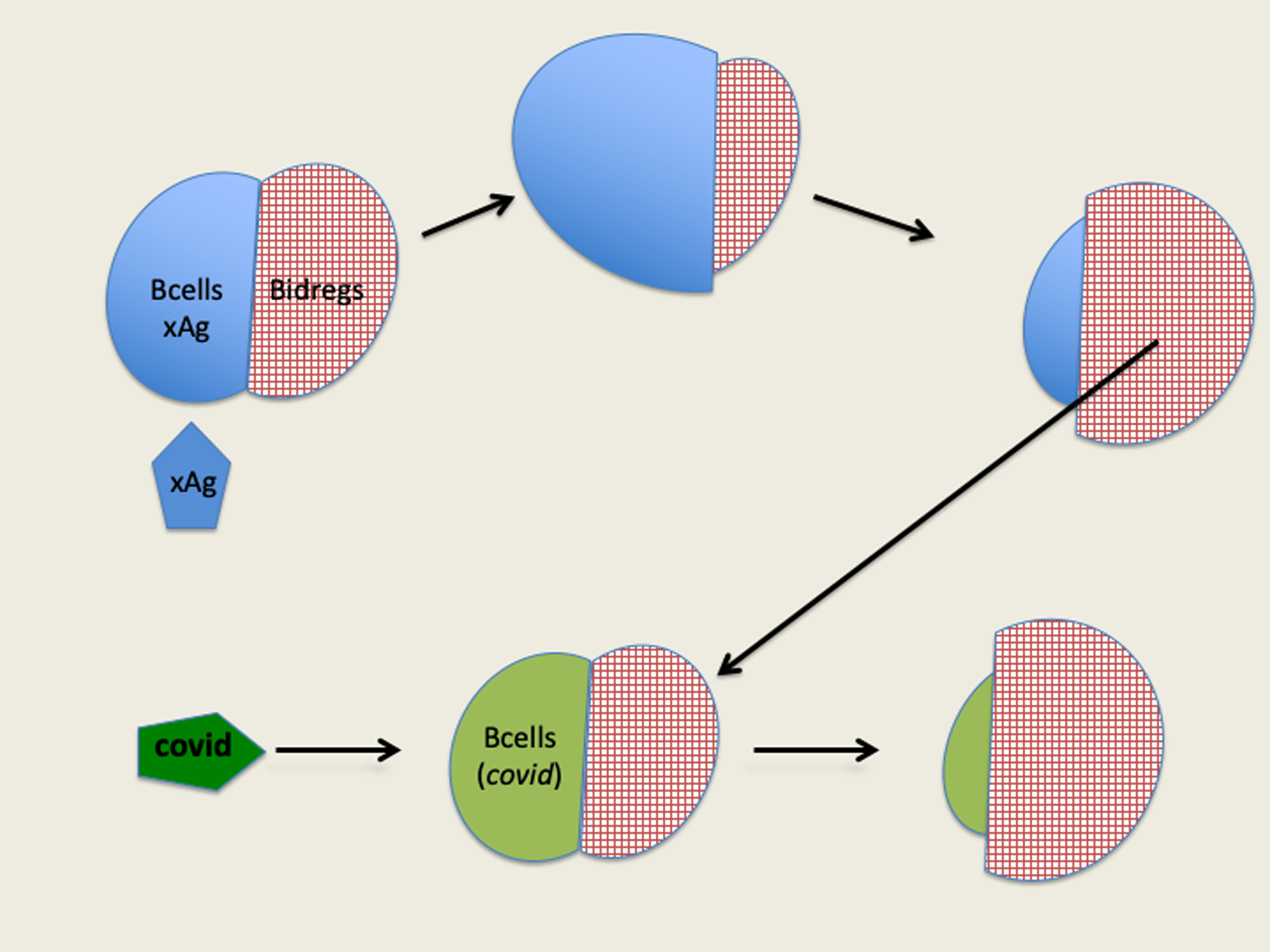
Common cold coronavirus (xAg) infection induces cross-reacting suppressing antibodies that suppress immune response against Covid-19. Light-shaded half circles represent antibodies induced by antigen; cross-pattern shapes designate regulating antibodies produced by Bidregs. These antibodies can suppress the B cells responding to Covid-19 infection.
How Can IvIg Prevent the Cytokine Storm?
The paradigm of a symmetrical immune network posits a balanced response clonality. Inherent in this network is a certain instability allowing antigen-specific activity. An analogy to the cosmic universe mirrored by the instability microwave pattern leading to cosmic energy explosion and expansion maybe helpful. So the question is of how IvIg prevents the immune overreaction?
IvIg is a pool of natural antibodies collected from thousands of healthy donors. Each donor contributes to this pool a balanced individual antibody repertoire. Natural antibodies are mirrors of the symmetrical immune network(27) and the first defense against pathogens produced by B1 cells.(28) IvIg is a pool of normal immunoglobulins from several thousand healthy donors and are generally considered as natural antibodies that represent physiological natural antibody repertoire.
This highly diverse antibody network, when injected into a patient, is superimposed over the patient's infection-induced imbalanced repertoire.
There are good reasons to support the conclusion that the therapeutic potential is mediated by the (Fab’)2 domain of the highly diverse repertoire of IvIg antibodies. For example, to the best of our knowledge, plasma from single donors does not mitigate autoimmune diseases, treatable with IvIg. Furthermore, the percentile small increase of Fc domains with even high dose if IvIg over the concentration of Fc in patients would not account for the proposed competing to Fc receptors.
The highly diverse repertoire of natural antibodies provides binding sites for suppressing antibodies produced in Covid-19 patients by the Bidregs(1) (Fig. 2). The release from suppression allows the immune system to produce virus neutralizing antibodies. The outlined mechanism of IvIg rebalancing provides opportunities for research to confirm or reject the proposed pathway. For example, the proposed symmetrical network involving antibody and anti-Id antibodies, produced by regulatory Bidregs could be studied at a monoclonality level. Monoclonal antibodies rescued by single cell immunoglobulin extraction(29) would support the hypothesis and allow functional and structural studies of the regulatory network.

Restoration of a balanced immune response with IvIg. Exposure of the Covid-19 suppressed response (Bidregs) to the IvIg antibody repertoire neutralizes the suppressing Bidregs through symmetrical B cell clones. Thereby the balance of Covid-19 responding B cells and symmetrical Bidregs is restored, allowing a “normal” antibody response. IvIg, intravenous immunoglobulin.
Conclusion
IvIg has become a proven therapeutic tool to mitigate severe disease inflicted by the SARS-Cov 2 virus. The proposed mechanism, based on a symmetrical immune network, can guide timing and IvIg dose to treat patients. Furthermore, it is feasible to design and manufacture a “synthetic” IvIg using large libraries of human antibody genes. This would create a standardized and reproducible medicine.
Footnotes
Author Disclosure Statement
No competing financial interests exist.
Funding Information
No funding was received for this article.