




Abstract

Recently a new variant of SARS-CoV-2, B1.1.529, is of interest because of its far evolutionary divergence with 37 mutations in the spike and 14 of them in the receptor binding domain (
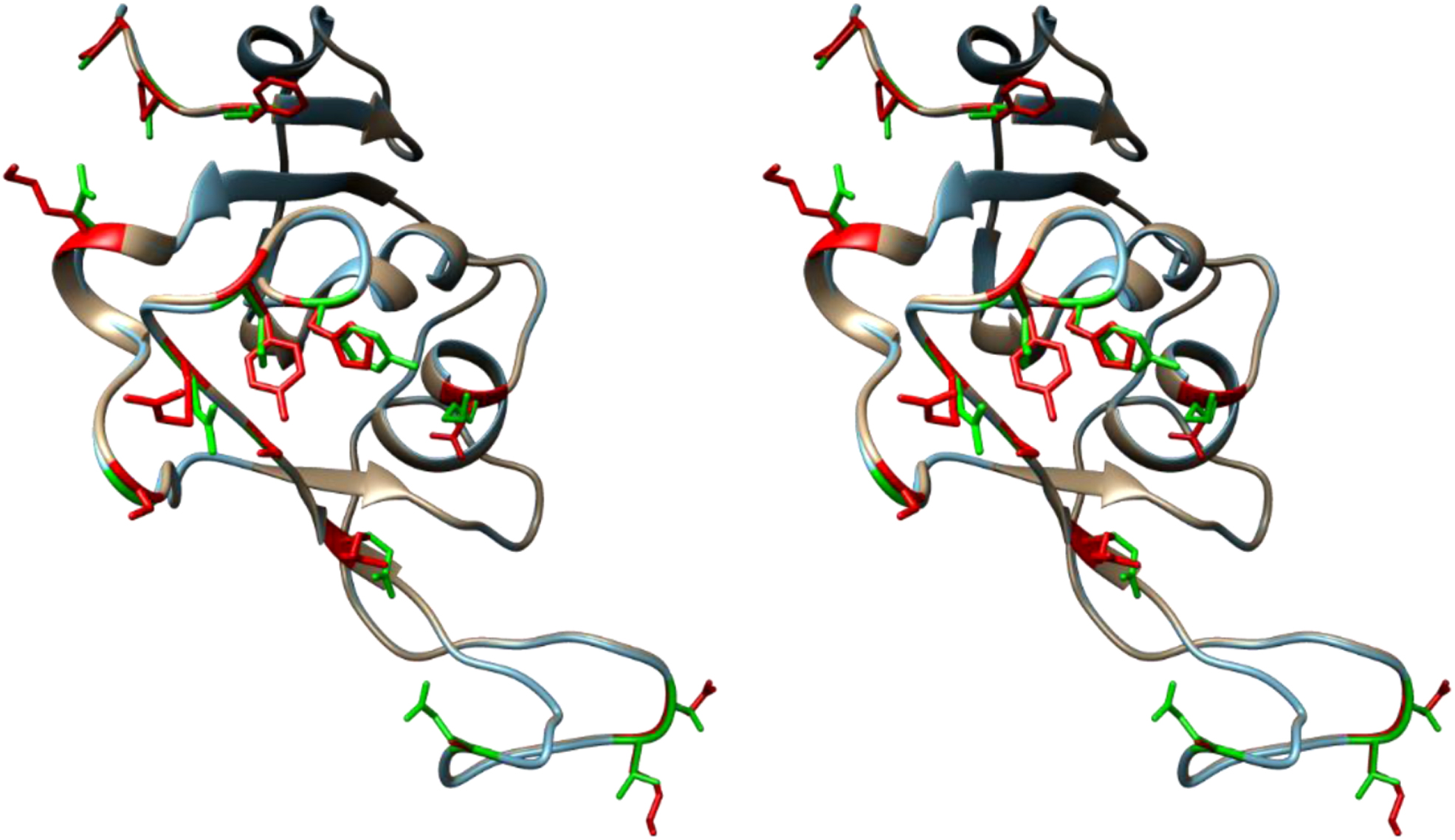
Stereo view of the receptor binding domain in open conformation from the top. The chain A of the 7dk3 structure of the spike of SARS-CoV-2 was used to model the B1.1.529 spike. Green—original sequence, red—B1.1.529 mutations. Overall mutations in the spike: A67V, H69del, V70del, T95I, G142D, V143del, Y144del, Y145del, N211del, L212I, ins214EPE, G339D, S371P, S373P, S375F, K417N, N440K, G446S, S477N, T478K, E484A, Q493R, G496S, Q498R, N501Y, Y505H, T547K, D614G, H655Y, N679K, P681H, N764K, D796Y, N856K, Q954H, N969K, and L981F 529 (
It is the phenomena known as original antigenic sin (OAS) and antigenic seniority that boil down to a suppression of de novo immune response to new (mutated) epitopes in the presence of recall response to other unchanged epitopes.(1–4) Thus, individuals already immune to the previous variants could face a diminished reactivity to the new epitopes. If few neutralizing epitopes remain and the cross-reactivity to the changed epitopes is not sufficient for neutralization, a classic case of OAS may lead to a more severe disease in those with immunity to previous variants compared with the immunologically naive individuals.
Although little can be done to help the already reinfected, the rest could be protected by a vaccine that circumvents the antigenic sin mechanism. It seems that thwarting would require the neoepitope to be presented in the absence of known epitopes and, thus, induce only primary responses. In the case of a cross-reactive epitope that triggers the recall response itself but is not efficiently blocked by the elicited antibodies, there is little to be done. But, overall, it seems that a strategy removing as many of the recall epitopes as possible and focusing only on the highly mutated neutralizing epitopes would be worth trying. This would necessitate introducing the targets into a different molecular context that does not trigger recall responses.
Chimeric molecules based on antibodies have been repeatedly tested in experimental settings, as well as humanizing antibodies have been widely applied as therapeutics. Humanized antibodies have been successfully engineered to carry in their complementarity-determining regions (CDRs) functional hormones(5) as well as antigenic peptides.(6) The self-immunoglobulin molecule presents an immunologically blind spot. Introducing the highly mutated inhibitory epitopes of the target antigens as peptides fused in place of the CDRs can be a way to focus the antibody response to (predominantly) neoepitopes without the interference of recall responses. The already successfully tested mRNA vaccine platform can be easily retuned to delivering such chimeric antibodies.
Such a vaccine should probably be formulated with additional T cell epitopes from the same infectious agent that can be delivered in the same way. The main point is to avoid as much as possible a recall B cell response. Once a primary immune response has been induced and the necessary naive B cell clones are recruited to the repertoire of memory cells, the following booster immunizations may go back to using the full length of the antigen (e.g., the SARS-CoV-2 spike). This strategy draws inspiration from idiotypy although it is not directly related to the putative idiotypic mechanisms.
Alternative strategies have been proposed with the most successful involving the use of strong adjuvants that, possibly, help recruit a wider repertoire of T and B cells in the secondary challenge.(7,8) Use of adjuvants is generally avoided but CpG containing polynucleotides are probably compatible with the mRNA vaccine concept.(9) In any case, the main cause of OAS is the concomitant recall response and adjuvant only based strategies do not address it. The strong OAS consequences to the point of failed boost or deadly secondary infections are not seen so often. Thus, the phenomena in the case of dengue infection have become proverbial but that is about all as far as other infections are considered.
The role of OAS in the great variability in COVID-19 clinical manifestations is suspected but not yet proven.(4) After all flu vaccines are applied to millions of people every year, they are not as efficient as desired but sufficiently so to reduce the burden of the epidemics. As anything biology, there is no clear-cut rule for OAS occurrence and its detrimental effects. Yet, just in case this new omicron variant presents a significant problem because of the degree of its evolutionary distance from the variants to which many of us are already immune to, this new vaccine strategy may be worth considering.
Footnotes
Author Disclosure Statement
No competing financial interests exist.
Funding Information
No funding was received.