




Abstract
Prevalence of serotype 6B penicillin (PEN)-nonsusceptible Streptococcus pneumoniae significantly increased from 15.8% (1993–1997) to 67.3% (1998–2002) (p < 0.001) in Argentina. Serogroup 6 ranks fourth among different capsular types within invasive isolates from Argentinean patients <6 years of age. To evaluate whether the increase in PEN resistance in serotype 6B pneumococci was due to the dissemination of one or more clones, the genetic diversity of 93 S. pneumoniae serotype 6B isolates was analyzed. Five BOX-polymerase chain reaction types were obtained (65.5% isolates) and a group of 15 isolates, representing 41.6% of those having a decreased susceptibility to PEN, were further characterized. The antibiotype of these isolates showed their multiresistance, with 100% of the isolates being resistant to erythromycin, 80% to tetracycline, and 73.3% to trimethoprim–sulfamethoxazole. Of the 15 isolates, 13 belonged to the same pulsed-field gel electrophoresis type and galU cluster and were members of the same clone. The identity of the clone was confirmed in four isolates by multilocus sequence typing. The sequence type found (ST315) corresponds to the Poland6B-20 clone. In summary, BOX-polymerase chain reaction, pulsed-field gel electrophoresis, and galU polymorphism were useful tools to detect the presence of a clone whose identity was confirmed by multilocus sequence typing. The isolates belonging to Poland6B-20 found in this work are described for the first time in Latin America.
Introduction
Worldwide epidemiological studies of pneumococcal resistance have revealed the global dissemination of resistant clones. 17 The Pneumococcal Molecular Epidemiology Network (PMEN) was established in 1997 with the aim of identifying antimicrobial resistant clones of S. pneumoniae. Not long time ago, it had been decided to include major invasive antibiotic-susceptible clones having a wide geographic spread. Currently, 43 internationally disseminated pneumococcal clones have been recognized; interestingly, three PEN-resistant and two PEN-susceptible PMEN clones have been detected in Argentina (www.sph.emory.edu/PMEN). 30
Since 1993, the Pan-American Health Organization has coordinated a surveillance network of S. pneumoniae in Latin American countries. Within this framework, the National Reference Laboratory of Argentina received 1,357 isolates from the Argentinean S. pneumoniae Working Group between 1993 and 2002 with the main objective of studying the prevalence of capsular types and antimicrobial resistance patterns of S. pneumoniae causing invasive infections in children <6 years of age. Surveillance data revealed that type 6B PNSP increased from 15.8% in the period 1993–1997 to 67.3% in 1998–2002 (p < 0.001). Serotype 6B is placed fourth among the capsular types of pneumococci causing invasive diseases in Argentinean patients aged <6 years and has been included in the heptavalent conjugate polysaccharide vaccine recently licensed in Argentina.21,24 Therefore, the aim of our study was to characterize the population of type 6B PNSP strains isolated from pediatric patients in Argentina between 1993 and 2002 with the use of molecular typing methods including BOX-polymerase chain reaction (PCR), pulsed-field gel electrophoresis (PFGE), multilocus sequence typing (MLST), and galU sequencing.
Materials and Methods
Bacterial strains
In the 1993–2002 period, 1,357 pneumococcal isolates were collected from 18 medical centers in the whole country and submitted to Servicio de Bacteriología Clínica, INEI-ANLIS “Dr. C.G. Malbrán.” These isolates were recovered from patients <6 years of age with invasive disease. A total of 93 pneumococcal serotype 6B isolates recovered from blood (66.6%), cerebrospinal fluid (19.4%), pleural fluid (11.8%), bronchoalveolar lavage (1.1%), and joint fluid (1.1%) were studied. These represented all the available isolates of this serotype collected in Argentina from 1993 to 2002. Identification was confirmed on the basis of colony morphology, Gram staining, susceptibility to optochin, and the bile solubility test. Serotyping was performed by the capsular swelling method (Quellung reaction) using sera combined in pools and confirmed with individual specific antisera purchased from the Statens Serum Institut. Demographic data collected during the study included the patient's age, the infection type, the culture source, and the date of sample collection (Table 1).
PCR, polymerase chain reaction; PEN, penicillin; MIC, minimal inhibitory concentration; NR, no resistance; SXT, trimethoprim–sulfamethoxazole; TET, tetracycline; CXM, cefuroxime; CHL, chloramphenicol; ERY, erythromycin; NG, not grouped. Box, Repetitive sequences in S. pneumoniae DNA.
Susceptibility testing
Minimal inhibitory concentration (MIC) was determined by the agar dilution procedure using Mueller-Hinton agar (Difco) supplemented with 5% lysed horse blood and incubated overnight at 35°C, using the isolate S. pneumoniae ATCC 49619 as control. MIC values to PEN, cefuroxime, ERY, chloramphenicol, TET, and trimethoprim–sulfamethoxazole (SXT) were interpreted according to the Clinical and Laboratory Standards Institute guidelines. 4 Isolates were classified as PEN susceptible (MIC ≤ 0.06 mg/ml) or PEN nonsusceptible (MIC ≥ 0.12 mg/ml).
Genetic relatedness
Chromosomal DNA extraction and BOX-PCR were performed as previously described.15,20 BOX-PCR types were defined using Bionumerics software (version 3.0; Applied Maths). The dendrogram was generated from a similarity matrix calculated with the Jaccard coefficient, applying a 2% tolerance in band position, and patterns were clustered with the unweighted pair group method with arithmetic mean. S. pneumoniae R6 was used as internal marker. A similarity of 70% was used to define a cutoff for BOX-PCR types.
PFGE 16 using SmaI was performed for 14 isolates of the main BOX-PCR type. The dendrogram was constructed by unweighted pair group method with arithmetic mean and with the Dice similarity coefficient, applying a 1.5% tolerance in band position. A similarity of 80% was used as the appropriate cutoff value to define a PFGE pulsotype; PFGE subtype within a pulsotype was defined at 85% similarity level. PFGE types were coded with capital letters and subtypes by using capital letters with numerical subscripts.
Polymorphism of the galU gene was used to explore phylogenetic relationships among S. pneumoniae isolates. 18 The nucleotide sequences of a 590-bp PCR-amplified fragment obtained from selected isolates were analyzed using the Clustal W multiple sequence alignment program 27 (www.ebi.ac.uk/clustalw/) to calculate a neighbor-joining phylogenetic tree. 25
MLST was performed for selected pneumococcal isolates according to the standard procedure involving the amplification of seven housekeeping genes, as proposed by Enright and Spratt. 7 The sequence types (STs) obtained were compared with those available at the MLST database (www.mlst.net). 17 The reference isolate of the Poland6B-20 clone (ATCC BAA-612) was included for MLST and analysis of galU polymorphism.
Nucleotide sequence accession numbers
The nucleotide sequences determined were deposited in the EMBL/GenBank/DDBJ databases under accession numbers GU721112–GU721125.
Results
Serotyping and antibiotic resistance
During the study period, 1,357 invasive isolates collected from children under 6 years of age were studied at the National Reference Laboratory. Serotyping results indicated that serotype 14 was the most common, followed by serotypes 5, 1, 6B, and 7F, in descending order of frequency, and below 5% of frequency were 9V, 19A, 18C, 23F, 19F, 6A 3, and 9N. A total of 93 S. pneumoniae 6B isolates were recovered from 1993 through 2002. Six of 38 collected between 1993 and 1997 were PNSP, whereas 37 of the 55 isolates from the second period (1998–2002) also corresponded to PNSP. There was a significant increase (15.8%–67.3%; p < 0.001) in the frequency of PNSP during the last 5 years of the study (Fig. 1). Seventeen PNSP (45.9%) and one PEN-susceptible isolate (2.7%) recovered in the second period were found to be resistant to, at least, two antibiotics (regardless of PEN resistance/susceptibility). Ten isolates were resistant to ERY, TET, and SXT; this antibiotype had not been detected before 1999 among S. pneumoniae serotype 6B isolates.
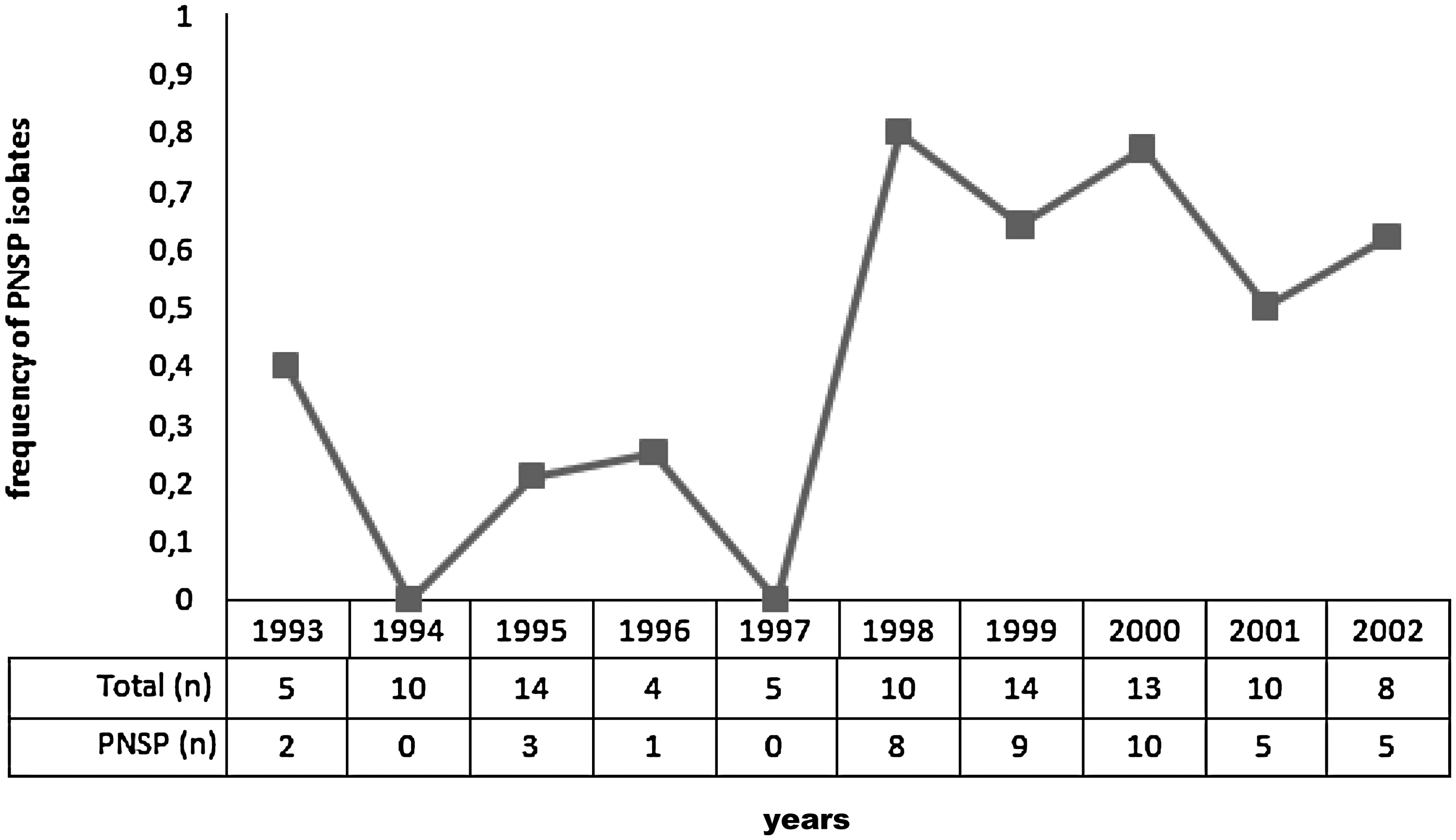
Frequency of PNSP 6B isolates in Argentina from 1993 to 2002. PNSP; penicillin-nonsusceptible Streptococcus pneumoniae.
BOX-PCR types
Figure 2 shows a dendrogram illustrating the genetic relatedness of the 93 S. pneumoniae isolates on the basis of BOX-PCR analysis. Five major BOX-PCR types (designated as I to V) accounted for 65.6% of the isolates (n = 61). The remaining 32 isolates presented unrelated profiles. BOX-PCR-I included 19 isolates, 8 of which were PNSP isolated between 1998 and 2002. BOX-PCR-II was shared by five PNSP isolates and a single PEN-susceptible isolate. BOX-PCR-III (15 isolates) and BOX-PCR-IV (5 isolates) mainly included PEN-susceptible isolates. Only one PNSP was detected in each group. BOX-PCR-V was defined by 16 isolates, 15 of which corresponded to the 1998–2002 period and showed resistance to PEN and ERY; the 10 isolates resistant to ERY, TET, and SXT described above belonged to this group. The single PEN-susceptible isolate (APN59) was recovered in 1994. Finally, half of the 32 isolates whose patterns were unique (similarity <70%) corresponds to PNSP isolated in the last 5 years of this study.
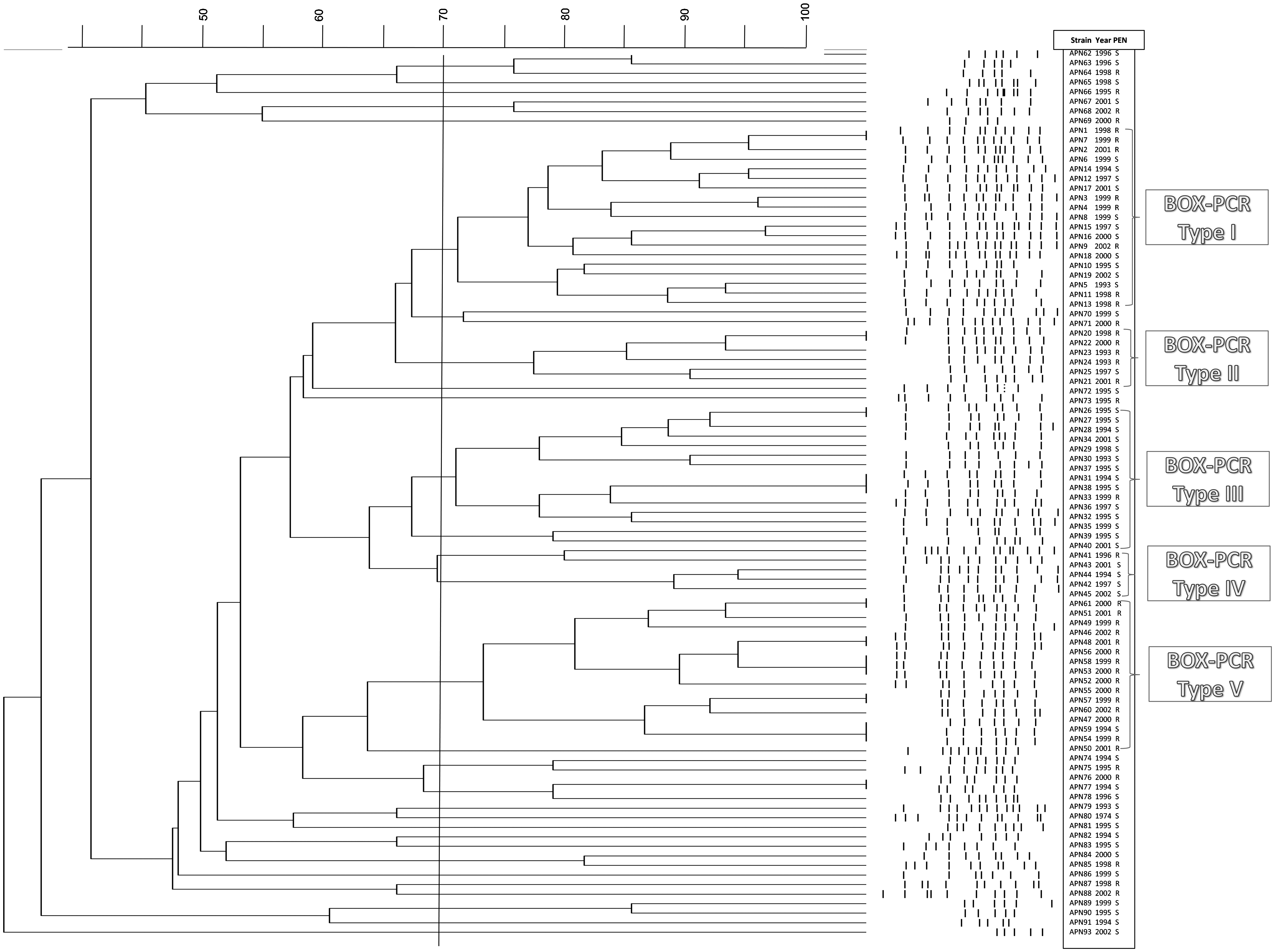
Dendrogram depicting genetic relatedness of 93 S. pneumoniae serotype 6B isolates on the basis of BOX-PCR results. Types I to V containing isolates of ≥70% similarity in their banding patterns are indicated. Strain number, year of isolation, and PEN susceptibility are indicated on the right. S, fully susceptible; R, decreased susceptibility; PCR, polymerase chain reaction; PEN, penicillin; BOX, Repetitive sequences in S. pneumoniae DNA.
PFGE, galU sequencing and MLST of BOX-PCR-V isolates
As mentioned earlier, clustering of the BOX-PCR profiles from 93 pneumococcal isolates showed that type V is the main cluster and includes PNSP from the 1998–2002 period (plus an additional isolate recovered in 1994). Fourteen type V isolates were available for PFGE analysis and galU sequencing. Three PFGE pulsotypes (level of similarity on the dendrogram ≥80%) were found (Fig. 3). Pulsotype A included 12 PNSP from the 1998–2002 period and could be divided into two related subtypes, A1 and A2 (85% similarity). Pulsotypes B and C included only one isolate each (APN49 and APN59, respectively). The latter strain was the single PEN-susceptible isolate that was recovered in 1994 (see above).
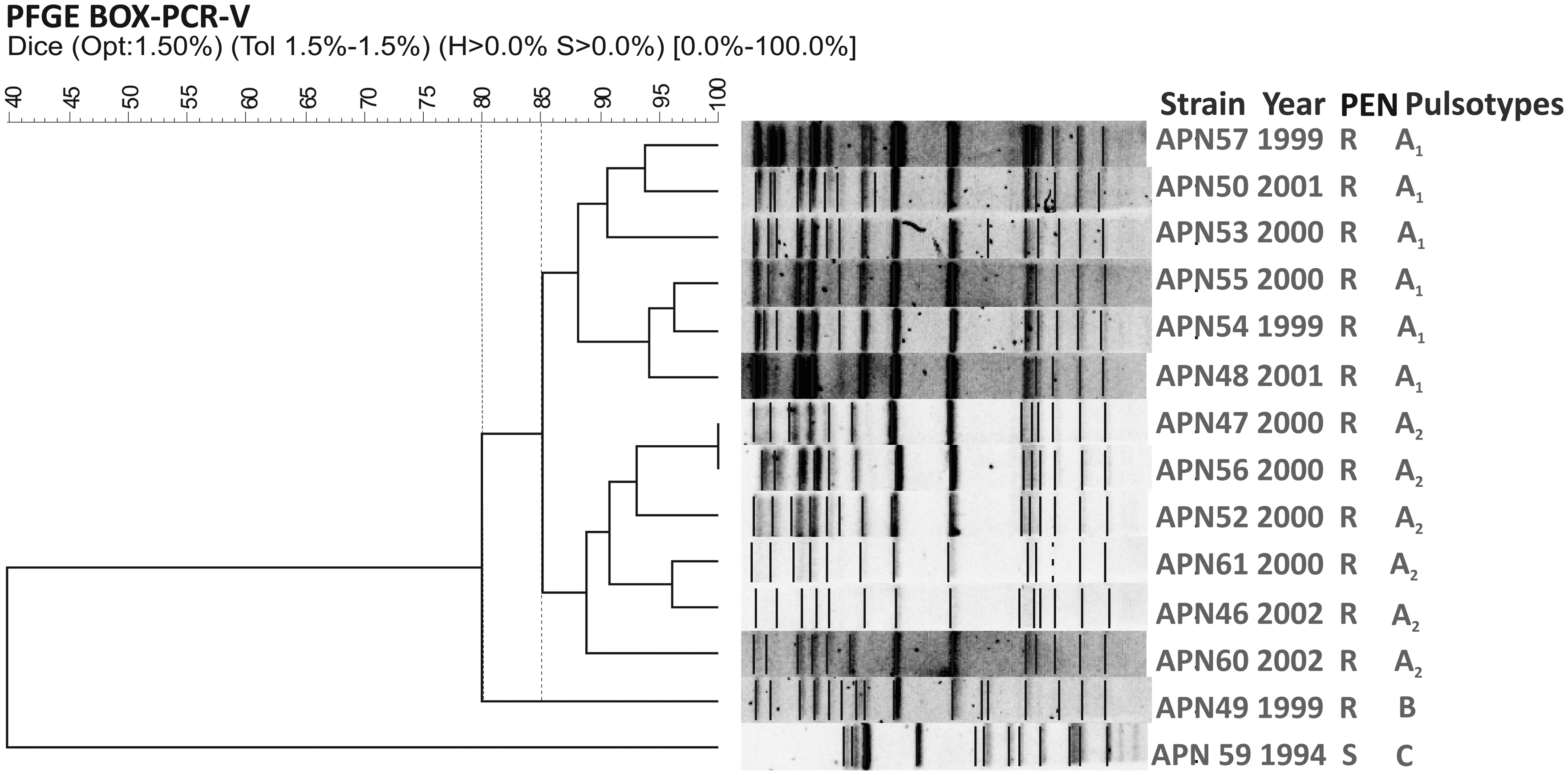
PFGE of SmaI-digested DNA and dendrogram of 14 S. pneumoniae isolates clustered as BOX-PCR type V. The relatedness between isolates was estimated on the basis of the proportions of shared bands. Strain number, year of isolation, and PEN susceptibility are indicated on the right. PFGE, pulsed-field gel electrophoresis.
A partial nucleotide sequence of the galU gene (590 bp corresponding to codons 52–248) was determined for the 14 BOX-PCR-V isolates. Strains of pulsotypes A (n = 12) and B (n = 1) have an identical galU allele (galUA1), with the notable exception of APN52 (pulsotype A2), which contains a different allele (galUA2) having a synonymous transversion at codon 237. The single PEN-susceptible isolate APN59 harbors a galU allele (galUC) that differs at nine nucleotide positions (three synonymous transversions and six synonymous transitions) of galUA1 (data not shown).
PFGE results were used to select four individual isolates for MLST analysis. These included two representatives of pulsotypes A1 (APN54 and APN57), one isolate of pulsotype A2 (APN47), and a single isolate of pulsotype C (APN59). It could be found that the ST of the isolates of pulsotype A (ST315) corresponds to that of the multidrug-resistant Poland6B-20 clone (strain ATCC BAA-612). 25 In addition, the galUBAA-612 allele was identical to the aforementioned galUA1 allele (data not shown). On the other hand, the allelic profile of the APN59 isolate (2, 25, 78, 4, 15, 20, 14) do not correspond to a described ST.
Discussion
This study provides useful information on the spread of an international clone within the Argentinean pneumococcal population. As previously reported, S. pneumoniae serotype 6B is one of the most frequent causes of invasive disease in Latin American children younger than 6 years of age.6,9,24 The high genetic diversity detected by BOX-PCR may be explained considering that this serotype is frequently isolated from healthy carriers.10,23,26,30 This study shows that the increase in PEN nonsusceptibility in serotype 6B from 15.8% (1993–1997) to 67.3% (1998–2002) may be partly explained by the appearance of the Poland6B-20 clone, which is a PMEN clone not previously described in Argentina. Moreover, the detection of PFGE subtypes suggests that horizontal transfer or differentiation events had occurred after the common lineage became established. Dissemination of this clone may be traced through demographic data, as isolates representatives of the clone have been recovered in different regions of Argentina. It is important to point out that the expansion of this clone is also responsible for the ERY resistance emergence in S. pneumoniae serotype 6B.
BOX-PCR typing is a rapid molecular method that is appropriate for the investigation of genetic relatedness of pneumococcal strains. 28 PMEN has included this technique in the guidelines for the recognition of pneumococcal clones. 17 In this study, BOX-PCR-V clustered 14 strains of the Poland6B-20 clone and also an unrelated PEN- and ERY-susceptible isolate (APN59). This isolate does not belong to that clone, as corroborated by PFGE and MLST.
In a previous work, we had postulated that the galU gene encoding the S. pneumoniae UDP-glucose pyrophosphorylase is absolutely required for the synthesis of the capsular polysaccharide and represents an informative marker to be used alone or in conjunction with other molecular typing methods.18,19 In this work, we were interested to know whether galU sequencing would be used as a tool to discriminate within the set of 14 isolates of this clone. The results obtained in this study were similar to those obtained using the MLST scheme. Further evidence, including a higher number of isolates, should be necessary to confirm that galU sequencing could be used as a molecular typing method with similar results to MLST. The nucleotide differences among galUA1 and galUA2 alleles are silent and, consequently, do not produce changes in the primary structure of the protein being evolutionary neutral. Besides, it is interesting to notice that the unique strain (APN52) that presented the galUA2 allele was clustered in PFGE subtype A2 with other strains that harbored the galUA1 allele, showing the different discriminatory powers of PFGE and galU sequencing in establishing evolutionary events between isolates.
It is important to determine the degree of dispersion of the Poland6B-20 clone throughout Latin America, especially in countries where pneumococci of this serotype are frequently isolated. Surveillance of resistant clones, an extensive use of successful vaccines that interrupt carriage, and rational treatments are decisive strategies in the control of antimicrobial resistance in S. pneumoniae.
Footnotes
Acknowledgments
This research was partly supported by grants from Universidad de Buenos Aires (UBACyT B034), Agencia Nacional de Promoción Científica y Tecnológica (ANPCYT), and the Novel Targets to Combat Bacterial Pathogens (COMBACT) program (S-BIO-0260/2006) of the Comunidad de Madrid (Spain). Centro de Investigación Biomédica en Red de Enfermedades Respiratorias (CIBERES) is an initiative of the ISCIII. M.M. and L.B. are members of “Carrera del Investigador,” Consejo Nacional de Investigaciones Científicas y Técnicas (CONICET), Argentina. We acknowledge the use of the pneumococcal MLST database located at the Imperial College, London, and funded by the Wellcome Trust.
Disclosure Statement
No competing financial interests exist.