




Abstract
Abstract
Methicillin resistance in staphylococci is conferred by the acquisition in its chromosome of the mecA gene, which is located on a mobile genetic element called staphylococcal cassette chromosome mec (SCCmec). Genetic type of SCCmec is defined by combination of mec gene complex class and cassette chromosome recombinase gene (ccr) allotype. In this study, we analyzed genetic diversity of the SCCmec in 11 Staphylococcus haemolyticus strains and a Staphylococcus sciuri strain, which were recently isolated from clinical specimens in Bangladesh. Among these strains, only two S. haemolyticus strains were proved to have the known types of SCCmec, that is, SCCmec V (class C2 mec–ccrC) and VII (class C1 mec–ccrC). Five S. haemolyticus strains were assigned two unique mec–ccr gene complexes combination; that is, class C1 mec–ccrA4B4 (four isolates) and class A mec–ccrC (one isolate). In the remaining four S. haemolyticus strains with class C1 mec, no known ccr allotypes could be detected. A single S. sciuri strain with class A mec complex carried a ccrA gene belonging to a novel allotype designated ccrA7, together with ccrB3. The ccrA7 gene in the S. sciuri strain showed 61.7%–82.7% sequence identity to the ccrA gene sequences published so far, and 75.3% identity to ccrA3, which is a component of the type 3 ccr complex (ccrA3-ccrB3) in methicillin-resistant Staphylococcus aureus. The results of the present study indicated that mec gene complex and ccr genes in coagulase-negative staphylococci are highly divergent, and distinct from those of common methicillin-resistant S. aureus. Identification of the novel ccrA7 allotype combined with ccrB3 suggested an occurrence of recombination between different ccr complexes in nature.
Introduction
Methicillin resistance in Staphylococci is caused by the acquisition of mecA, which encodes an additional altered low-affinity penicillin-binding protein (PBP2a), 29 and is located on a mobile genetic island, termed the staphylococcal cassette chromosome mec (SCCmec). 21 SCCmec is integrated at the 3′ extremity of orfX, 19 a gene of unknown function existing near the chromosomal origin of replication, in MRSA and in MR-CoNS. The SCCmec, which varies in size and genetic structure, carries two essential components: the mec gene complex and the cassette chromosome recombinase (ccr) gene complex. The mec gene complex consists of mecA, its regulator genes, and associated insertion sequences, whereas the ccr gene complex is composed of recombinase genes and surrounding ORFs. Eight different SCCmec types (I–VIII) have been identified to date in MRSA, and are categorized by different sets of the mec gene complex (A, B, C) and ccr gene complex (types 1–4, i.e., ccrAB1 to ccrAB4, respectively, and type 5, i.e., ccrC).4,17,18,31,40
Several studies reported the higher structural heterogeneity of SCCmec elements in MR-CoNS clinical isolates compared with those carried by MRSA. Many MR-CoNS isolates cannot be assigned to any of the eight SCCmec types defined so far in MRSA mainly owing to the following three reasons: a new combination of mec complex and ccr complex that had not been reported in MRSA, no polymerase chain reaction (PCR) amplification from ccr gene, and presence of more than one ccr gene complex.2,9,11,12,16,30,33,38 Previous reports indicated that ccr gene complex harbors more diversity than mec complex with untypeable and/or multiple ccr allotypes.11,33 Further, extra ccr allotypes have been reported from some MR-CoNS strains.6,13,27
Although the origin of SCCmec remains unknown, it has been suggested that SCCmec can be horizontally transferred between staphylococci. 1 MR-CoNS in the community is considered to act as reservoir of resistance genes not only for methicillin3,10,30,37 but also for other antibiotics, because many other resistance genes were encoded on SCCmec found in MR-CoNS.8,15,35,36 Whereas distribution of SCCmec has been vigorously studied on S. aureus, little is known about genomic structure of SCCmec in MR-CoNS.
In the present study, we examined the distribution of SCCmec types in hospital-acquired MR-CoNS strains recently collected in Bangladesh. During the course of study, we identified a novel type of ccr complex with a novel ccrA allotype, as well as novel combinations of mec gene and ccr gene complexes representing putative new SCCmec types.
Materials and Methods
Bacterial isolates
A total of 12 MR-CoNS were isolated from clinical specimens of patients admitted to the Mymensingh Medical College hospital in Bangladesh from August 2008 to January 2009. These strains were cultivated on tryptone soy agar containing 5% sheep blood (Beckton and Dickinson) at 37°C for 24 hr. Staphylococcal isolates were identified for their species morphologically and biochemically with use of BD BBL CRYSTAL (Becton, Dickinson and Company). For further confirmation, partial sequencing analysis of the 16S rRNA gene was carried out with use of Stap756-F and Staph750-R. 39
Susceptibility testing to oxacillin
The minimum inhibitory concentration (MIC) for oxacillin was determined by using broth microdilution method according to National Clinical and Laboratory Standard Institute (CLSI) guidelines. 5 The MIC was recorded as the lowest concentration of oxacillin that completely inhibited growth.
Determination of SCCmec type
Each strain was determined for its SCCmec types by multiplex PCR as described previously20,25 with minor modifications. Briefly, genomic DNA was isolated from cultured bacterial cells with the use of achromopeptidase. 14 MecA gene complex was identified by PCR with primer mixture containing mA7, mI6, mDA2, 24 and ISF4. ISF4 was newly designed inside the IS431 gene. Gene targets for each primer pair are as follows: mA7 and mI6 target class A mec; mA7 and mDA2 target class B mec; mA7 and ISF4 target class C1 mec; and mA7 and IS2 target class C2 mec. The PCR for the assignment of ccr1, ccr2, ccr3, and ccr5 (ccrC) gene complex was performed as described in the previous reports.20,25 Primer sets for ccr4 and SCCmercury were newly designed in this study. All the primers used are listed in Table 1.
ntd, nucleotide; PCR, polymerase chain reaction; SCCmec, staphylococcal cassette chromosome mec.
Characterization of cassette chromosome recombinase genes
Genomic DNA was prepared from bacterial strains with Qiagen Dneasy tissue kit, and amplified using PrimeSTAR GXL (Takara Bio Inc.) according to the manufacture's instruction. PCR products were purified with AGENCOURT® AMPure® XP (Beckman Coulter) and sequenced using the Applied Biosystems Big-Dye terminator sequencing kit (Applied Biosystems) and ABI3310 automated DNA sequencer (Applied Biosystems). Genetyx Version 5.1 (Software Development) was used to perform pairwise alignment and calculate sequence identity of ccr genes from different strains. Sequence homology and identity comparison to other sequences was performed with the DDBJ BLAST sequence search (www.ddbj.nig.ac.jp/Welcome-j.html) or NCBI BLAST sequence search (www.ncbi.nlm.nih.gov). Sequenced ccr gene complexes including the possible novel ccr allotype were compared with 13 known ccr allotypes: ccrAB1 NCTC10442 (GenBank accession no. AB033763), 45394F (GU122149), TSU33 (AB353724), MSSA476 (BX571857), and ATCC15305 (AP008934); ccrAB2 N315 (NC002745); ccrAB3 85/2082 (AB014436); ccrAB4 HDE288 (AF411935), ATCC12228 (BK001539), CHE482-1 (EF126185), and CHE482-2 (EF126186); ccrA5B3 KM241 (AM904731) and H9 (EU934095). Phylogenetic trees of ccr genes were constructed using the neighbour-joining methods of MEGA software (version 4.1). The topology of the phylogenetic trees was evaluated by bootstrap analyses with 1,000 replicates to give the degree of confidence intervals for each node as indicated on the phylogenetic trees.
GenBank accession numbers
The nucleotide sequences and annotations of the novel ccr gene, ccrA7B3, and a ccrA4B4 found in the present study have been deposited in the GenBank database under accession number AB587080 and AB587081, respectively.
Results and Discussion
Isolation, identification, and type assignment of the SCCmec type in CoNS isolates
Twelve MR-CoNS isolates were identified as S. haemolyticus (11 strains) and Staphylococcus sciuri (one strain). Results of the SCCmec typing by multiplex PCR and sequencing analysis for the 12 strains are summarized in Table 2. In SCCmec typing by multiplex PCR, two S. haemolyticus strains, MCS22 and MCS25, were assigned to VII (class C1 mec–ccrC) and V (class C2 mec–ccrC), respectively. On the other hand, the SCCmec carried by remaining 10 strains could not be classified by the multiple PCR approach. In 5 of the 10 strains, 2 unique/new combinations of mec-ccr gene complexes were identified. One S. haemolyticus strain MCS12 harbored class A mec gene complex and type 5 ccr gene (ccrC), which has been reported in some MR-CoNS strains,2,11,16,33 but not in S. aureus. Strains MCS11, 13, 15, and 34 carried class C1 mec gene complex and a type 4 ccr gene (ccrA4-ccrB4). The remaining 5 strains, MCS6, 7, 24, 28, and 32 were untypeable for their ccr gene types, because no PCR product was amplified with use of primers to detect type 1–5 ccr gene complex, although their mec gene complex was typed as A or C1. This supports the view that the ccr gene complex is more diverse than the mec complex.11,33 Diversity of the mec gene complex in CoNS has been reported in several studies. Katayama et al. described that the most prevalent mec complex in S. haemolyticus was class C2 by examining 91 methicillin-resistant CoNS strains of seven different species isolated in Japan. 22 Higher frequency of class C2 mec in hospital-acquired strains of S. haemolyticus was observed in our previous study, 23 and in multiple-country study among Algeria, Mali, Moldova, and Cambodia. 33 Unlikely, the most common mec complex was class C1 in our present study for Bangladeshi strains (Table 2). In the analysis of MR-CoNS collected in Sweden, the C1 mec complex was similarly dominant in S. haemolyticus (19 out of 23 isolates). 11 Such difference in prevalence of mec gene complex might possibly reflect the background of the isolates, such as the geographic area, and so on.
ND, not determined; bNT, not typeable; New #1–#3, new SCCmec types carring a new combination of mec-ccr complex that had not been reported.
Methicillin susceptibilities in CoNS isolates
In susceptibility test for oxacillin, all strains showed MICs in the resistance range (≥0.5 μg/ml), in accordance with CLSI guidelines for CoNS 5 (Table 2). Strains having class C1 mec gene complex exhibited high-level resistance to oxacillin (MIC ≥512 μg/ml). In contrast, class C2 mec gene complex (MCS25) showed low or marginal level of resistance to oxacillin, which was unexpected because mec regulator genes were disrupted by insertion of IS431 in the class C2 mec complex. Likewise, lower oxacillin MICs from class C2 mec complex were similarly reported for some S. haemolyticus strains in Japan, 22 and for S. aureus isolated in Taiwan, 34 suggesting that some factors other than the regulating gene systems are involved in mecA expression in the class C2 mec gene complex. 22 Two isolates of S. haemolyticus (MCS12) and S. sciuri (MCS24) with class A mec complex showed a very low level of resistance to oxacillin (MIC ≤1 mg/ml), which may be due to the repression of mecA gene translation by intact mecI gene product.
Characterization of a new ccr complex from MCS24
To characterize ccr genes in the five S. haemolyticus strains, MCS6, 7, 24, 28, and 32, which were negative for type 1–5 ccr gene complex, we attempted to use other primer sets designed to amplify the ccr gene complex found specifically in CoNS strains, ccrAB15305RM (AP008934), 27 ccrABTSU33 (AB353724), 13 and ccrABSHP (EU934095). 32 As a result, only the primer set for ccrAB15305RM could amplify a band from S. sciuri strain MCS24, whereas there observed no amplification from four S. haemolyticus strains (data not shown). We subsequently designed primers in accordance with the reported ccrA and ccrB sequences of ccrAB15305RM (Table 1), and obtained overlapping fragments that covered whole ccr genes. The nucleotide sequence revealed that the ccr genes in MCS24 contain a total of 3,047 nucleotides of ccrA (1,353 bp: 450aa) and ccrB (1,671 bp: 556aa). Nucleotide sequence identities between ccr genes reported were summarized in Supplementary Tables S1 and S2 (Supplementary Data are available online at www.liebertonline.com/mdr), and phylogenetic tree of ccr genes is indicated in Fig. 1. The ccrA gene of MCS24 shared at the highest identity (82.7%) to ccrA1 of S. aureus strain NCTC10442 (AB033763), and it did not cluster with other ccrA1 genes. In the proposed criteria from International Working Group on the Classification of Staphylococcal Cassette Chromosome Elements (IWG-SCC), novel ccr genes should be defined based on nucleotide sequence similarities, and novel allotypes of ccr genes should be designated if their nucleotide sequence identities are between 50% and 85%. 17 We consulted IWG-SCC about the nomenclature of the ccrA harbored in MSC24, and it was designated to a new allotype of ccrA and ccrA7. The ccrB gene of MCS24 showed 91.3% and 89.0% identity with ccrB3 of S. pseudintermedius KM241 (AM904731),6,17 and S. aureus 85/2082 (AB014436), respectively, indicating that it belonged to ccrB3 allotype. In addition to major five types of ccr gene complex, a few additional ccr allotypes were currently reported from some MR-CoNS strains: ccrA5 from Staphylococcus pseudintermedius KM241, 6 ccrB6 from Staphylococcus saprophyticus ATCC 15305, 27 and ccrB7 from S. saprophyticus TSU33. 13 Although the origin of the ccrA7 in S. sciuri is not evident, it is suggested that the ccrA7-ccrB3 complex might arise from recombination between ccrA3-B3 (type 3 ccr complex) and unidentified ccr gene complex including ccrA7. Further sequence analysis of the entire region of SCCmec in MSC24, and investigation of ccr gene complex in more S. sciuri strains could provide more information on the origin of the ccrA7 gene.
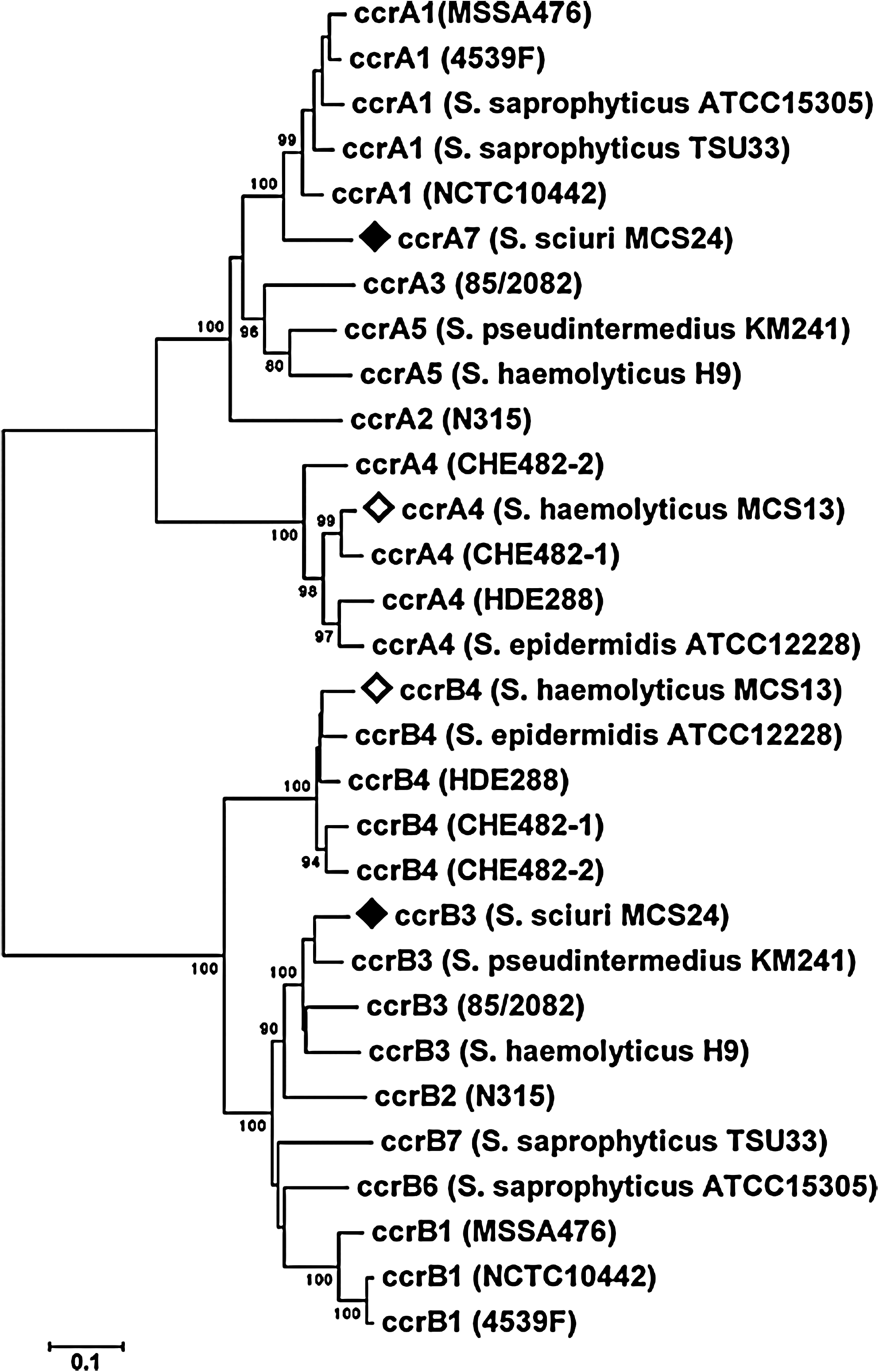
Phylogenetic tree obtained by the alignment of nucleotide sequences among ccrA and ccrB genes. The nucleotide sequences of 13 ccrA genes and ccrB genes are aligned using the ClustalX program. In parentheses, names of Staphylococcus aureus strains carrying ccr genes are indicated. In the case of CoNS strains, names of both species and the strains are indicated. The variation scale (substitution per site) is indicated at the bottom. Percent bootstrap support is indicated by the values at each node, and the values <80 are omitted. The ccr genes analyzed in the present study are indicated by closed diamond (ccrA7 and ccrB3 from MCS24) and open diamond (ccrA4 and ccrB4 from MCS13).
Sequence analysis of a new ccrA4B4 variant from MCS13
PCR analysis suggested that SCCmec of MCS11, 13, 15, and 34 contained a novel set of mec gene and ccr gene complexes, class C1 and type 4 (ccrA4B4). This combination was not described before, although SCCmec consisting of class C2 mec complex, not C1 mec complex, and a type 4 ccr gene was reported from S. epidermidis strains. 2 To determine the entire type 4 ccr gene complex, we designed a primer pair for PCR amplification according to the reported nucleotide sequence of type VI SCCmec from S. aureus strain HDE288 (AF411935) and ATCC12228 (BK001539) (Table 1). Sequence analysis of the PCR product (∼4.4 kb) indicated that the four strains harbor the identical ccrA and ccrB. The ccr genes expand a total of 3,047 nucleotides encoding ccrA (1,362 bp: 453aas) and ccrB (1,698 bp: 563aa), and four nucleotides were overlaying between the end of ccrA and the beginning of ccrB. We regard that the two strains, MCS13 and MCS15, among the four strains should be the pathogens that directly caused infection, because they were isolated from pus. Of the two, MCS13 was defined as the prototype because of its earlier detection. ccrA and ccrB from MCS13 exhibited 88.3%–93.8% and 90.8%–93.8% nucleotide sequence identities to the reported ccrA4 and ccrB4 sequences, respectively (Supplementary Tables S1 and S2); in addition, the phylogenetic tree showed that it could be categorized as the type 4 ccr gene complex (Fig. 1). These findings indicate that ccrA4 and ccrB4 from MCS13 are new variant types. Sequence analysis of the entire region of the SCCmec in MSC13 would be helpful to understand the origin of the new mecA-ccr combination, class C1-type 4.
Our present data, together with previous reports, emphasized high degree of genetic diversity in SCCmec in CoNS. An alternative strategy to identify increasing new types of SCCmec might be needed in the near future. More widespread analysis and data accumulation would help to understand the mechanisms of horizontal transfer of SCCmec among staphylococci.
Footnotes
Acknowledgment
This study was supported in part by a Grant-in-Aid for Scientific Research (No. 20590608) from the Ministry of Education, Culture, Sports, Science, and Technology, Japan, and the research grant from the Heiwa Nakajima Foundation.
Disclosure Statement
The authors of this article have no commercial associations that might create a conflict of interest.
References
Supplementary Material
Please find the following supplemental material available below.
For Open Access articles published under a Creative Commons License, all supplemental material carries the same license as the article it is associated with.
For non-Open Access articles published, all supplemental material carries a non-exclusive license, and permission requests for re-use of supplemental material or any part of supplemental material shall be sent directly to the copyright owner as specified in the copyright notice associated with the article.
