




Abstract
This study evaluated methicillin-resistant Staphylococcus aureus (MRSA) survival on environmental surfaces: glass, wood, vinyl, plastic, and cloth. Effects of relative humidity (RH) and bovine serum albumin (BSA) were examined. Surfaces were inoculated with 107–108 colony forming units per milliliter (CFU/ml)of MRSA with and without 1% BSA and incubated at 35°C at 45%–55% and 16% RH. Surfaces were sampled, and each collected sample was re-suspended in phosphate buffer, spread plated, and incubated at 35°C for 24 hrs; resulting colonies were enumerated. Samples were collected immediately on drying, and at 3 hrs, 24 hrs, 2 days, 3 days, 4 days, and 5 days. Results demonstrated that MRSA survived the longest on plastic and vinyl and for the least amount of time on wood (p < 0.001). BSA enabled MRSA to survive for significantly longer duration (p < 0.001). The number of CFU/ml was significantly lesser on surfaces stored in 45%–55% RH versus 16% RH. This study demonstrates that viable MRSA bacteria can remain on surfaces for days, which may impact the public health of occupants in workplace and residential settings.
Introduction
Bacterial surface contamination is a matter of public health concern, as it can result in cases of human illness and disease. Research has found that bacteria are able to persist on environmental surfaces for up to several months and can serve as a reservoir for transmission.3,8,11 Previous data also indicate that when bacteria are offered organic protection from drying by materials such as blood or pus, they are able to persist for significantly longer amounts of time. 16 Relative humidity (RH) influences survival; as RH increases, the amount of bacterial surface contamination decreases.2,9,17 Interestingly, no data exist on bacterial surface survivability in low RH conditions common in arid climates. In addition, overall data on the survivability of MRSA on nonhospital, environmental surfaces are limited.
The goal of this study was to add to the literature on MRSA surface survival focusing on five environmental surfaces common to indoor environments; glass, wood, plastic, vinyl, and cloth. In addition, the effect of a low level of RH was compared with a moderate RH value. Further, survival rates were compared with and without the presence of bovine serum albumin (BSA), a proteinaceous serum used to mimic human proteins that may offer some organic protection to the MRSA in both adherence and desiccation.
Materials and Methods
Test organisms and culture media
The test MRSA, S. aureus ATCC 43300, was obtained from American Type Culture Collection (ATCC; Manassas, VA). The organism was cultured on Tryptic Soy Agar (TSA; Difco™, Sparks, MD) and Tryptic Soy Broth (TSB, Bacto™, Sparks, MD) and incubated at 35°C for 24–96 hrs. The culture was suspended, washed, and re-suspended in a sterile 0.01 M phosphate buffer (PB; Fisher Scientific, Fair Lawn, NJ). In comparative experiments, the final washed culture was re-suspended in PB containing 1.0% BSA (Rockland, Philadelphia, PA).
Test materials
MRSA survivability was tested on common indoor environmental surfaces including non-PVC plastic cutting boards, glass, raw wood cutting boards, vinyl flooring tiles, and flannel cloth with quilt batting purchased at a local fabric store. Vinyl, plastic, and wood surfaces were divided into 5.1 cm squares, separated by ¼ inch wide laboratory tape. Glass Petri-plates were used as the glass surface. Each Petri plate was sectioned into square areas that were distinguished by a marker line drawn on the underside of the dish opposite the sampling surface. Cloth surfaces were cut into 5.1 cm squares and sewn together with a low loft 100% cotton quilting batting sandwiched in between the two flannel layers. For each surface, the squares were tested under varying conditions: four squares maintained at 45%–55% RH with BSA, four squares maintained at 45%–55% RH without BSA, four squares maintained at 16% RH with BSA, and four squares maintained at 16% RH without BSA. This set of conditions was repeated at seven different time intervals. This resulted in an n of 112 squares for each surface and 560 squares tested for all surfaces combined.
Procedure
For each experiment, a culture was grown by streaking freezer stock of MRSA strain ATCC 43300 onto TSA and incubating at 35°C for 24 to 96 hrs. An overnight culture was prepared by inoculating 20 ml of TSB with approximately five bacterial colonies from the TSA plate and incubating at 35°C on an orbital incubator shaker (Amerex Instruments, Lafayette, CA) at 60 rpm for approximately 15 hrs. A working culture was prepared by inoculating 100 ml of TSB from this suspension and incubating at 35°C at 200 rpm until the culture was in log phase. The log phase growth was determined using optical density (OD) measured with a spectrophotometer (Beckman Coulter, Fullerton, CA). The OD was read at periodic intervals until an absorbance OD of 0.9 to 1.0 was obtained.
Twenty-five milliliters of culture was then harvested and centrifuged at 10,000 g for 5 min at room temperature. The supernatant was removed, and the bacterial cell pellet was washed and re-suspended in 25 ml of PB two additional times. The final washed culture was re-suspended in either PB or PB containing 1.0% BSA. The concentration of colony forming units per milliliter (CFU/ml) of the final washed culture was enumerated via serial dilutions and spread plating. The five environmental surfaces were inoculated with a cell concentration of 3.0 × 10⁷–1.4 × 10⁸ CFU/ml in order to show a statistically significant decline over time.
A 100 μl aliquot of the culture was pipetted onto the 5.1 cm2 of each environmental surface, spread with a disposable sterile plastic loop, and allowed to dry at room temperature. Sampling took place immediately on drying (time 0), and at 3 hrs, 24 hrs, 2 days, 3 days, 4 days, and 5 days. For hard surface area sampling (i.e., plastic, glass, wood, and vinyl), two sterile cotton tipped swabs were moistened in 500 μl of PB and used simultaneously to swab the 5.1 cm2 of surface in two directions at right angles to each other. Each swab was then individually processed by being placed in 1 ml of PB and vortexed (VWR VM-3000 Mini Vortex, West Chester, PA) for 1 min to release MRSA cells into suspension. For cloth, each sample was individually processed in a sterile stomacher bag with 10 ml of PB and hand stomached for 1 min to release MRSA cells into suspension. For all surfaces, serial dilutions were made in PB and 100 μl spread plated onto TSA. Plates were then incubated at 35°C for 24 hrs. Surfaces were stored in an incubator that was maintained either at 45%–55% or 16% RH. The resulting colonies were then enumerated to determine the number of CFU/ml. The detection limit was 1 CFU/ml. Replicate experiments were performed for each surface.
Quality control
For each surface, one square was left blank; received no aliquot of the culture. A sample was taken of such a square and processed in the same manner as previously mentioned. A control was also performed on the buffers being used (PB and PB amended with 1.0% BSA) to ensure that there was no contamination. If the controls consisted of no growth after 24 hrs, it was presumed that the materials were free from bacterial contamination.
Statistical analysis
SPSS for Windows® Version 15.0 was used to perform a repeated measures analysis of variance. Tukey's post hoc test was used for comparison of each surface.
Results
Before data analysis, data were log10 transformed to ensure normality. From a starting MRSA cell concentration of 3.0 × 10⁷–1.4 × 10⁸ CFU/ml, there was generally a steep decline in the overall mean on all surfaces. The study was terminated at 5 days due to minimal growth persisting at this time as measured by the number of MRSA CFU/ml. There was a significant difference among the surface types (p < 0.001). MRSA survived the longest on plastic and vinyl, persisting up to 5 days. The rate of decline was greatest on wood with no CFU/ml present at 2 days, followed by cloth, which had no CFU/ml present at 4 days. Tukey's post hoc test showed that the overall mean was significantly lowest for wood (p < 0.001) as compared with all other surfaces and highest for cloth (p < 0.001) with a mean difference of 9.7 × 10⁵ CFU/ml (±7.1 × 10⁴ S.E.).
The addition of BSA had a significant positive effect on time of survival of MRSA as compared with studies with no BSA (p < 0.001). The mean of the number of CFU/ml was initially higher at time 0 and remained so throughout day 5 (Fig. 1). There were interaction effects with surface type and culture type. The concentration of MRSA CFU/ml was significantly higher (p < 0.001) with the addition of BSA on all surface types. The means of MRSA CFU/ml with and without BSA are listed in Table 1.
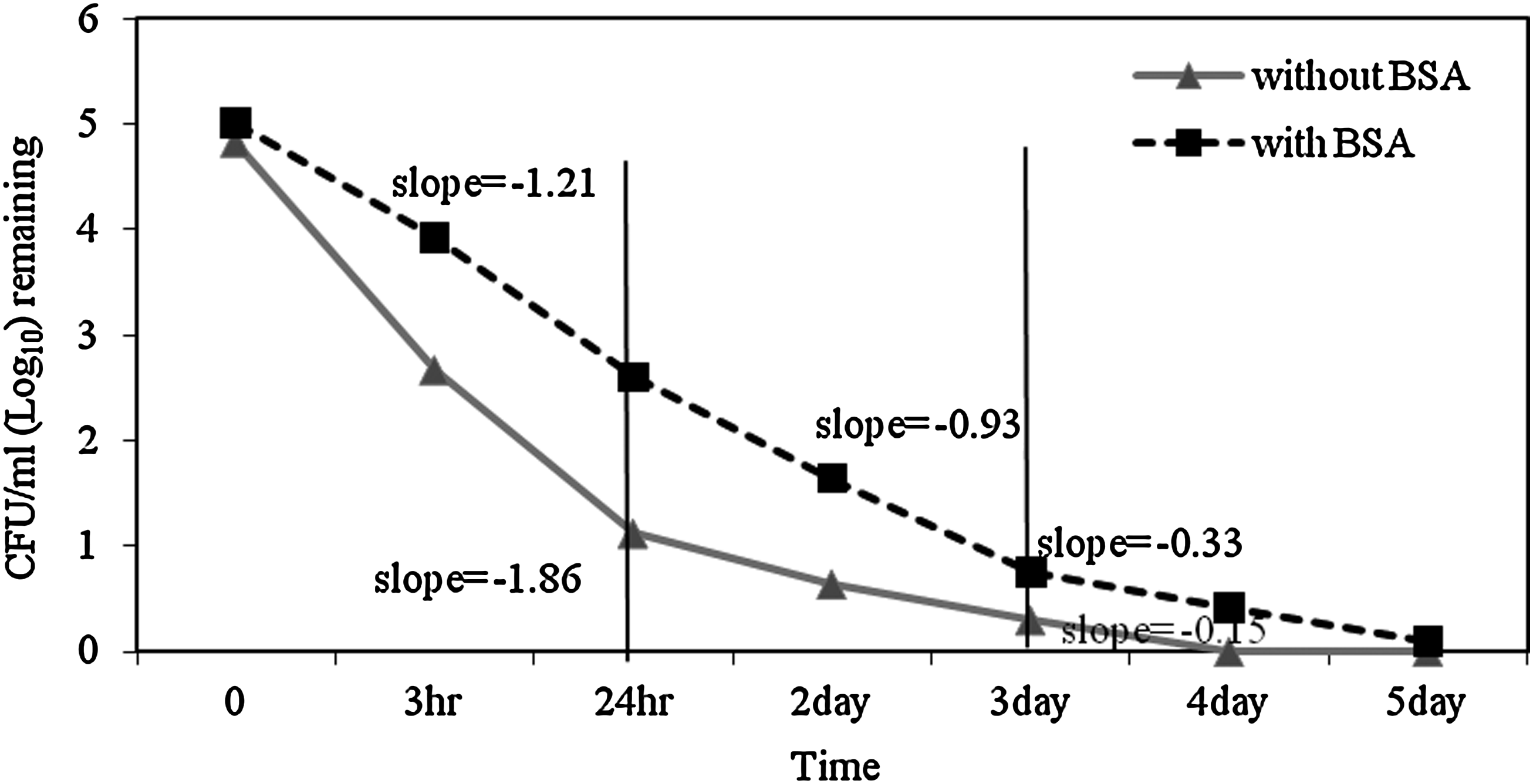
Average concentration of methicillin-resistant Staphylococcus aureus (Log10 CFU/ml) remaining over time with and without BSA for all five surface types. CFU/ml, colony forming units per milliliter; BSA, bovine serum albumin.
CFU/ml, colony forming units per milliliter; SE, standard error; BSA, bovine serum albumin.
The moderate humidity of 45%–55% had a significant negative effect on survival time (p = 0.002) as compared with the lower 16% RH (Fig. 2). There were interaction effects (p < 0.001) with surface type and RH overall. Individually, plastic and vinyl surfaces were significantly different; concentration of CFU/ml was significantly lower in 45%–55% RH. The means of MRSA CFU/ml with the two studied humidities on plastic and vinyl are listed in Table 2.

Overall average concentration of methicillin-resistant S. aureus (Log10 CFU/ml) over time with 45%–55% and 16% RH. RH, relative humidity.
There was no significant interaction effect with humidity and BSA/no BSA; no specific combinations of RH and BSA/no BSA resulted in a change in survivability of MRSA as measured by CFU/ml (data not shown).
Discussion
Surface differences
There was a significant difference (p < 0.001) in MRSA survival time among the different surface types. Viable MRSA cells survived the longest on plastic and vinyl surfaces. This may be a result of the physical contours of these surfaces. At the macroscopic level, they appear smooth, yet at the microscopic level there are deep crevices that may allow cells to sequester with protection from dehydration and colonize. Conversely, the smoother surfaces offer little protection from drying. The greater the amount of time that viable organisms are present on the varying depth surfaces of plastic and vinyl, the larger the risk for transmission from that contaminated surface. In contrast, the survival of MRSA as measured by CFU/ml was less on the smooth surface of glass, which offered the bacteria little protection from desiccation. This finding can be applied to settings in which transmission is more likely to occur. The lowest survivability of MRSA as measured by CFU/ml was found on the wood surface of commercially available cutting boards. This was surprising, as wood is not a smooth surface. The results are likely due to the swabbing technique which was used to retrieve the cells from the surface and was not able to effectively remove cells from the deep crevices that were present in the wood. Additionally, wood is porous and MRSA cells may have dispersed throughout the wood beneath the surface, again making it difficult to retrieve the cells with the swab. Swab sampling was utilized in the current study, as it is the traditional method of surface sampling. Other surface sampling techniques, such as bulk sampling, may have been effective at retrieving cells, though such methods are destructive and often not practical for use in the field. 5 Previous studies have found that the species of wood or natural chemicals in the wood may affect survival rate. 1 Unfortunately, the species of the wood cutting board used is unknown. However, the data are interesting due to the continued popularity of wood cutting boards, despite concerns for transmission of infectious organisms.
Although the likelihood of transmission of MRSA may be lessened for wood surfaces compared with the other surfaces studied in this article, proper precaution should still be observed with wooden surfaces in facilities used by vulnerable populations.
The greatest survival of CFU/ml overall was found on the flannel cloth. However, no viable bacteria remained on day 4. The MRSA suspension was pipetted onto the flannel cloth and dispersed as much as possible, yet often the liquid was absorbed onto the fabric at contact. The rapid absorption of the liquid on the flannel cloth may have forced crowding of the cells, resulting in competition that caused cell death, ultimately resulting in fewer viable bacteria. Though accounted for in calculations, it is possible that the increased diluents required for the hand stomaching method may have contributed to the underestimation of CFU/ml beyond day 4.
Although no bacteria were recovered from the cloth on day 4 in this study, Oie et al. (2005) observed that porous materials remained colonized with MRSA even after disinfection. 13 This raises concern about linens, clothing, and accessory items worn in healthcare settings such as bed sheets, white coats, and ties as such items may aid in transmission of bacteria.
There has been previous research which shows that the hydrophobicity of a surface may influence the formation of biofilms.14,15 Pagedar et al. (2010) found that S. aureus formed biofilms more readily on hydrophobic substrates, which may enhance survival time. 14 This study did not examine biofilm formation; future work could study the influence of hydrophobicity and biofilm formation on survival time of MRSA on environmental surfaces.
The effect of BSA
The addition of BSA had a significant positive correlation (p < 0.001), enabling longer MRSA survival times. There was also a significant interaction effect with BSA and surface type (p < 0.001). One potential explanation is that the BSA aided in the adherence to the physical contours of the surfaces. Makison and Swan (2006) found that bacterial cells aggregated within the BSA and collected at the edges of BSA flakes as drying occurred. 8 BSA may have offered the cells protection from dehydration. This is likely the same effect a human protein or bodily fluid would have, allowing the bacteria to survive on the surface for a greater length of time.6,9 Tolba et al. (2007) found that the addition of actual human fluid in the form of blood and pus enhanced survival from 4 hrs to greater than 13 days. 16
The effect of humidity
Previous research has indicated that increases in RH have a negative correlation with bacterial survival.2,9,17 However, there is a gap in the literature when it comes to low RH, specifically levels common in arid climates. It was initially hypothesized that the arid climate would hinder bacterial survivability by quickening dehydration, yet that was not the case in this study. The overall mean in regard to humidity was significantly higher (p = 0.002) at 16% RH. Additionally, bacterial survival was significantly higher at 16% on plastic and vinyl surfaces. This poses the question as to whether or not areas of high to moderate RH have lower incidence rates of MRSA infection than do areas with lower RH. An epidemiological study is necessary to answer this question.
The current study is not without limitations. The particular MRSA strain used was not recently isolated or a US300 strain, which is of growing concern, though the ATCC4330 strain that was used produced valid data on the survival aspects of MRSA on environmental surfaces and minimized risk to laboratory personnel. Swab sampling was utilized to retrieve MRSA cells from the environmental surfaces. This technique was chosen, because it is the traditional method and most practical for field environmental sampling, though other methods may have been more effective at retrieving cells. Additionally, it is possible that the bacterial cells may have become trapped within the cotton fibers of the swab, 10 and the use of traditional spread plating does not capture those cells which may be in a viable, but not culturable, stage. This may have resulted in an underestimation of the amount of MRSA remaining on the surface. Future research should include additional detection methods such as microscopy or polymerase chain reaction.
It is important to note that viable MRSA cells were able to survive for a day or longer on all surfaces, regardless of conditions. In many situations, this may be long enough to transmit the bacteria. Even if the organism does not cause immediate infection, colonization may occur from the contact, and colonization increases the risk of infection fourfold. 4 Consequently, proper disinfection and precautionary measures are vital. The best way to control the MRSA epidemic is to prevent transmission.
Footnotes
Acknowledgments
The authors thank Dr. Chad Cross for his help and guidance in the statistical analysis for this study. We thank Dr. Shawn Gerstenberger and Dr. Michelle Chino of the UNLV School of Community Health Sciences for their valuable input.
Disclosure Statement
None of the authors have any conflicts of interest to disclose. No competing financial interests exist.