




Abstract
This study was aimed to investigate the molecular epidemiology, mechanism of carbapenem resistance, and occurrence of class 1 integrons among 13 carbapenem-resistant clinical isolates of Acinetobacter baumannii obtained between 2004 and 2007 from Sweden. Nine isolates were linked with hospitalization abroad. Molecular epidemiology was investigated by multilocus sequence typing, multiplex PCRs for major international clones/sequence groups (SGs), and pulsed-field gel electrophoresis. OXA-carbapenemase genes/genetic surroundings and class 1 integrons were examined by PCRs and sequencing. The isolates belonged to sequence type (ST) 2/international clone II (n=6), ST23/SG5 (n=2), ST25 (n=2), ST5/SG7 (n=1), and ST109 (n=2). OXA-58, OXA-23, and OXA-24 were detected in seven, five, and one isolate, respectively. Different genetic structures surrounded the blaOXA-58-like and blaOXA-23-like genes. Interestingly, ISAba825 was detected upstream blaOXA-58-like in two isolates. Class 1 integrons with three different variable regions (VR) were detected. VR1 (aacA4-orfO-blaOXA-20) was found in four isolates from ST2/international clone II, with three of them imported from Greece. VR2 (aadB-aadA1-IS) was detected in one ST5 isolate imported from Poland, and VR3 (blaGES-11-aacA4-dfrA7) was present in a nonimport ST25 isolate. In conclusion, a variety of clonal lineages, OXA-carbapenemases genes and genetic structures, and class 1 integrons were detected among carbapenem-resistant A. baumannii from Sweden.
Introduction
Carbapenem resistance in A. baumannii is mainly due to the production of Ambler class D OXA-type carbapenemase genes, commonly associated with insertion sequence elements. 15 An association has been recently detected between blaOXA-23-like- and blaOXA-58-like-positive carbapenem-resistant strains and the two major A. baumannii clones, international clone II/CC2 and international clone I/CC1.5,11 Integrons have contributed to the emergence of multidrug resistance in bacteria. 9 The occurrence of class 1 integrons with gene cassettes encoding aminoglycoside modifying enzymes has, for instance, been a main mechanism of resistance to aminoglycosides among A. baumannii clinical isolates. 13
The aim of this study was to characterize carbapenem-resistant A. baumannii isolates obtained from Sweden with regard to their molecular epidemiology, mechanism of carbapenem resistance, and the occurrence of class 1 integrons.
Materials and Methods
Bacterial isolates
The study included 13 A. baumannii clinical isolates obtained from different cultures (blood, pus, respiratory secretions, and abdominal cavity fluid) from 11 patients hospitalized at Karolinska University Hospital, Stockholm (n=10), or Kalmar County Hospital, Kalmar (n=1), in Sweden between 2004 and 2007 (Table 1). All isolates were nonsusceptible to imipenem or meropenem according to Swedish Reference Group for Antibiotics (SRGA) disk diffusion methodology (www.srga.org/RAFMETOD/BASMET.HTM, accessed on May 1, 2011) and breakpoints (www.srga.org/ZONTAB/zontab2a.htm, accessed on May 1, 2011).
Isolates ÖN-74, AO-471, and AO-2412 were recovered from one patient.
SG, sequence group (PCR based). AO-471 and AO-21841 showed the amplification of blaOXA-51-like in Group 1 multiplex PCR and no amplifications in Group 2 multiplex PCR, whereas AO-2412 and ÖN-25 showed the amplification of csuE and ompA in Group 1 multiplex PCR and no amplifications in Group 2 multiplex PCR.
ST, sequence type; CC, clonal complex; KUH, Karolinska University Hospital; KCH, Kalmar County Hospital; MLST, multilocus sequence typing; PFGE, pulsed-field gel electrophoresis.
Molecular epidemiology
MLST was performed according to the scheme described at the Pasteur Institute's MLST website (www.pasteur.fr/recherche/genopole/PF8/mlst/Abaumannii.html). Phylogenetic analysis of the concatenated sequences, using Lasergene MegAlign software (DNASTAR, Madison, WI, USA), was performed to confirm the species identification of the isolates. 3 The allelic profiles were analyzed using eBURST V3 (http://eburst.mlst.net/) under stringent (minimum of six shared alleles) grouping parameters. Identification of major SGs/international clones was done by two multiplex PCRs targeting ompA, csuE, and blaOXA-51-like. 21 Pulsed-field gel electrophoresis (PFGE) using ApaI-digested genomic DNA was performed as previously described. 11 Similarities among the PFGE patterns were calculated by the Dice coefficient method using the BioNumerics software v.6.01 (Applied Maths, Sint-Martens-Latem, Belgium).
Antimicrobial susceptibility testing
Minimum inhibitory concentrations (MICs) were determined by Etest (bioMérieux, Marcy l'Etoile, France) according to the manufacturer's instructions. Results were interpreted using clinical breakpoints as defined by the European Committee on Antimicrobial Susceptibility Testing (EUCAST), except of tigecycline for which the epidemiological cutoff value (ECOFF; nonwild type,>1 mg/L) was used (www.eucast.org).
Detection of carbapenem resistance genes and class 1 integrons
PCR assays were performed to detect the presence of class D (blaOXA-23-like, blaOXA-24-like, blaOXA-51-like, and blaOXA-58-like) and class B (blaVIM, blaGIM, blaIMP, blaSPM, and blaNDM-1) carbapenemase genes and to link OXA-carbapenemase genes with the insertion sequence (IS) elements ISAba1, ISAba2, ISAba3, and IS18.8,16 The occurrence of other IS elements was determined by sequencing using same primers used in the linkage PCR assays. The integrase gene (intI1) and the variable regions (VR) of class 1 integrons were amplified and sequenced using previously described and in-house designed primers.8,9
GenBank accession number
The nucleotide sequences of the class 1 integron variable regions of isolates AO-21841 and AO-8866 have been submitted to GenBank under accession numbers JN253503 and JN253504, respectively.
Results
Molecular epidemiology
Nine isolates were derived from patients who were firstly hospitalized abroad including four isolates from two patients transferred to Sweden after the tsunami of December 2004 in Thailand. Phylogenetic analysis of the MLST concatenated sequences (2,976 bp in total) confirmed the species identification of the isolates (data not shown). All isolates were also positive for the intrinsic blaOXA-51 gene of A. baumannii.
MLST and eBURST analyses assigned the isolates into ST2/CC2 (n=6), ST23/CC10 (n=2), ST25/singleton (n=2), ST109/CC109+83 (n=2), and ST5/singleton (n=1) (Table 1). All the ST2 isolates belonged to international clone II. 21 ST23 and ST5 isolates belonged to PCR-based SGs 5 and 7, respectively, and the isolates of ST25 and ST109 showed new combinations of amplicons by the clonal lineage PCRs. 20 It is important to clarify that the labels of the PCR-based SGs do not correspond to the labels proposed by another typing approach based on comparative sequence analysis of the same three genes.5,6 PFGE assigned each two of the ST23 and ST109 isolates into one pulsotype (100% similarity). Four of the ST2 isolates also belonged to one pulsotype (>80% similarity) and the remaining isolates each revealed a distinct pulsotype (Table 1).
Antimicrobial susceptibility testing
All the isolates were multidrug resistant (Table 2). MICs of imipenem (16–>32 mg/L) were higher than those of meropenem (2 to>32 mg/L). All the isolates were resistant to amikacin (MIC: 32 to>256 mg/L). In addition, resistance to gentamicin and tobramycin was detected in 12 of 13 and 11 of 13 of the isolates, respectively. Two isolates were resistant to colistin. Clinical data revealed that the colistin-resistant isolate AO-2412 (MIC:>1,024 mg/L) was initially colistin susceptible (MIC: 0.25 mg/L) and the emergence of colistin resistance in this isolate took place after colistin therapy. The colistin-resistant isolate was recovered from a patient who undertook surgery and hyperbaric oxygen therapy.
ISAba3/ISAba2, an ISAba3 element disrupted by the insertion of an ISAba2 element; ISAba3/ISAba825, an ISAba3 element disrupted by the insertion of an ISAba825 element.
IPM, imipenem; MEM, meropenem; CIP, ciprofloxacin; AMK, amikacin; GEN, gentamicin; TOB, tobramycin; SXT, trimethoprim/sulphamethoxazole; CST, colistin; TGC, tigecycline; MIC, minimum inhibitory concentration; IS, insertion sequence.
Detection of carbapenem resistance genes and class 1 integrons
Resistance to carbapenems was related to blaOXA-58-like (n=7), blaOXA-23-like (n=5), and blaOXA-24-like (n=1) (Table 2). OXA-58-like-producing isolates showed lower MIC values against meropenem compared with the OXA-23-like- and OXA-24-like-producing isolates. 8 None of the isolates contained metallo-β-lactamase genes. Six of the blaOXA-58-like genes were combined with different ISAba3-related elements both upstream and downstream, whereas the last blaOXA-58-like gene was associated only with a downstream ISAba3 (Table 2). Sequence analysis of the ISAba3-related elements detected the occurrence of ISAba825 upstream blaOXA-58-like in two isolates. Four of the blaOXA-23-like genes were surrounded by two copies of ISAba1, whereas the last blaOXA-23-like gene was associated only with an upstream ISAba1. Class 1 integrons with three different VR were detected in six isolates (Fig. 1). One isolate was found to carry a class 1 integron with the gene cassettes aadB and aadA1 together with an IS element inserted between aadA1 and the 3′ conserved sequence. 7 The VR3-positive isolate showed a negative PCR amplification of the intI1 gene. This was explained later by a deletion within intI1, including the binding site of intI1-R primer. 10
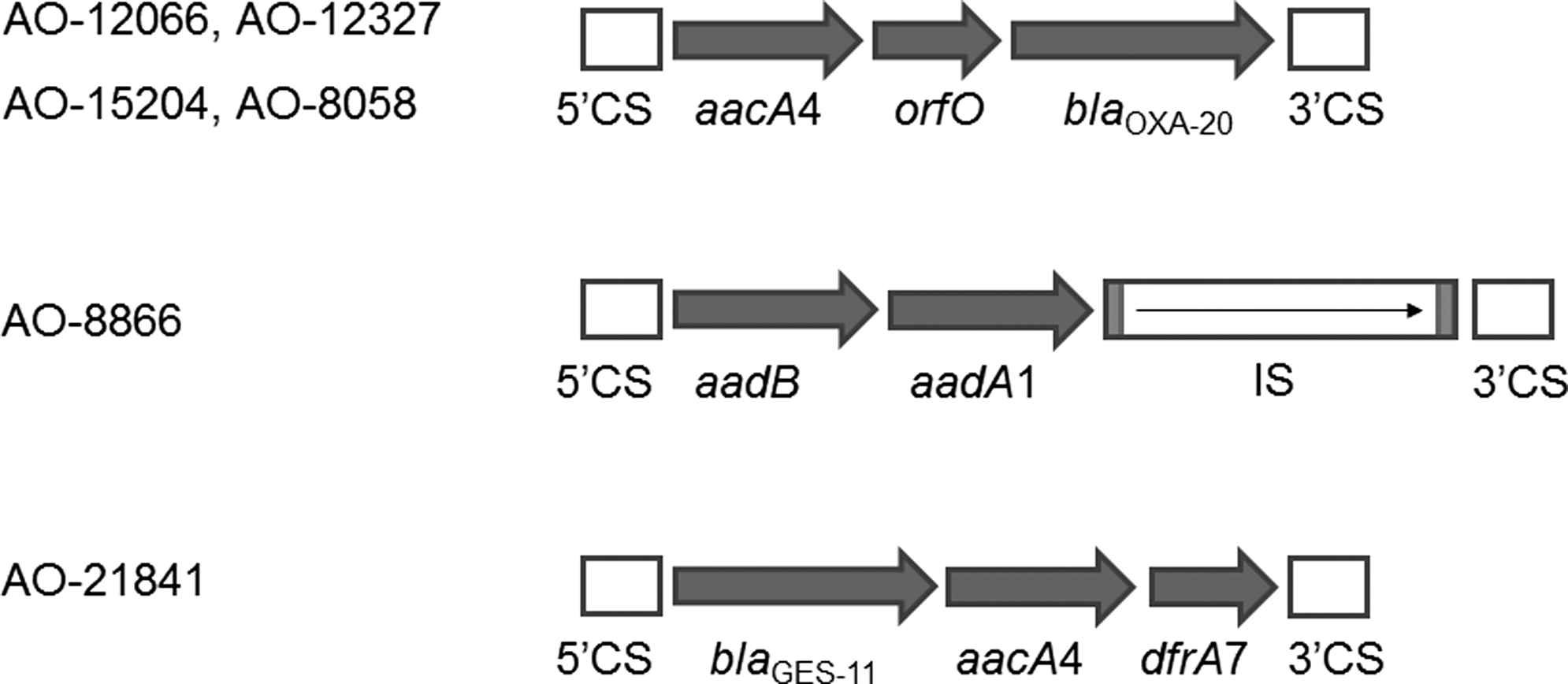
The variable regions of detected class 1 integrons.
Discussion
The emergence of multidrug- and carbapenem-resistant strains of A. baumannii is a major problem in the clinical setting, because empiric treatment choices are limited. 4 Strain typing of the isolates, molecular characterization of particular resistance determinants, and detection of elements involved in resistance gene mobilization are valuable in studies investigating the epidemiology of antibiotic-resistant bacteria. Our study demonstrated the occurrence of a variety of OXA-type carbapenemase genes among isolates of ST2/CC2/international clone II, most likely due to the worldwide spread of this clone and the subsequent contact with different local pools of resistance genes. 13 Consistent with other studies, the clone included isolates with distinct pulsotypes principally because of a higher genetic diversity indexed by PFGE. 8 A. baumannii strains from international clone II carrying a class 1 integron with the aacA4-orfO-blaOXA-20 gene array (VR1) have so far showed a geographic distribution restricted to Europe, with a frequent occurrence in Greece.8,18,22
Interestingly, homology search in GenBank database showed that the two ST23/SG5 isolates contained a blaOXA-58-like gene associated with an upstream ISAba3 element disrupted by the insertion of ISAba825, a 975-bp IS element bounded by a perfect 17-bp inverted repeat. 12 The occurrence of ISAba825 within ISAba3, at the same insertion site, has been previously reported only once in isolates from Argentina (GenBank accession number: HM068378). 17 Noteworthy, ISAba825 and ISAba2 were inserted at different sites within ISAba3 (GenBank accession number: AY665723). 16
The two isolates of ST25 belonged to distinct pulsotypes and had distinct genetic structures surrounding their blaOXA-23-like gene, and only one of the isolates contained a class 1 integron (VR3). One of the ST25 isolates was imported from Thailand, whereas the other was not associated with import. This probably indicated a geographically separated independent emergence of this clone from an old ancestor. A previous study has recently reported the involvement of ST25 in three outbreaks of infections from Greece in 2003, Turkey in 2005, and Italy in 2009. 5 The nonimport ST25 isolate was found to carry a class 1 integron with the gene array blaGES-11-aacA4-dfrA7, which has been previously found in an isolate from France and several isolates from Belgium associated with import from Turkey, Palestine, and Egypt.1,10 Class 1 integrons carrying the same gene array but with single point mutation variants of blaGES-11 have also been described.1,2 Of note, the whole genome sequence for an epidemic A. baumannii ST25 strain obtained in Italy has been recently published, which might help in understanding the molecular basis for the epidemicity of this novel international clone. 23
The ST5/SG7 isolate, isolated in 2006, was associated with import from Poland. The MLST isolate database included only one ST5 isolate, which was interestingly obtained in 1999 also from Poland (www.pasteur.fr/recherche/genopole/PF8/mlst/Abaumannii.html). 3 The ST5 isolate in this study was found to carry a class 1 integron with the VR aadB-aadA1-IS, which has been previously described only in a swine E. coli isolate from Germany and on a plasmid recovered from a wastewater treatment plant.7,19 To our knowledge, this is the first occurrence of aadB-aadA1-IS gene array in A. baumannii.
In summary, our study detected the occurrence of A. baumannii strains of different STs and pulsotypes producing a variety of OXA-type carbapenemases and carrying class 1 integrons with different gene arrays.
Footnotes
Acknowledgments
Part of this study was supported by a research grant from the Northern Norway Regional Health Authority. Bjørg Haldorsen and Bettina Aasnæs are thanked for expert technical assistance.
Disclosure Statement
N. Karah, A. Sundsfjord, and Ø. Samuelsen have no competing interests. C.G. Giske has received speaker's honoraria from Meda, Wyeth, and AstraZeneca.