




Abstract
A total of 121 Campylobacter isolates from 4,788 humans with gastroenteritis were identified and characterized by biochemical detection methods, polymerase chain reaction, and multilocus sequence typing (MLST). These samples were obtained during a 3-year period, from January 2007 to December 2009, using the National Notifiable Diseases Surveillance System at the Research Institute of Public Health and Environment in Seoul Metropolitan, Korea. Antimicrobial susceptibilities of the bacterium were also determined with the agar dilution method. All 121 isolates were identified as Campylobacter jejuni, with all (100%) of them having two virulence genes (ceuE and cadF) and a toxin gene (cdtB). Twenty-three different sequence types (STs), including 9 new STs, were determined by MLST. The most prevalent ST and clonal complex (CC) observed in this study were ST-45 (28.9%) and ST-45 CC (53.7%), respectively. Percentages of antimicrobial-resistant isolates were 1.9% for ampicillin, 0.8% for chloramphenicol, 24% for ciprofloxacin, 46.3% for enrofloxacin, 0.8% for erythromycin, 6.6% for gentamicin, and 46.3% for tetracycline. This study demonstrated that the majority of the Campylobacter isolates obtained from human samples in Korea were C. jejuni with ST-45 CC, which has been detected mainly in broilers worldwide, and all strains with new STs were uniformly resistant to enrofloxacin and tetracycline. This study indicates that broilers may be a breeding ground for bacteria as well as an important potential source of human campylobacteriosis.
Introduction
Uncomplicated illnesses caused by Campylobacter, which are characterized by symptoms such as fever, abdominal cramping, and diarrhea, are usually self-limiting and do not require antimicrobial treatment. However, severe, prolonged, or relapsing cases can occur, and these necessitate antimicrobial treatment. In these cases, macrolides and fluoroquinolones such as erythromycin and ciprofloxacin have been utilized as the first- and second-line therapies. 10 In rare cases, the acute phase is followed by serious sequelae such as Guillain-Barré syndrome and reactive arthritis.10,16,24 An increase in antimicrobial resistance in both humans and animals to erythromycin, fluoroquinolones, and tetracycline has been reported in many countries. 11 The use of antimicrobial agents in animal production for therapy, prophylaxis, and growth promotion plays a role in the dissemination of antimicrobial resistance genes from animals to humans. 10 National surveillance for food-borne disease has been carried out in Korea by the Research Institute of Public Health and Environment of the Seoul Metropolitan Government. As a part of this program, the incidence of Campylobacter from human diarrheal samples was examined from 2007 to 2009. The aims of this study were (1) to isolate and characterize Campylobacter species using molecular technologies focusing on MLST analysis, (2) to determine antimicrobial susceptibility of these isolates, and (3) to investigate possible associations between genotypes and antimicrobial susceptibilities.
Materials and Methods
Isolation of Campylobacter
Fecal samples from patients with food poisoning were submitted to a laboratory of the Research Institute of Public Health and Environment of the Seoul Metropolitan Government, under a program of national food poisoning surveillance. A total of 4,788 stool samples were examined over the 3-year period from January 2007 through December 2009. Fecal swabs were cultured directly on modified charcoal cefoperazone deoxycholate agar (mCCDA) plate (Campy blood-free selective medium [Acumedia, Baltimore, MD] plus LC30-05 [Dalynn Biologicals, Calgary, Canada]), and then incubated for 48 hr under a microaerobic condition at 42°C. Colonies with the characteristic translucent morphology of Campylobacter species were subcultured from mCCDA plates onto trypticase soy agar (TSA; BBL, Sparks, MD) with 5% defibrinated sheep blood and incubated at 42°C under microaerobic condition for further 48 hr. Isolates were initially identified using API Campy (API-bioMérieux SA, Marcy l'Etoile, France) following the manufacturer's recommendations.
DNA extraction
Campylobacter was incubated on TSA (BBL) with 5% defibrinated sheep blood for 48 hr under microaerobic condition at 42°C. Bacterial cells were suspended in sterile saline, and then harvested by centrifugation at 14,000 g for 10 min. Genomic DNA was extracted, using a G-spin genomic extraction kit (Intron Biotechnology, Seoul, Korea), in 30 μl of TE buffer and stored at −20°C until analysis.
Detection of virulence and toxin genes with polymerase chain reaction
Three pathogenic genes potentially responsible for Campylobacter infection were selected for polymerase chain reaction (PCR) amplification. PCR amplifications were performed with primers specific to the following virulence genes: ceuE for enterochelin uptake periplasmic binding protein in Campylobacter jejuni, cadF for fibronectin-binding protein, and toxin gene, cdtB, for cytolethal distending toxin in Campylobacter.2,25,28 Primer sequences of virulence and toxin genes, sizes of PCR products, and PCR conditions used in this study are presented in Table 1. The amplification reaction was carried out in a final volume of 25 μl containing 1× buffer, 1.5 mM MgCl2, 200 μM deoxynucleoside triphosphates, 1 μM of each primer, 0.63 U of Taq polymerase (Takarabio, Otsu, Shiga, Japan), and 1 μl of genomic DNA prepared as described above. Campylobacter jejuni ATCC 33560 and C. coli ATCC 33559 were included as controls in all PCR amplifications.
Antimicrobial susceptibility testing
Antimicrobial susceptibility testing for the Campylobacter isolates was determined by the agar dilution method in accordance with the recommendations of the Clinical Laboratory Standard Institute, 4 as described previously. 27 Minimum inhibitory concentrations (MICs) were assayed using ampicillin, chloramphenicol (Fluka, Buchs, Switzerland), ciprofloxacin (Korea Research Institute of Chemical Technology, Daeduk, Korea), enrofloxacin (Dr. Ehrenstofer, GmbH, Germany), erythromycin, gentamicin, and tetracycline at concentrations ranging from 0.5 to 128 mg/L. All chemicals used in this study were purchased from Sigma (St. Louis, MO) unless otherwise stated. MICs were determined using Muller-Hinton agar (BBL) containing 5% sheep blood. The agar plates were incubated for 48 hr under microaerobic condition at 36°C. Campylobacter jejuni ATCC 33560 and C. coli ATCC 33559 were included in each batch of agar dilution tests, and Clinical and Laboratory Standards Institute (CLSI)-approved MIC quality control limits (for ciprofloxacin, erythromycin, and gentamicin) of fastidious organisms were used for the control of agar dilution performance.4,27 The MIC interpretive standards of Staphylococcus spp. and veterinary pathogens defined by the CLSI were employed as breakpoints for erythromycin and enrofloxacin, respectively. 8 For MIC breakpoints of other antimicrobials, MIC interpretive standards for Enterobacteriaceae were utilized. 5 Multidrug resistance was defined as resistance to three or more antimicrobial groups.
Multilocus sequence typing
PCR amplifications and sequencing reactions were performed using primers specific to seven housekeeping genes: aspA for aspartase, glnA for glutamine synthetase, gltA for citrate synthase, glyA for serine hydroxymethyl transferase, pgm for phosphoglucomutase, tkt for transketolase, and uncA for ATP synthase subunit, according to the methods of Dingle et al.6,7 Allele profiles, sequence types (STs), and clonal complexes (CC) were designated using the C. jejuni and C. coli PubMLST profile database (www.pubmlst.org/campylobacter). Each sequence was assigned an allele number, and the combinations of alleles yielded an ST. Related STs were clustered into an appropriate CC. A neighbor-joining tree was drawn for the concatenated MLST gene sequence data using MEGA software (version 4.0.2, available at http://megasoftware.net). 6 The discriminatory index for the typing access was calculated to obtain Simpson's index of diversity. 15
Results
Isolation and identification of Campylobacter
From January 2007 through December 2009, 4,788 human diarrheal stool samples were examined, and 154 Campylobacter isolates were obtained. The overall isolation rates of Campylobacter-induced human gastroenteritis varied from year to year. Briefly, 59 Campylobacter isolates (3.9%) were obtained from 1,522 samples in 2007; 54 (3.6%) from 1,518 samples in 2008; and 41 (2.3%) from 1,748 samples in 2009. The average isolation rate of Campylobacter for these 3 years was 3.2%. All Campylobacter isolates were identified as C. jejuni by API Campy testing. A total of 121 isolates were investigated for the molecular characterization and antimicrobial susceptibility testing. Thirty-three isolates failed to grow after transfer from stock storage.
Amplification of virulence and toxin genes
The prevalence of two virulence genes and one toxin gene in Campylobacter isolates was determined by PCR with primers specific to the ceuE gene present in C. jejuni and the cadF and cdtB genes present in Campylobacter spp. All three genes were detected in all Campylobacter isolates (100%) concurrently. All of these isolates were identified as C. jejuni and confirmed the biochemical identification.
Antimicrobial susceptibility
The MICs of human C. jejuni isolates to ampicillin, chloramphenicol, ciprofloxacin, enrofloxacin, erythromycin, gentamicin, and tetracycline are shown in Table 2. The resistance rates of human C. jejuni isolates were 1.9% for ampicillin, 0.8% for chloramphenicol, 24% for ciprofloxacin, 46.3% for enrofloxacin, 0.8% for erythromycin, 6.6% for gentamicin, and 46.3% for tetracycline. The MIC50 values of all antimicrobial agents were lower than the resistance criteria, and the MIC90 values of ciprofloxacin, enrofloxacin, and tetracycline were higher. MIC values were different for each year. For example, in 2009, the resistance rates to enrofloxacin (100%) and tetracycline (100%) were remarkably increased from the previous years. In addition, significant differences were noted between the MIC50 and MIC90 values of gentamicin in 2009. MIC tests yielded 11 patterns of C. jejuni, including a type that was susceptible to all tested antimicrobials, as well as various kinds of antimicrobial agents (Table 3). Sixty-three (52.1%) isolates were susceptible to all tested antimicrobials, whereas 11 isolates (9.1%) were resistant to three or more classes of antimicrobials. All enrofloxacin-resistant isolates except one were concomitantly resistant to tetracycline only. Twenty-nine isolates among the enrofloxacin-resistant isolates were concomitantly resistant to ciprofloxacin. Interestingly, one isolate (CCARM 13322) was found to be resistant to all seven antimicrobials. This isolate was obtained from a patient returning to Korea from South Asia.
Criterion limit for resistance according to the European Committee on Antibiotic Susceptibility Testing (except enrofloxacin). MIC interpretive standards for veterinary pathogens were employed as breakpoints for enrofloxacin.
MIC, minimal inhibitory concentration.
New sequence types identified in this study are in boldface.
Am, ampicillin; Cm, chloramphenicol; Cip, ciprofloxacin; Ef, enrofloxacin; Em, erythromycin; Gm, gentamicin; Tc, tetracycline.
Multilocus sequence typing
A total of 23 STs were obtained, and 14 of these were found in the existing database, which included 108 isolates (89.3%), while 9 STs were new STs encompassing 13 isolates (10.7%). These new STs were registered as ST-4586, ST-4934, ST-5043, ST-5044, ST-5045, ST-5046, ST-5070, ST-5071, and ST-5075, in the Campylobacter PubMLST database. Among these new STs, seven were new combinations of previously described alleles, and the remaining two, namely ST-5046 and ST-5075, were new combinations of previously described alleles as well as novel allele sequences (Table 4). Nineteen STs belonged to 1 of the 8 C. jejuni ST CC, except ST-468, ST-2083, ST-5075, and ST-5046. In total, four STs could not be assigned to an ST CC. The most frequently isolated ST from the human C. jejuni strains was ST-45 (35 isolates, 28.9%). ST-468 (ST-CC unassigned, 24 isolates, 19.8%) and ST-538 (ST-45 CC, 24 isolates, 19.8%) appeared as the next most common STs. Thirteen STs were represented by a single isolate. The major ST CC observed in this study was ST-45 CC accounting for 65 of 121 isolates (53.7%). The genetic distance of the 23 STs was presented by creating a neighbor-joining tree that was composed of three separate clusters (Fig. 1). The discriminatory index for MLST was 0.837.
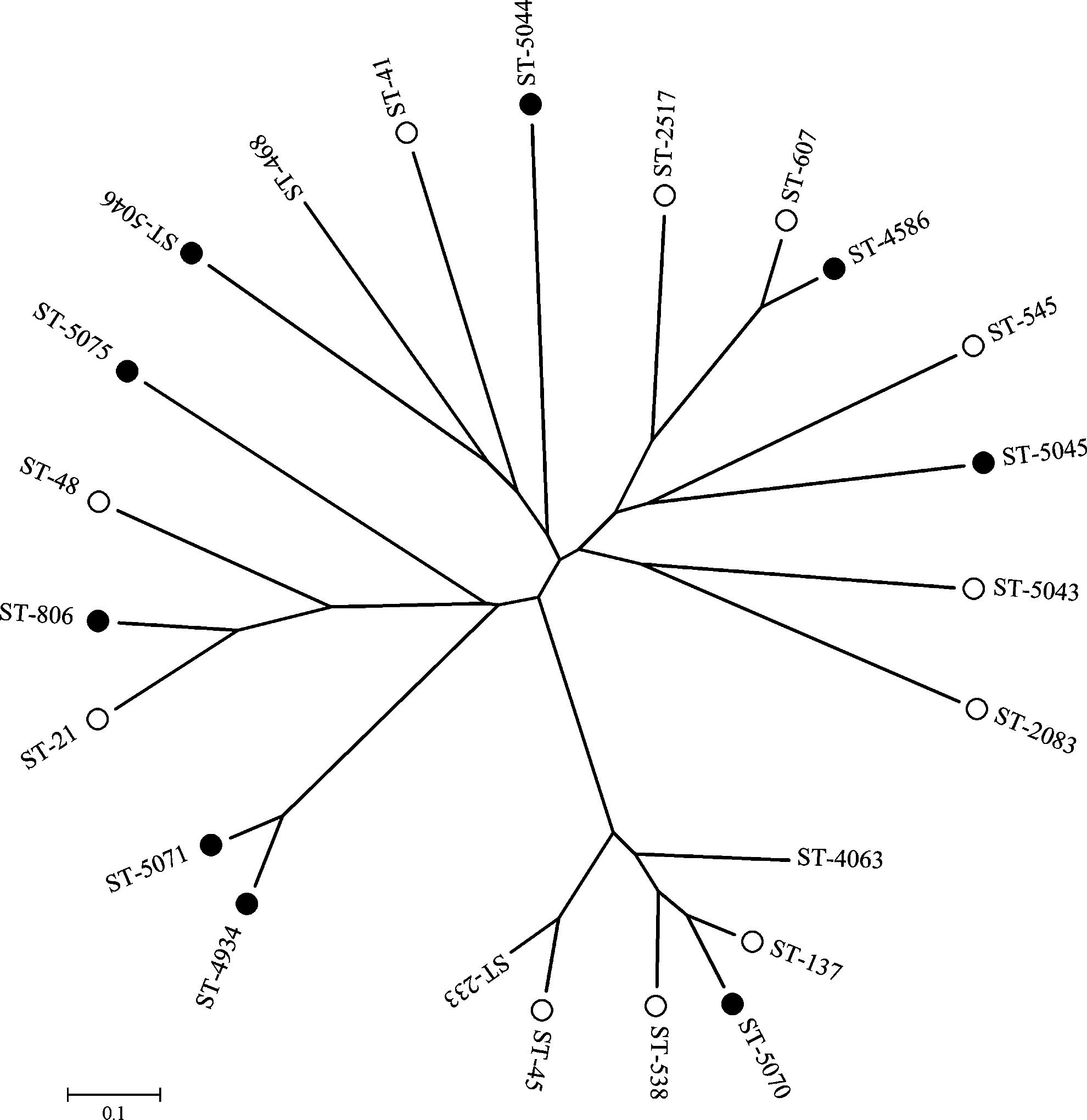
Neighbor-joining tree created with the 23 sequence types (STs) of Campylobacter jejuni to indicate the relationships within 121 C. jejuni human isolates. The dendrogram was constructed using the program MEGA 4. Open circles indicate the STs representing multidrug resistance. Closed circles indicate the novel STs identified in this study and submitted to the multilocus sequence-typing database. These represent the novel STs with multidrug resistance.
Sequence type and new sequence types identified in this study are in boldface.
New alleles identified in this study are in italics.
CC type, clonal complex type; —, unassigned.
Discussion
Campylobacter jejuni has been one of the leading causes of gastrointestinal illness of humans in recent years. 3 In this study, we found that the isolation rate of Campylobacter from cases of food poisoning in Korea within a 3-year period showed a declining trend, while antimicrobial resistance showed year-to-year fluctuations. Year-to-year fluctuations in antimicrobial resistance did not seem to be directly linked to the total amount of antimicrobial consumed. The mechanisms behind the decrease in the incident number of infections are possibly multifactorial and are not understood in detail. Consumption and handling of raw or undercooked have generally been accepted as the main source of human infections in recent years. 3 The application of control measures such as Hazard Analysis and Critical Control Points (HACCP) aimed at improving the level of food safety has been initiated and expanded since 1998 in Korea. This measure has played a key role in the reduction of Campylobacter infection cases.
The resistance rates of Campylobacter vary from country to country, which seems to be related to not only the extent of antimicrobial use but also the lack of uniformly applicable interpretive standards.8,19,20 In 2009, Campylobacter showed 100% resistance to enrofloxacin and tetracycline, which are chiefly used to treat animal diseases. 21 In Korea and other countries, tetracycline is the most widely used antimicrobial for veterinary use. For instance, in 2007 and 2008, about 624 and 470 tons of tetracycline, respectively, were sold. 1 The use of fluoroquinolones in animals was banned in Korea in July 2008, but fluoroquinolones produced before June 30, 2008, could still be used for 2 years. The amounts of macrolide and quinolone sold during the same period were 75–69 and 57–51 tons, respectively. The total amounts of antimicrobials sold over a 4-year period (2006–2009) were 1,457, 1,526, 1,210, and 998 tons, respectively. 1
Several reports describe an increase in resistance rates to ciprofloxacin among human isolates of Campylobacter species after enrofloxacin was licensed for veterinary use. 21 Thus, the increase in the sales of antimicrobials for animal use could explain increased ciprofloxacin resistance rates in the human isolates. According to reports by other Korean researchers, 14 who covered a different period in 2004, the resistance rates of C. jejuni poultry isolates to ampicillin was 43.1%, to ciprofloxacin was 92.2%, to chloramphenicol was 2.6%, to gentamicin was 6.9%, and to tetracycline was 99.1%. The resistance rate to each antimicrobial agent was found to be higher than our results, with the only exception being gentamicin, which was nearly same as this study.
Significant differences in antimicrobial resistance were observed between the STs. Campylobacter jejuni isolates with ST-45 and ST-468 were susceptible to all antimicrobials, while 13 isolates belonging to the nine new STs exhibited concurrent resistance to enrofloxacin and tetracycline. In particular, six isolates were multidrug resistant. One isolate obtained from a patient returning to Korea from South Asia belonged to the new ST group and was resistant to all seven tested antimicrobials. Further study to characterize the antimicrobial resistance mechanism of the travel-related strain is under way.
The most predominant ST CC of C. jejuni human isolates in Korea was ST-45 CC, which was reported as the predominant C. jejuni ST CC in isolates from chicken, turkey, and human diarrheal stool samples in sporadic cases.17,22,23,26 The ST-45 CC has a wide host range, including bovines, dogs, wild birds, and even penguins in Antarctica. It has also been isolated from raw milk, natural water, and soil. 12 In contrast, the most common CC type occurring worldwide, ST-21 CC,12,13,30 was detected in only five samples in this study, indicating that ST-21 CC is not the major type in Korea. ST-22 has been detected worldwide as a minor ST, but it is frequently reported in Japan. 30 ST-22 was not detected in this study. ST-468 and ST-538 were detected as the second most common STs in our samples. These two STs have been found in human diarrheal isolates (http://pubmlst.org/campylobacter). Determinations made on the basis of the Simpson's index of diversity showed that the human Campylobacter isolates were not highly diverse, suggesting that the common source of infection was related to human isolates.
This study demonstrates that the majority of the Campylobacter isolates obtained from human samples in Korea are C. jejuni with ST-45 CC, which has been detected mainly in broilers worldwide, and all strains with new STs were uniformly resistant to enrofloxacin and tetracycline. This study indicates that broilers may be a breeding ground for bacteria, while also being an important potential source of human campylobacteriosis. The multidrug-resistant new STs may have occurred under the selective pressure of antimicrobial resistance. To our knowledge, this is the first report from Korea providing an overview of the genotypes of C. jejuni human isolates as identified by PCR and MLST analysis as well as their antimicrobial susceptibilities. This study will contribute to the search for preventive and control measures that can effectively block contamination of human foods and improve the efficacy of antimicrobial therapy during outbreaks as well as in sporadic cases of Campylobacter infection.
Footnotes
Acknowledgment
This work was supported by the National Research Foundation of Korea (NRF) grant funded by the Korea Government (MEST) No. 2010-0024440.
Disclosure Statement
No competing financial interests exist.