




Abstract
We analyzed extended-spectrum β-lactamase (ESBL)-producing Escherichia coli (226) and Klebsiella pneumoniae (53) collected from urine specimens during 2005–2009 for the presence of ESBL genes, class 1 integrons, and characterization of gene cassettes. TEM and CTX-M β-lactamase genes were the most prevalent. One hundred and forty-four E. coli and 35 K. pneumoniae were positive for the class 1 integrase gene; among them, 99 E. coli and 14 K. pneumoniae detected gene cassettes. Gene cassette regions were identified by restriction fragment length polymorphism and DNA sequencing analysis. Eleven distinct gene cassette arrays were found in E. coli isolates, and seven distinct gene cassette arrays were found in K. pneumoniae isolates. The cassette array aacA4-catB8-aadA1 was first found in E. coli and dfrA1-orfC was first reported in K. pneumoniae. Most of the gene cassettes found in this class 1 integrons were for aminoglycoside resistance. Enterobacterial repetitive intergenic consensus–polymerase chain reaction fingerprint patterns revealed the isolates carrying gene cassettes were genetically unrelated. In conclusion, we studied the class 1 integrons among urinary isolates of ESBL-producing E. coli and K. pneumoniae in Southern China during the past 5 years and found that class 1 integrons were widely disseminated and played a major role in antibiotic resistance.
Introduction
The rapid dissemination of antibiotic resistance genes by horizontal gene transfer is a major cause for concern in bacterial isolates. Recent studies have shown that mobile and mobilizable DNA elements, such as integrons, play an important role in the development and dissemination of antibiotic resistance.6,17,21 Integrons are defined as site-specific recombination systems that are capable of integrating and expressing open reading frames contained in modular structures called mobile gene cassettes. 12 Different classes of integrons are characterized by sequence differences in the intI gene encoding an integrase.
Class 1 integrons possess two conserved segments (CSs), the 5′-CS and the 3′-CS, separated by a variable region, which includes integrated antibiotic resistance gene cassettes of different lengths, arrangements, and sequences. 12 In the clinical environment, three main groups or classes of integrons associated with antibiotic resistance have been described. Class 1 integrons are most frequently found in clinical isolates of Gram-negative bacteria. 21
The aim of this work was to screen the incidence of class 1 integrons and characterize antibiotic resistance genes inserted into class 1 integrons among the urinary isolates of ESBL-producing E. coli (ESBL-EC) and ESBL-producing K. pneumoniae (ESBL-KP) from patients with UTIs collected during a five-year period (2005–2009) in Southern China.
Materials and Methods
Bacterial strains
Two hundred and twenty-six ESBL-EC and 53 ESBL-KP isolates were isolated from hospitalized patients with UTIs at Nanfang Hospital, a 2,200-bed tertiary-level teaching hospital in Guangzhou, China, between January 2005 and December 2009. These strains were collected from urine specimens from diverse units in the hospital, and repeat isolates from the same patients were excluded. All bacterial identification and susceptibility testing were performed by the automated BD Phoenix 100 Automated Microbiology System (Becton, Dickinson and Co.). A panel of 19 antimicrobial agents were tested, including ampicillin, ampicillin–sulbactam, amoxicillin–clavulanic acid, piperacillin, piperacillin–tazobactam(4 mg/L tazobactam), ceftazidime, cefotaxime, cefazolin, cefepime, imipenem, meropenem, aztreonam, chloramphenicol, levofloxacin, ciprofloxacin, gentamicin, tetracycline, trimethoprim–sulfamethoxazole, and amikacin. Isolates were stored at −80°C in a nutrient broth containing 30% v/v glycerol. Control strains (E. coli ATCC 25922 and K. pneumoniae ATCC 700603, Staphylococcus aureus ATCC 25923, and Pseudomonas aeruginosa ATCC 27853) were included for testing.
DNA extraction for use as polymerase chain reaction template
DNA was extracted based on the phenol-chloroform extraction method 18 from fresh overnight cultures grown in a 5 ml Luria broth at 150 rpm. One milliliter of the culture was treated with 20 mg/L proteinase K in the presence of 10% sodium dodecyl sulfate, which efficiently lysed the cells. Equal volumes of a phenol:chloroform:isoamyl alcohol (25:24:1, v/v) mixture and samples were mixed to remove proteins from nucleic acids. The DNA was washed with 70% ethanol to remove organic solvents, and the pellet was redissolved in 200 μl of the TE buffer.
Polymerase chain reaction amplification of ESBL genes, class 1 integrase gene, and gene cassette regions
Polymerase chain reaction (PCR) screening was performed for ESBL genes of the isolates, including blaTEM, blaSHV, and blaCTX-M.1,14 The conserved regions of class 1 integrase gene were amplified using the primers IntI1-F(5′-GCATCCTCGGTTTTCTGG-3′) and IntI1-R(5′-GGTGTGGCGGGCTTCGTG-3′) to detect the class 1 integron as described previously. 22 Amplification of the variable region of class 1 integrons was performed using the primers 5′-CS (5′-GGCATCCAAGCAGCAAG-3′)/3′-CS (5′-AAGCAGACTTGACCTGA-3′). 15 The PCR amplifications were performed in a total volume of 20 μl containing approximately a 50 ng template, 4 μM of the stock primer solution, 4 mM each dNTP, 2 μl of the 10×PCR buffer, and 1 U Extaq DNA polymerase (Takara), which allowed amplification of longer products than Taq DNA polymerase, with 20-kb lengths possible from genomic DNA. Sterilized distilled water was then added to make a final volume of 20 μl. The PCR cycle consisted of denaturation at 94°C for 5 min, followed by 35 cycles of 30 sec at 94°C, annealing for 40 sec at 55°C, and extension at 72°C for 40 sec for the class 1 integrase gene and 4 min for the variable region. The PCR products were separated by electrophoresis at 100 V through 1.0% agarose gel with 0.5× TBE running buffer, stained with ethidium bromide, and visualized under UV light.
Restriction fragment length polymorphism and sequencing of gene cassette regions
To determine identical arrays of gene cassettes, same-sized amplicons were digested with RsaI (Takara) and HinfI (Takara) restriction enzymes, which was dependent on the species. Amplicons showing the same restriction fragment length polymorphism (RFLP) pattern were deemed to be identical, and one representative product of each distinct RFLP was purified and sequenced at the Beijing Genomics Institute. The resulting DNA sequences were analyzed with the BLAST program at the homepage of the National Center for Biotechnology Information (www.ncbi.nlm.nih.gov/blast/).
Enterobacterial repetitive intergenic consensus sequence-PCR analysis
Enterobacterial repetitive intergenic consensus (ERIC)-PCR was performed with 99 ESBL-EC and 14 ESBL-KP strains that detected gene cassettes. Total DNA was amplified with the ERIC-2 primer (5′-AAGTAAGTGACTGGGGTGAGCG-3′) 23 using a standard reaction mixture (100 ng template DNA, 2.5 ml 10×buffer solution, 1.35 μl (10 pmol/μl) ERIC2 primer, and 4 μl dNTP mixture (2.5 mM each dNTP), 1 U ExTaq DNA polymerase (Takara), and the following parameters: one cycle of 94°C for 5 min; 35 cycles of 94°C for 30 sec, 52°C for 45 sec, and 72°C for 10 min. Amplicons were separated by electrophoresis on 1.5% agarose gels and stained with ethidium bromide.
Results
Presence of ESBL genes
Most of the isolates contained either blaTEM, blaCTX-M, or both. The blaTEM was amplified from 201 (89.2%) ESBL-EC isolates, 37 (69.3%) ESBL-KP isolates; blaSHV was amplified from 2 (4.5%) ESBL-KP isolates; blaCTX-M was amplified from 76 (34.3%) ESBL-EC isolates, 24 (45.5%) ESBL-KP isolates.
Presence and characterization of class 1 integrons in ESBL-EC isolates
The class 1 integrase gene was detected in 144 (63.7%) ESBL-EC strains during 2005–2009. Integrase-positive strains were further analyzed by the amplification of the variable region. Ninety-nine of the isolates were positive for the variable region and the inserted gene cassette sizes varied in size from 0.6 to 3.0 kb (Table 1). Eight isolates implying the presence of at least two distinct class 1 integrons in the same isolate. Gene cassette arrays could be divided into 11 types according to their restriction fragment lengths of the variable region-positive strains. Upon sequencing, the 11 different gene cassette arrays contained a total of 14 different gene cassettes (Table 1). The genes dfrA17 encoding trimethoprim resistance and aadA5 encoding streptomycin/spectinomycin resistance had a high prevalence.
Gene cassette arrays were first found in some species.
No. of Gene cassette-positive isolates/No. of intI 1 gene-positive isolates.
Presence and characterization of class 1 integrons in ESBL-KP isolates
Of the 53 ESBL-KP isolates tested, 35 carried class 1 integrase genes. Integrase-positive strains were further analyzed by the amplification of the variable region to determine its presence and size. Fourteen of the isolates were positive with an amplicon size in the range of 0.7–4.6 kb. Two bands were detected in a single isolate. All were subjected to restriction analysis, and their product sizes were compared. These were separated into a total of seven distinct profiles. Sequencing results revealed that 7 gene cassette arrays contained a total of 19 different gene cassettes (Table 1).
ERIC-PCR analysis of ESBL-EC and ESBL-KP strains detected gene cassettes
ERIC-PCR analysis was performed to determine the genetic relatedness of isolates carrying gene cassettes. Genotyping for 99 ESBL-EC 14 ESBL-KP strains that detected gene cassette clinical isolates was performed using the ERIC-2 fingerprinting assay. ERIC-PCR yielded a complex banding pattern varying from 1 to 12 bands ranging in size from 0.1 to 6.0 kb. Based on the results of cluster analysis, these isolates were considered as being unrelated (Figs. 1 and 2).
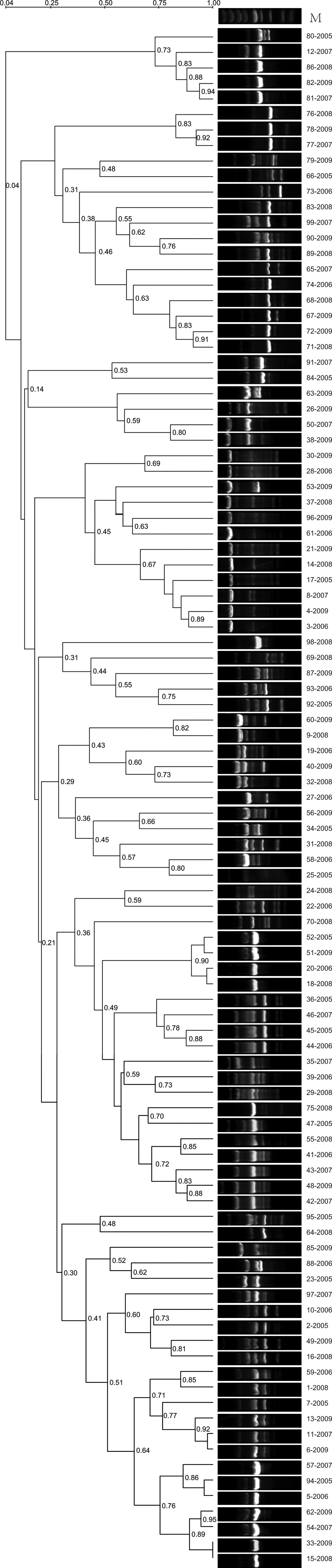
Enterobacterial repetitive intergenic consensus polymerase chain reaction (ERIC-PCR) profile of 99 gene cassette-positive extended-spectrum β-lactamase-producing Escherichia coli. 1–63 E. coli isolates carrying dfrA17-aadA5.

ERIC-PCR profile of 14 gene cassette-positive ESBL-producing K. pneumoniae.
Discussion
Integrons have become an important means of horizontal transfer of resistance genes in clinical isolates.19,21 The present study characterized class 1 integrons and their gene cassettes in urinary isolates of ESBL-EC and ESBL-PK collected from clinical patients over the past five years. Sixteen different gene cassette arrays were found in class 1 integrons. A total of 25 gene cassettes were observed by amplification of the cassette region of class 1 integron. The gene cassettes included those containing genes encoding resistance to trimethoprim (dfrA1, dfrA5, dfrA12, dfrA17, dfrA25, and dfrA2d), aminoglycosides (aadA1, aadA2, aadA5, aadB, aacA1, aacA4, and aacC1), β-lactamase (blaOXA-10), chloramphenicol (cmlA1, cmlA7, catB3, and catB8), rifampicin (aar-2), and macrolide (ereC), and proteins of unknown function. Forty-five (31.3%) ESBL-EC isolates and 21 (60.0%) ESBL-PK isolates containing the IntI1 gene failed to produce an amplicon using primers 5′-CS and 3′-CS. This was probably due to defects or mutations in the 3′-CS or gene cassette array in novel, complex unusual class 1 integrons.2,13
One hundred and forty-four of the 226 ESBL-EC isolates (63.7%) carried class 1 integrons, and this detection rate was comparable with previously reported frequencies: 59.7% in Spain 17 ; 55.0% in Palestine 9 ; and 70.9% in Taiwan. 8 For ESBL-EC isolates, dfrA17-aadA5, which was prevalent in Enterobacteriaceae isolates in Korea, 11 China,5,8,24 and Palestine, 9 was a common cassette array, and ERIC-PCR fingerprint patterns revealed that these ESBL-EC isolates harboring dfrA17-aadA5 were not clonal. The gene cassette tnpA-rve, which encodes transposase, allows genetic fragments to be integrated into host genomes, and it is used in nature, for example, to confer drug resistance in bacteria. 7 The aacA4-catB8-aadA1 array was first found in E. coli, which is prevalent in Acinetobacter spp. and was detected in ESBL-PK in this study, indicating that the gene cassette array may be disseminated among different species in China.
We observed a lower class 1 integron prevalence in ESBL-PK (66.0%) compared to the previously reported frequencies of 92% in India, 3 93.2% in Shan Dong, China, 25 73% in Australia, 10 and 70% in the United States. 20 The gene cassettes commonly detected among class 1 integrons of ESBL-PK over the past 5 years were dfrA12-orfF-aadA2 and dfrA17-aadA5. The cassette array dfrA1-orfC has not been reported previously in K. pneumoniae, although it is present in Acinetobacter baumannii, Salmonella, and Vibrio cholerae.
In our study, TEM and CTX-M β-lactamase was the most prevalent. Although all the isolates exhibited the ESBL activity, no cassette encoding ESBLs was found, indicating that ESBL genes were rarely spread by integron.
In this study, the frequency of class 1 integrons among the urinary isolates of ESBL-EC and ESBL-PK demonstrates that these genetic structures are widespread among isolates from Southern China. The wide distribution of integrons in the urinary isolates of ESBL-EC and ESBL-PK might become a serious threat to the search for effective antimicrobial therapy in the future. Therefore, continued monitoring of antimicrobial resistance from Southern China is urgently needed.
Footnotes
Disclosure Statement
All authors state that no competing financial interests exist.