




Abstract
Plasmid-mediated quinolone-resistance (PMQR) genes were determined by polymerase chain reactions (PCRs) in 250 Escherichia coli isolates from food-producing animals in Guangdong, China, in 2009–2010. Then, the prevalence of plasmid-mediated β-lactamase and 16S rRNA methylase genes was determined by PCRs among the PMQR-positive isolates. One hundred fifty-seven (62.8%) isolates were found to harbor at least one PMQR gene, and qnrS (84) and oqxAB (97) were the most two prevalent PMQR genes. β-lactamase (ESBL and/or AmpC type) genes were detected in 106 of the 157 PMQR-positive strains. The blaTEM-1 (78) was the most prevalent β-lactamase gene in the 157 PMQR-positive isolates, followed by blaCMY-2 (28), blaCTX-M (25), blaSHV-1 (3), and blaDHA-1 (3). Twenty-nine were detected to produce more than one type of β-lactamase. The rmtB was the most prevalent 16S rRNA methylase gene detected (11.5%, 18/157), and armA was detected in only two (1.27%, 2/157) isolates, with one isolate coharboring rmtB and armA. Sixteen isolates were found to coharbor the three types of resistance genes detected in this study. Only 1 transconjugant JGDA2 harboring oqxAB, aac(6′)-Ib-cr, blaDHA-1, and rmtB was obtained from the 16 isolates harboring the three types of resistance genes, by conjugation experiment. The results of Southern blot hybridization revealed that oqxAB, blaDHA-1, and rmtB were colocated on the same plasmid of ∼54 kb in the JGDA2. To our knowledge, this is the first description of the coexistence of the oqxAB, rmtB, and blaDHA-1 resistance genes on the same plasmid in one E. coli strain.
Introduction
Since 1998, a number of plasmid-mediated quinolone resistance (PMQR) mechanisms have been described: the pentapeptide-repeat family Qnr proteins (QnrA, QnrB, QnrS, QnrC, and QnrD),3,14,18,34,51 AAC(6′)-Ib-cr, an aminoglycoside acetyltransferase that confers reduced susceptibility to ciprofloxacin by modifying ciprofloxacin, 40 QepA, an efflux pump belonging to the major facilitator subfamily, 57 and OqxAB, a multidrug efflux pump that confers resistance to multiple agents, which has been recently reported to reduce susceptibility to ciprofloxacin and nalidixic acid. 13 Except for oqxAB, other PMQR genes were often found to be strongly associated with extended-spectrum β-lactamase (ESBL), AmpC β-lactamase, or 16S rRNA methylase genes, and some were often found to be located on the same plasmid.2,31 Reports on the prevalence of coexistence of PMQR, β-lactamase, and 16S rRNA methylase genes on the same isolate have increased in the past years, and most of them were about Enterobacteriaceae of human origin.31,38,42,46
However, reports about E. coli isolates from farm animals are very few.27,54 Because antibiotic resistant bacteria from food-producing animals can be transferred to humans through the food chain or other routes,33,39 monitoring antimicrobial resistance in bacteria from the food-producing animals is important for ensuring food safety and public health.
Since oqxAB was reported to be related to reduced susceptibility to ciprofloxacin and nalidixic acid, 13 it has been found among E. coli isolates from animals and humans.22,62 There has been some concern about whether it would be linked to other resistance determinants. Although one recent report described that oqxAB and an ESBL-encoding gene blaCTX-M-24 were simultaneously colocated on the same plasmid, 29 epidemiological data regarding oqxAB colinked with other resistance genes in E. coli clinical isolates are lacking.
The aims of this study were to investigate the prevalence of the β-lactamase and 16S rRNA methylase genes among PMQR-positive E. coli isolates from farm animals in South China, and to study the coexistence of multiple resistance genes, especially oqxAB.
Materials and Methods
Bacterial isolates
A total of 250 E. coli isolates were collected from 21 food-producing animal farms all over the Guangdong province between September 2009 and April 2010. One hundred nine isolates (76 from healthy pigs and 33 from diseased pigs) were isolated from rectal swabs of pigs in a farm in Guangdong 2009. One hundred forty-one (86 ducks, 51 pigs, and 4 geese) were collected from the liver, heart, lung, or muscle samples of diseased or dead animals from 20 animal farms in Guangdong in April 2010. Antimicrobials, including ciprofloxacin, streptomycin, ceftiofur, and florfenicol, were often used to treat the animals on the farms. Samples were seeded on MacConkey agar, and one colony with typical E. coli morphology was selected from each sample. Each isolate was from an individual animal. The bacterial strains were identified by classical biochemical methods and confirmed using the API-20E system (bioMérieux). All confirmed E. coli isolates were stored at −80°C in the Luria–Bertani broth medium containing 30% glycerol. E. coli C600, resistant to streptomycin, or E. coli J53Azir, resistant to sodium azide, was used as the recipient strain in the conjugation experiments. E. coli DH5α served as a recipient strain for DNA cloning.
Antimicrobial susceptibility testing
Susceptibilities to ciprofloxacin, levofloxacin, nalidixic acid, streptomycin, amikacin, gentamicin, florfenicol, chloramphenicol, ampicillin, ceftiofur, doxycycline, and tetracycline of the 250 isolates were assayed by the agar dilution method, according to the guidelines of the Clinical and Laboratory Standards Institute (CLSI) (2009). As there are no CLSI breakpoints for florfenicol and ceftiofur that are applicable to E. coli of animal origin, the breakpoints of florfenicol (≥32 mgL−1) and ceftiofur (≥8 mgL−1) were referred to CLSI document M100-S18 (2008) for isolates of animal origin. E. coli ATCC 25922 was used as a quality control strain in antimicrobial susceptibility testing experiments.
Detection of PMQR determinants
All 250 clinical E. coli isolates were screened for the presence of qnrA, qnrB, qnrS, qnrC, qnrD, aac(6′)-Ib-cr, qepA, oqxA, and oqxB by PCR amplification, using specific primers described previously.3,29,32,51,60 E. coli J53Azir containing the plasmid pMG254 (kindly provided by Minggui Wang) was used as a qnrA-positive control, and strains containing qnrB, qnrS, aac(6′)-Ib-cr, qepA, qnrD, oqxA, and oqxB, respectively, reported in our previous studies,7,60,62 were also used as positive controls for the target genes in the PCR-screening experiments. The DNA sequences obtained after direct sequencing of the amplification products and the deduced amino acid sequences were confirmed using the BLAST algorithm available through the National Center for Biotechnology Information (NCBI).
Detection of β-lactamase (ESBL and AmpC β-lactamase) and 16S rRNA methylase genes
All PMQR-positive isolates were further analyzed for the presence of β-lactamase genes (blaTEM, blaSHV, blaCTX-M-1G, blaCTX-M-9G, blaCTX-M-2G, blaCTX-M-25G, blaCMY-2, and blaDHA) and 16S rRNA methylase genes (armA, rmtA, rmtB, rmtC, and rmtD), using previously published primers and protocols.1,8,30,36,53
Conjugation experiment
Isolates harboring three types of the following resistance genes simultaneously, PMQR determinants, β-lactamase genes, and 16S rRNA methylase genes, were selected for conjugation experiments by the broth-mating method using E. coli C600 or E. coli J53 as the recipient. 5 Transconjugants were selected on MacConkey agar plates containing streptomycin (1,000 mg/L) and ampicillin (200 mg/L) or sodium azide (200 mg/L) and ampicillin (200 mg/L). The transconjugants harboring the three type genes mentioned above were confirmed by PCR as previously and antimicrobial susceptibility testing for the transconjugants, recipient, and donor. The transconjugants were distinguished from the donor strains by Repetitive-sequence-based PCR.
Analysis of genetic relatedness
To determine the genetic backgrounds of the E. coli isolates, chromosomal DNAs of 10 E. coli isolates randomly selected from the isolates harboring the three types of genes were digested with the restriction enzyme XbaI and then subjected to pulse-field gel electrophoresis (PFGE) analysis using the CHEF-MAPPER System (Bio-Rad Laboratories) as described by Gautom. 11 The gels were run at 6.0 V/cm with an initial/final switch time of 2.2 sec/54.2 sec and an angle of 120° at 14°C for 20.3 hr. The results were interpreted according to the criteria of Tenover et al. 47 S. enterica serotype Braenderup H9812 standards served as size markers.
Statistical analysis
Differences in proportions were compared using the χ2-test. All tests of significance were two-tailed, and a value of p<0.05 was considered statistically significant. Statistical analysis was performed with SPSS software (Version 17.0).
Results
Antimicrobial susceptibility testing
Almost all the E. coli isolates were highly resistant to nadidixic acid (98%), and the resistance rates to ciprofloxacin and levofloxacin were 78% and 72%, respectively. The antimicrobial resistance rates to other antibiotics were as follows: ampicillin (99.2%), tetracycline (98.4%), chloramphenicol (96.3%), florfenicol (94%), doxycycline (90%), ceftiofur (78.4%), gentamicin (72.8%), streptomycin (72.8%), and amikacin (23.2%). With regard to multidrug resistance profiles, 23.6% of the total isolates were resistant to 10 antimicrobials tested; 19.2% were resistant to 11; 18.8% were resistant to 9; 13.2% were resistant to 8, 9.6% were resistant to all 12 antimicrobials; 7.6% were resistant to 7, 5.6% were resistant to 6; 1.2% were resistant to 5; 0.8% were resistant to 4; and 0.4% (1) were resistant to 3 antimicrobials. The most frequently observed pattern of multidrug resistance was chloramphenicol-florfenicol-gentamicin-streptomycin-ampicillin-ceftiofur-nalidixic acid-ciprofloxacin-levofloxacin-tetracycline.
Prevalence of PMQR determinants
As shown in Table 1, 157 (62.8% of the total) isolates carried at least one PMQR gene, with qnr, aac(6′)-Ib-cr, qepA, and oqxAB being detected alone or in combination in 93 (37.2%), 68 (27.2%), 3 (1.2%) and 97 (38.8%) strains, respectively. qnrB and qnrS were detected in 16 (6.4%) and 84 (33.6%) isolates, respectively. qnrA, qnrC, and qnrD were not found in this study. oqxAB and qnrS were the most two common PMQR genes. Among the 157 (62.8%) PMQR-positive isolates, 80 isolates were positive for more than one PMQR gene, and combinations of oqxAB-qnrS (n=24) and oqxAB-qnrS-aac(6′)-Ib-cr (n=16) were the most two common combination types. Eight other combination types of PMQR were also found in this study (Table 1).
PMQR, plasmid-mediated quinolone resistance.
β-lactamase and 16S rRNA methylase genes in PMQR-positive isolates
The β-lactamase (ESBL and/or AmpC type) genes were detected in 67.5% (106/157) of the PMQR-positive strains. As shown in Table 1, blaTEM-1 (76, 48.4%) was the most prevalent β-lactamase gene among the 157 isolates, followed by blaCMY-2 (28, 17.8%), and blaCTX-M (25, 15.9%). Only three isolates (1.9%, 3/157) were found to carry blaSHV-1 and blaDHA-1, respectively. Twenty-nine (18.5%) isolates were detected to produce more than one type of β-lactamase.
16S rRNA methylase genes were detected in 12.1% (19/157) of the PMQR -positive isolates. Among the 19 isolates producing 16S rRNA methylases, rmtB detected in 18 isolates was the most prevalent 16S rRNA methylase gene. armA was detected in only 2 (1.27%) isolates, and 1 isolate was confirmed to harbor both armA and rmtB. The rmtA, rmtC, and rmtD genes were not detected in the 157 PMQR -positive isolates. As shown in Table 1, 16 isolates were found to coharbor the three types of resistance genes detected in this study. Detailed information on the distribution of β-lactamase and 16S rRNA methylase genes among the 157 PMQR- positive isolates is listed in Table 1.
Conjugation experiment
Only one transconjugant JGDA2 harboring oqxAB, aac(6′)-Ib-cr, blaDHA-1, and rmtB was successfully obtained from the 16 isolates harboring the three types of resistance genes, by conjugation experiment. The transconjugants showed a multidrug resistance phenotype that included resistance to nalidixic acid, ampicillin, and chloramphenicol. Transconjugants showed 32-fold and 16-fold increases in the minimum inhibitory concentration (MIC) of nalidixic acid and ciprofloxacin, respectively, when compared with the recipient strain E. coli J53. With regard to the MICs of chloramphenicol and doxycycline, they both showed eightfold increases. For the β-lactam antibiotics, the transconjugants showed 64-fold and 2-fold increases in the MICs of ampicillin and ceftriaxone, respectively, when compared with the recipient. The transconjugants showed about 4-fold and 32-fold increases in the MICs of gentamicin and amikacin, respectively. To confirm whether these genes were located on the same plasmid, Southern blot hybridization was performed with digoxigenin-labeled probes specific for oqxB, blaDHA-1 and rmtB. The results revealed the colocalization of oqxAB, bla DHA-1, and rmtB on the same plasmid of ∼54 kb in the E. coli GDA2 and its transconjugant JGDA2 (Fig. 1).
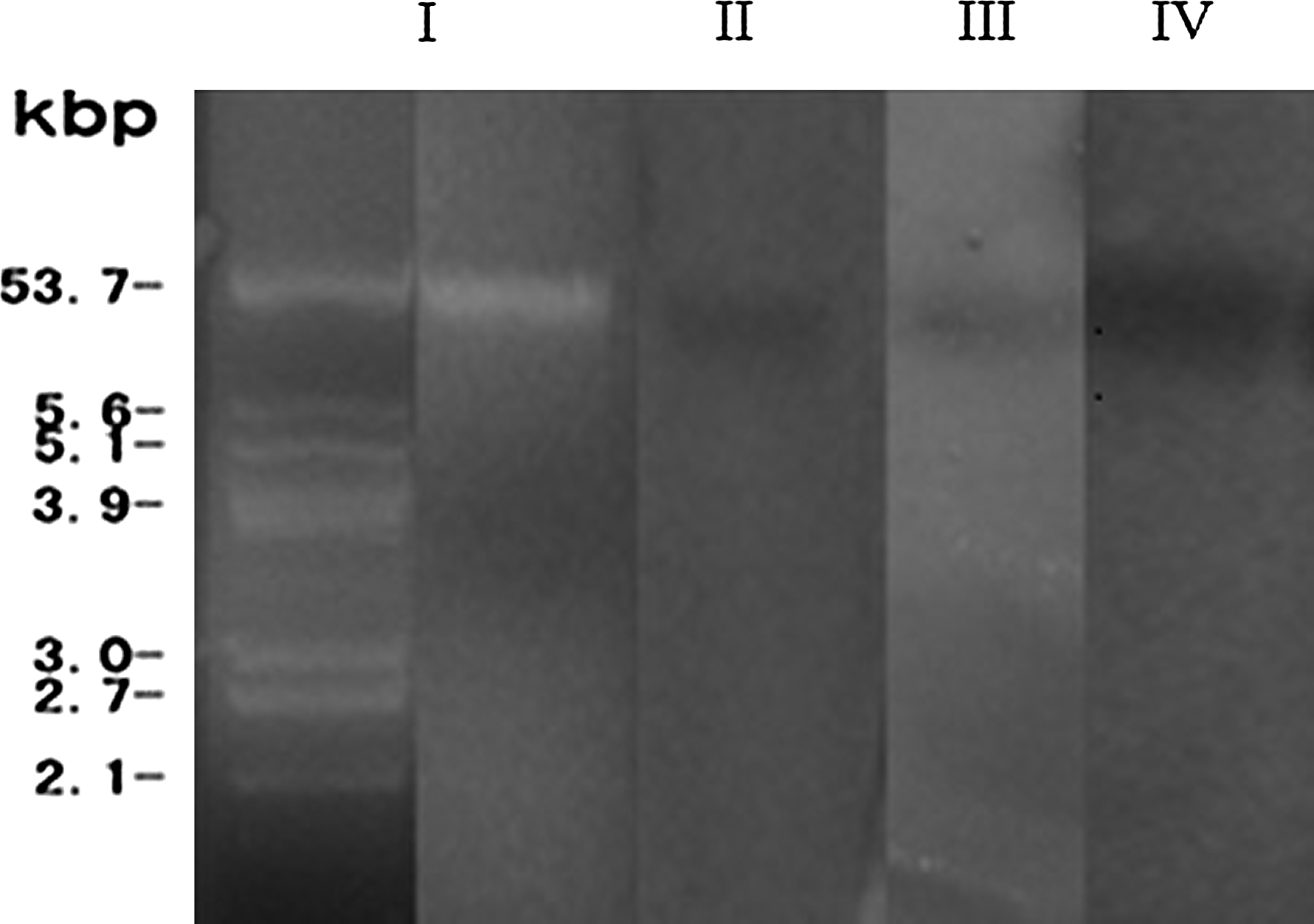
Panel I showed electrophoresis of the plasmid of transconjugant Escherichia coli JGDA2, and the left line was the plasmid profile of E. coli standard V517. Panels II, III, and IV showed the results of Southern blot analysis of uncut plasmid hybridized with oqxAB(II), blaDHA-1 (III), and with rmtB (IV), respectively.
Analysis of genetic relatedness
Of the 10 multidrug-resistant E. coli, chromosomal DNAs of 9 isolates were available for PFGE typing and 8 XbaI-pulsed-field gel electrophoresis patterns were observed, with GD5 and GD10 showing identical PFGE patterns (Fig. 2). It is suggested that the dissemination of multidrug resistance was not mainly due to the clonal dissemination of multidrug resistance E. coli.
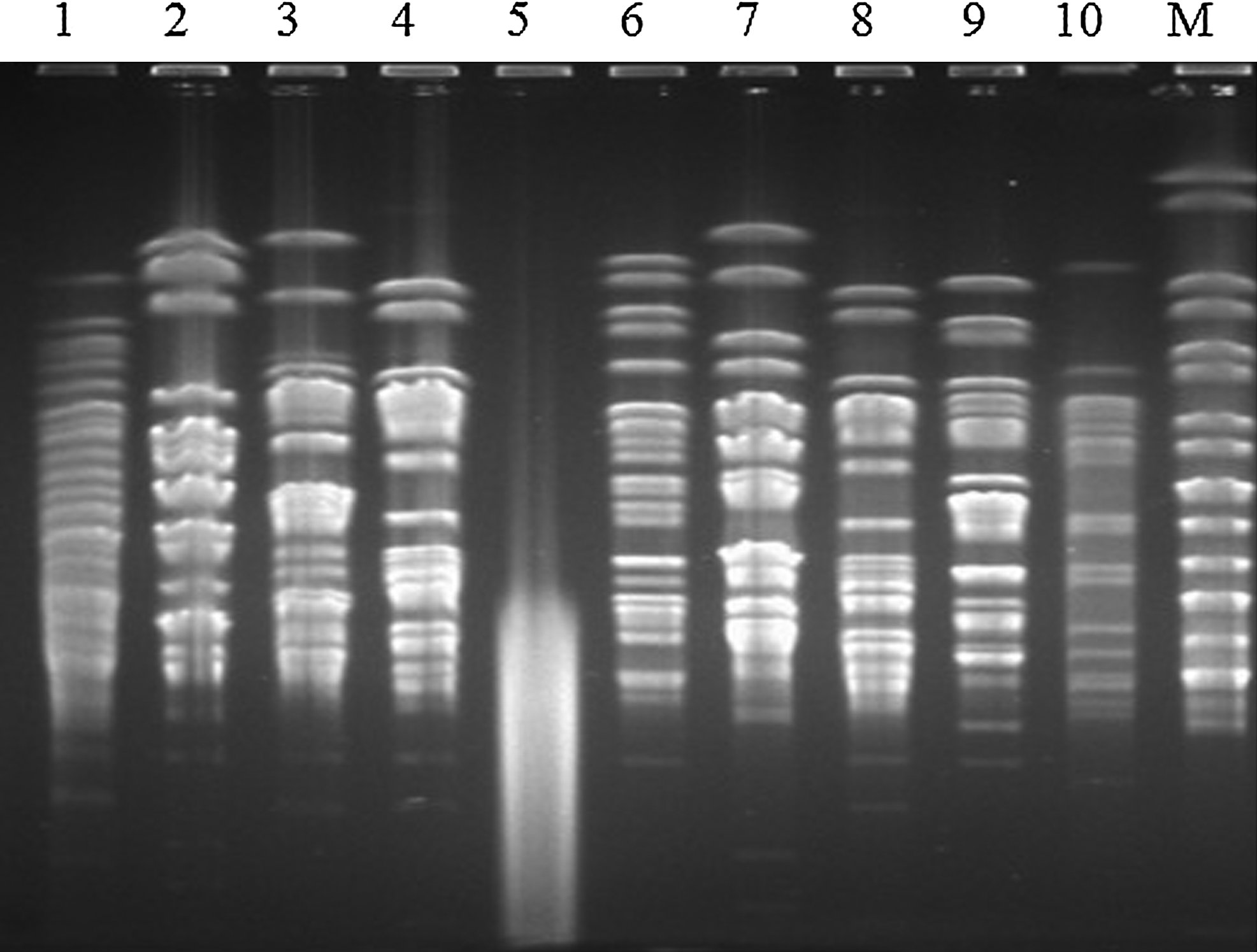
Pulse-field gel electrophoresis fingerprinting patterns of XbaI-digested total DNA preparations from 10 E. coli isolates harboring PMQR, β-lactamase, and 16S rRNA methylase genes. Lanes: M, S. enterica serotype Braenderup H9812 standards; 1, GD8; 2, GD3; 3, GD9; 4, GD10; 5, GDA2; 6, GD4; 7, GD7; 8, GD5; 9, GD6; 10, GD1.
Discussion
High antimicrobial resistance in bacteria resulting from the frequent use of antimicrobials as therapy or feed additives in animals is becoming a serious concern in China. 58 In this study, the E. coli isolates showed alarming frequencies of resistance to many antimicrobial agents commonly used in China. Almost all the E. coli isolates (98%) in this study were resistant to nalidixic acid, and very high rates of ciprofloxacin (78%) and levofloxacin (72%) resistance were also observed in the E. coli isolates. Somewhat similar findings have also been reported in other studies in China, where >65% of E. coli from farm animals, especially diseased animals, and humans were resistant to ciprofloxacin.24,28,56 However, fluoroquinolone resistance in E. coli isolates in other countries was low, with 16% of the E. coli isolates from avian in the United States and 8.0% E. coli isolates from pigs in Korea.26,63 The high rates of resistance to fluoroquinolones in this study might support the speculation that widespread addition of quinolones to animal feed in China was associated with the high rates of fluoroquinolones resistance among Enterobacteriaceae. Similar to the findings of previous studies,20,24,52 most E. coli isolates described here were resistant to older, frequently administered antibiotics such as streptomycin, chloramphenicol, ampicillin, and tetracycline.
Most E. coli isolates in this study showed high resistance to florfenicol (94%), which is much higher than that reported in previous studies in China,20,52 and this might be attribute to the frequent use of florfenicol on these farms. The rate of resistance to amikacin (23.2%) was relatively low, compared with the other antimicrobial agents tested in the study, and similar findings were also observed in other studies in China.24,52 This result indicated that amikacin was not frequently used in veterinary medicine in China. The rate of resistance to ceftiofur was up to 78.4%, higher than that in previous studies,52,58 although it was the only cephalosporin approved for systemic use in food-producing animals in China, and the high frequency of resistance to ceftiofur might be attribute to the long-term use of it in veterinary medicine in China and the common use of it on these farms described here.
Recently, several studies on the prevalence of PMQR determinants among E. coli isolates of animal origin have been reported10,32,48,60; however, oqxAB was not included in those studies except two recent reports about E. coli from pigs in China.28,62 The present study demonstrated high prevalence (62.8%) of PMQR among E. coli isolates from animals in South China, and most isolates showed high-level resistance or reduced susceptibility to levofloxacin and ciprofloxacin, as well as to nalidixic acid, similar findings have also been observed in other studies among E. coli isolates.24,35 The detected rate of oqxAB (38.8%) in this study was similar to that (38.4%) in a previous report by Zhao et al., 62 but was much higher than that (6.6%) in E. coli from humans in China. 59 In China, olaquindox is widely used as a therapeutic and preventive antibiotic in swine, whereas it has been forbidden in poultry due to its toxic side effects. Furthermore, mequindox, a new synthetic quinoxaline 1,4 dioxide (QdNO) derivative, developed in China, has also been widely used in veterinary medicine in China since 1990s. 17 The high levels of prevalence and dissemination of oqxAB in E. coli isolates from animals in China might be due to the overuse or long-term use of them in food animals. In this study, oqxAB and qnrS were more common than other PMQR genes, similarly to the result of Zhao et al.; however, the positive rate of qnrS (33.6%) was significantly higher. The positive rate of qepA (1.2%) in this study was similar to that (2.9%) in pigs during 2002, 62 1.7% in ESBL-producing Enterobacteriaceae isolates in Mexico, 43 and 1.9% in ampicillin-resistant E. coli from healthy chickens and pigs in 2006, 10 but lower than that (15.8%) in ceftiofur-resistant Enterobacteriaceae from companion and food-producing animals between September 2006 and May 2007 (p<0.01). 32 qnrA, which appeared to be the most common qnr allele in E. coli in China 50 and in North America, 41 was not detected in our study. This result was in accordance with that in Enterobacteriaceae from companion and food-producing animals, 32 and in E. coli isolates from animals, farm workers, and the environment. 62 The detected rate of qnrB was 6.4%, and a similar result was also reported in China and other areas previously.10,32 In this study, the detected rate of qnrB was much lower than that of qnrS (33.6%), and the limitation in this study might come from the specific primers for qnrB we used, because such primers might not amplify all the known qnrB variants. To our surprise, in contrast to previous reports in E. coli from animals in China,60,62 an unusually high prevalence of qnrS was detected among the E. coli isolates in this study. This might be because the sampling time in this study was different from previous studies. The aac(6′)-Ib-cr carriage rate (27.2%) of the total isolates was significantly higher than that of reports from a China human hospital (3.4%) 12 and an animal survey (9.8%) (p<0.01), 16 but significantly lower than that in ESBL-producing isolates of Enterobacteriaceae (49.5%) (p<0.01). 43 Similar result was also found in ceftiofur-resistant isolates of Enterobacteriaceae from animals (18.8%). 32
qnr alleles were detected in about 48.5% (33/68) of the aac(6′)-Ib-cr-positive isolates, which was in accordance with a previous report that qnr alleles were frequently colocated with aac(6′)-Ib-cr on the same plasmid. 21 The high prevalence (62.8%) of PMQR determinants in this study, much higher than those previously found in the United States, China and Europe,37,45,62 might partly be attributed to extending our detection to include oqxAB. Furthermore, various quinolones, including enrofloxacin, ciprofloxacin, norfloxacin, and levofloxacin, approved for use in food-producing animals in China, might be another reason for the high prevalence of PMQR determinants. However, this result was in accordance with that in a recent report in E. coli from food-producing animals in China. 28
Previous studies showed that ESBL/AmpC β-lactamase genes, or 16S rRNA methylase genes, such as blaSHV-2, blaSHV-7, blaSHV-12, blaCTX-M-9, blaCTX-M-14, blaCTX-M-15, blaDHA-1 and rmtB, were often found in most PMQR-positive strains.7,44 The present study demonstrated a high prevalence (68.8%) of β-lactamase genes, especially blaTEM-1 (48.4%) and blaCMY-2 (17.8%) among the 157 PMQR-positive E. coli isolates from animals. This was in accordance with the findings that TEM-type derivatives of β-lactamases are the most common β-lactamases identified in Enterobacteriaceae of both human and animal origin.4,25,54 The prevalence of blaCMY-2 (19.2%) among the PMQR-positive isolates in this study was similar to that of a report about a chicken farm from China, 54 in which 18.6% of 220 PMQR-positive isolates carried blaCMY-2. The result in this study however differed significantly from a previous report about clinical Klebsiella pneumoniae isolates in China. 31 Only 15.9% of the PMQR-positive isolates were positive for blaCTX-M, not in accordance with the findings of previous reports that the CTX-M type ESBLs were harbored in most E. coli and K. pneumoniae.32,54 This might be due to that all 157 PMQR-producing E. coli isolates in this study were collected regardless of their susceptibilities to antimicrobials. The blaSHV-1 gene was only detected in three isolates in our study, and the reason might be that narrow-spectrum SHV-1 may have been substituted by extended-spectrum enzymes, such as CTX-M enzymes. 9 The proportion of the blaDHA-1 gene detected in 157 PMQR-producing E. coli isolates was 1.9%, similar to that in ceftiofur-resistant isolates of Enterobacteriaceae from animals in China. 32 The occurrence of blaDHA-1 in E. coli isolates from animals in China would be lower than that in other countries, and also lower than human clinical K. pneumonia isolates.19,49 All the three isolates harboring blaDHA-1 were also found to carry aac(6′)-Ib-cr and oqxAB, indicating that there might be a strong association between blaDHA-1 and aac(6′)-Ib-cr/oqxAB, and this was in accordance with the findings that aac(6′)-Ib-cr might exhibit a close relationship with blaDHA. 31
An increasing number of studies have reported the prevalence of 16S rRNA methylase genes among clinical strains, especially among quinolone-resistant isolates or ESBL-producing isolates,6,54,55 and no other type of 16S rRNA methylase genes was detected in China, except rmtB and armA. Similar result was also found in our study. Moreover, in our study, rmtB (11.5%) was more prevalent than armA (1.3%) among the PMQR-positive isolates, in accordance with previous finding that rmtB was the most prevalent 16S rRNA methylase gene among isolates of Enterobacteriaceae in China.6,54
One recent report about 94 ESBL-producing K. pneumoniae from Taiwan has shown that the blaCTX-M, blaDHA-1, qnr, aac(6′)-Ib-cr, and armA genes were simultaneously found in 11 isolates, and 4 transconjugants coharboring qnrB4, aac(6′)-Ib-cr, armA, blaCTX-M, and blaDHA-1 were available. 23 Similarly, the three types of resistance genes, including oqxAB, rmtB, and blaDHA-1, were found on the same plasmid in this study. To our knowledge, this is the first description of the coexistence of the oqxAB, rmtB, and blaDHA-1 resistance genes on the same plasmid in one E. coli strain. Moreover, in one report on 119 clinical K. pneumoniae isolates from China, 17 of the PMQR-positive isolates displayed a cefotaxime-ciprofloxacin-amikacin multidrug-resistant phenotype, and PMQR determinants, ESBL, and 16S RNA methylase genes were all detected in 6 isolates, simultaneously. 31 In this study, 16 isolates were found to harbor β-lactamase and 16S RNA methylase genes on the same isolate, among the 157 PMQR-positive E. coli isolates (Table 1), and various combinations of qnrS and/or aac(6′)-Ib-cr and/or oqxAB, blaTEM-1, and rmtB were mainly present in our study. These isolates were resistant to most, if not all, classes of therapeutic agents available in veterinary medicine. This might be attributed to the heavy selection pressure caused by overuse of antimicrobials, especially quinolones, or the possibility of cross-selection with other antimicrobials used in veterinary medicine (such as β-lactams and aminoglycosides) might explain this result. Although the multidrug resistance in food-borne pathogens is relatively small in numbers, in comparison with those from humans, 46 coexistence of different classes of resistance genes in the same bacterial isolate will potentially select multidrug resistances and pose threat to both animal and human health; thus, surveillance for bacterial isolates carrying multiple resistance genes in animals is warranted.
Conjugation experiments suggested that the dissemination of multidrug resistance among E. coli in veterinary clinic in China might be mediated by horizontal dissemination of conjugative plasmids harboring various genes. It is necessary to pay more attention to transferable multidrug resistance mechanisms among common opportunistic pathogens. The result of PFGE indicated that multidrug-resistant isolates in this study were caused by horizontal spread rather than the spread of clonal strains.
In conclusion, we report the high prevalence (62.8%) of multiple PMQR determinants, including oqxAB in E. coli and the high prevalence of β-lactamase and 16S RNA methylase genes among the PMQR-positive E. coli strains from food-producing animals in China between September 2009 and April 2010. The high prevalence of multidrug resistance in E. coli may be attributable to horizontal spread of the plasmid coharboring the related resistance determinants among different isolates or species. Overuse of various antimicrobials in food production may have served as a major cross-selection pressure for the selection of multidrug resistance in E. coli of animal origin. This is the first report on the prevalence of combinations of oqxAB, β-lactamase genes, and 16S RNA methylase genes, and like other PMQR genes, oqxAB was commonly found with other resistance genes in the same isolate. To our knowledge, this is also the first description of the coexistence of the oqxAB, rmtB, and blaDHA-1 resistance genes on the same plasmid in one E. coli strain.
Footnotes
Acknowledgments
This work was supported by the National Science Fund for Distinguished Young Scholars (Grant No. 31125026), the Special Fund for Agroscientific Research in the Public Interest (Grant No.201203040), the National Natural Science Foundation of China (Grant No. U0631006), and Natural Science Foundation of Guangdong Province of China (Grant No. S2011010001133).
Author Disclosure Statement
No competing financial interests exist.