




Abstract
Retail meat products could serve as an important medium for the transfer of multidrug resistant isolates from food-producing animals to the community. In this study, the prevalence and characteristics of cefotaxime and ciprofloxacin co-resistant Escherichia coli isolates were investigated in retail chicken and ground pork samples from four provinces of China. The isolates were subjected to phylogenetic group typing and antimicrobial susceptibility testing. All isolates were further characterized by pulsed-field gel electrophoresis to determine the genetic relatedness. These isolates were also screened for beta-lactamase genes, quinolone resistance determinants by PCR, and followed by DNA sequence analysis. Cefotaxime and ciprofloxacin co-resistant E. coli isolates with diverse genetic origins were recovered in 31.9% (106/332) of retail meat samples. E. coli isolates of phylogenetic group A were dominant (59.4%, 63/106), and all isolates showed multidrug resistant profiles. The dominant resistant profiles were AMP-CAZ-CTX-CIP-CHL-GEN-SXT-TET (n=43) and AMP-CAZ-CTX-CIP-CHL-SXT-TET (n=43). Point mutations in quinolone resistance determination regions of topoisomerases were identified in all the isolates, and most of the isolates accumulated three (n=78) or four (n=21) point mutations. Plasmid-mediated quinolone-resistant determinants were identified in 68 isolates, including oqxAB (n=66), qnrS1 (n=7), qnrS2 (n=4), and aac(6')-Ib-cr (n=9). Eight subtypes of blaCTX-M were identified in 103 E. coli isolates, and blaCTX-M-55 (n=90) was dominant. This study highlights that retail meat could serve as an important reservoir of cefotaxime and ciprofloxacin co-resistant E. coli isolates. It is necessary to evaluate their contribution in the community and hospital infections.
Introduction
E
Fluoroquinolones and third-generation cepholosprins are important antimicrobial classes in clinical treatment for community infections. 14 Recent studies have shown that food-producing animals and retail food products might be important reservoirs of extended-spectrum β-lactamase (ESBL)-resistant E. coli isolates.6,41 E. coli isolates resistant to both cefotaxime and ciprofloxacin are known to have greater threat to humans, because they can limit the treatment options. 14 Studies have reported the wide distribution of cefotaxime and ciprofloxacin co-resistant E. coli isolates among patients and the emerging of cefotaxime and ciprofloxacin co-resistant E. coli isolates in retail meat samples,12,16 but limited data are available for the distribution and characteristics of cefotaxime and ciprofloxacin co-resistant E. coli isolates in retail meat of China. In addition, China is one of the main antimicrobial production bases for the world. 26 Of the 210,000 tons of antibiotics made in China, 97,000 tons of antibiotics are used in animal breeding each year. 42 The large volume of antimicrobial use in livestock significantly increases the prevalence of antimicrobial-resistant bacteria in retail meat products, and the poultry farming in large cities usually used a large volume of antimicrobials in disease prevention because of the high density of chicken in limited areas.
The objectives of this study are to investigate the prevalence of cefotaxime and ciprofloxacin co-resistant E. coli isolates in retail chicken and ground pork samples. The characteristics of these isolates and the resistant mechanisms of cefotaxime and ciprofloxacin were fully investigated.
Materials and Methods
Sample collection and cefotaxime and ciprofloxacin co-resistant E. coli isolation
From April to December in 2011, retailed whole chicken carcasses were collected from 29 supermarkets and 15 farmer’ markets (retail market featuring foods sold directly by farmers to consumers) of eight districts or counties in Beijing, Guangdong, Inner Mogolia, and Shanxi province. Ground pork samples were collected from eight supermarkets and from four farmer’ markets in Beijing and Shanxi province. No more than three samples were collected from each market for one visit during the study.
Whole chicken carcass and ground meat samples were shipped to the laboratory within 24 hrs on ice. Each whole chicken carcass was thoroughly rinsed with 500 ml buffered peptone water (BPW; BD), and each 25 g ground pork sample was stomached with 225 ml BPW. After incubation at 36±1°C for 20–22 hrs, 100 μl of BPW culture were transferred to 10 ml EC broth (BD) and incubated at 44±1°C with shaking at 100 rpm for 20–22 hr. A loopful of EC broth culture was streaked on to Statens Serum Institut (SSI) enteric agar (Statens Serum Institut, Denmark) supplemented with 4 μg/ml ciprofloxacin and 8 μg/ml cefotaxime, and the plates were incubated at 36±1°C for 22–24 hrs. A single red colony was selected from each plate and confirmed by the API 20E test (BioMérieux). All confirmed E. coli isolates were kept in brain heart infusion broth with 50% glycerol in a −70°C freezer for subsequent susceptibility testing and molecular analysis.
Antimicrobial susceptibility testing
Antimicrobial susceptibility of all the E. coli isolates was determined by agar dilution method with use of the anti-bacterial determiner (SAKUMA) to control the inoculum volume, and interpreted according to the Clinical and Laboratory Standards Institute (CLSI) guidelines. 5 Susceptibility to 12 antimicrobials was measured for all isolates, including ampicillin (AMP, 1–128 μg/ml), cefotaxime (CTX, 0.015–128 μg/ml), cefotaxime-clavulanic acid, ceftazidime (CAZ, 0.03–64 μg/ml), ceftazidime-clavulanic acid, chloramphenicol (CHL, 1–128 μg/ml), ciprofloxacin (CIP, 0.015–512 μg/ml), gentamicin (GEN, 0.125–64 μg/ml), imipenem (IMP, 0.03–16 μg/ml), tetracycline (TET, 0.25–64 μg/ml), tigecycline (TGC, 0.015–32 μg/ml), and trimethoprim-sulfamethoxazole (SXT, 0.06/1.19–16/304 μg/ml). Isolates showing a ≥3 twofold concentration decrease in an MIC for either ceftazidime or cefotaxime tested in combination with clavulanic acid versus the MIC of the agent when tested alone were considered as ESBL producing (for example, ceftazidime MIC=8 μg/ml; ceftazidime-clavulanic acid MIC=1 μg/ml). All ESBL-producing isolates were counted as resistant to ceftazidime and cefotaxime as recommended by the CLSI standards. 5 E. coli ATCC 25922, E. coli ATCC 35218, and Klebsiella. pneumoniae ATCC 700603 were used as quality control organisms in antimicrobial susceptibility tests. Antimicrobial susceptibility data were analyzed by Whonet 5.4 software (World Health Organization) according to the CLSI interpretive standards. The tigecycline MIC interpretive breakpoints were recommended by the European Committee on Antimicrobial Susceptibility Testing (EUCAST-2012; www.eucast.org).
PCR amplification and DNA sequence analysis
All the E. coli isolates were screened by PCR for transferable quinolone resistance determinants qnrA, qnrB, qnrC, qnrD, qnrS, oxqAB, aac-(6′)-Ib, and qepA as previously described.24,28,39 All PCR products positive for aac-(6′)-Ib were digested with BtsCI (New England Biolabs, Beijing, China) to identify aac-(6′)-Ib-cr that lacked the BtsCI restriction site, while the wild-type aac-(6′)-Ib PCR product yielded 210-bp and 272-bp fragments after digestion. 24 Salmonella enterica isolates carrying qnrA, qnrB6, qnrD, qnrS2, and aac-(6′)-Ib-cr from a previous study 7 and an E. coli C600 derivative harboring qepA that was confirmed by sequencing were used as control organisms. The quinolone resistance determination regions (QRDRs) of gyrA, gyrB, parC, and parE in E. coli isolates were amplified by PCR as previously described. 13
A multiplex PCR was used to screen for blaCTX-M in all the ESBL-producing isolates, 38 and the sequences of blaCTX-M-like genes were analyzed by primer pairs of M9, M13, and M25 as previously described. 11 Another multiplex PCR method was applied to screen for plasmid-mediated AmpC encoding genes in clavulanic acid-resistant isolates. 25 All the PCR products were either directly sequenced or cloned into pMD18-T plasmid (Takara Biotechnology Cooperation, Dalian, China) for sequence analysis at Takara Biotechnology Cooperation. The sequences obtained were analyzed by Sequencher 4.6 software (Gene Codes Corporation). The qnrS allele numbers were designated based on the qnr gene nomenclature. 17 The search for homologous sequences was performed by using the BLASTN program at the U.S. National Center for Biotechnology Information Website (www.ncbi.nlm.nih.gov/BLAST/). New blaCTX-M-like sequences identified in this study have been submitted to the National Center for Biotechnology Information Data Libraries(GenBank) and the Lahey Clinic database (www.lahey.org/Studies/).
Phylogenetic analysis
Phylogenetic analysis of recovered isolates was determined through the presence or absence of chuA, yjaA, and TspE4.C2 as previously described. 4
Pulsed-field gel electrophoresis
All E. coli isolates were analyzed by pulsed-field gel electrophoresis (PFGE) to determine DNA fingerprinting profiles resulting from digestion by restriction enzyme XbaI (New England Biolab, Beijing LTD) according to the procedures developed by the United States Centers for Disease Control and Prevention (U.S. CDC) PulseNet program. 27 The interpretation of the PFGE patterns was performed with BioNumerics software (Applied Maths) using the Dice Similarity coefficient. The tree indicating relative genetic similarity was constructed on the basis of the Unweighted Pair Group Method of Averages (UPGMA), position tolerance of 1%. Clusters were defined as DNA patterns sharing ≥70% similarity (C1, C2, C3,···).
Statistical analysis
The differences of frequencies were analyzed by Chi-square test using Epi Info 6 software (www.cdc.gov/epiinfo/).
Results
Sample collection and E. coli recovery
In total, 214 whole chicken carcasses were collected from 29 supermarkets and 15 markets of eight districts or counties in Shanxi (n=91), Guangdong (n=63), Inner Mogolia (n=53), and Beijing (n=7). Cefotaxime and ciprofloxacin co-resistant E. coli isolates were recovered from 80 (37.4%) chicken samples. This prevalence was found to be significant in the four provinces with the highest prevalence in Beijing (100%, 7/7) and the lowest prevalence in Inner Mongolia (5.7%, 3/53) (χ2=69.524, p<0.05) (Table 1).
Of the 118 ground pork samples collected from eight supermarkets and four farmers' markets in Shanxi province (n=81) and Beijing (n=37), cefotaxime and ciprofloxacin co-resistant E. coli isolates were recovered from 22.0% (n=26) samples, which was similar to those (32.7%, 32/98) of chicken samples in the same sampling region (χ2=3.074, p>0.05) (Table 1).
Of the 106 cefotaxime and ciprofloxacin co-resistant E. coli isolates, phylogenetic group A was dominant (59.4%, 63/106), followed by group B1 (25.5%, 27/106), D (14.2%, 15/106), and B2 (0.9%, 1/106). No region or sample category-specific distribution pattern was identified for phylogenetic groups (Table 1).
Antimicrobial susceptibility testing
All 106 E. coli isolates showed multidrug resistant profiles (at least resistant to three categories of antimicrobials). The dominant resistant profiles were AMP-CAZ-CTX-CIP-CHL-GEN-SXT-TET (n=43) and AMP-CAZ-CTX-CIP-CHL-SXT-TET (n=43), which were also the dominant resistance profiles of isolates from Beijing (72.2%, 13/18), Guangdong (84.4%, 38/45), and Shanxi provinces (82.5%, 33/40). No correlation was identified for antimicrobial resistance profiles and phylogenetic group or sample categories (Table 2). All the 106 E. coli isolates were resistant to ampicillin, cefotaxime, ceftazidime, and ciprofloxacin and susceptible to imipenem and tigecycline. These isolates also showed high resistance prevalence to tetracycline (94.3%, 100/106), trimethoprim-sulfamethoxazole (94.3%, 100/106), chloramphenicol (88.7%, 94/106), and gentamicin (50.9%, 54/106) (Table 3). In total, 103 isolates (97.2%, 103/106) that exhibited at least a ≥3 twofold concentration decrease in an MIC for either ceftazidime or cefotaxime tested in combination with clavulanic acid versus the MIC of the agent when tested alone were confirmed as ESBL producers.
The percentage in this type of resistant profiles.
AMP, ampicillin; CAZ, ceftazidime; CTX, cefotaxime; CHL, chloramphenicol; CIP, ciprofloxacin; GEN, gentamicin; SXT, trimethoprim/sulfamethoxazole; TET, tetracycline.
All antimicrobial breakpoints were recommended by the CLSI-M100-S21, except the tigecycline whose breakpoint was recommended by the EUCAST-2012.
MIC, minimal inhibitory concentration; MIC10, MIC50, MIC90, 10%, 50%, or 90% of isolates were inhibited.
The percentage of the antibiotics in this province.
Identification of quinolone-resistant determinants
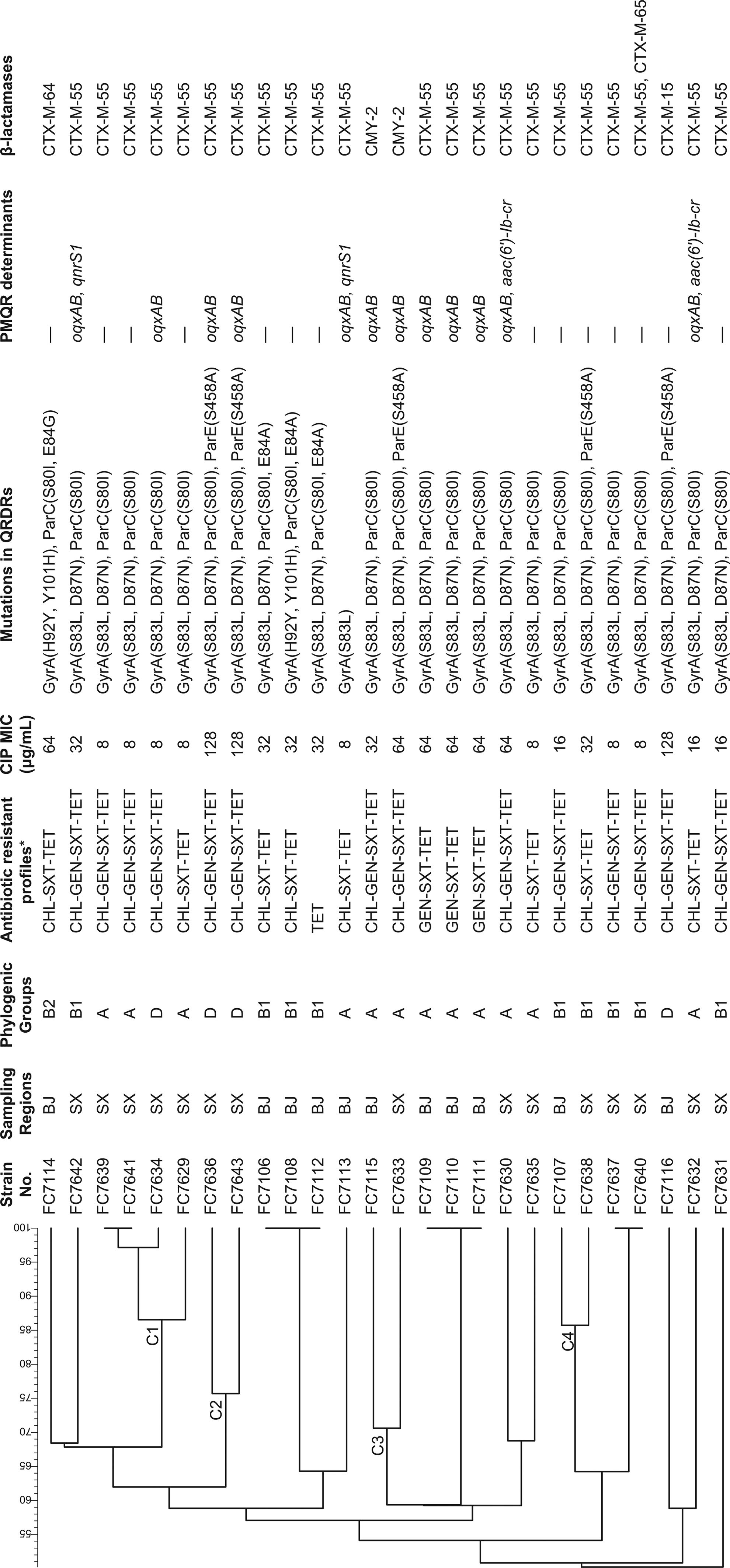
Point mutations in QRDRs of GyrA, GyrB, ParC, or ParE were identified in all 106 cefotaxime and ciprofloxacin co-resistant E. coli isolates. Three-point mutations in QRDRs were found in 78 isolates with GyrA(S83L, D87N) and ParC(S80I) as the dominant profile (72/106, 67.9%). Four-point mutations were found in 21 isolates (21/106, 19.8%) with profiles GyrA(S83L, D87N), ParC(S80I), and ParE(S458A) as the dominant (n=9), followed by GyrA(S83L, D87N) and ParC(S80I, E84G) (n=4), GyrA(S83L, D87N) and ParC(S80I, E84A) (n=3), and ciprofloxacin MIC of all these isolates was ≥32 μg/ml. Four isolates had single-point mutations in GyrA (S83A or S83L) also acquired one (qnrS), two (qnrS and oqxAB), or three Plasmid-Mediated Quinolone Resistance (PMQR) determinants (qnrS2, aac(6')-Ib-cr, and oqxAB). Three isolates accumulated two topoisomerase point mutations in GyrA (S83L), and ParC (S80I or E84V) also acquired two PMQR determinants (qnrS and oqxAB).
Among the 106 cefotaxime and ciprofloxacin co-resistant E. coli isolates, PMQR determinants were identified in 68 isolates (68/106, 64.2%) from both chicken (n=56) and ground pork (n=12) samples, including oqxAB (n=66), qnrS1 (n=7), qnrS2 (n=4), and aac(6')-Ib-cr (n=9). Compared with the pork isolates (46.2%), chicken isolates (67.5%) showed higher prevalence of oqxAB, and isolates of phylogenetic groups A (45/63, 71.4%) and D (11/15, 73.3%) showed higher oqxAB prevalence than isolates of phylogenetic group B1 (10/27, 37.0%). The following PMQR determinants, including qepA, qnrA, qnrB, qnrC, and qnrD, were not detected in all these 106 isolates. Sixteen isolates (16/106, 15.1%) possessed more than one PMQR determinant. Two PMQR determinants were identified in each of the 14 isolates from chicken (n=10) and ground pork (n=4) samples, including oqxAB and aac(6')-Ib-cr (n=6), oqxAB and qnrS1(n=6), and oqxAB and qnrS2 (n=2). Three PMQR determinants (qnrS2, oqxAB, and aac(6')-Ib-cr) were identified simultaneously in two chicken isolates from Shanxi and Guangdong provinces.
Among the 63 (63/106, 59.4%) ciprofloxacin highly resistant (MIC≥32 μg/ml) isolates from chicken (n=48) and ground pork (n=15) samples, a minimum of three topoisomerase point mutations and one PMQR determinant were identified in each of the 50 isolates. Four topoisomerase point mutations in each of the ten isolates, two topoisomerase point mutations (GyrA[S83L], ParC[S80I]), and two PMQR determinants (qnrS2 and oxqAB) in one isolate were identified. Among the 17 isolates showing ciprofloxacin MIC≥128 μg/ml from chicken (n=14) and ground pork (n=3) samples, three isolates accumulated four-point mutations in QRDRs; 14 isolates had acquired both point mutations (three [n=5] or four [n=9] mutations) in QRDRs and a minimum of one PMQR determinant.
Identification of β-lactam resistance genes
Among the 103 ESBL-producing E. coli isolates from chicken and ground pork samples, eight subtypes of blaCTX-M were identified, including blaCTX-M-55 (n=90), blaCTX-M-123 (n=4), blaCTX-M-15 (n=4), blaCTX-M-64 (n=2), blaCTX-M-65 (n=8), blaCTX-M-14 (n=3), blaCTX-M-27 (n=2), and blaCTX-M-132 (n=2). The novel blaCTX-M-123 variant with nine-point mutations (S121T, Q195N, H200K, E204D, T205S, L214M, R225Q, T230A, and T233V) was identified in two isolates recovered from chicken samples in Guangdong and Shanxi provinces, respectively (Fig. 1). This new blaCTX-M gene has been assigned accession numbers in the GenBank and the Lahey Clinic database as JX313020 (CTX-M-132). E. coli isolates containing blaCTX-M-55 were recovered from four sampling provinces: Guangdong 40 isolates from chicken, Shanxi 33 isolates from chicken (n=19) and ground pork (n=14), Beijing 14 isolates from chicken (n=6) and ground pork (n=8), and Inner Mongolia three isolates from chicken. In each of the 12 (11.3%, 12/106) isolates from chicken (n=10) and ground pork (n=2) samples, two blaCTX-M subtypes were detected, including blaCTX-M-55 and blaCTX-M-14 (n=3), blaCTX-M-55 and blaCTX-M-27 (n=2), blaCTX-M-55 and blaCTX-M-65 (n=6), and blaCTX-M-15 and blaCTX-M-65 (n=1). BlaCMY-2 was identified in three clavulanic acid-resistant isolates from chicken (n=1) and ground pork (n=2) samples.

Dendrogram of patterns generated by pulsed-field gel electrophoresis (PFGE) of Escherichia coli isolates collected from chicken. *Since all E. coli isolates were resistant to ampicillin, ceftazidime, ciprofloxacin, and cefotaxime, these four antimicrobials were not shown in the resistant profiles. “–” denotes not detected. CHL, chloramphenicol; GEN, gentamicin; SXT, trimethoprim/sulfamethoxazole; TET, tetracycline; PMQR, plasmid-mediated quinolone resistance; QRDRs, the quinolone resistance-determining regions; BJ, Beijing; GD, Guangdong; SX, Shanxi; IM, Inner Mongolia.
PFGE analysis of E. coli isolates
No dominant PFGE cluster or pattern was identified among chicken and ground pork isolates. In total, 77 PFGE patterns and 24 PFGE clusters were identified among 80 chicken isolates and 20 PFGE patterns, and four PFGE clusters were identified among 26 ground pork isolates (Figs. 1 and 2). Three PFGE patterns of chicken isolates and four PFGE patterns of ground pork isolates contained more than one isolate, and all the isolates grouped into the same PFGE pattern were recovered from the same sampling region. Eight chicken isolate clusters (C1, C4, C8, C9, C16, C17, C21, and C22) and two ground pork isolate clusters (C1 and C2) contained isolates from the same sampling region. Of the chicken isolates, 11 clusters (C2, C5, C7, C9, C10, C12, C15, C16, C17, C20, and C22) belonged to phylogenetic group A, two clusters (C21 and C24) belonged to phylogenetic group D, and one cluster (C13) belonged to phylogenetic group B1. Of the ground pork isolates, clusters C2, C3, and C4 contained isolates of phylogentic groups D, A, and B1, respectively.
Dendrogram of patterns generated by PFGE of Escherichia coli isolates collected from ground pork samples. *Since all E. coli isolates were resistant to ampicillin, ceftazidime, ciprofloxacin, and cefotaxime, these four antimicrobials were not shown in the resistant profiles. “–” denotes not detected.
Discussion
In this study, cefotaxime and ciprofloxacin co-resistant E. coli isolates with diverse genetic origins were recovered in 37.4% (80/214) of retail chicken and 22% (26/118) of retail ground pork samples from four sampling provinces in China. In addition, chromosomal and plasmid-mediated quinolone and extended-spectrum cephalosporin-resistant mechanisms were identified in these isolates. These data added to the growing evidence that retail meat could serve as an important medium to transfer multidrug resistant isolates from food-producing animals to the community and highlighted the growing problem of fluoroquinolone resistance and ESBL production in E. coli isolates of meat origins.9,23 To the best of our knowledge, this is the first report focusing on cefotaxime and ciprofloxacin co-resistant E. coli isolates from retail meat products in China.
The PFGE profile variation of the 106 isolates from retail chicken and ground pork products demonstrated extensive genetic heterogeneity and diverse origins of these resistant isolates and also provided some information on the high transmission capacity of blaCTX-M and PMQR determinants detected in these isolates. The diverse genetic heterogeneity of these resistant isolates also indicated a long-term evolutionary process of resistant mechanisms. In addition, the high resistance ratio of these E. coli hosts to cephalosprins, trimethoprim-sulfamethoxazole, and gentamicin, which were the common antimicrobials used in clinics, can provide the resistant isolates with selective advantage over other isolates. Besides, several isolates from the same sampling region exhibiting similar or identical PFGE patterns indicate the clonal spread of cefotaxime and ciprofloxacin co-resistant strains.
Our data showed that all 106 cefotaxime and ciprofloxacin co-resistant E. coli isolates were multidrug resistant. Isolates were mostly resistant to tetracycline (94.3%), trimethoprim-sulfamethoxazole (94.3%), chloramphenicol (88.7%), and gentamicin (50.9%), which indicated the popular usage of these antimicrobials in the food-producing animals. All the isolates accumulated the same fluoroquinolone and cepholosprin-resistant mechanisms as in isolates from patients, which highlighted the fact that retail meat might be a reservoir of these resistant isolates.32,40 However, in some isolates, both chromosomal and varying plasmid-mediated quinolone-resistant mechanisms were accumulated, and these isolates showed higher ciprofloxacin MIC (≥32 μg/ml), which further indicated the long-term evolutionary process of these isolates in resistance development (Figs. 1 and 2). Since these isolates were co-resistant to both cefotaxime and ciprofloxacin, the alternative antimicrobial treatment options will be limited once these isolates infect the community population, which might also significantly increase the mortality and financial burdens.15,34 Furthermore, this study revealed that blaCTX-M-55 was identified in 90 out of 106 E. coli isolates recovered from retail meat products. Since blaCTX-M-55 has been widely detected in both animal and clinical isolates and blaCTX-M is usually located on conjugative plasmids,19,20,30 the contribution of blaCTX-M-55 in retail meat to the community infections should be studied at the molecular level through DNA sequence analysis of the genetic environment of blaCTX-M-55.
Our data showed that the prevalence of cefotaxime and ciprofloxacin co-resistant E. coli isolates in retail chicken and ground meat was region specific, which might be related to the use of antimicrobials in farms. The lowest prevalence was in Inner Mongolia (5.7%, 3/53), which was a sparsely populated under-developed province. In this province, chicken farming was usually free range and little antimicrobials were used for disease prevention and treatment. However, for large cities as in Beijing, chicken was usually raised in a high density and large volumes and different categories of antimicrobials, such as enrofloxacin and ceftiofur, were widely used for both disease prevention and treatment. 21 Althogh only seven chicken samples were collected in Beijing in this study, cefotaxime and ciprofloxacin co-resistant E. coli isolates were recovered from all these samples.
E. coli isolates of phylogenetic B2 and D groups usually carry the greatest number of virulence factors and most commensal isolates belong to group A.4,10 Among the 106 cefotaxime and ciprofloxacin co-resistant E. coli isolates in this study, commensal E. coli isolates belonging to group A (59.4%, 63/106) were dominant, which was similar to a recent study in Spain. 12 However, a few isolates belonging to potentially pathogenic groups D (14.2%, 15/106) and B2 (0.9%, 1/106) were also recovered. Studies have shown that E. coli in retail meat products could not only serve as a reservoir for antimicrobial-resistant determinants, but also serve as a reservoir for multidrug-resistant isolates, causing both intestinal and extra-intestinal infections.23,31,35 As the cefotaxime and ciprofloxacin co-resistant E. coli isolates became more and more prevalent in patients in China, 36 it is necessary to carry out a rigorous designed study to evaluate the contribution of meat-orginated antimicrobial-resistant isolates in the community infections and provide evidence for the development of new interventions to reduce the risk for transmission.
The value of ciprofloxacin MIC was highly related to the accumulation of resistant mechanisms. 22 In this study, all the 21 isolates with four topoisomerase point mutations showed ciprofloxacin MIC≥32 μg/ml. Isolates with higher ciprofloxacin MIC in this study usually acquired more complex quinolone-resistant determinants, including PMQR mechanisms. More than 60% of isolates in this study have acquired PMQR determinants, including oqxAB, qnrS, and aac(6')-Ib-cr (Figs. 1 and 2). Studies showed that transferable quinolone resistance determinants could allow bacteria to survive in the presence of quinonlones and substantially enhance the number of resistant mutants which can be selected from the population.29,33 However, the accurate relationship of PMQR determinants and point mutations in the QRDRs has not been clearly documented. 3 Since this study revealed a high prevalence of PMQR in the resistant isolates, it might be interesting to carry out a well-designed study to investigate the relationship between these PMQR determinants and point mutations in the QRDR in a defined chromosomal background.
The antimicrobial determinant oqxAB-containing isolates showed an unequal phylogenetic group distribution, with a lower percentage of isolates in group B1 (10/27, 37.0%), a higher percentage of phylogenetic groups A (45/63, 71.4%) and D (11/15, 73.3%) isolates. These results suggested that the acquisition of this transferable quinolone resistance determinant might be an uneven event. Since isolates of phylogenetic group D are usually more pathogenic, the virulent factors of those isolates containing transferable quinolone resistance determinants and blaCTX-M should be further characterized to clarify whether those isolates harbored common virulent factors or not.
In conclusion, our study demonstrated that retail meat products could be an important reservoir for the cefotaxime and ciprofloxacin co-resistant isolates. Since these isolates have accumulated complex resistant mechanisms, it is necessary to study their pathogenicity and evaluate its contribution in the community and hospital infections.
Footnotes
Acknowledgment
This research was supported by grant (2012ZX1000470) from the Ministry of Science and Technology, China.
Disclosure Statement
No competing financial interests exist.