




Abstract
Benzalkonium chloride is one of the invaluable biocides that is extensively used in healthcare settings as well as in the food processing industry. After exposing wild-type Salmonella Typhimurium 14028s or its AcrAB inactivation mutant to gradually increasing levels of benzalkonium chloride, resistance mutants S-41, S-150, S-AB-23, S-AB-38, and S-AB-73 were selected and these mutants also showed a 2–64-fold stable minimum inhibitory concentration (MIC) increase to chloramphenicol, ciprofloxacin, nalidixic acid, and tetracycline. In S-41 and S-150, the expression of acrB was increased 2.7- and 7.6-fold, and ΔtolC or ΔacrAB mutants of S-41 and S-150 showed the same MICs to all tested antimicrobials as the equivalent Salmonella Typhimurium 14028s mutants. However, in S-AB-23, S-AB-38, and S-AB-73, the expression of acrF was increased 96-, 230-, and 267-fold, respectively, and ΔtolC or ΔacrEF mutants of S-AB-23, S-AB-38, and S-AB-73 showed the similar MICs to all tested antimicrobials as the ΔtolC mutant of Salmonella Typhimurium 14028s. Our data showed that constitutively over-expressed AcrAB working through TolC was the main resistance mechanism in ST14028s benzalkonium chloride resistance mutants. However, after AcrAB had been inactivated, benzalkonium chloride-resistant mutants could still be selected and constitutively over-expressed, AcrEF became the dominant efflux pump working through TolC and being responsible for the increasing antimicrobial resistance. These data indicated that different mechanisms existed for acrB and acrF constitutive over-expression. Since exposure to benzalkonium chloride may lead to Salmonella mutants with a decreased susceptibility to quinolones, which is currently one of the drugs of choice for the treatment of life-threatening salmonelosis, research into the pathogenesis and epidemiology of the benzalkonium chloride resistance mutants will be of increasing importance.
Introduction
S
Currently, the food industries and hospitals are heavily relying on the sanitizers and disinfectants to prevent pathogen contamination. However, after the specific resistant mechanism of a popular used cationic sanitizer, triclosan, was reported,9,14,20 it raised a great concern for the public to re-evaluate the resistant mechanisms of other cationic agents, such as quaternary ammonium compounds. Quaternary ammonium compounds—synthetic derivatives of ammonium chloride—are the most popular active ingredients in the sanitizers and disinfectants that are commonly used in homes, hospitals, and food industries. As previously reported, after the penetration of quaternary ammonium compounds into the cell wall, they can damage the cytoplamic membrane, increase the leakage of intracelluar low-molecular-weight material, and degrade proteins and nucleic acids; finally, bacterial cells will die of the cell wall lysis caused by autolytic enzymes. 13 Although bactericidal mechanisms of quaternary ammonium compounds are nonspecific, tolerant mutants have been emerging, which indicated the adaptability of bacteria, especially Listeria, Salmonella, and Escherichia coli.3,6,16 The emerging quaternary ammonium compound-tolerant pathogens have raised great concerns, because these tolerant pathogens can not only become cross-resistant to other sanitizers, but also become cross-resistant to different structurally and functionally unrelated antibiotics.2,10
Active effluxes have been identified as the quaternary ammonium compound-resistant mechanisms in different bacteria, such as E. coli and Pseudomonas fluorescens.8,15 Active efflux transporters could extrude structurally dissimilar compounds, often providing resistance to multiple toxic agents, including antibiotics and disinfectants. 26 Efflux transporters usually function through the outer membrane proteins, such as TolC, and form a stable intermembrane multidrug efflux complex. 24 Enhanced expression of the efflux pumps AcrB and AcrF has been observed in antimicrobial-selected Salmonella mutants and clinical isolates.1,18,19
Although adaptive resistance to quaternary ammonium compounds has been reported, 2 the quaternary ammonium compound-resistant mechanisms in Salmonella Typhimurium are still poorly defined. The objective of this study is to determine the dominant quaternary ammonium compound-resistant mechanisms existing in lab-selected Salmonella Typhimurium mutants. Different benzalkonium chloride-resistant Salmonella Typhimurium mutants were selected by exposing a benzalkonium chloride susceptible Salmonella Typhimurium strain to increasing concentrations of benzalkonium chloride. Different potential benzalkonium chloride resistant mechanisms were inactivated in the benzalkonium chloride-selected mutants. The expression of the main efflux pump encoding genes was also studied by real-time polymerase chain reaction (PCR) method.
Materials and Methods
Bacterial strains, phages, and plasmids
Salmonella Typhimurium 14028s (ST14028s), phage P22HT105/1 int-201 and P22H5 were obtained from the National Center for Medical Culture Collections, Beijing, China. The phage λ Red recombinase system (plasmid pKD46, pCP20, and pDK4) has been previously described. 5 All strains identified in this study were cultured in Mueller-Hinton (MH) medium (BD, Beijing) unless noted otherwise.
Selection of Salmonella Typhimurium mutants with decreased benzalkonium chloride susceptibility
Different Salmonella Typhimurium mutants with decreased benzalkonium chloride susceptibility were selected by exposing ST14028s to increasing levels of benzalkonium chloride (Sigma-Aldrich) in MH broth. Briefly, 5 ml of wild-type ST14028s overnight culture were inoculated into 100 ml MH broth supplemented with 8 μg/ml benzalkonium chloride. After overnight incubation, a 5-ml culture was inoculated into 100 ml MH broth supplemented with a 5 μg/ml higher concentration of benzalkonium chloride (13 μg/ml). The selection process was repeated stepwise by increasing the benzalkonium chloride concentration for 5 μg/ml each time until the selection of mutants that were capable of growth in MH broth supplemented with 150 μg/ml of benzalkonium chloride. Mutants that were selected in MH broth supplemented with 41 or 150 μg/ml of benzalkonium chloride were used for further studies and designated as ST-41 or ST-150. These two mutants were transferred using a 1 μl sterile loop into 10 ml MH broth without benzalkonium chloride for 10 times with the interval for 18–20 hr. Cultures were next streaked on blood agar, and their minimum inhibitory concentrations (MICs) for benzalkonium chloride were determined by agar dilution method. A similar method was used to select benzalkonium chloride-resistant mutants from ST14028s ΔacrAB mutant by the starting benzalkonium chloride concentration of 2 μg/ml in MH broth. Mutants that were selected from MH broth supplemented with 23, 38, or 73 μg/ml of benzalkonium chloride were used for further studies and designated as ST-AB23, ST-AB38, or ST-AB73.
Construction of Salmonella Typhimurium mutants
The chromosomal acrAB, acrEF, or tolC were first inactivated in strain ST14028s using the phage λ Red recombinase system. 5 Briefly, PCR products were generated using a pair of long (60-nucleotide [nt]) primers (Table 1) and a special template plasmid (pKD4) carrying a kanamycin-resistance gene flanked by flippase (FLP) recombination enzyme target sites. The primers included 20 nt at the 5′ end for the template plasmid and 40 nt homologous extensions at the 3′ end for targeting genes. The gel-purified PCR products were electroporated into ST14028s competent cells expressing the phage λ Red recombinase (pKD46), which allowed recombination in short homologous regions. The deletion mutations were transduced to other mutants using bacteriophage P22HT105/1 int-201 following the standard protocol, and pseudolysogens were excluded by the susceptibility testing to phage P22H5. 12 Kanamycin-resistance gene was eliminated by introducing a temperature-sensitive plasmid pCP20 encoding FLP recombinase as previously described. 5 A new mutation was transduced to the gene-inactivated mutants as described earlier. All mutations were confirmed by three PCRs: the loss of PCR products by using primers corresponding to the deleted gene sequence and two PCR amplifications recommended by the gene inactivation method (Table 1). 5
Antimicrobial susceptibility testing
The MICs of chloramphenicol, tetracycline, nalidixic acid, and benzalkonium chloride were measured using agar dilution method following the Clinical and Laboratory Standards Institute (CLSI) standard protocol. 4 E. coli ATCC 25922 was included as the quality control organism in all antimicrobial susceptibility experiments.
RNA extraction and reverse-transcription PCR test
Expression of efflux gene acrB and acrF in various benzalkonium chloride selected mutants was determined by reverse-transcription PCR analysis. All tested strains were grown to mid-logarithmic phase (OD600=0.4–0.5) in MH broth at 37°C with 230 rpm shaking. Cells in 2 ml of culture were harvested using an RNAprotect reagent (Qiagen), and the total RNA was extracted using TRIZOL (Invitrogen) and cleaned up by the RNeasy Mini-kit (Qiagen) according to the manufacturer's instructions. RNA preparations were treated with RNase-free DNase (Invitrogen) on columns to remove genomic DNA contamination. An additional PCR reaction was conducted to confirm the loss of genomic DNA. RNA quantity was determined by measuring the absorbance at 260 nm, and quality was assessed by electrophoresis on 1.2% agarose gel containing 1.9% (v/v) formaldehyde. Bacterial cDNA was synthesized from total bacterial RNA by using random primer solution (Invitrogen) and Superscript III H− reverse transcriptase (Invitrogen). Real-time PCR was performed using the IQ5 multicolor real-time PCR system (Bio-Rad) with each of the specific primer pairs described in (Table 2) and iQ SYBR Green Supermix (Bio-Rad). PCR conditions included 3 min at 95°C, following by 40 cycles of 95°C for 10 sec, 60°C for 30 sec, and 72°C for 30 sec. Transcription levels of target genes were normalized using 16s RNA as an internal standard. The efficiency of amplification was determined for each primer set, and a melting curve was conducted to confirm the absence of primer-dimer formation. Real-time PCR for each gene was repeated by at least three independent trials. The ΔΔCt method was used to calculate fold induction of a target gene transcription by comparison to a value relative to the parent strain grown in MH broth at log phase.
CIP, ciprofloxacin; BKC, benzalkonium chloride; NAL, nalidixic acid; CHL, chloramphenicol; TET, tetracycline; MIC, minimum inhibitory concentration.
Results
Benzalkonium chloride-selected ST14028s mutants
After exposing wild-type ST14028s to gradually increasing levels of benzalkonium chloride in MH broth, mutants S-41 and S-150 were selected from MH broth supplemented with 41 and 150 μg/ml of benzalkonium chloride. After 10 transfers in MH broth without selective pressure, S-41 and S-150 showed stable MICs to benzalkonium chloride and other tested antimicrobials. Compared with the parental strain ST14028s, mutant S-41 and S-150 also showed a 2–8 time MIC increase to chloramphenicol, ciprofloxacin, nalidixic acid, and tetracycline (Table 2).
Antimicrobial susceptibility of gene deletion mutants
ΔtolC, ΔacrAB, and ΔacrEF mutants of ST14028s, S-41, or S-150 were constructed and confirmed as described in the “Materials and Methods” section. Compared with ST14028s, ΔtolC or ΔacrAB mutants of ST14028s showed a 2–4-fold MIC decrease to benzalkonium chloride, chloramphenicol, ciprofloxacin, nalidixic acid, and tetracycline. However, ΔtolC or ΔacrAB mutants of S-41 showed 8–16-fold MIC decreases, and ΔtolC or ΔacrAB mutants of S-150 showed 8–32-fold MIC decreases to the tested antimicrobials that behaved in a similar manner to the equivalent ST14028s mutants. No MIC changes were observed for all ΔacrEF mutants compared with their parental strains (Table 2).
Benzalkonium chloride selected ST14028s ΔacrAB mutants
After exposing ST14028s ΔacrAB mutant to increasing levels of benzalkonium chloride in MH broth, mutants S-AB23, S-AB38, and S-AB73 were selected in MH broth supplemented with 23, 38, and 73 μg/ml benzalkonium chloride. These mutants showed stable MICs for all tested antimicrobials after 10 transfers in MH broth with an interval of 20–24 hr. The colonies of mutants became tiny on MH agar after benzalkonium chloride concentration in MH broth was higher than 38 μg/ml. Compared with ST14028s ΔacrAB mutant, S-AB23, S-AB38, and S-AB73 showed a 4–64-fold MIC increase for all tested antimicrobials. The ΔtolC or ΔacrEF mutants of S-AB23, S-AB38, and S-AB73 showed a 4–128-fold MIC decrease to benzalkonium chloride and other antimicrobials. ΔtolC or ΔacrEF mutants of S-AB23, S-AB38, and S-AB73 showed similar MICs for all tested antimicrobials (Table 2).
Quantitative analysis of acrB and acrF
In S-41 and S-150, the expression of acrB was increased 2.7- and 7.6-fold, respectively, compared with their parental strain ST14028s. Although the expression of acrF was also increased 3.4 times in S150, the transcript concentration was still 80-fold lower than acrB. In the benzalkonium chloride selected ΔacrAB mutants, the expression of acrF was increased 96-, 230-, and 267-fold in S-AB23, S-AB38, and S-AB73, respectively (Fig. 1).
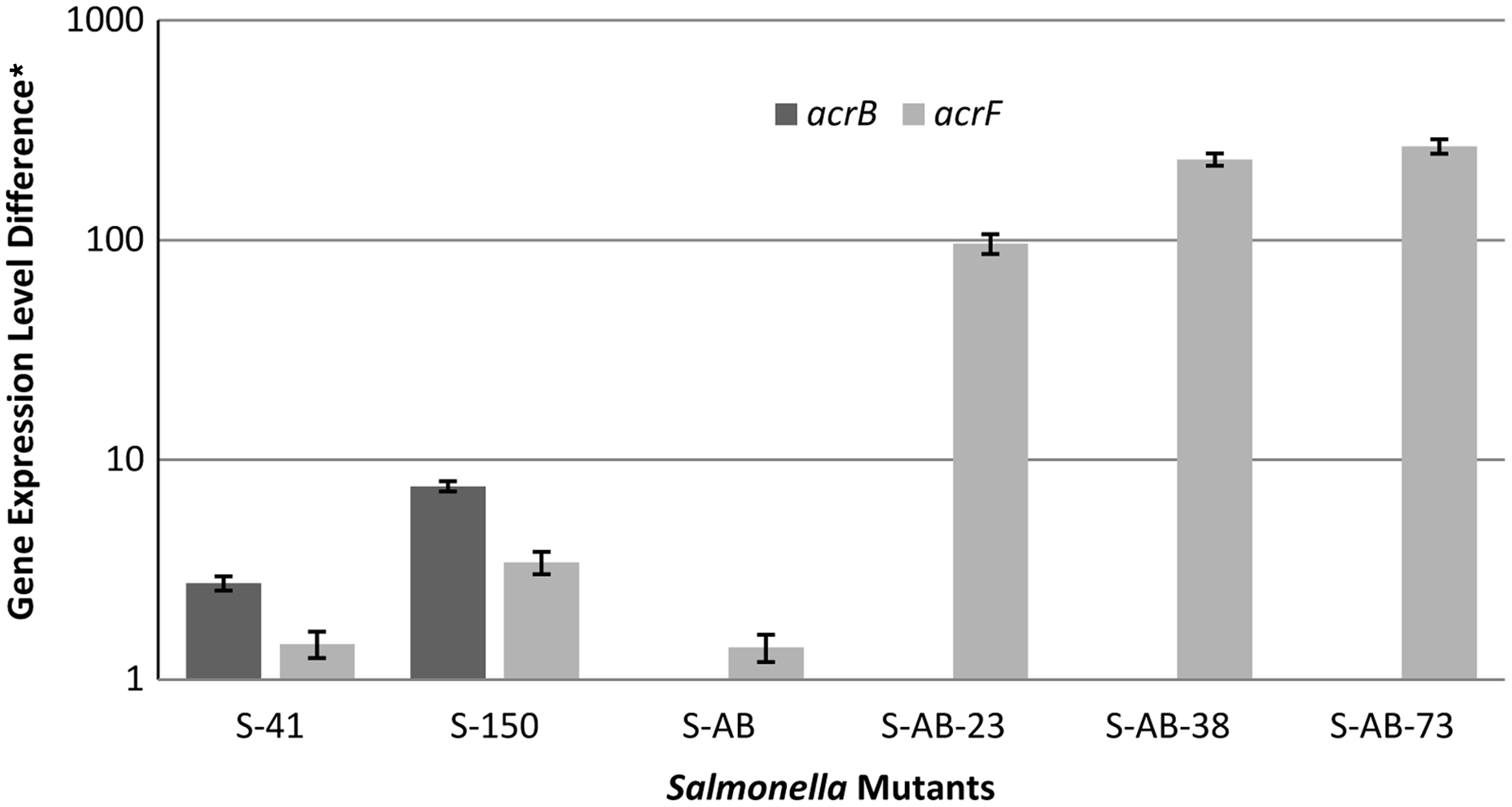
The expression changes of acrB and acrF in different Salmonella Typhimurium mutants. *The fold differences in expression levels of the genes tested using real-time polymerase chain reaction (in light gray box) were calculated from triplicate reactions against CT value of housekeeping gene (16sRNA) of Salmonella Typhimurium.
Discussion
Benzalkonium chloride is one of the invaluable biocides that is extensively used in healthcare settings as well as in the food processing industry. In this study, ST14028s was subjected to several rounds of in vitro selection. With increasing concentrations of benzalkonium chloride, resistance mutants with gradual increases in the benzalkonium chloride MIC could be selected, as the benzalkonium chloride concentration increase interval was 5 μg/ml in the growth medium. The benzalkonium chloride resistance mutants also showed cross-resistance to chloramphenicol, nalidixic acid, ciprofloxacin, and tetracycline. The main resistance mechanisms in these mutants were constitutively over-expressed AcrAB working through TolC. However, when AcrAB was inactivated, benzalkonium chloride resistance mutants could still be selected and constitutively over-expressed AcrEF, became the dominant efflux pump working through TolC and our data showed that acrEF constitutive over-expression might require different mechanisms compared with acrAB constitutive over-expression.
In this study, Salmonella Typhimurium benzalkonium chloride resistance mutants showed increased MICs to additional antimicrobials not employed in the selection, which indicated that these derivatives had increased expression of multiple drug-resistant efflux systems. Different efflux pumps, such as AcrB, AcrF, AcrD, YegOMN, have been reported to play different roles in antimicrobial resistance. 23 However, in this study, even though S-41 and S-150 showed increased MICs for all tested antimicrobials than their parental strain ST14028s, all ΔtolC or ΔacrAB mutants of ST14028s, S-41, and S-150 showed the same MICs to all tested antimicrobials, which indicated that acrAB was the dominant constitutively over-expressed efflux gene in S-41 and S-150. Other effluxes may also contribute to the antimicrobial resistance, but the contribution of other effluxes could be ignored compared with the main efflux pump AcrAB. This hypothesis was further confirmed by real-time analysis of the expression level of acrB and acrF that the expression of acrB was 80-fold higher than acrF in S-150. These data were different from a recent study in which AcrF was the main efflux up-regulated when Salmonella was exposed to biocides for a single time. 25 In other studies, enhanced effluxes have also been implicated in multidrug resistance phenotypes of other bacteria (e.g., E. coli, Listeria, and Pseudomonas) after exposure to disinfectants.8,15,21
Our data showed that acrEF constitutive over-expression might require different mechanisms compared with acrAB constitutive over-expression in these benzalkonium chloride resistance mutants. In benzalkonium chloride resistance mutant S-41 and S-150, constitutively over-expressed AcrB, instead of AcrF, was the dominant efflux pump, but when AcrAB was inactivated in S-41 and S-150, the existing AcrB regulatory system could not improve acrF expression level to compensate the loss of AcrAB. However, in benzalkonium chloride resistance mutants S-AB-23, S-AB-38, and S-AB-73, acrF was over-expressed more than 100 times (Fig. 1). These data indicated that different mechanisms should be involved in acrB and acrF constitutive over-expression, and it might be interesting to characterize the regulatory mechanisms in these mutants, as different efflux regulatory proteins, such as marA, ramA, or soxS, have been reported as being responsible for the resistant phenotypes.17,27
Since benzalkonium chloride resistance mutants also showed decreased susceptibility to other antimicrobials, the resistance mutants described in this study have a number of clinical or environmental implications as has been discussed for other pathogens.9,16 Especially, exposure to benzalkonium chloride may lead to Salmonella mutants with decreased susceptibility to quinolones, which is currently one of the drugs of choice for the treatment of life-threatening salmonelosis. Research into the pathogenesis and epidemiology of the benzalkonium chloride resistant mutants will be of increasing importance in the future.
Footnotes
Acknowledgment
This research was supported by grant (2012AA101603) from the Ministry of Science and Technology, China.
Disclosure Statement
No conflicts of interest exist.