




Abstract
Selection of bacterial strains for resistance to antimicrobial agents may affect fitness; and fluoroquinolone resistance has been shown to affect fitness of aerobic and facultative bacteria. The impact on bacterial fitness of resistance selection to three fluoroquinolones was examined in three wild-type strains of Clostridium perfringens: ATCC 13124, ATCC 3626, and NCTR. Selection for resistance to norfloxacin, ciprofloxacin, and gatifloxacin affected the fitness of nine mutant strains differently. In a series of pure cultures grown in the absence of drugs, the growth of each of the mutants was comparable to that of the corresponding wild type. In competition experiments between mutants and isogenic wild types, however, some of the mutants were less fit. The fitness of ciprofloxacin-resistant mutants was comparable for all three strains, but two gatifloxacin-resistant mutants and one norfloxacin-resistant mutant were significantly less fit than the corresponding wild types. We conclude that both the genetic background of the strain and the fluoroquinolone which induced resistance affected the fitness of the resistant mutants. This is the first time that the effect on fitness of resistance to antimicrobial agents has been measured for C. perfringens.
Introduction
Use of fluoroquinolones has been associated with the emergence of more virulent, drug-resistant strains of Clostridium difficile. 25 Resistance to fluoroquinolones also affects the metabolic activities of C. perfringens, including production of toxins.18,20 Using microarray analysis of gatifloxacin-resistant (GR) mutants of C. perfringens strains NCTR and ATCC 13124, we found global changes in the expression of various genes. 15 Transcription of a variety of genes involved in all aspects of bacterial metabolism, including those coding for energy metabolism, transport, and virulence, was affected. 15
Bacterial fitness, the ability of bacteria to survive and reproduce, is affected by antibiotic resistance, specifically resistance caused by mutations in the chromosome.1,5,27 Fitness cost is the reduction of the growth rate when the resistant bacteria are less fit to survive and grow than the wild type in the absence of the drug. 1 In a clinical setting, where repeated and prolonged treatments with antimicrobial agents are needed 6 for control of symptoms attributed to the activities of intestinal microflora, such as those associated with inflammatory bowel diseases, 3 resistant strains of pathogens may develop. The fitness determines whether a resistant bacterial strain is able to persist or spread in the absence of antibiotic selection pressure. 11 In this study, we have investigated whether the changes that occurred in the drug targets and elsewhere, as the result of resistance selection to norfloxacin, ciprofloxacin, and gatifloxacin, affected the fitness of three strains of C. perfringens. This is the first time that the effect of selection for resistance to different fluoroquinolones on an anaerobic bacterium has been investigated.
Materials and Methods
Bacterial cultures
The strains of Clostridium perfringens used in this study 21 and their levels of resistance to fluoroquinolones are listed in Table 1. All bacteria were maintained in brain heart infusion (BHI) medium in a glove box under an atmosphere of 85% N2, 5% H2, and 10% CO2. 21
All mutants were resistant to >32 μg/ml of norfloxacin.
MIC of ciprofloxacin (μg/ml) for the wild types ATCC 13124, ATCC 3626, and NCTR were 0.25, 0.125, and 0.25, respectively.
MIC of gatifloxacin (μg/ml) for the wild types ATCC 13124, ATCC 3626, and NCTR were 0.19, 0.125, and 0.125, respectively.
The ratio of the log of the number of mutants to wild types at 24 hr, divided by the ratio of the log of the number of mutants to wild types used for inoculation at zero time.
NR, norfloxacin-resistant; CR, ciprofloxacin-resistant; GR, gatifloxacin-resistant; MIC, minimum inhibitory concentration.
Kinetics of growth in pure and two-membered cultures
The growth rates of the wild types and fluoroquinolone-resistant mutants of C. perfringens during 24 hr incubation were measured thrice for each strain, both separately and in two-membered cultures. The absorbance at 600 nm was used to determine optical density (OD) of an overnight culture of each of the strains. These cultures were then used for inoculation of fresh BHI tubes, so that all the tubes received the equivalent OD of the cells. The BHI tubes were incubated under anaerobic conditions at 37°C. At 0, 2, 4, 6, and 24 hr, a 0.1 ml sample was taken from each culture. Serial dilutions of the samples were made, and 100 μl of each dilution was used for plating on both BHI agar and BHI agar supplemented with 10 μg/ml of norfloxacin. The plates were incubated overnight, and then, the numbers of viable cells in the cell suspensions were estimated by counting the colony-forming units (CFU) on the plates. In the two-membered cultures, the number of wild-type cells was calculated by subtracting the number of colonies on the plates with norfloxacin from the number of colonies on the plates without norfloxacin.
Growth competition assay
Clostridium perfringens ATCC 3626, ATCC 13124, and NCTR (a strain of unknown origin), and each of their respective mutants that were resistant to norfloxacin, ciprofloxacin, and gatifloxacin (Table 1), were inoculated together in competition assays. Three separate competition experiments were performed, each with three cycles. Each strain was grown overnight in BHI in the absence of any antimicrobial agent. The cells were counted microscopically, and fresh tubes containing BHI were inoculated with each of the mutants and the corresponding wild type, either separately or in two-membered cultures at a 1:1 ratio. All cultures were incubated under anaerobic conditions for 24 hr to complete the growth cycle. Successive growth cycles were initiated by diluting the pure cultures and two-membered cultures to 10−2 in BHI medium, incubating the new cultures for another 24 hr, and then repeating this procedure for the third cycle. 12
The initial inocula and samples taken every 24 hr were used for monitoring growth of each of the wild types and resistant mutants, both separately and in the mixtures. Appropriate dilutions of the bacteria sampled from the first, second, and third cycles were plated on BHI agar, with and without 10 μg/ml of norfloxacin, for colony counting. Plates were incubated overnight in the anaerobic chamber at 37°C, and then, the wild-type and mutant colonies were counted. In two-membered cultures, the number of wild-type cells was determined by subtracting the number of colonies on plates with norfloxacin from the number on plates without norfloxacin.
The relative fitness, expressed as the competition index (CI), was determined for each of the resistant mutants by the method of Smani et al. 24 For each of the cycles, the CI was measured as the ratio of the log of the number of CFU of the fluoroquinolone-resistant mutant recovered at 24 hr (CFU of FR24) to the number of CFU of the fluoroquinolone-sensitive wild type recovered (CFU of FS24), divided by the ratio of the log of the number of fluoroquinolone-resistant cells inoculated (CFU of FR0) to the number of wild type cells inoculated (CFU of FS0), in the following formula: (CFU of FR24: CFU of FS24)/(CFU of FR0: CFU of FS0).
Effect of efflux pump inhibitor on resistance to fluoroquinolones
The fluoroquinolone-resistant strains of bacteria were grown overnight and used to inoculate replicate wells of 96-well plates containing twofold serial dilutions of the 4–128 μg/ml concentrations of norfloxacin, with or without 10 μg/ml of the efflux pump inhibitor reserpine. 19 The plates were incubated under anaerobic conditions, and the effect of reserpine on the minimum inhibitory concentration (MIC) of the drug for each strain was determined.
Results
Resistance of the mutants
The mutants of C. perfringens had different levels of resistance to fluoroquinolones (Table 1). Each had a stable mutation in the quinolone-resistance determining region of gyrA; and some had mutations in both gyrA and parC. Some mutations were common, and other mutations were unique. The GR mutants, 13124GR and 3626GR, shared double mutations in gyrA, resulting in the substitutions G81C and D87Y, but they had different parC mutations. NCTRGR also carried the same double mutation in gyrA, but it had no mutation in parC. The efflux pump inhibitor reserpine increased the sensitivity of strains 13124NR, 13124CR, 3626CR, and NCTRCR to norfloxacin by twofold (data not shown), but did not affect the resistance of any other strain.
Growth of the mutant strains in pure and two-membered cultures
The effect of fluoroquinolone resistance on the growth rate of each of the resistant mutants was measured and compared with the respective wild type in both pure and two-membered cultures. In the pure cultures, the growth rates of all of the mutants were comparable to those of the wild types (Fig. 1A–C). However, in the two-membered cultures, lower growth rates were observed for some of the resistant mutants (Fig. 1D–F). The growth rates of the norfloxacin-resistant (NR) and ciprofloxacin-resistant (CR) mutants of strains NCTR and ATCC 3626 were comparable to those of the wild types, but after the first 2 hr of incubation, the growth of the GR mutants NCTRGR and 3626GR in cultures with their wild types was substantially less (Fig. 1E, F). The growth of NR mutants of ATCC 13124 also decreased in the two-membered cultures.
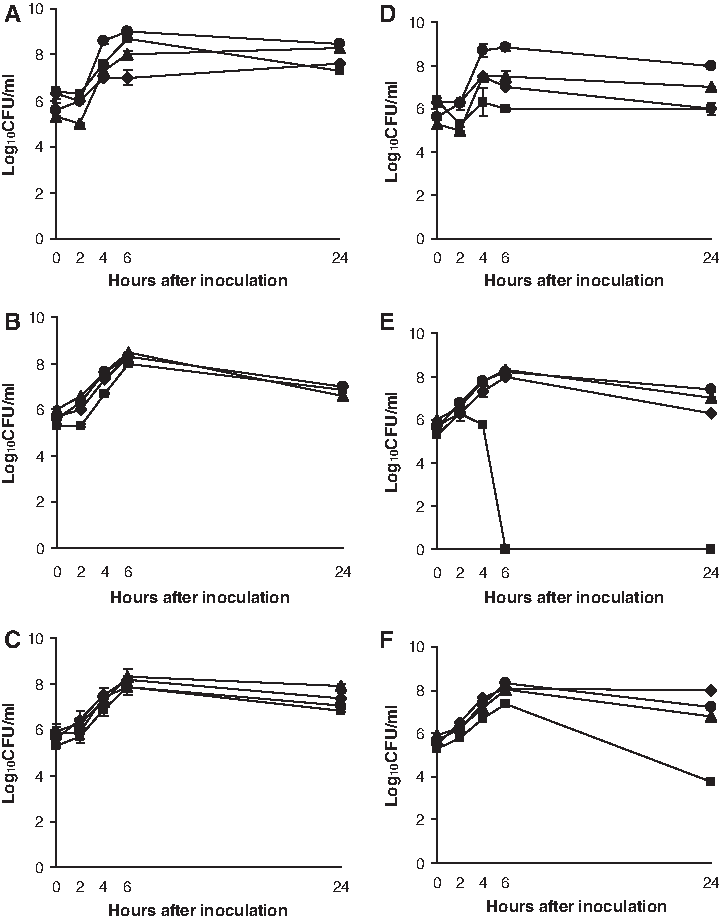
Growth (log10 CFU per ml) of fluoroquinolone-resistant mutants of Clostridium perfringens and their corresponding wild types measured during the first 24 hr in the absence of fluoroquinolones.
Fitness of the mutants
For comparing fitness of the mutants and wild types through sequential growth cycles, the growth was measured, alone (Fig. 2A–C) and in two-membered cultures (Fig. 2D–F), in three successive cycles. The growth of each of the mutants in pure culture was comparable with that of the respective wild type (Fig. 2A–C). Resistance to norfloxacin did not affect the fitness of NCTRNR, but it substantially reduced the fitness of 13124NR, as evidenced by a continuous decrease in the number of cells surviving in the two-membered cultures after each passage (Fig. 2D). The fitness of mutant 3626NR was also affected in the first passage, but growth was stable in the second and third passages. The growth of ciprofloxacin- resistant mutants was also reduced in the two-membered cultures, but the reduction was comparable for all three mutants. Gatifloxacin resistance selection had a major fitness cost for both mutants 3626GR (Fig. 2E) and NCTRGR (Fig. 2F). Strain 3626GR did not survive during the second competition cycle; and the number of surviving NCTRGR cells had substantially decreased in the second passage and continued to decline in the third passage (Fig. 2F). The CI reflected the fitness cost of resistance selection for the mutants relative to the wild types (Fig. 3). Except for the mutant NCTRNR, fluoroquinolone resistance selection affected the fitness of all strains tested. The fitness cost was greatest for mutants 3626GR, NCTRGR, and 13124NR (Fig. 3). The decrease in the CI for mutant 13124NR in each cycle was much more pronounced than those for the gatifloxacin- and CR mutants 13124GR and 13124CR (Table 1 and Fig. 3A). In contrast, the CI of NCTRNR was comparable in all three passages. The CI and fitness costs of the gatifloxacin and CR mutants 13124GR and 13124CR were comparable (Table 1 and Fig. 3A). However, the CI values for mutants NCTRGR and 3626GR continued to decline (Fig. 3B, C).
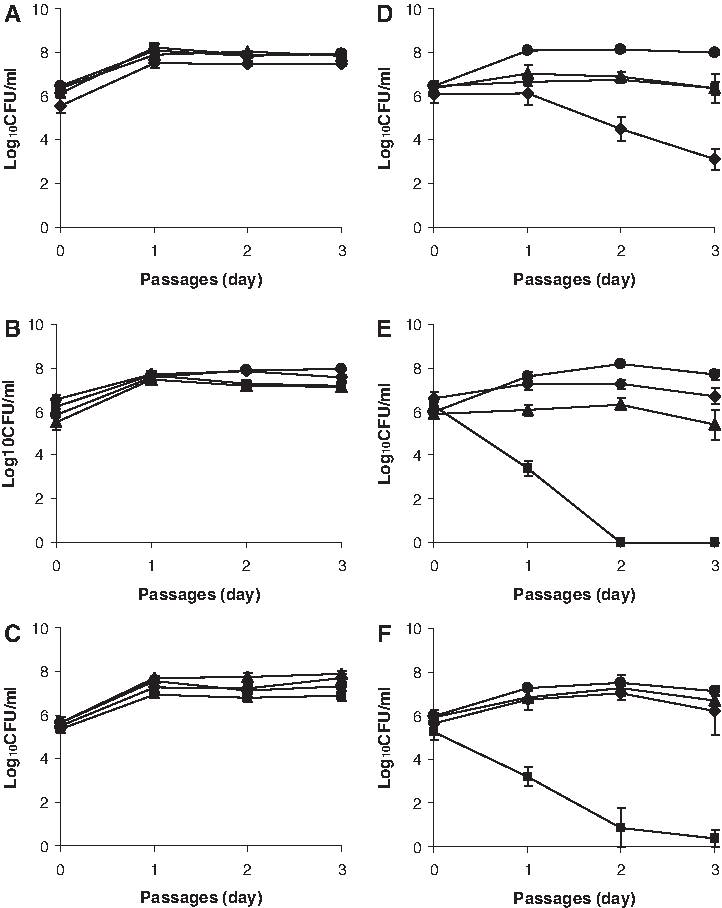
Survival (log10 CFU per ml) of wild types and mutants of C. perfringens, derived from
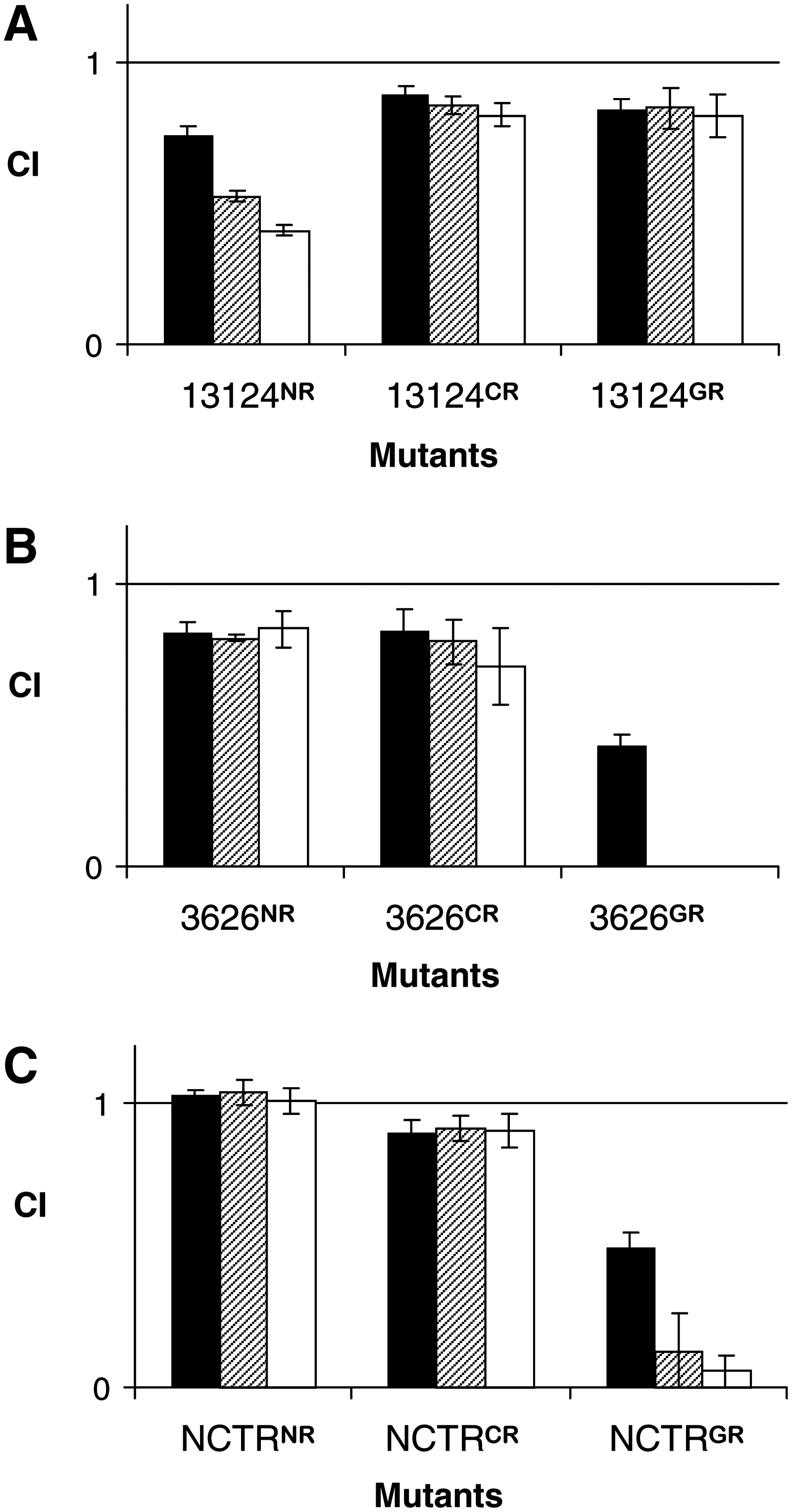
Competition index (CI) of each of the mutants of C. perfringens when grown with the corresponding wild types, measured 24 hr after each of three different transfers. Mutants derived from
Discussion
Fluoroquinolone resistance has been shown to affect the fitness of various aerobic and facultative bacteria7–10,12,23,24,28,29 but not yet that of anaerobes. Using three different strains of C. perfringens and their mutants selected for resistance to three different fluoroquinolones, we found that resistance selection for each drug affected bacterial fitness differently.
Resistance to different fluoroquinolones had a strain-specific effect on the fitness cost of each of the mutants. Norfloxacin resistance selection had no effect on the fitness of mutant NCTRNR, but it affected mutant 13124NR by reducing its growth in each cycle in the competition assay. The fitness of mutant 3626NR was affected somewhat less. Ciprofloxacin resistance selection affected the fitness of all three strains, reducing the growth of the mutants by 10%–20%, but it had the least effect on mutant NCTRCR. Gatifloxacin resistance selection resulted in a 20% fitness cost for mutant 13124GR in the first cycle, but the fitness cost was stable in successive cycles. However, gatifloxacin resistance selection had a dramatic fitness cost for mutants NCTRGR and 3626GR; indeed, mutant 3626GR did not grow in a two-cycle competition.
Regardless of a slight variation in the inoculum size of some strains, the growth rates of mutants and wild types were comparable. Differences in growth between wild types and mutants were only observed when there was a fitness cost associated with the mutant in the two-membered culture. The CR mutants NCTRCR, 3626CR, and 13124CR, which had the same mutation in gyrA (D87Y substitution), had comparable fitness costs of 10%–20%. However, the NR mutant NCTRNR had the same gyrA mutation but no fitness cost. Since the efflux pump inhibitor reserpine enhanced the sensitivity of all three CR mutants to norfloxacin by twofold but did not affect the sensitivity of mutant NCTRNR, it is possible that factors affecting efflux pump activity, rather than this gyrA mutation, decreased the fitness of the CR mutants. A fitness cost was also found with strain 13124NR, which had one mutation in gyrA (A119E substitution), but its sensitivity to norfloxacin was enhanced twofold by reserpine, supporting the involvement of an efflux pump in decreasing fitness. Mutations in target genes and efflux pump genes of bacteria appear to reduce fitness in other bacteria.12,16 Knockout of the efflux pump also has been shown to reduce fitness of Enterobacter cloacae. 16
The fitness cost of mutant 3626NR, which has a gyrA mutation (G81C substitution), was comparable to that of 3626CR, but 3626NR did not show efflux pump activity. The G81C substitution in gyrA may contribute to reduction in fitness, either alone or combined with other mutations. The GR mutants, 13124GR, 3626GR, and NCTRGR, which had double mutations in gyrA (G81C and D87Y substitutions), also had reduced fitness. There was a major fitness cost for mutant 3626GR, which in addition to gyrA mutations (G81C and D87Y substitutions), had parC mutations (D93Y and A131S). These four mutations may have changed the mutant sufficiently to make it unable to survive in competition with the wild type. The fitness cost for mutant 13124GR, which had a parC mutation (S89I substitution), was less than that of the mutant NCTRGR, which had no mutation in parC. Previously, it has been shown that compensatory mutations may reduce fitness cost in other bacteria.12,27,28,30 At this point, it is not clear whether the mutation in parC (S89I substitution) in mutant 13124GR was a compensatory mutation that reduced the fitness cost due to the double mutation in gyrA.
Large concentrations of ciprofloxacin have been detected in fecal samples from subjects taking oral ciprofloxacin 22 ; and fluoroquinolones are not generally effective against anaerobes. 2 In the intestinal tract, C. perfringens strains that come in contact with these drugs may become resistant to them. By analyzing the transcription of two GR mutants of C. perfringens, NCTRGR and 13124GR, we showed that resistance selection had affected them differently. 15 Apparently, selection also affected fitness, as was evidenced here by the different fitness costs for mutants NCTRGR and 13124GR. Our in vitro experiments also show that the fitness of various strains of fluoroquinolone-resistant C. perfringens differed based not only on the drug that induced resistance in a strain, but also on the strain's genetic background. If the in vitro assays reflect the in vivo survival of resistant strains, this may explain the inconclusive or contradictory results obtained when attempting to link the use of fluoroquinolones with the emergence of certain pathogens such as C. difficile. 5 However, the fitness cost of fluoroquinolone resistance was estimated from competition assays performed in vitro. If resistant mutants develop in vivo as the result of fluoroquinolone treatment, the rate of survival compared with sensitive strains is not yet known. This is the first time that fitness of C. perfringens has been shown to be affected by fluoroquinolone resistance development.
Footnotes
Acknowledgments
The authors thank Stephanie Jang and Aleum Lee for their technical assistance and Carl E. Cerniglia for his research support. The views presented in this article do not necessarily reflect those of the U. S. Food and Drug Administration.
Disclosure Statement
The authors declare that they have no competing interests.