




Abstract
Neonatal sepsis is a disease affecting newborns ≤1 month of age with clinical symptoms and positive blood cultures. The number of Escherichia coli strains causing neonatal sepsis resistant to the antibiotics used in the treatment is increasing. In this study, two E. coli strains causing sepsis in neonates of mothers infected with an E. coli strain harboring extended spectrum beta-lactamases were characterized. The blaCTX-M-15 and the blaCTX-M-14 genes were found in an IncFIA and nontypeable transferable plasmids, respectively. In addition, these highly virulent strains belonged to ST705 and ST156 clonal groups, respectively. The presence of strains, which are highly virulent and resistant to ampicillin, gentamicin, and cephalosporins, makes a change in empirical treatment necessary as well as an increase in the surveillance of these infections.
Introduction
B
Group B Streptococcus is considered to be the most common microorganism causing EONS, but there have been reports of an increase in the incidence of EONS by Escherichia coli, especially in premature or very low birth weight neonates.3,26,27
Newborns presenting sepsis are treated with ampicillin, gentamicin, or cephalosporins. However, the number of E. coli strains causing neonatal sepsis resistant to these antibiotics is increasing.3,12,19,29 The emergence of extended spectrum beta-lactamases (ESBL)-producing E. coli in neonates1,12,13,23,24 makes epidemiological surveillance for vertical transmission of neonatal sepsis necessary, being of special interest in the cases of newborns from mothers with obstetric risk factors.
The aim of this study was to characterize E. coli strains harboring ESBL causing neonatal sepsis.
Materials and Methods
Bacteria
Two E. coli strains causing EONS (Ec-EONS) and LONS (Ec-LONS) collected in 2008 from neonates whose mothers presented an intra-amniotic infection also caused by an E. coli ESBL producer were studied.
Antimicrobial susceptibility
Minimal inhibitory concentrations (MICs) were determined using the MicroScan-Negative MIC Panel Type 37 (NM37; Siemens). Results were interpreted following the CSLI guidelines. 9 The E. coli ATCC25922 strain was used as control.
Detection of resistance genes
We detected the following selected antimicrobial resistance genes: blaTEM1-like and blaOXA1-like in all ampicillin-resistant strains; tetA, tetB, tetC, tetD, and tetG in tetracycline-resistant strains; dfrA, dfrIb, and dfrVII in trimethroprim-resistant strains; sul1, sul2, and sul3 in sulfadiazine (Sd)-resistant strains; aac(3)-IV and aac(3)-II in gentamicin-resistant strains; and catA, cmlA, and floR in choramphenicol-resistant strains. Mutations in the quinolone resistance-determining region (QRDR) of the genes encoding the essential enzymes, DNA gyrase and topoisomerase IV, were determined by polymerase chain reaction (PCR) and sequencing. 10 The blaCTX-M genes and their link with the ISEcp1 insertion sequence were analyzed by PCR using specific primers and sequencing of the resulting fragments.5,11 The sequences obtained were compared with those registered in GenBank.
Gene location
Plasmid DNA was extracted from the E. coli isolates using the Kado and Liu and S1 method, 15 transferred onto membranes, and hybridized with probes for blaCTX-M genes as described. 10 Conjugation experiments were performed as reported, 10 using the kanamycin-resistant strain E. coli K7 759Lac- as recipient. The incompatibility group of the plasmids was determined using the PCR-based inc/rep typing method described by Carattoli et al. 6
Epidemiological characterization
The phylogenetic group of the isolates was analyzed by a triplex-PCR. 8 MLST was analyzed by amplification of seven housekeeping genes (adk, fumC, icd, purA, gyrB, recA, and mdh) (www.web.mpiib-berlin.mpg.de/mlst). Virulence profiles were analyzed by PCR using gene-specific primers for 17 virulence genes. 25 The PCR conditions used have been described elsewhere. 14
Results
The two cases presented in this study were independent episodes that happened over 10 years in our hospital, from 1998 to 2008. No outbreaks by E. coli harboring ESBLs were reported in the period under study. The Ec-EONS strain was collected from a newborn within the first 24 hr of life, and the Ec-LONS strain was isolated from a child 4 days after birth.
The Ec-EONS strain presented the blaCTX-M-15 gene and the Ec-LONS strain presented the blaCTX-M-14 gene. The blaCTX-M gene was linked with the ISEcp1 insertion sequence in both cases. In addition to cephalosporin resistance, the Ec-EONS strain showed resistance to ciprofloxacin due to a mutation in the QRDR region of the gyrA gene (Asp87 to Lys) and two mutations in the QRDR region of the parC gene (Ser80 to Ile and Glu84 to Val), and gentamicin due to the presence of the aac(3)-II. The Ec-LONS strain presented resistance to chloramphenicol caused by the presence of the cml1 gene, ciprofloxacin due to a mutation in the QRDR region of the gyrA gene (Ser83 to Leu), tetracycline by the presence of the tetA gene, and trimethroprim-sulfamethoxazole encoded by the dfrA12 and sul2 genes, respectively.
Ec-EONS presented two transferable plasmids of about 400- and 145-kb. The Ec-LONS presented three plasmids of about 95-, 120-, and 205-kb (Fig. 1a, b), but only the plasmid of about 120-kb was present in the transconjugant isolates. Hybridization experiments demonstrated the presence of the blaCTX-M-14 gene in the nontypeable plasmid of 120-kb (Fig. 1c), whereas the blaCTX-M-15 gene was found in the plasmids of 145-kb belonging to the IncFIA incompatibility group (Fig. 1d).
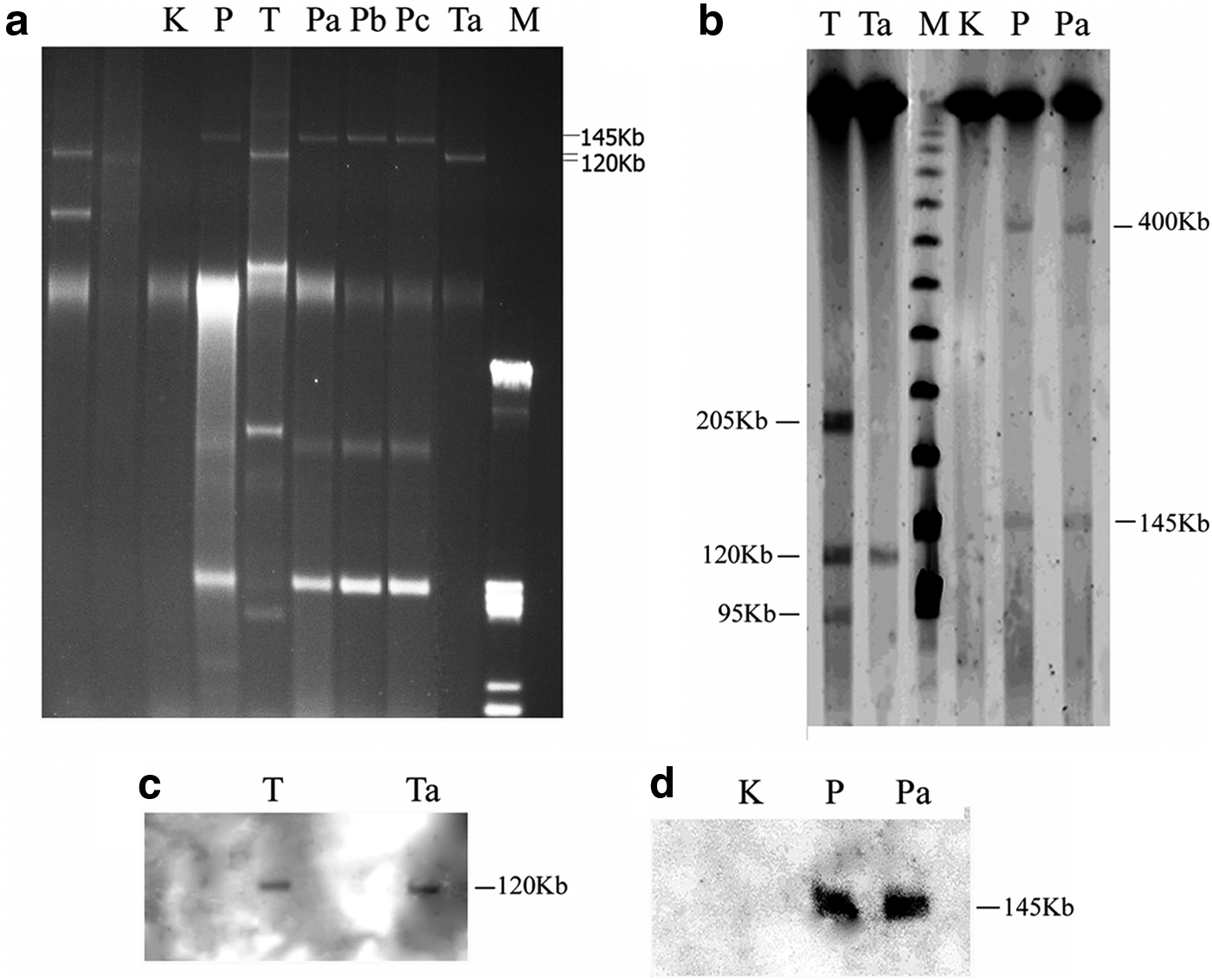
Plasmid analysis of the Escherichia coli strains under study.
A further characterization of the strains was carried out. The Ec-EONS strain belonged to the virulent phylogenetic group B2, ST705, and presented 14 virulence factors. On the other hand, the Ec-LONS was less virulent and belonged to the phylogenetic group D, ST156, and presented 10 virulence factors (Table 1).
Ec-EONS, E. coli strains causing early-onset neonatal sepsis; Ec-LONS, E. coli strains causing late-onset neonatal sepsis.
Discussion
The increase of antimicrobial resistance among E. coli strains causing neonatal sepsis is becoming an important problem. 12 The percentage of strains resistant to ampicillin and gentamicin is on the rise, cephalosporins being the alternative treatment in these cases. However, the number of strains resistant to cephalosporins is also becoming an increasingly notable problem in developing countries.1,21,24
Several studies on the presence of ESBLs among neonates or in neonatal intensive care units (NICUs) in India have been reported, but only reporting percentages of ESBL-producing E. coli.1,13,23 The percentages of neonatal sepsis caused by ESBL-producing E. coli were found to be between 52–65.3%.1,7,13,23 Shakil et al., 23 found blaCTX-M-15 in five preterm neonates from NICU. All of these E. coli strains presented transferable plasmids. E. coli belonging to ST131 and harboring blaCTX-M-15 was also associated with cases of neonatal meningitis. 22 In contrast, the strain studied in the present study belonged to ST705.
In developed countries, only a few cases of ESBL-producing E. coli have been reported in NICUs.17,28 Boyer-Mariotte et al. 4 reported a case of fatal meningitis and sepsis in a newborn caused by an E. coli strain belonging to the phylogenetic group B2 and harboring blaCTX-M-15. In contrast to our findings, in which the strains presented more than 10 virulence factors, this strain only presented aerobactin and yersiniabactin as virulence factors.
The CTX-M-14 enzyme has been reported worldwide, but has been substituted by CTX-M-15 in the last years. 2 An outbreak caused by a strain of E. coli presenting the CTX-M-14 enzyme has been reported in the literature. 20 The blaCTX-M-14 gene was found in an IncK plasmid of about 80-kb. This strain belonged to ST23 and phylogenetic group A. In addition, the blaCTX-M-14 gene was linked to an ISEcp1 insertion sequence. The strain characterized in the present study also presented the blaCTX-M-14 gene, but was different to that described in the previously commented study in both clonal and phylogenetic groups. Other E. coli strains belonged to ST156, but carrying different ESBL genes were found in China and United Kingdom.18,21
The presence of antimicrobial-resistant strains in neonates makes it necessary to avoid empirical treatment in these cases. López-Cerero et al. 16 studied the case of a neonate whose mother presented premature membrane rupture and fever and was treated with ampicillin and gentamicin. The neonate was also treated with these two antimicrobial agents and his condition deteriorated due to the sepsis caused by a CTX-M-32-positive E. coli strain.
In summary, this is the first time that a CTX-M-14 producing E. coli strain belonging to ST156 and phylogenetic group D causing neonatal sepsis has been studied. The presence of strains that are highly virulent and resistant to ampicillin, gentamicin, and cephalosporins makes a change in empirical treatment necessary as well as an increase in the surveillance of these infections.
Footnotes
Acknowledgments
This material is based upon work supported by Grants FIS 10/01579 and FIS11/02024 from the Ministry of Health (Spain) and by the Research Grant 2012 of the European Society of Clinical Microbiology and Infectious Diseases (ESCMID).
Disclosure Statement
No competing financial interests exist.