




Abstract
A total of 70 multidrug-resistant (MDR) Salmonella isolates (44 human and 26 poultry) were examined. The conserved segment–PCR, restriction fragment length polymorphism–PCR analysis, and DNA sequencing were used to determine the presence and cassette content of integrons. The genetic relatedness among the isolates was examined by pulsed-field gel electrophoresis (PFGE). The rate of integron carriage for MDR Salmonella isolates was 91.4% and integron-positive isolates belonged to six distinct serovars. Out of 64 integron-positive isolates, only four Salmonella Paratyphi C isolates could transfer integrons to Escherichia coli K12 by conjugation. Thirty-three PFGE types were detected in 52 integron-positive isolates, including 22, 4, 3, 2, 1, and 1 patterns among Salmonella serovars Enteritidis, Typhimurium, Paratyphi C, Paratyphi B, Paratyphi A, and Havana, respectively. The human and poultry Salmonella Enteritidis isolates from different regions with identical integrons had closely related PFGE patterns. Of the four integron-positive Salmonella Typhimurium isolates, the two poultry isolates with identical integron had very closely related PFGE patterns whereas the two human isolates with different integrons showed unrelated PFGE patterns. PFGE showed undistinguishable patterns in Salmonella Paratyphi C isolates with identical cassettes but revealed relatively unrelated patterns in those with different cassettes. Relatively unrelated and identical PFGE patterns were found in two Salmonella Paratyphi B and three Salmonella Paratyphi A isolates with the same integrons, respectively. In conclusion, PFGE patterns demonstrated more genetic relatedness among each Salmonella serovar with identical class 1 integrons than the same serovar with different class 1 integrons.
Introduction
S
A large number of antimicrobial resistance genes in gram-negative bacteria are accompanied by gene cassettes integrated in mobile genetic elements called integrons. 15 The most common gene cassettes include genes that confer resistance to antimicrobial agents, such as aminoglycosides, β-lactams, chloramphenicol, and trimethoprim. 2 Detection of class 1 integrons in Salmonella serovars has been documented in different countries.1,11,13,16,34 Insertion of integrons into transposons and plasmids led to wide dissemination of resistance genes among bacteria. 2
Salmonella enterica subspecies enterica has more than 1,500 serovars. Macrorestriction analysis by PFGE has been used to determine discrimination between subtypes within serovars. 31 The results of a study conducted in Iran using ribotyping method for typing of human Salmonella Typhimurium isolates have revealed that Salmonella Typhimurium strains have ribotype diversity and do not belong to a specific ribotype. 21 Further in another report, lack of genetic diversity and high clonality of Salmonella Enteritidis isolated from poultry have been documented by PFGE typing. 20
The molecular characterization of antibiotic resistance determinants and identification of their diversity and genetic linkage are very important in identifying factors involved in resistance. 29
Although class 1 integrons have been reported in previous studies in Iran, 7 the study of dissemination and diversity or similarity of these genetic elements among different Salmonella serovars obtained from human and animal sources have not been described and compared in our region. In addition, the role of clonal spread in distribution of integron-carrying Salmonella serovars has not been truly explained. The objective of this study was to determine the occurrence, distribution, and gene cassette content of class 1 integrons and their transferability as well as the genetic diversity or similarity among Salmonella serovars isolated from human and poultry.
Materials and Methods
Bacterial isolates
Seventy MDR Salmonella isolates (44 human and 26 poultry) that showed resistance to more than two different classes of antibiotic families by disk diffusion method were used in this study. 4 Human isolates were collected from human clinical specimens, and poultry isolates were recovered from clinical samples taken from sick poultries referred to Department of Microbiology, University of Tehran, during November 2009 to June 2010. Multiplex PCR was used for serotyping of isolates to identify Salmonella enterica serovars Enteritidis and Typhimurium as described previously.6,18 In brief, the multiplex PCR assays were performed in a final volume of 25 μl. PCR conditions for amplification of the target genes for Salmonella Enteritidis were as follows: 1 cycle of 95°C for 5 min, 35 cycles of 94°C for 30 sec, 56°C for 90 sec, 72°C for 30 sec followed by a final cycle of 72°C for 10 min. Also, the target genes for Salmonella Typhimurium were amplified and the following program was used: 1 cycle of 95°C for 5 min, 30 cycles of 95°C for 60 sec, 65°C for 60 sec, 72°C for 30 sec, followed 72°C for 7 min for final extension. The PCR products of Salmonella Typhimurium and Salmonella Enteritidis serotype-specific genes were electrophoresed on 1.2% and 1.8% gel agarose, respectively. The gels were stained in ethidium bromide for 15 min and visualized under UV light (Bio-Rad). Remaining isolates that were not identified as Salmonella Typhimurium and Salmonella Enteritidis serotypes with multiplex PCR assays were serotyped according to the Kauffmann–White scheme using slide agglutination test with commercial antisera (Difco).
DNA extraction and class 1 integron detection
Before DNA extraction the antibiotic-resistant Salmonella isolates were cultured in LB broth at 37°C for 18 hr. DNA of MDR Salmonella isolates was extracted using a standard method as described previously. 22 PCR assays were used to detect three conserved sequences (qacEΔ1, intI1, and sul1) of class 1 integrons as well as internal variable regions (IVRs). The primers used for amplification of integron-associated genes are shown in Table 1. Amplification was carried out in a thermocycler (Eppendorf master cycler®); the amplification condition was as follows: initial denaturation for 5 min at 94°C, 35 cycles consisting of 94°C for 30 sec, 55–60°C for 30 sec, 72°C for 2 min, and 72°C for 5 min for the final extension. The electrophoresis of PCR products was performed on 1% agarose gels. The gels were stained in ethidium bromide for 20 min and visualized in gel document system (Bio-Rad).
PCR, polymerase chain reaction.
Restriction fragment length polymorphism
Restriction fragment length polymorphism (RFLP) analysis was tested to determine whether different isolates yielding PCR products of the same size carried similar integrons. The conserved segment–PCR (CS-PCR) amplification products were purified with Qiaquick purification kit (Qiagen). The purified CS-PCR products were digested using restriction endonuclease enzyme AluI (Fermentase) according to that company's protocol. The integrons of isolates with similar RFLP patterns were considered identical and were randomly sequenced.
DNA sequencing
The CS-PCR products of isolates with equal RFLP patterns were randomly chosen for sequencing. The PCR products obtained for IVRs were purified using Qiaquick PCR purification kit (Qiagen). The purified amplicons were sequenced using the ABI Capillary System (Macrogen Research). Sequences were compared and alignments were done using online National Center for Biotechnology Information (NCBI) BLAST software (www.ncbi.nlm.nih.gov/BLAST/). The sequences were then submitted to the EMBL/GenBank databases.
Conjugation experiments
Conjugation experiments were performed to determine whether the antimicrobial resistance genes and class 1 integrons of the MDR integron-positive Salmonella isolates could be transferred to other species. The MDR integron-positive Salmonella isolates and Escherichia coli K12 strain (rifampicin-resistant and sulfamethoxazole-susceptible) were used as the donors and recipient, respectively, as described previously. 29 The biochemical characteristic, antibiotic susceptibility patterns, and the presence of class 1 integrons among transconjugants were determined as described previously in this study.
Pulsed-field gel electrophoresis
The genetic relatedness among 52 integron-positive Salmonella isolates, including 36 human and 16 poultry isolates, was determined using PFGE of XbaI-digested genomic DNA, according to the protocol developed by CDC. 30 The reference isolate was PulseNet Salmonella Braenderup (H9812). The generated PFGE patterns of Salmonella serovars isolated from human and poultry were analyzed and compared with each other using the Gel Compare II (Applied Maths) software (Fig. 1).
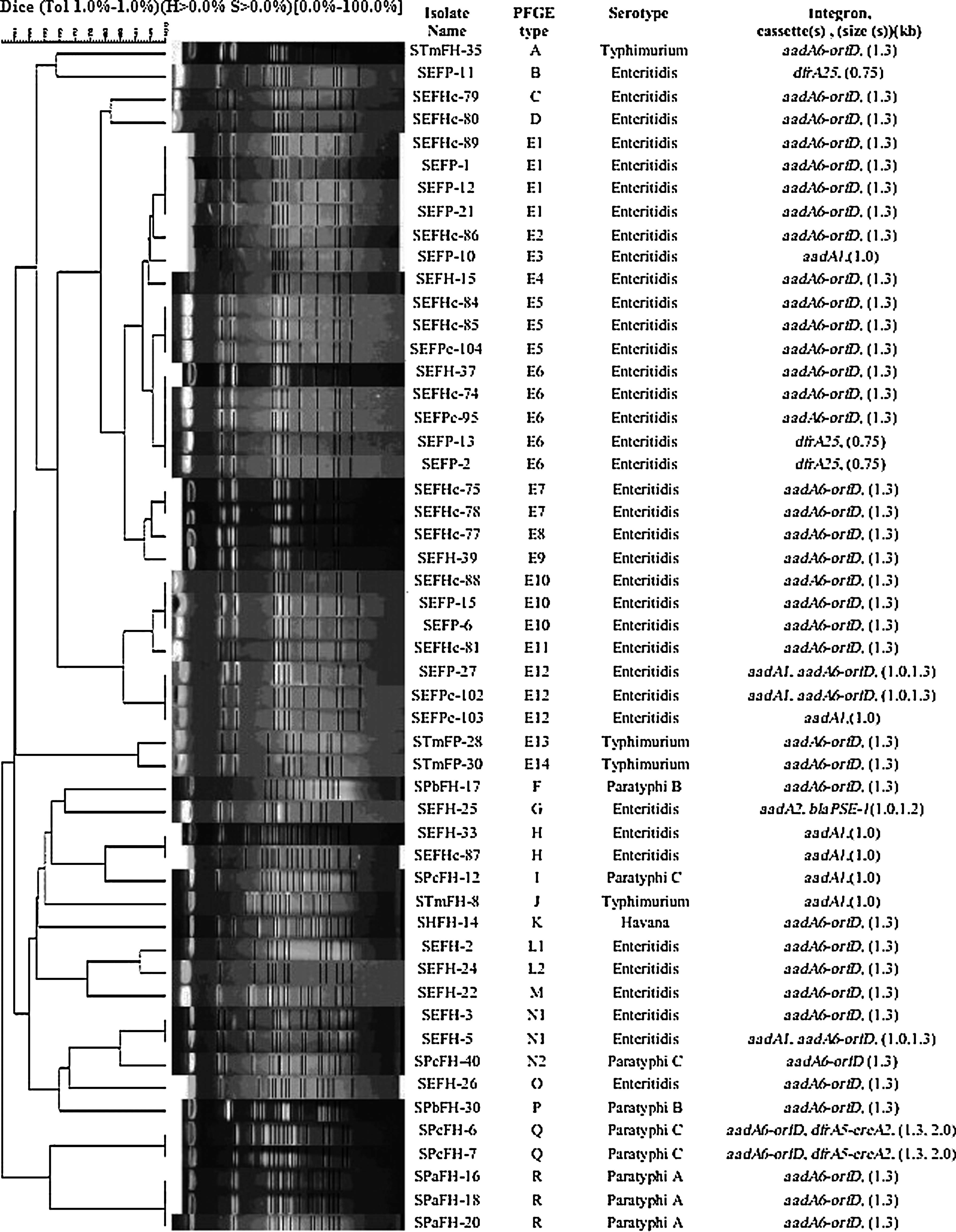
Dendrogram generated by Gel Compare II software that demonstrates the relationship of 52 integron-positive Salmonella serovars, including 36 human and 16 poultry isolates, after digestion with XbaI. The analysis of the bands generated was performed using the Dice coefficient and unweighted pair group method with arithmetic averages (UPGMAs). The scale bar at the top of the dendrogram indicates Dice similarity coefficient (%).
Results and Discussion
Detection of class 1 integron and gene cassette characterization
The results showed that 64 (91.4%) of MDR Salmonella isolates carried integron class 1. Approximately 44 (100%) of human MDR Salmonella isolates and 20 (76.9%) of poultry MDR Salmonella isolates carried class 1 integrons. The presence of class 1 integrons was higher in the human than in the poultry strains. This was probably due to the fact that our human isolates were obtained from hospitalized patients, where the selective pressure could facilitate dissemination of antimicrobial resistance genes via integrons. Integron-positive isolates belonged to six Salmonella serovars and six different variable regions were identified among them (Table 2). Fifty-seven isolates contained one integron and belonged to six Salmonella serovars while 7 isolates contained two integrons and belonged to Salmonella serovars Enteritidis and Paratyphi C (Table 2). The RFLP patterns of amplicons with same size were identical and the identified gene cassettes according to DNA sequencing were as follows: aadA6-orfD (GenBank accession No. JF907584), aadA1 (GenBank accession No. JN097815), aadA2 and dfrA25 (GenBank accession No. JN181062), blaPSE-1 (GenBank accession No. JQ968458.1), and dfrA5-ereA2 (GenBank accession No. JX297812.1). Overall, the 1.3-kb aadA6-orfD was detected in 47 (73.4%) of integron-positive isolates. All six Salmonella serovars contained the 1.3-kb integron identified as aadA6-orfD cassette encoding resistance to aminoglycosides. 25 The aadA6-orfD cassette has been reported as the most common array found in MDR isolates of Pseudomonas aeruginosa in Thailand, also identified in a human P. aeruginosa isolate in Iran.12,25 The presence of aadA6-orfD cassette in different Salmonella serovars in our study indicates that this cassette may be interchanged between different Salmonella serovars as well as other species. The 1,000-bp amplicons were shown to contain the aadA2 and aadA1 genes that confer resistance to streptomycin and spectinomycin. 5 The aadA2 gene cassette was seen alone in one Salmonella Typhimurium isolate and in combination with blaPSE-1 cassette in two Salmonella Enteritidis isolates. The integrons carrying the aadA2 and blaPSE-1 gene cassettes are very common among MDR Salmonella Typhimurium. 5 Similar gene cassettes also have been identified in other S. enterica serovars. 5 To our knowledge this is the first report in the Salmonella Enteritidis serovar.
Cassettes were identified by PCR assay and sequencing.
Integron sizes were determined by PCR assay.
Two different dfr-genes, including dfrA25 and dfrA5, were identified among five poultry Salmonella Enteritidis isolates and two human Salmonella Paratyphi C isolates, respectively. Of these, the dfrA25 cassette was seen alone, but the dfrA5 cassette was accompanied with ereA2 and aadA6-orfD cassettes in two 2.0- and 1.3-kb integrons. The dfrA25 gene had not been described in Salmonella Enteritidis isolates previously and this is the first report describing dfrA25 gene among Salmonella Enteritidis isolated from animal. The dfrA5 gene has been shown to occur alone or in combination with ereA2 gene in different studies of integron gene cassettes.19,26,33
Conjugation experiments
The conjugation experiment showed that only four human Salmonella serovar Paratyphi C isolates could transfer integrons to the E. coli K12 strain. Also the antibiotic resistance patterns of the transconjugants as well as the sizes of integrons detected were similar to that of the donors. This observation shows the potential of this serotype for resistance gene transfer to other genera of the family Enterobacteriaceae. Regarding the fact that Salmonella Paratyphi C was identified as the second most common serotype among human Salmonella isolates in this study makes this result critical. In the Netherlands, it has been shown that none of the integron-positive Salmonella Dublin isolates could transfer their antibiotic resistance genes by conjugation. 28
PFGE profiles
The PFGE revealed 33 different genetic patterns among 52 integron-positive isolates (36 from human and 16 from poultry sources) (Fig. 1). Salmonella Enteritidis isolates showed 22 PFGE patterns and 10 clusters, including B, which is relatively unrelated to other clusters and isolated from poultry; C, D, which are relatively related clusters and isolated from human; and E, which could be consisted of 12 subtypes (E1–E12) with 85% similarity and isolated from both poultry and human. As well as clusters without genetic relatedness to just-described clusters, including G, H, L (L1 and L2), M, N1, and O, have been isolated from human sources.
These observations indicate that most of the Salmonella Enteritidis isolates that were isolated from humans and poultry in different geographical areas and carry the same integrons can have closely related PFGE patterns. This result is in agreement with the study by Thong et al. 27 that revealed identical PFGE patterns for all Salmonella Enteritidis isolates tested, also confirming previous studies in Iran that have shown the highly clonal nature of this serovar. 20 The finding that no difference was seen in the integron contents between human and poultry Salmonella Enteritidis isolates along with their closely related PFGE patterns suggests that food-producing animals might be a possible source of MDR isolates in humans.
An interesting finding in our study was that two out of four Salmonella Typhimuriu2m isolates that have been isolated from poultry in the same geographic location and displayed identical gene cassette of integrons had very closely related PFGE patterns with 90% similarity, including E13 and E14 clusters. In a similar study in Portugal, low diversity of integron types and the limited number of clones among Salmonella Typhimurium isolates in poultry products have been documented. 2 These results may be related to the use of limited genetic lines of breeding poultry flocks. While two remaining isolates of Salmonella Typhimurium that have been isolated from humans in the same hospital and carried different integrons showed two unrelated PFGE patterns, including A and J clusters. In a survey in United States, study of PFGE patterns indicated a genetically diverse Salmonella Typhimurium population. 35 The high diversity of PFGE patterns among Salmonella Typhimurium isolates suggests that the infections in humans could be from various sources, although the investigation of a higher number of isolates from various geographical origins will be necessary to verify this idea.
Two human Salmonella Paratyphi C isolates carrying similar integron types and isolated from the same hospital showed an identical PFGE profile consisting of Q cluster, whereas the two other Salmonella Paratyphi C isolates were identified as I and N2 cluster with relatively unrelated PFGE patterns and different cassettes. These data along with the potential of horizontal gene transfer by conjugation indicate that the multidrug resistance in Salmonella Paratyphi C strains could be due to acquisition of resistance genes rather than a single-clone multiplicity.
Relatively unrelated genetic clusters, including P and F, with similar percentage of 50% were found in two Salmonella Paratyphi B isolates carrying the same integrons. The results of a survey in Malaysia showed that isolates of Salmonella Paratyphi B that were typed by PFGE using XbaI restriction endonuclease generated XbaI-pulsotypes with 75% similarity. 10
Our results also indicated all three Salmonella Paratyphi A isolates represented an identical PFGE pattern (R cluster) and integron type (Table 3). This finding is similar to that found in studies in India and Nepal,8,32 indicating the infection by a spreading single clone rather than the occurrence of resistant bacteria during antibiotic therapy.
Gene cassette size was determined by PCR assay.
Gene cassette content was identified by PCR assay and sequencing.
AMC, amoxicillin-clavulanic acid; AMP, amoxicillin; ATM, aztreonam; CAZ, ceftazidime; CEF, cephlothin; CFM, cefixime; CHL, chloramphenicol; CIP, ciprofloxacin; CRO, ceftriaxone; CTX, cefotaxime; DIF, difloxacin; DTX, doxycycline; E, Enteritidis; ENF, enrofloxacin; FFC, florfenicol; GEN, gentamicin; H, Havana; H, human; IMP, imipenem; KAN, kanamycin; MDR, multidrug-resistant; NOR, norfloxacin; OT, oxytetracycline; P, poultry; PA, Paratyphi A; PB, Paratyphi B; PC, Paratyphi C; STR, streptomycin; SXT, trimethoprim-sulfamethoxazole; T, Typhimurium.
In conclusion, the high prevalence of integron in MDR Salmonella serovars in our study indicated that these mobile genetic elements are common among different S. enterica serovars. In addition, PFGE patterns demonstrated more genetic relatedness among each Salmonella serovar with identical class 1 integrons than the same serovar with different class 1 integrons.
Footnotes
Acknowledgments
The authors wish to express their gratitude to Vajiheh Al-Sadat Nikbin and Iradj Ashrafi for their technical assistance and Fahimeh Shooraj for the kind help. This study was financially supported by grant No. 10526 from Office of Vice Chancellor for Research of Ministry of Health and Pasteur Institute, Iran.
Disclosure Statement
No competing financial interests exist.