




Abstract
A loop-mediated isothermal amplification (LAMP) assay was developed and evaluated for rapid detection of blaKPC, blaNDM, blaIMP, and blaVIM carbapenemase genes. Six oligonucleotides, including outer, inner, and loop primers, were designed for eight distinct regions in each target gene. Two qualitative criteria were used to evaluate LAMP reactions: visual inspection of color change and real-time detection of fluorescence change. The lower detection limit was 10 colony forming units (CFU) per reaction for real-time detection and 100 CFU per reaction for visual inspection for each gene. Two hundred twenty-two carbapenem-resistant clinical isolates (including 100 Pseudomonas aeruginosa, 100 Acinetobacter sp., and 22 Enterobacteriaceae) were tested by LAMP assay. At the same time, these isolates were confirmed by conventional polymerase chain reaction (PCR) and sequencing analysis. In these clinical isolates, the results of 11 strains with blaNDM, 11 strains with blaKPC, 11 strains with blaVIM, and 2 strains with blaIMP obtained using LAMP assays were concordant with conventional PCR. The LAMP method reported here may be a useful and powerful tool for rapid detection of blaNDM, blaKPC, blaIMP, and blaVIM carbapenemase genes in bacteria.
Introduction
T
Standard methods for identifying carbapenemases are based on molecular techniques, primarily polymerase chain reaction (PCR), such as conventional PCR with sequencing, multiplex real-time PCR,10,19 and others. 9 These technologies are relatively complex and require specialized expensive instruments. Loop-mediated isothermal amplification (LAMP) is a relatively simple and field-adaptable technique. Autocycling strand displacement DNA synthesis is performed for 1 hr in the presence of the Bst DNA polymerase under isothermal conditions using a set of four or six primers that bind to unique sites on the target sequence, ensuring highly specific amplification. The technique has been used widely for clinical diagnosis and detection of bacteria and parasites involved in epidemics.6,8,20 This study aimed at developing and evaluating simple and rapid testing methods based on the LAMP assay for the most common carbapenemase genes (blaKPC, blaIMP, blaVIM, and blaNDM).
Materials and Methods
Primer design
Reference gene sequences for each of the four enzyme families (blaNDM, blaKPC, blaIMP, and blaVIM) were assembled from the GenBank database (www.ncbi.nlm.nih.gov/genbank). Based on comprehensive analyses and alignments of each carbapenemase gene, primers were designed to amplify as many variants as possible from each carbapenemase gene family. As of this writing, the sequences of 10 blaNDM and 14 blaKPC alleles have been deposited at the GenBank. The LAMP primers for blaNDM and blaKPC were specifically designed to amplify all alleles of each gene family except of blaNDM-10, a rare variant found recently. However, unlike blaNDM and blaKPC, allelic variation in blaVIM and blaIMP is very high. According to the GenBank database, blaIMP and blaVIM genes are found in more than 30 variants, respectively. LAMP primers for blaIMP and blaVIM genes are expected to amplify at least the most common variants blaIMP-4 and blaVIM-2 described in Enterobacteriaceae in China. These primers for LAMP detection of four genes are listed in Table 1 and were synthesized by Sangon Biotech (Shanghai) Co., Ltd. (Guangzhou, China). For each target gene, a set of inner (FIP and BIP), outer (F3 and B3), and loop (LoopF and LoopB to accelerate the reaction) primers were designed for eight distinct regions.
The complete coding sequence of NDM-1, KPC-2, IMP-4, and VIM-2 were the reference sequences.
LAMP assay development
LAMP reactions were performed using a commercially available DNA thermostatic amplification kit (Guangzhou Diao Bio-technology Co. Ltd., Guangdong, China) according to the manufacturer's instructions. Enterobacter cloacae 920856 (harboring blaNDM-1, accession No. JN711113), Klebsiella pneumoniae 112334 (harboring blaKPC-2, accession No. JF894296), Enterobacter aerogenes 208630 (harboring blaIMP-4, accession No. KF184385), and P. aeruginosa 108631(harboring blaVIM-2, accession No. KF184387) were used as positive controls for target genes. These reference strains were resistant to carbapenem and the target genes were confirmed by PCR and sequencing in our previous study. Sterile distilled water was used as a negative control.
LAMP reactions were performed in 25 μl volumes containing 2× reaction buffer [40 mM Tris-HCl, pH 8.8, 20 mM KCl, 16 mM MgSO4, 20 mM (NH4)2SO4, 0.2% Tween 20, 0.8M betaine, and 2.8 mM each dNTP], 0.5 μL Syto-9, 0.2 mM each outer primer (F3 and B3), 1.6 mM each inner primer (FIP and BIP), 0.8 mM each loop primer (LoopF and LoopB), 8 U Bst polymerase (New England Biolabs, Ipswich, MA), and 1.0 μL eluted DNA. DNA amplification was carried out at 63°C for 50 min. Analysis was performed using data acquired every minute of the reaction by the Applied Biosystems 7500 Fast Real-Time PCR System (version 2.0.4 software).
As an additional detection method for evaluating the LAMP assays, the completed reactions were visually inspected by the naked eye for reaction color. To avoid opening tubes during the reaction, the reaction mixtures were prepared as described previously and topped with sterile liquid paraffin before the SYBR Green color indicator was added to the inside of the tube lid. After the reactions were completed, tubes were inverted to mix the reaction and indicator and visually inspected. Yellowish green reactions were considered to be positive, reactions that remained orange were considered negative.
Comparison of sensitivity and specificity of LAMP and PCR assays
To estimate the sensitivity and specificity of the LAMP assay under real conditions, pure genomic DNA was extracted from reference strains harboring the target genes using the TaKaRa MiniBEST Universal Genomic DNA Extraction Kit Ver.5.0 (TaKaRa Bio, Inc., Tokyo, Japan).
Experimental sensitivity for visual and real-time detection of the LAMP assay was ascertained by determining the lowest number of colony forming units (CFU) that could be detected. Ten-fold serial dilutions of DNA from reference strains harboring the target genes were prepared for a range corresponding to 105 to 100 CFU/reaction.
Experimental specificity was determined using four standard strains, with clinical strains harboring the target genes as positive control and sterile distilled water as negative control. Four standard bacteria (Staphylococcus aureus ATCC 29213, Escherichia coli ATCC 25922, P. aeruginosa ATCC 27853, and K. pneumoniae ATCC 70060) were used for testing under the same conditions.
As a standard for evaluating LAMP detection, PCR amplifications were performed using published primers for the four genes (Table 2). PCR products were subjected to electrophoresis on 1.5% agarose gels and stained with ethidium bromide.
The primers were used to detect the target gene by PCR and sequence.
The primers were only used to detect the target gene by PCR.
The primers were used to confirm the target gene by PCR and sequence.
PCR, polymerase chain reaction.
The evaluation experiments of sensitivity and specificity were replicated to ensure reproducibility.
Evaluation of LAMP assay using clinical isolates
A total of 222 strains (100 P. aeruginosa, 100 Acinetobacter sp., and 22 Enterobacteriaceae) resistant to both meropenem and imipenem were collected for evaluation of LAMP assay from the Laboratory Medicine Centre of Nanfang hospital, a 2,200-bed, university-affiliated tertiary-care hospital. These isolates, dated from January 2010 to June 2012, were subjected to identification and susceptibility tests using the BD Phoenix 100 Automated Microbiology System (Becton, Dickinson and Co., Franklin Lakes, NJ). The four target genes of these strains were confirmed by PCR and sequencing. Sequencing of PCR amplification products was performed by the Beijing Genomics Institute (Shenzhen, China).
Results
The LAMP assay was initially validated using reference strains harboring the target genes. Reactions were performed using two qualitative criteria: visual inspection of color change and fluorescence change in real-time detection. Both detection methods evaluating LAMP assays for four targets could distinguish clearly positive from negative controls.
The limit of assay was 10 CFU/reaction for real-time detection and 100 CFU/reaction for visual inspection for four targets. Figure 1 shows the result of the assay for these genes in limit of detection for LAMP and PCR.
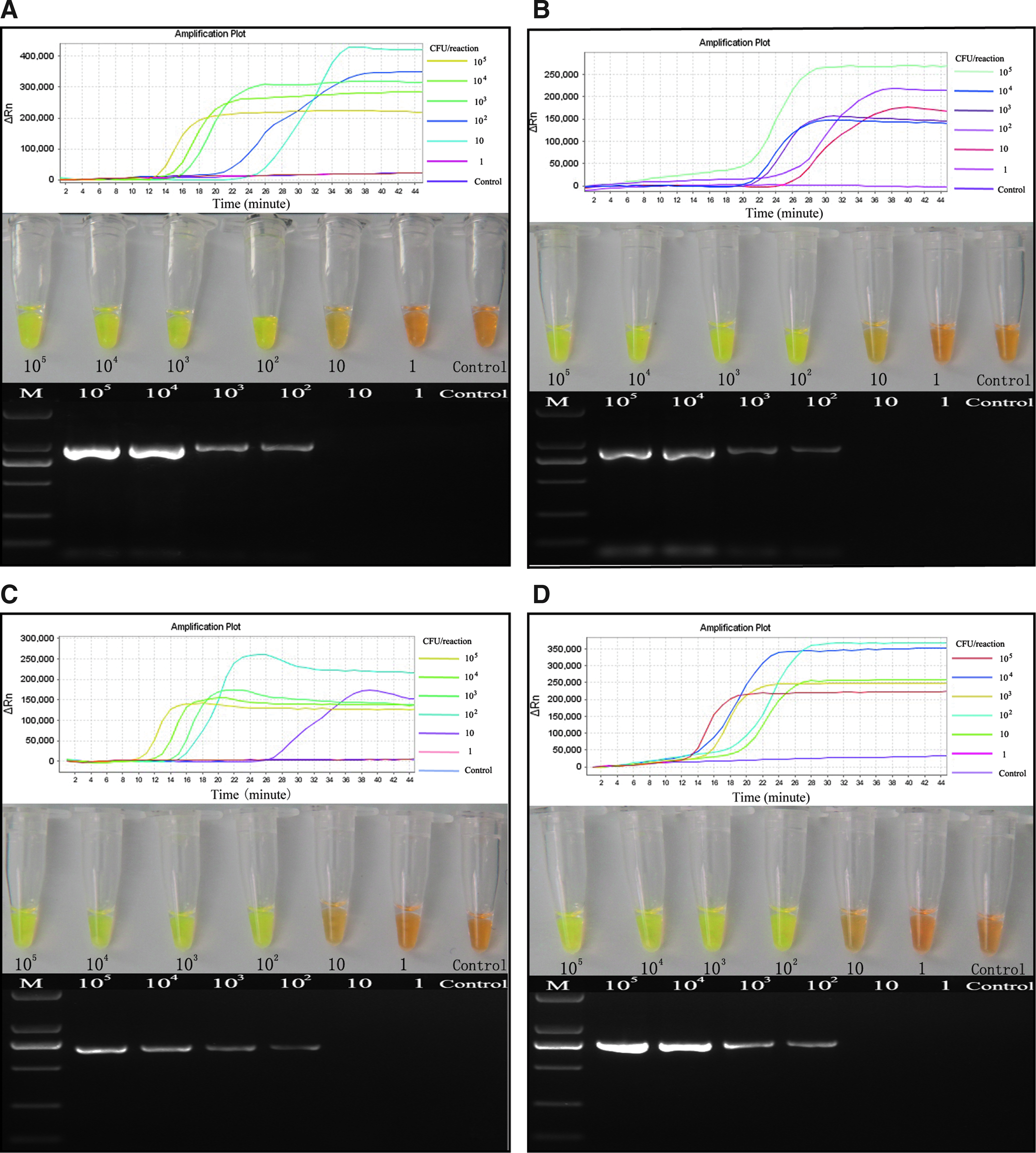
The sensitivity between the LAMP reaction and PCR for detection of four carbapenemase genes. The detection of the blaNDM gene
The analytical specificity was also applied on standard strains with no known antibiotic resistance gene, which showed negative results with no amplification. The developed LAMP method exhibited high specificity for the detection of the four genes, blaKPC, blaNDM, blaIMP, and blaVIM.
The established LAMP assays were applied to detect 222 clinical isolates using two qualitative criteria. The result showed that 187 strains were detected to be negative by LAMP assays, which was consistent with the result by PCR. LAMP assays detected 11 strains with blaNDM, 11 strains with blaKPC, 11 strains with blaVIM, and 2 strains with blaIMP. The results were 100% in concordance with genotypes determined by PCR and sequencing. After sequence analysis, these strains harboring the carbapenemase gene with their species identification confirmed by sequencing the 16S rRNA gene or intergenic 16S -23S rRNA spacer regions are listed in Table 3.
The swab from the deep wound.
MIC, minimum inhibitory concentrations; IPM, imipenem; MEM, meropenem.
Discussion
As carbapenemase genes become more widely distributed, CPEs are becoming an increasingly serious public health concern. Fortunately, molecular-based technologies allow gene-specific detection, 14 and it is possible to develop a sensitive and available test for the most frequent carbapenemase genes, with the goal of facilitating early diagnosis and control for the CPE infection. We describe the successful development of a LAMP-based method for the detection of four carbapenemase genes using two evaluation methods. To the best of our knowledge, this is the first report of real-time detection of fluorescence change LAMP assay of the common carbapenemase genes blaNDM, blaKPC, blaIMP, and blaVIM. Although LAMP assays for blaNDM-1 gene have been described,7,16 these methods evaluate only the turbidity and/or color change of the LAMP assay.
The method developed in this study would detect all presently known variants of blaKPC (blaKPC-2 through blaKPC-15) from the Enterobacteriaceae (Supplementary Fig. S1 shows the sequence analysis; Supplementary Data are available online at www.liebertpub.com/mdr). Although LoopB contains a mutation site of blaKPC-15, loop primers, used to accelerate the reaction, do not affect the specificity of reaction. The variants of blaNDM, including blaNDM-1 through blaNDM-9, would be detected by our assay (Supplementary Fig. S2). The blaIMP is the most diverse carbapenemase gene family and the developed LAMP assay detects the clinically common blaIMP variant, blaIMP-4, from Enterobacteriaceae isolated in China (Supplementary Fig. S3). In addition, blaIMP-38 could be detected by the LAMP assay. The blaVIM gene family is also diverse, but lesser compared with blaIMP. This reported method detects the most important blaVIM variants from the Enterobacteriaceae, including blaVIM-2, blaVIM-3, blaVIM-6, blaVIM-8, blaVIM-9, blaVIM-10, blaVIM-14, blaVIM-16, blaVIM-17, blaVIM-18, blaVIM-20, blaVIM-29, blaVIM-30, blaVIM-31, and blaVIM-36 (Supplementary Fig. S4). When positive strains were detected by this LAMP-based method, PCR and sequencing analysis can be used to determine the subtypes of each gene when necessary for further study. The blaOXA-48 gene recently reported in Enterobacteriaceae in different countries of North Africa and Europe. However, we did not detect blaOXA-48-carrying clinical isolates and few case reports or studies were found in China. We temporarily do not have the conditions to build the detection of LAMP for this gene.
The main advantages of the methods reported here are the short analysis time, the potential for automation, and the simplicity and ease of performance. In addition, the only specific equipment required for the LAMP assay is a water bath. The choice of evaluation method may depend on the needs of detection as well as the equipment of laboratories. The detection limits for the LAMP assay were ∼10–100 CFU/reaction. The sensitivity of RealAmp was 10 times higher compared with conventional PCR detection using total genomic DNA extracted from a culture of known cell count in this study. RealAmp is a technically simple single-tube reaction that can be completed in 1 hr after DNA preparation. It has been reported that the LAMP reaction is tolerant of amplification inhibitors contained in clinical samples,5,18 and therefore, it might possible to use LAMP for direct detection in samples without previous DNA purification. Due to the extremely high amplification efficiency, the conventional LAMP assay has been reported to result in a high rate of false positives. 11 To minimize false-positive results, the LAMP assay reported here used a shortened reaction time and was performed in a single tube that remained closed throughout assay and evaluation. In addition, considerable care was taken to design and select robust gene-specific primers.
This LAMP assay validated with Enterobacteriaceae, P. aeruginosa, and Acinetobacter sp. could be expected to detect blaNDM, blaKPC, blaIMP, or blaVIM carrying isolates. In fact, the four carbapenemase types encountered in this study were primarily identified on numerous occasions in enterobacterial species. In these clinical isolates, 22 Enterobacteriaceae harbored the target genes, but only 11 P. aeruginosa and 2 Acinetobacter sp. of 200 nonfermenter rods were detected blaVIM and blaNDM positive, respectively. Carrying OXA-type β-lactamases or other resistance mechanisms may be also related to the elevated minimum inhibitory concentrations (MICs) of carbapenems in nonfermenter rods. In stark contrast, Enterobacteriaceae with the four carbapenemase genes may be the greatest clinical threat.
In this study, a gene-specific, sensitive, and rapid LAMP method for blaKPC, blaNDM, blaIMP, and blaVIM gene detection in bacteria was established. We anticipate that this method will be very useful for rapid detection of the common carbapenemase genes in clinical settings. Based on this preliminary study, additional studies involving a much larger number of isolates and clinical samples will be interesting to further develop and evaluate this method.
Footnotes
Acknowledgments
This study was supported by a grant from the Natural Science Foundation of Guangdong Province (No.S201201 0009153), Guangzhou City Science Technology Project (No. 2010J-E461).
Disclosure Statement
The authors declare that they have no competing financial interests.
References
Supplementary Material
Please find the following supplemental material available below.
For Open Access articles published under a Creative Commons License, all supplemental material carries the same license as the article it is associated with.
For non-Open Access articles published, all supplemental material carries a non-exclusive license, and permission requests for re-use of supplemental material or any part of supplemental material shall be sent directly to the copyright owner as specified in the copyright notice associated with the article.
