




Abstract
The prevalence of extended-spectrum β-lactamases (ESBLs) has been increasing worldwide. Recently, a pandemic clone of Escherichia coli O25:H4, sequence type 131 (ST131), producing ESBL-type CTX-M-15 has been reported as a major problem. In this study, we investigated the molecular characteristics of 72 ESBL-producing E. coli isolates. We detected the ESBL blaCTX-M gene and nine virulence factor genes (papC, papEF, fimH, hlyA, iutA, sfa, eaeA, bfpA, and aggR) by PCR and DNA sequencing, plasmid replicon typing, phylogenetic grouping, repetitive-sequence-based PCR (rep-PCR), and multilocus sequence typing. All strains were positive for blaCTX-M. Twenty-two (30.6%) strains in CTX-M-1 group included 9 (12.5%) of CTX-M-15, 3 (4.2%) in CTX-M-2 group, and 47 (65.3%) strains in CTX-M-9 group. The CTX-M-15-producing E. coli O25:H4 ST131 was derived from phylogenetic group B2 and rep-PCR pattern d. The most prevalent virulence factor was fimH (72 strains; 100%) and the most common replicon type was the IncF type (65 strains; 90.3%). The CTX-M-9 group was significantly associated with the presence of papC and papEF [OR (95% CI)=9.22 (1.32–64.7), p=0.025] or hlyA [OR (95% CI)=5.57 (1.17–26.4), p=0.031]. In conclusion, we confirmed that CTX-M-15-producing E. coli O25:H4 ST131 has emerged in Japan and found significant virulence factors with CTX-M-9 group.
Introduction
E
The detection of plasmid replicon types is an important tool to trace the diffusion of plasmids conferring antimicrobial resistance and to follow the evolution and spread of emerging plasmids. A formal scheme of plasmid classification is based on the incompatibility (Inc) group. 36 Inc group identification has been frequently used to classify plasmids. This method of identifying them is another essential tool to trace the diffusion of plasmids conferring antimicrobial resistance and also to follow the evolution and spread of emerging plasmids. 1 The Inc group has 18 kinds of replicon types, such as F, FII, FIA, FIB, FIC, HI1, HI2, I1-Ic, L/M, W, T, A/C, K, N, P, X, Y, and B/O.10,13
In addition, it is important in diagnosing pathogens to identify the E. coli virulence factors specific to E. coli infection because those with particular virulence factors cause bacteria extraintestinal infections and diarrhea. 38 It has been reported that it was increased prevalence of antibiotic-resistant bacteria, including ESBL producers, isolated from urinary tract infections (UTIs).24,39 Thus, we selected the virulence factors in E. coli, papC and papEF (P fimbriae), fimH (type 1 pili), hlyA (hemolysin), iutA (aerobactin), and sfa and foc (S and F1C fimbriae), which are widely known. 39 These factors are essential for interaction between bacteria, such as E. coli, and the infected host, as they facilitate colonization, proliferation, and the transition from uncomplicated to severe infections.21,26 Knowledge of which virulence factors are prevalent in specific clinical situations along with patients' backgrounds, immune status, or history of antibiotic use is important for targeted prevention of E. coli infection, as revealed by the epidemiological studies.21,34
It has been suggested that ESBL-producing strains attach to the intestinal wall to cause infection. 29 There are few reports to investigate the virulence factors of ESBL isolates except diarrhea-related samples.24,43 Enteroaggregative E. coli (EAEC) was recently shown to be the cause of a community-acquired outbreak of UTI strains. 4 Therefore, it is also necessary to pay attention to epidemiological trends for intestinal strains whose virulence genes include adhesion factors, initimin (eaeA), bundle forming pili (bfpA), and the transcriptional activator aggR except the factors related to diarrheal diseases. The eaeA and bfpA factors are related to adsorption to the intestinal tract, and are known virulence factors in enteropathogenic E. coli.40,44 The aggR related to aggregation adhesion to cells is a known virulence factor of EAEC.32,40
In the present study, we examined 72 strains for the ESBL blaCTX-M gene and the presence of nine virulence factor genes (papC, papEF, fimH, hlyA, iutA, sfa, eaeA, bfpA, and aggR) and for susceptibility to antimicrobial agents, including β-lactam drugs and quinolones. Additionally, we performed epidemiological plasmid replicon typing, multilocus sequence typing (MLST), repetitive-sequence-based PCR (rep-PCR) using DiversiLab system, and phylogenetic grouping, and investigated the correlation of CTX-M type with the presence of virulence factor genes, antibiotic resistance, and patients' backgrounds, such as the presence of diabetes mellitus (DM).
Materials and Methods
Bacterial strains
A total of 72 ESBL-producing E. coli strains were isolated from patients in Kobe University Hospital between May 2010 and July 2011. Strains producing ESBLs were confirmed by the double-disc synergy test. 20 ESBL-producing strains were further sero-grouped by the slide agglutination test with the use of O-antigen and H-antigen antisera (Denka Seiken, Tokyo, Japan). Among the 72 ESBL-producing strains of E. coli, 38 (52.8%) were isolated from urine, 11 (15.3%) from blood, 5 (6.9%) from vaginal discharge, 5 (6.9%) from pus, and 13 (18.1%) from other sites. The study design was approved by the ethics review committee, Kobe University Graduate School of Health Sciences.
Antimicrobial susceptibility tests
Antibiotic susceptibilities were tested using the reference broth microdilution method as described by the Clinical and Laboratory Standards Institute (CLSI) M7-A5 (2010; CLSI Document M100-S20). The minimal inhibitory concentration (MIC) was defined as the lowest antimicrobial concentration that totally inhibited bacterial growth. Susceptibilities were evaluated by CLSI category. We tested bacterial strains against the following antimicrobial agents: penicillin: ampicillin (ABPC) and piperacillin (PIPC); cephem: cefazolin (CEZ), cefotiam (CTM), cefotaxime (CTX), ceftazidime (CAZ), cefaclor (CCL), cefepime (CFPN), cefpirome (CPR), cefpodoxime (CPDX), flomoxef (FMOX), and cefmetazole (CMZ); carbapenem: imipenem (IPM); monobactam: aztreonam (AZT); macrolide: clarithromycin (CAM); aminoglycoside: gentamicin (GM) and amikacin (AMK); tetracycline: minocycline (MINO); fosfomycin: fosfomycin (FOM); new quinolone: levofloxacin (LVFX); and sulfa: trimethoprim-sulfamethoxazole combination (ST-C) and sulfachloropyridazine (SCPZ). Quality control for the MIC analyses was performed with E. coli ATCC 25922.
Detection of ESBL genes and sequencing
PCR was carried out using TaKaRa Ex Taq (TaKaRa Bio, Inc., Shiga, Japan) to identify ESBL blaCTX-M genes. The blaCTX-M-positive strains were determined by PCR using CTX-M-1-, CTX-M-2-, and CTX-M-9-group-specific primers.9,16 These primers are shown in Table 1. The PCR mixtures (20 μl) contained 10×Ex Taq Buffer (2 mM Mg2+; TaKaRa), 0.2 mM dNTP (TaKaRa), 0.5 μM of each primer, 1 U Ex Taq (TaKaRa), and 10 ng template DNA. The PCR was carried out under the following conditions: denaturation at 94°C for 5 min, followed by 30 cycles of denaturation at 94°C for 30 sec, annealing at 55°C for 30 sec, and elongation at 72°C for 1 min. Purification of the PCR products of these genes by QIAquick PCR purification kit (Qiagen, Hilden, Germany) and sequencing was performed at Operon Biotechnologies, Inc. (Tokyo, Japan).
ESBL, extended-spectrum β-lactamase.
Multilocus sequence typing
MLST was performed on 29 strains of serotype O25:H4 E. coli for the purpose of determining whether or not ST131 clone of this E. coli serotype, which is most relevant in the world,18,23,25,28,41,45 is spread into Japan. PCR was performed using seven primer sets targeting seven housekeeping genes (adk, fumC, gyrB, icd, mdh, purA, and recA) by following the recommended procedure at the E. coli MLST Web site (http://mlst.ucc.ie/dbs/Ecoli). Purification of the PCR products by QIAquick PCR purification kit (Qiagen) and sequencing was performed at Operon Biotechnologies, Inc.
Phylogenetic analyses
The multiplex-based PCR was performed using six primer pairs targeting the chuA and yjaA genes, and DNA fragment TSPE4.C2 as described by Clermont et al. 11 The bacterial DNA was assigned to one of the four main E. coli phylogenetic groups (A, B1, B2, and D).
Repetitive-sequence-based PCR
Bacterial DNA was extracted using the UltraClean microbial DNA isolation kit (bioMérieux, Marcy l'Etoile, France). Rep-PCR amplification was performed with the designated DiversiLab Escherichia kit for each species (bioMérieux). The products were detected on a microfluidic chip by the Agilent 2100 Bioanalyzer (Agilent Technologies, Inc., Palo Alto, CA) and the results were analyzed by DiversiLab analysis software (version 3.4; bioMérieux) to construct a genealogical tree from the calculation with Pearson's correlation coefficient and unweighted pair-group method using arithmetic averages for cluster analysis. A correlation of equal or greater as a cutoff as recommended by the manufacturer was used.
Plasmid-replicon-type determination
PCR-based plasmid replicon typing was performed as described by Carattoli et al. 10 Eighteen primer pairs targeting the F, FII, FIA, FIB, FIC, HI1, HI2, I1-Ic, L/M, W, T, A/C, K, N, P, X, Y, and B/O replicon were used in separating PCRs.
Virulence factor screening
PCR for virulence factor was performed using nine primer pairs, targeting papC, papEF, fimH, hlyA, iutA, sfa eaeA, bfpA, and aggR (Table 1).22,32,40,44 The PCR for aggR was carried out under the following conditions: denaturation at 95°C for 5 min, followed by 45 cycles of denaturation at 94°C for 45 sec, annealing at 55°C for 45 sec, and elongation at 72°C for 45 sec.
Statistical analysis
Statistical analysis was performed by univariate and multivariate logistic regression using the PASW Statistics 17.0 software packages (for Windows; SPSS, Inc., Chicago, IL). Associations were expressed as odds ratios (ORs) with 95% confidence intervals (95% CIs) and p-values of <0.05 were considered statistically significant.
Results
Patient characteristics
Patient characteristics are shown in Table 2. In short, 16.7% of the patients had DM and 13.9% had steroid dosing.
Serotyping
Of the 72 strains, 34 strains belonged to serotype O25 and 38 strains belonged to other serotypes (O1, O6, O15, O18, O26, O78, O86, O124, O151, O153, O159, and unknown). Of the 74 strains, 34 (47.2%) strains belonged to O25 and 29 (40.3%) strains belonged to O25:H4.
Antimicrobial susceptibility profiles
The results of antimicrobial susceptibility tests are shown in Table 3. All strains showed resistance to penicillin; cephems, except FMOX and CMZ; and monobactam. In addition, all strains were susceptible to FMOX, CMZ, IPM, and AMK. Forty-nine (68.1%) strains showed high resistance to LVFX. Thirty-two (94.1%) out of 34 O25 strains showed higher resistance to LVFX, compared with the other serotype strains, of which 17 (44.7%) showed resistance to LVFX.
Antimicrobial agents: ampicillin (ABPC), piperacillin (PIPC), cefazolin (CEZ), cefotiam (CTM), cefotaxime (CTX), ceftazidime (CAZ), cefaclor (CCL), cefepime (CFPN), cefpirome (CPR), cefpodoxime (CPDX), flomoxef (FMOX), cefmetazole (CMZ), imipenem (IPM), aztreonam (AZT), fosfomycin (FOM), clarithromycin (CVAM), gentamicin (GM), amikacin (AMK), minocycline (MINO), levofloxacin (LVFX), trimethoprim-sulfamethoxazole combination (ST-C), and sulfachloropyridazine (SCPZ).
Intermediate strains were counted as resistance strains.
Other serotypes were O1, O6, O15, O18, O26, O78, O86, O124, O151, O153, O159, and unknown.
Detection of ESBL genes and sequencing
All of the 72 strains were positive for blaCTX-M. Most relevant one is CTX-M-9 group; the detail is CTX-M-14 (33 strains: 45.8%) and CTX-M-27 (14 strains: 19.4%), followed by CTX-M-1 group including CTX-M-15 (9 strains: 12.5%) (Table 4).
Multilocus sequence typing
Among the 29 strains with O25:H4, CTX-M-14 (11 strains), CTX-M-15 (5 strains), and CTX-M-27 (9 strains) belonged to ST131. In four CTX-M-55-producing strains, three belonged to ST131, while one was categorized to ST2279.
Rep-PCR and phylogenetic groupings
Rep-PCR using the similarity index was divided into 18 (a–r) groups and identified O25 isolates, including clone-ST131-producing CTX-M-15, as group d (Fig. 1). The most phylogenetic group was B2 group, detected in 49 strains (68.1%), followed by D group in 15 strains (20.8%) and A group in 8 strains (11.1%). All of the O25 isolates, including clone-ST131-producing CTX-M-15, belonged to phylogenetic group B2, while almost all other ESBL-producing E. coli isolates belonged to phylogenetic groups D and A.
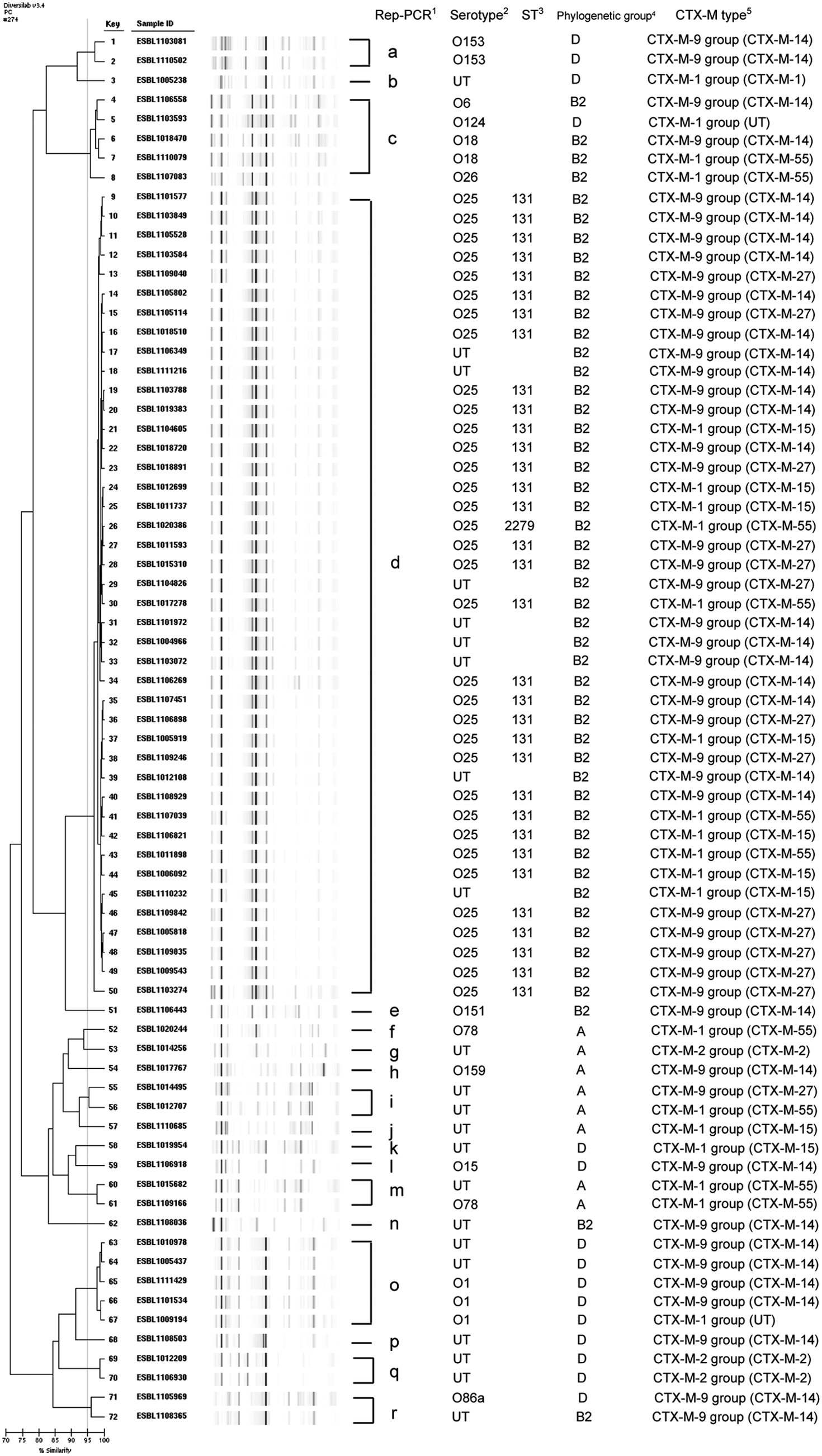
Dendrogram of repetitive-sequence-based PCR (rep-PCR) patterns typing with 95% similarity level for 72 extended-spectrum β-lactamase (ESBL)–producing Escherichia coli strains. 1, Rep-PCR pattern (a–r); 2, O serotype; 3, sequence type (ST) of multilocus sequence typing for O25 strains; 4, phylogenetic group; 5, CTX-M type of ESBL; UT, untypeable.
Plasmid-replicon-type determination
The most common replicon type was the IncF type, detected in 65 strains (90.3%), followed by FIB in 61 strains (84.7%), FIA in 25 strains (34.7%), P in 4 strains (5.6%), K in 3 strains (4.2%), B/O in 3 strains (4.2%), I1-1 in 2 strains (2.8%), Y in 2 strains (2.8%), and N in 1 strain (1.4%) (Table 5). Among 22 strains of the CTX-M-1 group, F was detected in 21 strains (95.5%), followed by FIB in 16 strains (72.7%), FIA in 6 strains (27.3%), P in 4 strains (18.2%), and Y in 1 strain (4.5%). Among three of the CTX-M-2 group, FIB was detected in three strains (100%), followed by F in one strain (33.3%), FIA in one strain (33.3%), and N in one strain (33.3%). Among 47 of the CTX-M-9 group, F was detected in 43 strains (91.5%), followed by FIB in 40 strains (85.1%), FIA in 18 strains (38.3%), B/O in 3 strains (6.4%), K in 2 strains (4.3%), FII in 1 strain (2.1%), and Y in 1 strain (2.1%).
Replicon type: FIC, HI1, HI2, 11M, W, T, A/C, and X were not detected.
As a percentage of each genotype number.
Number of strains.
Virulence factor screening
CTX-M-type-specific virulence factor retention is shown in Table 6. The most prevalent virulence factor was fimH, which occurred in all of the isolates, followed by iutA in 71 strains (98.6%), aggR in 23 strains (31.9%), hlyA in 12 strains (16.7%), eaeA in 11 strains (15.3%), papEF in 9 strains (12.5%), papC in 9 strains (12.5%), sfa/foc in 2 strains (2.8%), and bfpA in 1 strain (1.4%). In the CTX-M-1 group, the CTX-M-1 strain had fimH and iutA; the CTX-M-15 strains, including O25:H4 ST131 strain, had seven genes except sfa/foc and bfpA; and the CTX-M-55 strains had eight genes except bfpA. The CTX-M-2 strains had fimH, iutA, aggR, and eaeA. In the CTX-M-9 group, the CTX-M-14 strains had seven genes except papC and papEF, and the CTX-M-27 strains had seven genes except sfa/foc and bfpA (Table 6).
As a percentage of each genotype number.
Number of strains.
Correlation of the CTX-M-9 group with risk factors or virulence factor genes
We examined the correlation between the CTX-M-9 group, which was the most prevalent in this study, with the presence of risk factors in patients' backgrounds and virulence factors in order to investigate the correlation with sequence type and clinical data and virulence factors. First, we found no significant relationship between the CTX-M-9 group and patients' risk factors (Table 7). The correlation between risk factors and the presence of virulence factors found that the CTX-M-9 group was significantly associated with the presence of papC and papEF [univariate: OR (95% CI)=5.00 (1.13–22.2), p=0.034; multivariate: OR (95% CI)=9.22 (1.32–64.7), p=0.025], or hlyA [univariate: OR (95% CI)=3.54 (0.99–12.7), p=0.052; multivariate: OR (95% CI)=5.57 (1.17–26.4), p=0.031] (Table 8).
95% CI, 95% confidence interval; OR, odds ratio.
Bold, statistically significant.
Discussion
Long-term surveillance between 2000 and 2009 demonstrated that ESBL-producing E. coli increased about 35 times from 0.2% to 7.3% over 10 years in Japan. 33 Over the last decade, CTX-M-type ESBLs have increased dramatically and become the most prevalent ESBLs worldwide, frequently associated with E. coli. 31 Especially, the presence of a worldwide pandemic clone of O25:H4 ST131 E. coli was confirmed and these kinds of strains are known for antibiotic resistance.18,23,25,28,41,45 It is necessary to use caution with clones developing broad multidrug resistance. In terms of antibiotic susceptibilities, we detected ESBL-producing E. coli strains with high resistance to quinolone. In particular, 32 (94.1%) of the E. coli serotype O25 strains showed resistance to LVFX (Table 3), and, among the 72 ESBL-producing strains, 56 (78.9%) strains showed resistance to LVFX as generally observed in Japan 47 and the similar trend was also reported in the United States. 3 In general quinolone resistance is usually caused by chromosomal mutation or related to quinolone resistance genes and/or plasmid-mediated quinolone resistance (PMQR) genes. Plasmids having the PMQR gene often have the ESBL gene at the same time. 30 Retention of quinolone resistance genes and PMQR genes for LVFX resistance should be kept in mind with ESBL-producing strains.
In the detection of ESBL genes, all strains were positive for blaCTX-M in our data. By CTX-M typing, the CTX-M-9 group was the most commonly detected with 47 strains (65.3%) (Table 4). In the early 2000s, the dominant CTX-M group underwent a shift from CTX-M-2 to CTX-M-9, and a recent study showed that the most frequently detected genotype in Japan was the CTX-M-9 group. 33 Nine (12.5%) CTX-M-15 strains were isolated and, among the CTX-M-15 strains, 5 (6.9%) belonged to O25:H4 ST131, and rep-PCR identified ESBL-producing E. coli O25, including clone-ST131-producing CTX-M-15, as shown rep-PCR pattern (Table 4 and Fig. 1). It was reported that 32.2% of CTX-M-15 strains belonged to this kind of clone in the United States. 23 In northern Japan, 8 (7.8%) strains of this kind of clone were detected from clinical isolates between 2008 and 2009. 25
Moreover, our results showed that phylogenetic analyses have shown that E. coli strains fall into three main phylogenetic groups (A, B2, and D). It has been reported that virulent isolates causing extraintestinal infections belong to groups B2 and D, but not groups A and B1.11,42 Almost all strains (88.9%) were divided into phylogenetic groups B2 and D and all of ESBL-producing E. coli O25 strains, including clone-ST131-producing CTX-M-15, were derived from phylogenetic group B2 (Fig. 1). This phylogenetic analysis was almost consistent with our clonal analyses by rep-PCR. These results suggest that this kind of clone has become widespread in Japan.
In addition, we found that the IncF group predominated, since 65 (90.3%) of the strains had the IncF group replicon (Table 5). Similar results have been obtained in other studies, where the association of CTX-M-15-producing E. coli with IncF plasmid has been reported for isolates in Europe and other countries,12,27 Tunisia,17,31 and Japan. 33 IncF plasmid types are well adapted to proliferate in E. coli, but their successful retention in E. coli populations may be attributed to the presence of addiction systems. 31 It is considered that these strains retaining high virulence mediated by the IncF plasmids will spread around the world, like the CTX-M-15 O25:H4-ST131 strains. This reflects why detecting the plasmid replicon type provides essential information about the risk and spread of ESBL-producing bacteria. 17
The most prevalent virulence factor was fimH, which occurred in all of the isolates, followed by iutA in 71 strains (98.6%) in our study (Table 6). Moreover, we found the significant association of papC, papEF, and hlyA with the CTX-M-9 group (Table 8). It was reported that gene adhesins (fimH) and siderophores (iutA) were found in 93–100% of the ST131 E. coli strain. 37 The FimH protein recognizes its receptor on uroplakin that is disseminated on the surface of uroepithelium 39 and is important in the early stage of UTIs. The second commonest virulence factor of uropathogenic E. coli papC plays an important role in the pathogenesis of ascending UTIs and pyelonephritis in humans. 35 Also, S fimbriae and F1C fimbriae are implicated in the process of UTI via binding to epithelium and endothelium. The S fimbriae are also associated with E. coli strains that cause sepsis, meningitis, and ascending UTIs. 20 However, in this study, papC was found in 12.5% and sfa/foc was found in 2.8% of strains, which is a small proportion of the isolates, although 38 (52.8%) of the strains were isolated from urine. These differences in results are partly due to variation in patient backgrounds between studies.
In the detection of such virulence genes as adhesion factors, the most prevalent factor in our study was aggR (31.9%), followed by eaeA (15.3%) and bfpA (1.4%) (Table 6). A recent study reported that strains with EAEC-specific virulence factors, including aggR, showed increased uropathogenicity. 4 Other ESBL-producing isolates had both bfp and eae genes 43 or strains carried the eae gene, but not bfp gene. 24
Since the ESBL-producing gene is present during the conjugative transfer of plasmid, it might possibly be transmitted through plasmid between residents and ESBL-producing strains. ESBL-producing strains fixed to the intestinal tract require protective measures against epidemic, because they are a risk factor for horizontal transmission when excreted.2,19 ESBL-producing strains are therefore associated with higher pathogenicity.
In conclusion, we investigated ST, virulence factors, replicons, and related clinical risk factors using clinical E. coli strains and found that all ESBL-producing E. coli O25 strains, including clone-ST131-producing CTX-M-15, were derived from phylogenetic group B2, and this was consistent with rep-PCR clonal analyses. The CTX-M-15-producing E. coli O25:H4 ST131 with virulence factors, including adhesion factors, has emerged in Japan. The CTX-M-9 group was significantly associated with the presence of papC and papEF or hlyA. Further studies with more strains will be undertaken to define the relationship between these factors and antibiotic resistance.
Footnotes
Acknowledgment
This work was supported by JSPS KAKENHI grant number 24590610.
Disclosure Statement
No competing financial interests exist.