




Abstract
Serogroup 6 of Streptococcus pneumoniae contains four established serotypes (6A–6D). Recently, putative serotype 6E (genotype 6E) was proposed as a novel type, which is cross-reactive with 6B-specific antiserum, but its capsular polysaccharide synthesis (cps) locus is genetically distinct from those of serotypes 6A and 6B. In the present study, prevalence of genotype 6E was analyzed by a newly designed multiplex polymerase chain reaction (PCR) for noninvasive or colonizing S. pneumoniae isolates in northern Japan assigned to serogroup 6 in our previous study by the sequential multiplex PCR developed by Pai et al. Among the isolates previously assigned to 6A and 6B, 2.2% (1/45) and 77.3% (140/181) of isolates, respectively, were revealed to have cps genes of genotype 6E. Eight 6E isolates selected for further analysis were found to have identical or highly similar sequences of cps genes (wzg, wzh, wze, wciN, wciP, and wzy) to those of strains previously reported as putative serotype 6E, and all the isolates were classified into sequence type 90 (ST90). Reanalysis of genetic traits on penicillin and macrolide resistance clarified significantly higher rates of three pbp mutations (gPRSP) and ermB in genotype 6E than in serotypes 6A and 6B. These findings suggested a need for detection of genotype 6E in the surveillance of S. pneumoniae serotypes.
Introduction
S
We previously reported the serotype distribution and prevalence of resistance to penicillin and erythromycin for a total of 1,061 noninvasive S. pneumoniae isolates in northern Japan. 8 In this study, serogroup 6 serotypes were initially detected by the sequential multiplex polymerase chain reaction (SM-PCR) as described by Pai et al., 15 and each serotype (6A, 6B, 6C, and 6D) was further identified by a newly designed multiplex PCR (M-PCR) and PCR-restriction fragment length polymorphism (RFLP) method. 8 However, thereafter, when the sequence information of the genotype 6E cps locus was published, 9 it was noticed that serogroup 6-specific primers described by Pai et al. 15 targeting wciP and serotype 6A/6B-specific primers targeting wciN designed in our previous study 8 are complementary also to genotype 6E cps genes, suggesting their capability to amplify the PCR product also from genotype 6E. Therefore, serogroup 6 isolates, probably those assigned to serotypes 6A and 6B, in our previous study were assumed to contain genotype 6E isolates. The present study was conducted to examine the presence and frequency of genotype 6E among isolates previously assigned to serogroup 6 by PCR, and to characterize resistance traits to penicillin and macrolide of genotype 6E isolates.
Materials and Methods
S. pneumoniae isolates
In our previous study, serotype deduction was performed for a total of 1,061 noninvasive or colonization isolates of S. pneumoniae in Hokkaido, a northern main island of Japan in 2011, by SM-PCRs and PCR-RFLP methods.8,15 Among the 356 isolates classified into serogroup 6, 45 and 181 isolates were assigned to serotypes 6A and 6B, respectively, while the remaining 130 isolates to serotypes 6C and 6D (121 and 9 isolates, respectively). In the present study, all the 356 serogroup 6 isolates were analyzed. These isolates were stored in Microbank (Pro-lab Diagnostics) at −80°C until analyzed.
Detection of genotype 6E by M-PCR
To distinguish genotype 6E from serotypes 6A and 6B, we designed the M-PCR using 6A/6B- and 6E-specific primer pairs targeting wzd and wzh, respectively (Table 1 and Fig. 1). The M-PCR was performed in a 25 μl PCR mixture containing 200 μM of dNTP, 0.5 μM of each primer, 0.25 U of Ex Taq DNA polymerase (Takara Bio) and its buffer with Mg2+ (final conc. 2 mM), and 2 μl DNA template extracted from isolates. The PCR program consisted of the following steps: 94°C for 5 min, 35 cycles at 94°C for 30 sec, 48°C for 30 sec, and 72°C for 1 min, followed by 72°C for 3 min. PCR products were analyzed for their sizes by electrophoresis on 2% agarose gel. Genotype 6E was further confirmed by 6E-specific PCR targeting wze and detection of a 300-bp insertion sequence between wciN and wciO by PCR with primers designed in this study (Table 1) employing the same condition as described above. The locations of these primers in the cps locus are shown in Fig. 1.
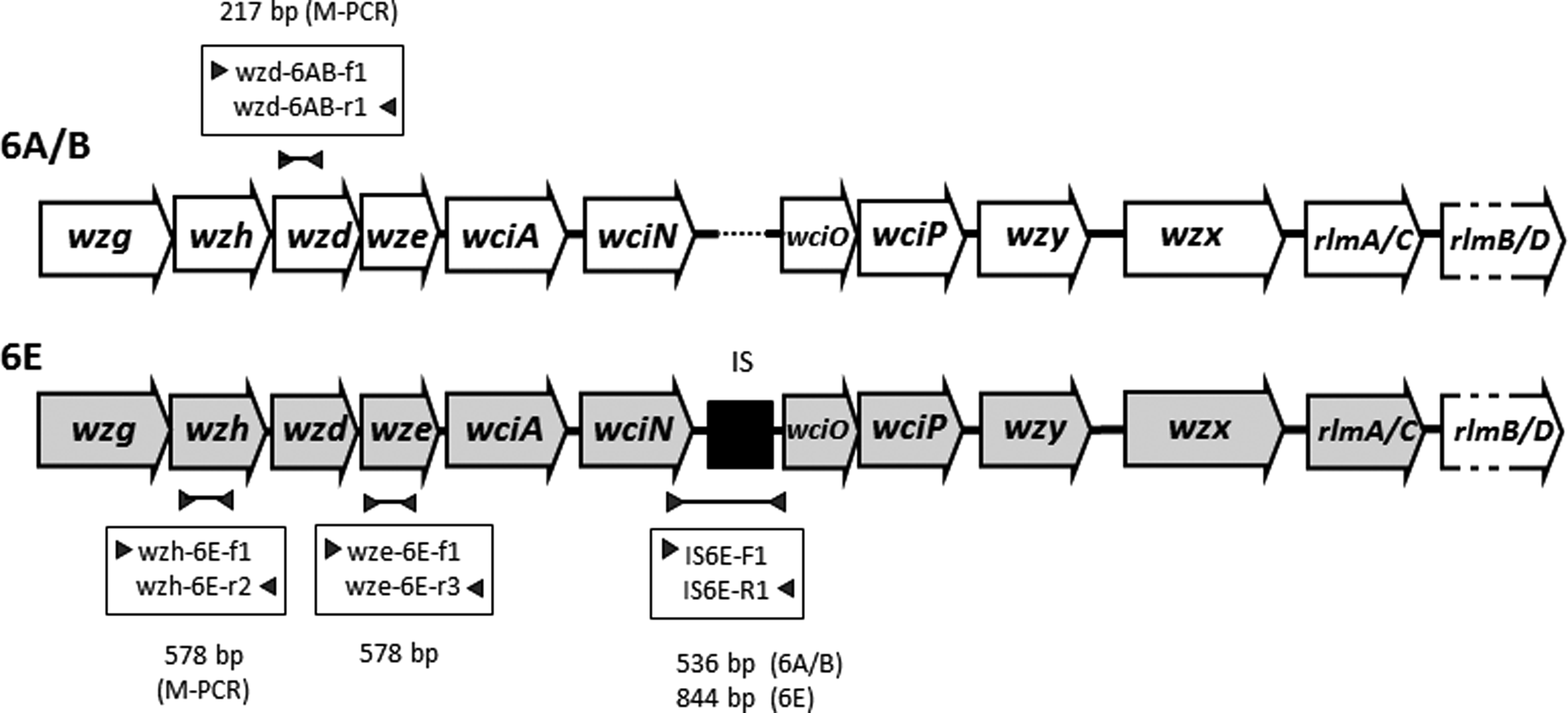
Schematic representation of the cps loci of 6A/B and 6E. Pairs of PCR primers (Table 1) are shown by arrowheads connected by horizontal lines, and primer names are boxed. Genes in the cps locus of genotype 6E that are divergent from those of 6A/B are shadowed. PCR, polymerase chain reaction.
Primers used for sequencing except for both end primers were omitted.
PCR, polymerase chain reaction.
Sequence analysis of cps genes
For the representative genotype 6E isolates, wzg, wzh, wze, wciN, wciP, and wzy in the cps locus were analyzed by direct sequencing with PCR products using primers designed based on the nucleotide sequence in GenBank accession no. JF911504 (Table 1). Gene sequences were determined by using the BigDye® Terminator v1.1 Cycle Sequencing Kit (Applied Biosystems) and 3130xL Genetic Analyzer (Applied Biosystems). Obtained sequence data were analyzed with BLAST (www.ncbi.nlm.nih.gov/BLAST) search and ClustalW (www.ebi.ac.uk/clustalw) program and compared with those of genotype 6E reference strains HK02-14, J01-5, M12-6, K13-21, V03-9, JF911504, and JF911507, and serotype 6A and 6B strains (CR931638 and Tw03-308, respectively).2,6,8
Multilocus sequence typing
Sequence type (ST) based on the multilocus sequence typing (MLST) scheme was determined by sequencing of seven loci of housekeeping genes according to the protocol in the MLST website (http://spneumoniae.mlst.net/).
Statistical analysis
In our previous study, the minimum inhibitory concentration (MIC) of penicillin G and erythromycin, prevalence of PBP gene genotypes, and macrolide resistance genes [erm(B)/mef(A/E)] were investigated. 8 In the present study, these data were reanalyzed among serotypes 6A and 6B and genotype 6E statistically by using the SPSS version 19.0 software. A two-tailed chi-square test or Fisher's exact test (for small group sizes) was used to examine the significance of difference in proportions. A p-value of <0.05 was considered statistically significant.
Nucleotide sequence accession numbers
The GenBank accession numbers for the nucleotide sequences of the wzg, wzh, wze, wciN, wciP, and wzy genes of genotype 6E S. pneumoniae isolates SRP536, SRP205, and SRP514 are KM114228-KM114233, KM114234-KM114239, and KM114240-KM114245, respectively.
Results
By the M-PCR designed in the present study, genotype 6E was discriminated from serotype 6A/6B (Fig. 2a). The wzh gene from which the genotype 6E-specific PCR product was obtained in the M-PCR was confirmed to have an identical sequence to those of genotype 6E reference strains, as described below. As a result, a total of 141 isolates, containing 140 isolates among the 181 previously assigned to serotype 6B (77.3%) and only one isolate among serotype 6A isolates (1/45, 2.2%), were revealed to have genotype 6E genes. Two isolates (one each of serotype 6A and 6B assigned previously) were not distinguished by the M-PCR due to no amplification by this PCR. From all the 130 isolates of serotype 6C or 6D isolates, only a product with 217 bp (the same size as those from serotype 6A/6B) was amplified by the M-PCR. All the 141 isolates assigned to genotype 6E by the M-PCR were confirmed to have the wze region of genotype 6E by the 6E-specific PCR (Fig. 2b).
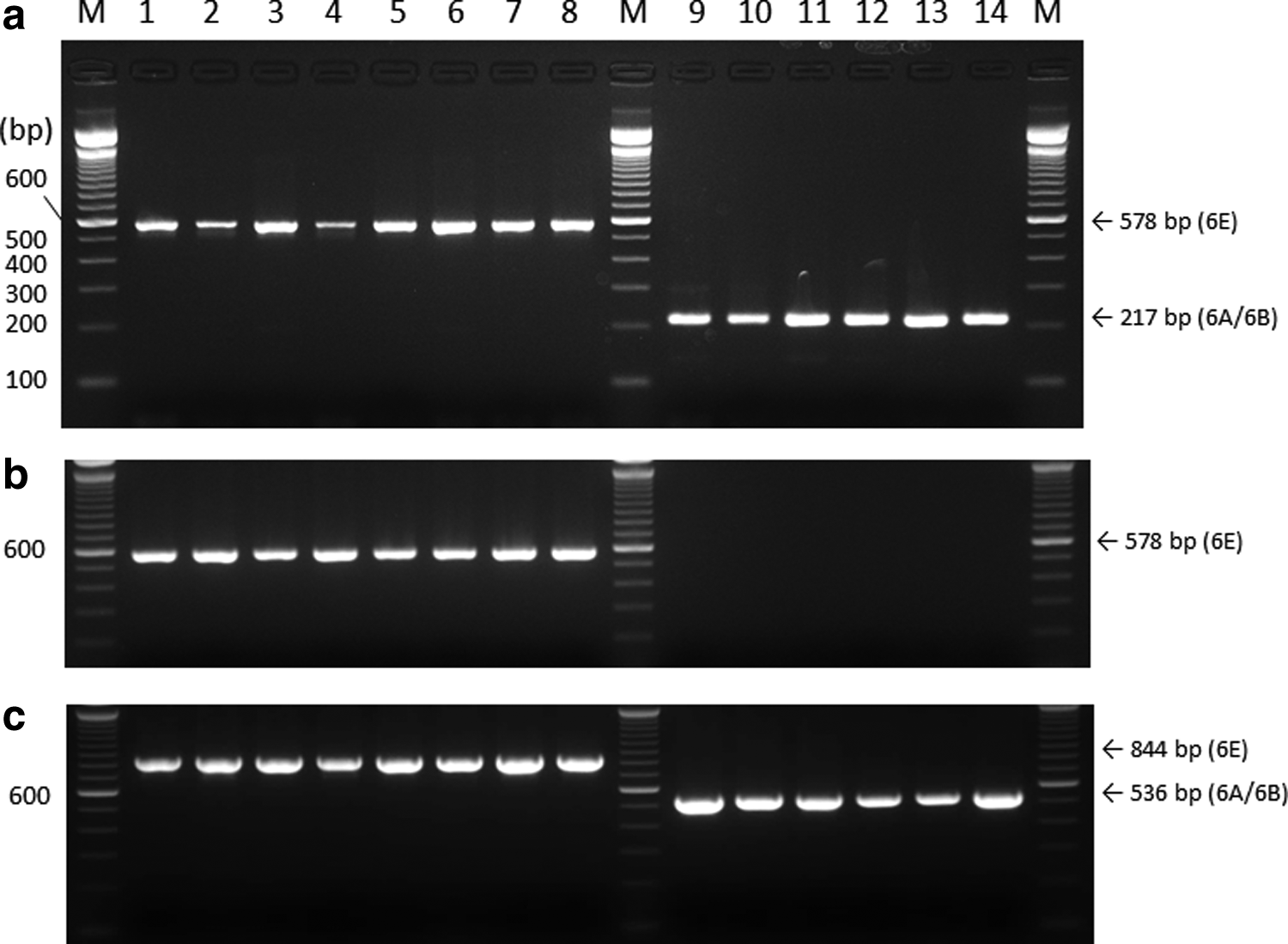
Amplified products generated by the M-PCR for discrimination of genotype 6E from serotype 6A/6B
Eight isolates with genotype 6E (one and seven isolates previously assigned to 6A and 6B, respectively), which were derived from different specimens and ages, were selected for further genetic analysis (Table 2). Nucleotide sequences of six cps genes, wzg, wzh, wze, wciN, wciP, and wzy, of the eight isolates were identical or highly similar to those of genotype 6E, showing 99–100% identity to 6B-III 6 and genotype 6E isolates in Korea and other Asian countries 9 (Table 2). Six isolates had identical sequences of these cps genes to JF911507, while one isolate to JF911504. Sequence identities of genotype 6E isolates to serotype 6A and 6B strains were 90–97%. In accordance with the traits of genotype 6E described previously, 9 a three-amino acid deletion in wze (position 220 to 222 of serotype 6A/6B) and threonine at amino acid 220 in wzy (serine and alanine in 6A and 6B, respectively) were found in all the eight isolates. Presence of the 300-bp insertion between wciN and wciO was also confirmed by PCR (Fig. 2c). In agreement with our previous results by the PCR-RFLP analyses, 8 an isolate SRP536 previously assigned to 6A and seven other 6B isolates had different nucleotides at position 584 in wciP (guanine and adenine, respectively). ST of all the eight isolates was determined as ST90.
Serotypes deduced by multiplex PCR described by Pai et al., 15 followed by multiplex PCR combined with PCR-RFLP analysis. 8
Sequences of these isolates are identical to those of SRP514.
ST, sequence type.
Data on susceptibility to penicillin G and erythromycin and genetic traits for resistance to these antibiotics of S. pneumoniae isolates in our previous study 8 were reanalyzed for the 141 genotype 6E isolates and the remaining authentic serotype 6A (n=43) and 6B (n=40) isolates (Table 3). Genotype 6E isolates had three pbp mutations (gPRSP) and ermB at significantly higher rates (80.9% and 85.1%, respectively) than serotype 6A and 6B isolates, while the prevalence of mef(A/E) was lower. The genotype 6E isolates contained penicillin G-susceptible isolates at a significantly low rate and isolates with high-level erythromycin resistance (MIC >256 μl/ml) at a higher rate than serotype 6A and 6B isolates.
p<0.001.
Resistance to EM (MIC, ≥1 μg/ml).
MIC, minimum inhibitory concentration.
Discussion
The present study clarified an unexpectedly high prevalence of genotype 6E among noninvasive S. pneumoniae isolates in Japan previously assigned to serotype 6B. The 6E isolates were revealed to have more resistance traits (gPRSP, ermB) than authentic serotype 6A and 6B isolates, and representative genotype 6E isolates belonged to ST90, which was the most frequently identified type in 6E isolates in Korea. 9 The presence of genotype 6E cps genes was reported also for strains assigned to 6B (or 6A) in Hong Kong, Vietnam, Malaysia, Japan (strain J01-5), 9 and the Netherlands. 6 In the recent report by Ohtsuka et al., 14 which characterized colonizing isolates from healthy children in Japan, two of the five serotype 6B isolates genetically analyzed were classified into ST90 with serotype 6B (ST906B) (SP598, SP711), and cps genes of these isolates were identical to those of genotype 6E. The ST906B strain has also been referred to as Spain6B-2 (or Spain6B), one of the multidrug-resistant international clones showing penicillin MIC of 1–2 μg/ml.12,13 Since the late 1980s, when the Spain6B-2 clone was first reported in Spain, this clone has also been detected in Iceland, Italy, the United States, Australia, Colombia, and Taiwan.7,12,16–20,22,23 Remarkably, recently in Japan, the Spain6B-2 clone accounted for 28% of serotype 6B invasive pneumococcal isolates, showing a high rate (∼60%) of penicillin-resistant genotype gPRSP. 4 Although it has not yet been clearly defined whether the Spain6B-2 clone intrinsically has genotype 6E cps, genotype 6E pneumococcus is suggested to be distributed globally, causing invasive/noninvasive infections or colonizing in humans.
Because the genotype 6E isolates have cross-reactivity with other serogroup 6 serotypes (particularly 6B) in the Quellung reaction with antisera, 6 6E might have been classified as serotype 6B to date. Ko et al. 9 reported a slightly increasing trend of 6E associated with decrease of 6B in Korea, which was described as a possible reason why an apparent decrease of serotype 6B had not been observed after introduction of the 7-valent pneumococcal vaccine (PCV-7) when 6E was misclassified as 6B. In Japan, an obvious decrease of vaccine serotypes in invasive isolates after introduction of PCV-7 was observed.4,5 However, the frequency of 6B was still higher than other PCV-7 serotypes. It is possible that the serotype 6B contains genotype 6E pneumococci, which might be protected by PCV-7 less efficiently compared with authentic serotype 6B. Despite the cross-reactivity to serotype 6B, genotype 6E is suggested to have a distinct capsule structure and antigenicity from other serogroup 6 serotypes due to substantial genetic diversity in its cps locus. 6 Furthermore, as revealed in the present study, genotype 6E isolates tend to have more traits of resistance to penicillin and erythromycin than serotypes 6A and 6B, which may be attributable to selective expansion of genotype 6E strains. Therefore, identification of 6E may be important for surveillance of pneumococcal serotypes, which are conducted globally.
Footnotes
Acknowledgment
This work was supported by the Grant-in-Aid for Scientific Research (KAKENHI) (No. 26893212) from Japan Society for the Promotion of Science (JSPS).
Disclosure Statement
The authors of this article have no commercial associations that might create a conflict of interest in connection with the submitted article.