




Abstract
Trimethoprim–sulfamethoxazole is the first-line antimicrobial combination for Stenotrophomonas maltophilia infections. However, allergy or intolerance and increasing resistance limit the use of trimethoprim–sulfamethoxazole. Quinolones can be used as an alternative therapeutic option, but resistance can emerge rapidly during therapy. We analyzed the contribution of SmeABC and SmeDEF efflux pumps to levofloxacin resistance in clinical isolates of S. maltophilia. Nonduplicate clinical isolates of S. maltophilia were collected in 2010 from 11 university hospitals (n = 102). Fifty-five levofloxacin nonsusceptible (minimum inhibitory concentration [MIC] ≥4 μg/ml) and 47 susceptible (MIC ≤2 μg/ml) isolates were tested for efflux pump overexpression. Real-time reverse transcription-PCR was performed for amplification and quantification of smeB, smeC, smeD, and smeF mRNA. To determine which antimicrobials were affected by smeD overexpression, the growth rates of a levofloxacin-susceptible S. maltophilia isolate were compared by measuring absorbance of antimicrobial-supplemented Luria-Bertani broth (LB) cultures with or without triclosan. Significant relationships between sme gene overexpression and resistance were observed for smeD against levofloxacin, smeC and smeF against ceftazidime, and smeC against ticarcillin–clavulanate. The mean MICs of moxifloxacin and tigecycline did not significantly differ for isolates with or without overexpression of smeB, smeC, and smeF, but were significantly higher for isolates with smeD overexpression. The mean MICs of amikacin were significantly higher for smeC or smeF overexpressing isolates. Increased growth of a levofloxacin-susceptible isolate was observed in LB with 1/2 MIC levofloxacin in the presence of triclosan. These data suggest that the expression of smeD plays a role in levofloxacin resistance in S. maltophilia.
Introduction
S
Trimethoprim–sulfamethoxazole is still considered the first-line antimicrobial combination for S. maltophilia infections.1–3 However, allergy or intolerance may limit the use of trimethoprim–sulfamethoxazole,1,6,7 and the number of resistant strains is increasing.8,9 Quinolones can be used as an alternative therapeutic option, but rapid resistance can emerge on therapy.1,2,10,11 Recently, multidrug resistance (MDR) efflux pump systems have been considered as the major mechanism of quinolone resistance and other antimicrobial agents, but the mechanisms involved in quinolone resistance are not fully clarified.8,12,13 The SmeABC and the SmeDEF MDR efflux pump systems have been described in S. maltophilia. The expression of MDR efflux pumps is usually controlled by specific transcriptional repressors. For example, the expression of SmeDEF is downregulated by the transcriptional repressor SmeT. The smeT gene is located upstream from the structural operon of the pump genes smeDEF and is divergently transcribed from those genes.14,15 The biocide triclosan binds to the repressor SmeT and releases SmeT from its operator and induces the expression of smeD. It is predicted that the susceptibility of S. maltophilia to antimicrobials would be lower in the presence of the biocide. 16 In this study, we have analyzed the contribution of SmeABC and SmeDEF efflux pumps to levofloxacin resistance in a collection of clinical isolates of S. maltophilia. To confirm the antimicrobials affected by the overexpression of smeD, we used triclosan.
Materials and Methods
Bacterial isolates and susceptibility test
A total of 102 nonduplicate clinical isolates of S. maltophilia were collected in 2010 from 11 university hospitals in South Korea. Antimicrobial susceptibility had been assessed in our previous study. 9 The antimicrobial agents used were trimethoprim–sulfamethoxazole (Dong Wha), levofloxacin (Daiichi), moxifloxacin (Bayer Korea), minocycline (SK Chemicals Life Science), tigecycline (Wyeth Research), ceftazidime (Sigma Chemicals), ticarcillin–clavulanate (Dong-A), chloramphenicol (Chong Kun Dang), and amikacin (Sigma Chemicals). The breakpoints recommended by CLSI for S. maltophilia were applied to interpret the minimum inhibitory concentrations (MICs). 17
RNA preparation and real-time reverse transcription PCR
Among the isolates, 55 levofloxacin nonsusceptible (MIC ≥4 μg/ml) and 47 susceptible (MIC ≤2 μg/ml) isolates were tested for efflux pump overexpression. One milliliter of suspensions from bacteria grown in Luria-Bertani broth (LB) at 37°C overnight was spun down at 6,000 × g for 10 min at 4°C and immediately frozen on dry ice and stored at −80°C. Total RNA was extracted from the pellets using the RNeasy Mini Kit (Qiagen) according to the manufacturer's instructions. cDNA was obtained from 1 mg RNA. Real-time reverse transcription-PCR was performed. In brief, a first denaturation step was allowed at 95°C for 10 min followed by 40 cycles (95°C for 15 s, 60°C for 1 min) for amplification and quantification. Amplification mixtures (50 μl) for smeB, smeC, smeD, smeF, and gyrA quantification contained template cDNA, 2 × SYBR Green I Master Mix (Applied Biosystems), and primers (Table 1). The parameter Ct was defined as the threshold cycle number at which the fluorescence generated by the binding of SYBR Green I dye to double-stranded DNA began to increase exponentially.
S. maltophilia ATCC 13637 was used as calibrator to normalize the relative expression level of smeB, smeC, smeD, and smeF genes in clinical isolates. The level of expression of MDR efflux genes was determined as described by Chang et al. 8 If the amount of the mRNA was relatively more than the calibrator, S. maltophilia ATCC 13637, MDR efflux genes were considered to be overexpressed, and if the amount was less than the calibrator, the genes were considered to be nonoverexpressed.
Confirmation of the antimicrobials affected by the overexpression of smeD gene
An isolate of levofloxacin-susceptible S. maltophilia (MIC = 0.5 μg/ml) was used. The sme genes of this isolate were not overexpressed. The MICs (μg/ml) were low to some antimicrobials, including moxifloxacin (0.12), minocycline (0.5), tigecycline (1), ceftazidime (4), chloramphenicol (8), and trimethoprim–sulfamethoxazole (0.5), but were high to amikacin (≥256) and ticarcillin–clavulanate (32). After an overnight incubation in Luria-Bertani medium at 37°C, 30 μl of bacterial suspension was used to inoculated 2,970 μl LB with and without 1/2 MICs of antimicrobials and 3 μg/ml of triclosan (Sigma). 16 All bacterial suspensions were agitated in the shaking incubator. The control growth rate without antimicrobials was obtained. Bacterial growth was compared spectrophotometrically by measuring absorbance at 595 nm during a 30 hr incubation period at 37°C. 16
Results
The MIC of levofloxacin for 102 isolates ranged from 0.12 to 64 μg/ml, and MIC50 and MIC90 were 4 and 32 μg/ml, respectively. The susceptibility rate was 46.1% (data not shown).
Among the clinical isolates analyzed in our work, smeB, smeC, smeD, and smeF were overexpressed by 70%, 77%, 59%, and 61%, respectively (Table 2). The mean MICs of antimicrobials were compared according to the expression of smeB, smeC, smeD, and smeF. The mean MICs of amikacin were significantly higher in smeC or smeF overexpressing isolates, but MICs were high in almost all tested strains, regardless of the expression of smeABC or smeDEF efflux pumps. The mean MICs of levofloxacin, moxifloxacin, minocycline, and tigecycline did not show significant differences according to the expression of smeB, smeC, and smeF, but showed significantly higher mean MICs in smeD overexpressing isolates (Table 2).
Comparison between Sme overexpressing and nonoverexpressing isolates by Students' t-test.
MIC, minimum inhibitory concentration; NON, nonoverexpressing; OVER, overexpressing.
Antimicrobial susceptibilities to trimethoprim–sulfamethoxazole, levofloxacin, minocycline, ceftazidime, ticarcillin–clavulanate, and chloramphenicol were compared according to the expression of smeB, smeC, smeD, and smeF. The overexpression of smeC was significantly correlated with ceftazidime-nonsusceptible or ticarcillin–clavulanate-nonsusceptible isolates (Table 3), and the overexpression of smeF correlated with ceftazidime-nonsusceptible isolates (Table 3). The overexpression of smeD was significantly associated in levofloxacin-nonsusceptible isolates, but the susceptibility to levofloxacin was not changed by the overexpression of smeB, smeC, or smeF (Table 3).
Comparison between Sme overexpressing and nonoverexpressing isolates by Fisher's exact test.
CAZ, ceftazidime; CHL, chloramphenicol; LEV, levofloxacin; MIN, minocycline; NS, nonsusceptible; n, number; S, susceptible; SXT, trimethoprim–sulfamethoxazole; T/C, ticarcillin–clavulanate.
To confirm that levofloxacin is effluxed by smeD overexpression, the growth rate of S. maltophilia was measured in broth supplemented with levofloxacin and/or triclosan. In addition, the influences of smeD overexpression are investigated for several classes of antimicrobials. The increased bacterial growth by the effect of triclosan was observed in a levofloxacin added tube, but not in the other tubes (Fig. 1).
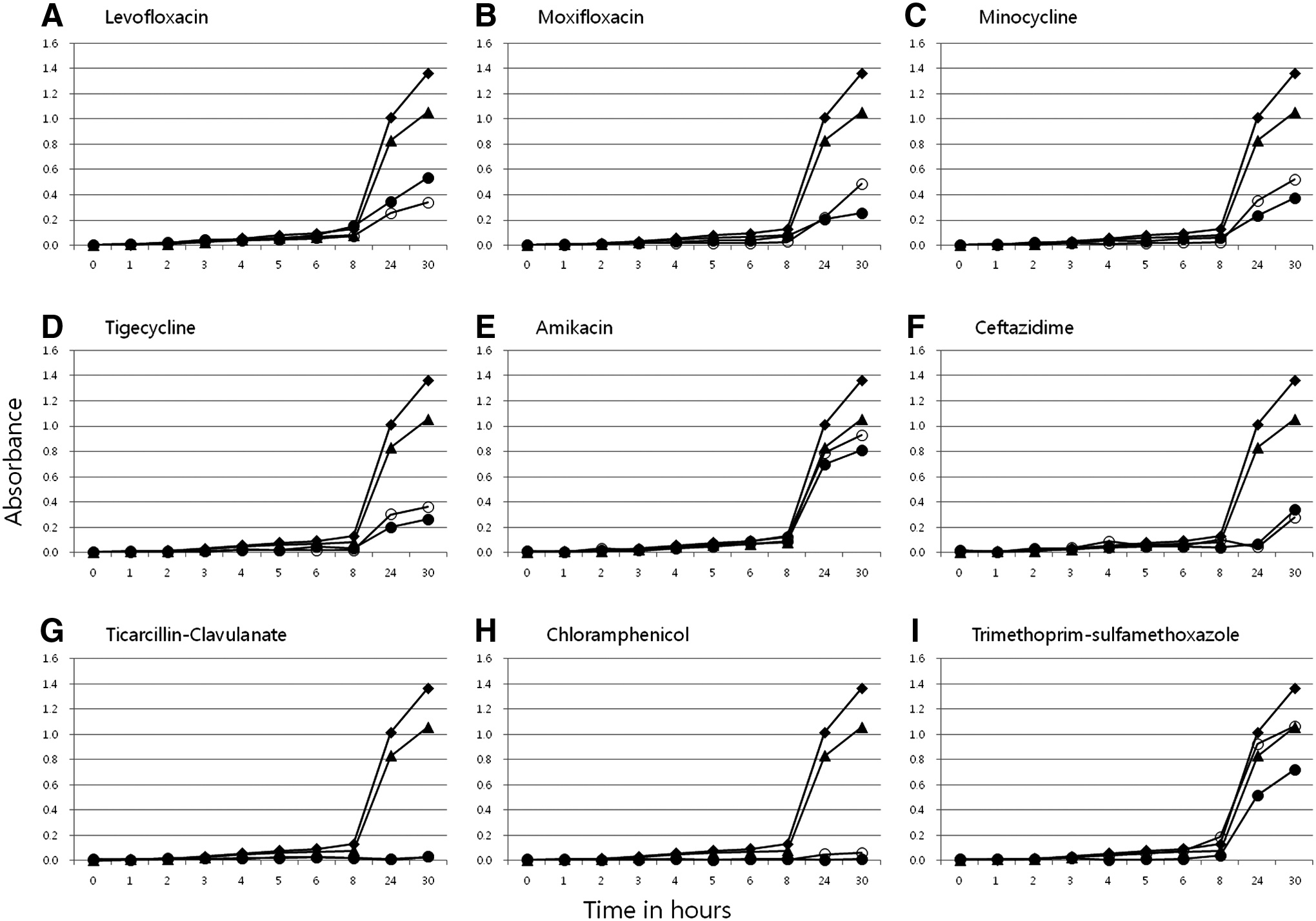
Effect of triclosan and antibiotics alone or in combination on the growth of Stenotrophomonas maltophilia.
Discussion
S. maltophila exhibits high-level intrinsic resistance to several antimicrobials, disinfectants, and heavy metals by β-lactamases, aminoglycoside-modifying enzymes, and multidrug efflux pumps.1–3 S. maltophilia can also acquire extrinsic resistance genes. Multidrug efflux pumps and low permeability of the outer membrane are major resistance mechanisms in multidrug resistant S. maltophila.1–3 The smeDEF system was from S. maltophila through genome analysis and cloning by Alonso and Martinez in 2000. 12 It was suggested that the overexpression of smeDEF genes might contribute to increased levels of resistance to tetracycline, chloramphenicol, erythromycin, and quinolones in clinical isolates of S. maltophilia. 18 Moreover, the deletion of smeF in wild-type S. maltophilia strains rendered the mutants hypersusceptible to several antimicrobials, suggesting that SmeDEF contributes to intrinsic antimicrobial resistance in this organism. 19 Li et al. described the smeABC system from S. maltophilia, and reported that the smeABC genes were overexpressed in a mutant strain displaying resistance to several antimicrobials, including aminoglycosides, β-lactams, and fluoroquinolones. 13 By constructions of sme deletion mutants, it was suggested that smeC but not smeB contributed to the MDR of the mutant as part of another, as-yet-unidentified multidrug efflux system. 13
In our study, the mean MICs of amikacin were significantly higher for isolates with smeC and smeF overexpressions (Table 2). Although the MICs of amikacin were significantly lower in nonoverexpressing isolates, still the MIC levels were more than 190 μg/ml (Table 2). However, Alonso and Martinez indicated that the MIC of amikacin in the multiresistant D457R mutant that overexpressed the SmeDEF multidrug efflux system was lower than that in the D457 strain. 12 It was also shown that the smeF-deleted mutants did not show changes in susceptibility to aminoglycoside antimicrobials. 19 The mean MICs of levofloxacin, moxifloxacin, minocycline, and tigecycline were significantly higher in smeD overexpressing isolates (Table 2). The differences of the mean MICs of ceftazidime, ticarcillin–clavulanate, chloramphenicol, and trimethoprim–sulfamethoxazole were not significant, regardless of the expression of smeB, smeC, smeD, and smeF (Table 2). These results are similar to those of previous studies.13,18 Li et al. showed that the elimination of SmeB (an SmeE homologue) did not compromise the enhanced MDR of MDR mutant. 13 In our study, there were no differences in the MICs and antimicrobial susceptibilities according to the expression of SmeB (Tables 2 and 3). However, by determining the relative expression levels of the smeB and smeF genes only, Cho et al. reported that the SmeABC efflux pump was associated with MDR. 20
In clinical aspects, to determine whether overexpression of the sme pump is substantially represented by the difference of sensitivity, we analyzed the MIC results according to the CLSI antimicrobial breakpoints (Table 3). The susceptibilities of ceftazidime and ticarcillin–clavulanate were decreased by the overexpression of smeC and smeF, but the MIC values were not significantly influenced (Tables 2 and 3). The susceptibility and MIC values of levofloxacin were significantly influenced by the overexpression of smeD (Tables 2 and 3). The MIC values of minicycline were influenced by the overexpression of smeD, but the susceptibility was not significantly affected (Tables 2 and 3). Therefore, we thought that the sensitivity and MIC value of levofloxacin would be more relevant to the expression of smeD.
In this study, SmeDEF (i.e., smeD) might be the most relevant antimicrobial resistance efflux pump. Expression of SmeDEF is downregulated by the transcriptional repressor SmeT. The smeT gene is located upstream from the structural operon of the pump genes smeDEF and is divergently transcribed from those genes.14,15 To confirm the antimicrobials affected by the overexpression of smeD, we used biocide triclosan. Since triclosan releases SmeT from its operator and induces the expression of smeDEF, it is predicted that the susceptibility of S. maltophilia to antimicrobials would be lower in the presence of biocide. 16 As shown in Fig. 1, growth curves could be plotted for S. maltophilia cultures with or without triclosan in the presence or absence of sub-MIC concentrations of these antimicrobials. Sub-MIC level antimicrobials were used to avoid complete inhibition of growth of the test organism. The impaired bacterial growth in the presence of levofloxacin reverted and improved with triclosan (Fig. 1). Unlike in the presence of levofloxacin, bacterial growth was not improved in the presence of triclosan and the other antimicrobials (Fig. 1). Therefore, it might be suggested that levofloxacin is pumped out of the bacterial cell by the expression of the SmeDEF system.
In conclusion, expression of smeD can play a role in levofloxacin resistance in S. maltophilia. Although the prevalence of levofloxacin-resistant S. maltophilia is low, continued surveillance of resistance in S. maltophilia to levofloxacin and other alternative antimicrobials is warranted.
Footnotes
Acknowledgments
This work was supported by Basic Science Research Program through the National Research Foundation of Korea (NRF) funded by the Ministry of Education, Science and Technology (NRF-2010-0008485).
Disclosure Statement
No competing financial interests exist.