




Abstract
Purpose:
The aim of the study was to investigate the prevalence and molecular support of carbapenem resistance in gram-negative bacilli clinical isolates collected between March 2013 and March 2015 in three cities (Annaba, Skikda, and Guelma) in northeastern Algeria.
Results:
One hundred eighty-six isolates were identified as Enterobacteriaceae (161), Pseudomonas aeruginosa (18), and Acinetobacter baumannii (7). Thirty-six of 186 (19.3%) were resistant to carbapenems. Among them, 11 harbored carbapenemase genes, including blaOXA-48 (2 Klebsiella pneumoniae), blaVIM-4 (2 P. aeruginosa), blaNDM-1 (2 A. baumannii), and blaOXA-23 (5 A. baumannii). In addition, other β-lactamases were detected: blaCTX-M-(15/66/139), blaSHV-(28/85/1/133), and blaTEM-1. All imipenem-resistant P. aeruginosa displayed OprD mutations. Multilocus sequence typing demonstrated the presence of ST 404 and ST 219 in K. pneumoniae, ST 2 and ST 85 in A. baumannii, and ST (244, 1076, 241, 227, and 233) in P. aeruginosa.
Conclusion:
In this study, we report the first detection of P. aeruginosa ST 1076 harboring the blaVIM-4 gene in African countries in two cities (Annaba and Skikda) in northeastern Algeria. Additionally, we report the first detection of blaOXA-48 in K. pneumoniae ST 404 and ST 219 in Algerian cities (Annaba and Skikda).
Introduction
R
Carbapenems are a β-lactam group of drugs that are often used as antibiotics of last resort to treat infections resulting from multidrug-resistant gram-negative bacilli. Carbapenems are restricted to hospital use and are mainly prescribed for the treatment of nosocomial infections. However, in recent years, this scenario has changed, with the emergence of carbapenem-resistant bacteria both in nonfermentative (A. baumannii and P. aeruginosa) and fermentative (Enterobacteriaceae) gram-negative bacilli. 3
Carbapenemase enzymes have been reported extensively in Enterobacteriaceae around the world.
Currently, carbapenemases in Enterobacteriaceae are mainly found in K. pneumoniae and, to a much lesser extent, in E. coli and other Enterobacterial species, with a higher prevalence in southern Europe and Asia than in other parts of the word. Class D β-lactamases, also known as blaOXAs for oxacillinases, have been detected in many gram-negative bacteria, including Enterobacteriaceae. The blaOXA-48 gene was initially identified in a K. pneumoniae isolate from Turkey in 2001. 3 Since then, the occurrence of blaOXA-48 producers has been reported as the source of nosocomial outbreaks in many parts of the world, notably in Mediterranean countries: Croatia, Egypt, France, Greece, Israel, Italy, Lebanon, Libya, Slovenia, Spain, Tunisia, Morocco, and Turkey. 3 Moreover, among the increasingly reported and commonly identified multi- or even pan-drug-resistant bacteria, P. aeruginosa holds an important place. Several types of metallo-β-lactamases (MBLs) have been described around the world in P. aeruginosa isolates (IMP, VIM, SPM, GIM, SIM, AIM, FIM, and NDM). 4 The most frequent of the MBLs are the VIM types. These have been identified in carbapenem-resistant isolates of P. aeruginosa in European countries with coastlines on the Mediterranean basin: Italy, France, Greece, Spain, Croatia, and Turkey and from African countries: Tunisia, Kenya, Libya, South Africa, 4 and Lebanon. 5 The main porin for uptake of carbapenems in P. aeruginosa is the outer membrane protein, OprD. Inactivating mutations in the OprD gene represent the most common molecular mechanism known for conferring resistance to carbapenems. 5
In Algeria, from the beginning of 2010, carbapenemases of the Ambler class D (OXA-23 and OXA-58) type or class B type, including VIM-19 enzyme, were considered to be the first carbapenemases detected in A. baumannii6,7 and Enterobacteriaceae, 8 respectively. Following that other types of carbapenemase classes, B (VIM-2, NDM-1, and NDM-5 enzymes), A (KPC enzymes), and D (OXA-23, OXA-24, and OXA-48 enzymes), were reported, with some of them becoming endemic in Algeria (e.g., OXA-23 and NDM-1 in A. baumannii).7,9
The objectives of the present study were therefore to investigate the prevalence and molecular support of carbapenem resistance in gram-negative bacilli from clinical isolates collected between March 2013 and March 2015 from patients in three cities (Annaba, Skikda, and Guelma) in northeastern Algeria.
Materials and Methods
Data collection
A total of 186 nonduplicated gram-negative bacilli strains were isolated from patients hospitalized between March 2013 and March 2015 in three cities (Annaba, Skikda, and Guelma) in northeastern Algeria. These strains were identified using API 20E (Enterobacteriaceae) and API 20NE (P. aeruginosa and A. baumannii) identification systems (bioMérieux) and were confirmed using a matrix-assisted laser desorption and ionization time-of-flight mass spectrometry (MALDI-TOF MS) method (Microflex; Bruker Daltonics) as previously described. 10
Antibiotic susceptibility testing
Antimicrobial drug susceptibility was determined using the disk diffusion method on Mueller–Hinton (MH) agar according to the Antibiogram Committee of the Société Française de Microbiologie (CA-SFM) (www.sfm-microbiologie.org). Seventeen antibiotics were tested: amoxicillin, amoxicillin/clavulanic acid, ticarcillin/clavulanic acid, cefoxitin, cefotaxime, aztreonam, ceftriaxone, ceftazidime, imipenem, ertapenem, trimethoprim/sulfamethoxazole, amikacin, gentamicin, ciprofloxacin, fosfomycin, rifampicin, and colistin. The minimum inhibitory concentrations for imipenem were determined using the Etest method (ABbiodisk). Interpretations were made according to CA-SFM breakpoints.
Phenotypic detection of carbapenemases
Phenotypic detection of carbapenemase production was performed using the modified Hodge test (MHT), the EDTA test, and modified Carba NP test (MCNP), as previously described.11,12
Detection of antibiotic resistance genes
Gram-negative bacilli isolates were screened using standard and real-time PCR for the following carbapenem-hydrolyzing enzyme-encoding genes: blaOXA-48, 13 blaVIM, 5 blaNDM, 14 blaKPC, 15 blaIMP, 5 blaOXA-58, 16 blaOXA-24, 16 blaOXA-23, 16 and other β-lactamases: (blaTEM, blaSHV, blaCTXM) 16 and blaOprD. 5
Sequencing of resistance genes
All amplified products obtained were sequenced to validate their identities. Both strands of the purified amplicons were sequenced using Big Dye terminator chemistry on an ABI 3130XL automated sequencer (Applied Biosystems). The nucleotide and deduced protein sequences were analyzed using the ARG-ANNOT (Antibiotic Resistance Gene-ANNOTation). 17 PCR products of OprD were fully sequenced as described above, and the resulting sequences were compared with the PAO1 reference strain sequence.
Genotyping clinical isolates
The epidemiology of K. pneumoniae, P. aeruginosa, and A. baumannii carbapenemase production was studied by multilocus sequence typing (MLST) as described.4,18 Isolates were attributed a sequence-type (ST) number according to the allelic profiles available on the Institut Pasteur's MLST website (www.pasteur.fr/mlst) and PubMLST (www.pubmlst.org).
Results
Between March 2013 and March 2015, 186 gram-negative bacilli were collected from three hospitals in northeastern Algeria, including Annaba, n = 114 (61.2%), Skikda, n = 47 (25.2%), and Guelma, n = 25 (13.4%). Identification using both API20NE or API20E (identification system) and MALDI-TOF MS led to the identification of 161 (86.5%) Enterobacteriaceae (54 E. coli [29%], 55 Klebsiella spp. [29.5%], 17 Enterobacter spp. [9.1%], 10 Serratia spp. [5.3%], 12 Proteus spp. [6.4%], 2 Citrobacter spp. [1.07%], 8 Morganella morganii [4.3%], and 3 Providencia spp. [1.6%]) as well as 25 (13.4%) nonfermenter species (18 P. aeruginosa [9.6%] and 7 A. baumannii [3.76%]). The strains were isolated from wounds (61.2%), urine (35.4%), bloodstream infections (2.1%), and pleural fluid (1%). These samples were recovered from various hospital units (internal medicine, general surgery, pediatrics, urology, traumatology, operating rooms, burns unit, accident and emergency, and neonatology).
The Enterobacteriaceae showed a high degree of resistance to amoxicillin, amoxicillin/clavulanic acid, cefotaxime, and rifampicin. All strains were resistant to at least one aminoglycoside, including gentamicin. A lower rate of resistance was observed for ertapenem and colistin (Table 1).
1: Escherichia coli, 2: Klebsiella spp., 3: Enterobacter spp., 4: Serratia spp., 5: Proteus spp., 6: Citrobacter spp.,7: Morganella morganii, 8: Providencia spp. 9: Pseudomonas aeruginosa, 10: Acinetobacter baumannii.
Of 161 Enterobacteriaceae, 20 (12.4%) were screened for carbapenemase based on their reduced susceptibility to ertapenem (Table 2) and were included in the molecular biology study. Two K. pneumoniae isolates were positive by MHT and MCNP, blaOXA-48 was detected in these two isolates with ST 404 and ST 219. Neither blaKPC nor blaNDM gene was detected. A wide range of β-lactamases was found, and further analysis of blaTEM and blaSHV indicated the presence of blaTEM-1 (n = 9), blaSHV-28, blaSHV-85, blaSHV-1, and blaSHV-133 in only four isolates. The blaCTX-M-15 gene was detected (n = 15) and two isolates carried the blaCTX-M-139 gene and one K. pneumoniae carried the blaCTX-M-66 gene (Table 2).
ESBL, extended spectrum beta-lactamase; ETP, ertapenem; IMP, imipenem; MCNP, modified Carba NP; MHT, modified Hodge test; MIC, minimum inhibitory concentration; MLST, multilocus sequence typing; NT, not tested.
In terms of the nonfermenter bacilli, the results of antibiotic susceptibility testing revealed that the isolates were resistant to almost all antibiotics, including β-lactams, aminoglycosides, and fluoroquinolones. In addition, 100% of A. baumannii and 50% of P. aeruginosa isolates were resistant to imipenem. All isolates were susceptible to colistin except Serratia and Proteus species (Table 1).
Of the nine imipenem-resistant P. aeruginosa isolates, β-lactamase activity was inhibited by the EDTA in only two, and PCR revealed a blaVIM-4 gene in these isolates. None of the strains contained blaIMP, blaNDM, blaOXA-58, blaOXA-24, blaOX-23, blaTEM, blaSHV, and blaCTX-M genes (Table 3). Due to various mutations, all carbapenem-resistant P. aeruginosa isolates had a modification in the amino acid sequence of the OprD protein based on comparison with the PAO1 reference. Indeed, all isolates had modifications in their OprD gene sequence with insertion sequences at different positions, leading to stop codons and causing mutations in the OprD gene sequences. Based on the mutations in OprD, the P. aeruginosa isolates could be classified into five groups (Table 3).
G1: insertion of G in nucleotide positions 40 and 137 leading to the premature stop codon TAG in oprD, resulting in a truncated polypeptide of 200 amino acid residues, G2: insertion of C in nucleotide positions 60 and 190 leading to the premature stop codon TGA in oprD, resulting in a truncated polypeptide of 64 amino acid residues, G3: insertion of G in nucleotide positions 134 leading to the premature stop codon TAG in oprD, resulting in a truncated polypeptide of 153 amino acid residues, G4: insertion of C in nucleotide positions 64 leading to the premature stop codon TGA in oprD, resulting in a truncated polypeptide of 89 amino acid residues, G5: insertion of C in nucleotide positions 180 leading to the premature stop codon TGA in oprD, resulting in a truncated polypeptide of 222 amino acid residues.
The MLST of P. aeruginosa revealed the presence of multiple clones (244, 1076, 241, 227, and 233) among the imipenem-resistant strains and which comprised strains from the hospitals of Annaba and Skikda with identical STs and identical OprD sequences. The compositions of these groups were as follows: G1, G2, G3, G4, and G5 were isolated from Annaba and consisted of ST 244, 1076, 241, 227, and 233, respectively. The G2 that was isolated from the Skikda Hospital consisted of ST 1076 (Table 3).
All imipenem-resistant A. baumannii tested were positive using MHT and MCNP and two of them tested were positive with the EDTA test. Carbapenemase genes were present in most A. baumannii, including blaOXA-23 (n = 5), and only two isolates were positive for the blaNDM-1 gene. None of the strains contained the blaOXA-58, blaOXA-24, blaVIM, and blaIMP genes. Furthermore, genotypic characterization of extended spectrum beta-lactamase (ESBLs) revealed the identification of the blaTEM-1 gene in five strains. The clonal relationship of A. baumannii isolates based on MLST analysis showed the presence of ST 2 and 85 (Table 3).
Discussion
Over the past 10 years, we have seen a significant increase in antibiotic resistance in gram-negative bacilli in Algeria. The nature of this resistance is of increasing concern with the emergence of new resistance determinants such as carbapenemases (classes A [e.g., KPC enzymes], B [VIM and NDM enzymes], and D [OXA enzymes]). In Algeria, the first carbapenemase described in Enterobacteriaceae was VIM-19 in 2010. 8 Following that the KPC gene was reported in Enterobacteriaceae in 201019 and KPC-3 in K. pneumoniae from a child's cerebrospinal fluid. 15 Recently, Sassi et al. reported the detection of the blaNDM-5 gene in E. coli. 20 Oxacillinase-type OXA-48 was first identified in Enterobacteriaceae in 2010. 19 The OXA-48 enzyme was detected in an E. coli isolate from a patient from a province bordering Tunisia 21 and recently in a K. pneumoniae isolate from patients in Algiers 22 and Constantine 23 (Fig. 1 and Table 4). In our document, we describe the first detection of OXA-48-producing K. pneumoniae ST 404 and ST 219 in two cities (Annaba and Skikda) in northeastern Algeria. These results indicate the spread of the blaOXA-48 gene to different regions in Algeria. K. pneumoniae ST 404 has been already reported in Korea 24 and ST 219 in Brazil. 25
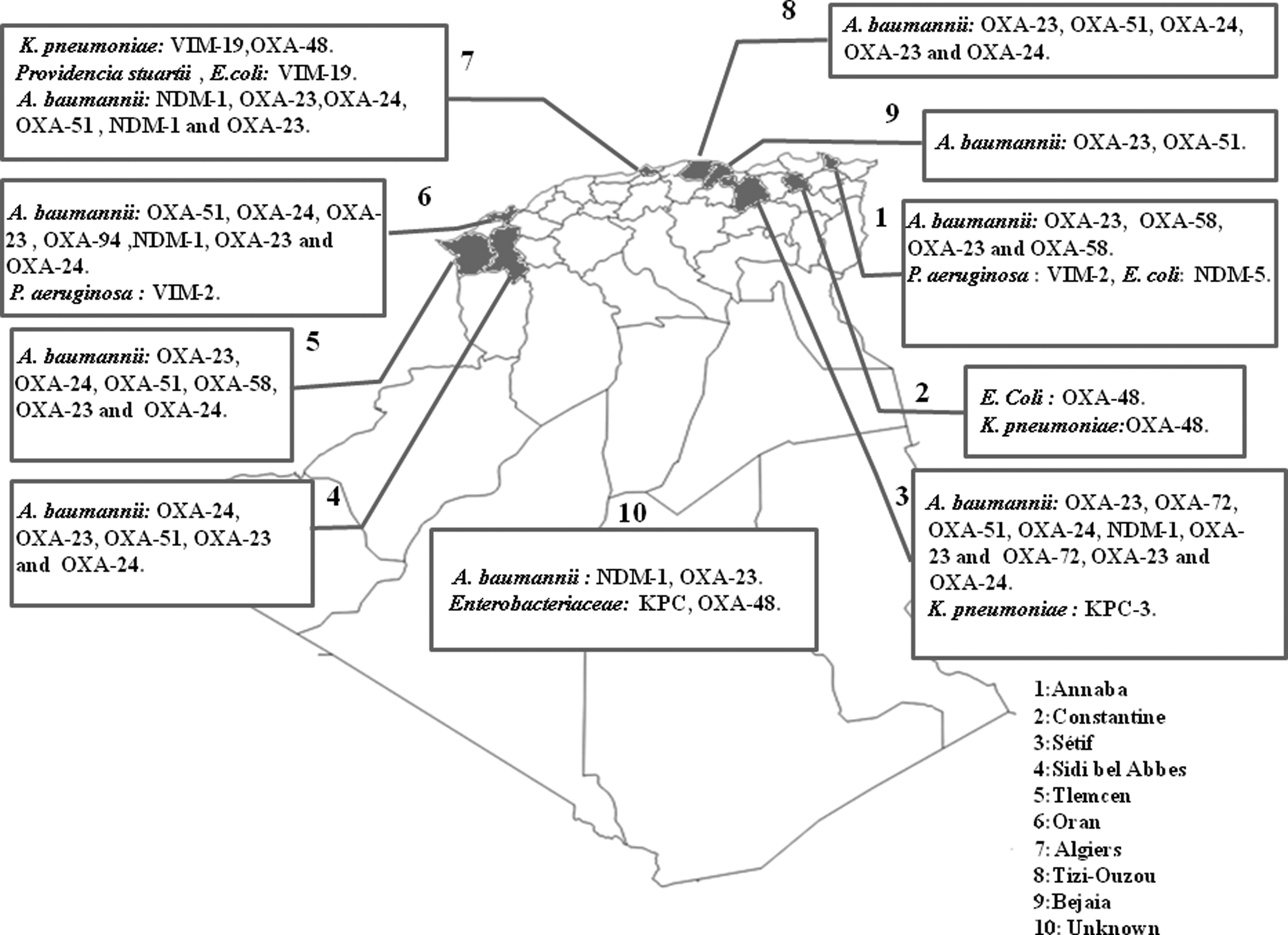
Carbapenemase described in gram-negative bacilli clinical isolates from Algeria.
In Algeria, few pieces of research have been conducted on the detection of OXA-48 enzyme. Routinely, in hospital laboratories, the use of imipenem antibiotic disks is more frequently used to detect OXA-48 than the other carbapenems such as ertapenem, but this enzyme confers high-level resistance to most β-lactam compounds, such as penicillins and cephalosporins, and variably affects carbapenems. 26 This was confirmed by our study, indeed, two OXA-48-producing K. pneumoniae, ST 404 and ST 219, which were resistant to ertapenem, were susceptible to imipenem.
For P. aeruginosa, only the blaVIM-2 gene has been identified in Algeria by Touati et al. in Annaba 27 and Sefraoui et al. in Oran 4 (Table 4 and Fig. 1). In this study, only two P. aeruginosa harbored the blaVIM-4 gene (ALG_P19 from Annaba in a burns ward (GenBank accession no. KT698096) and the other ALG_P2 from Skikda in the pediatric ward (GenBank accession no. KT698097) (Table 3). The blaVIM-4 gene was first described in P. aeruginosa from Thessaly (Larissa, Greece), and this finding was followed by an outbreak in this institution.28,29 In another study, the blaVIM-4 gene was reported by Libisch et al. in Hungary from seven hospitals 30 as it was also reported in Poland, 31 France, 32 Sweeden, 33 and Canada 34 (Fig. 2). Interestingly, a PubMed search failed to identify any published reports of coexpression of the blaVIM-4 gene and OprD porin loss in identical clinical isolates of P. aeruginosa in North Africa. In this study, we report the first coexpression of the blaVIM-4 gene and OprD in P. aeruginosa in two cities (Annaba and Skikda) in northeastern Algeria. These results indicate that the mutational inactivation of the OprD gene was the main mechanism for imipenem resistance in P. aeruginosa, as previously described.5,4 Likewise, MLST revealed the presence of multiple clones (ST244, ST1076, ST 241, ST 227, and ST233), and the results of this work are consistent in five countries within the Mediterranean basin. 35 The ST1076 and ST244 clones were most frequently in keeping with the studies by Sefraoui et al. in Algeria 4 and Al-bayssari et al. in Lebanon 5 (Table 3).
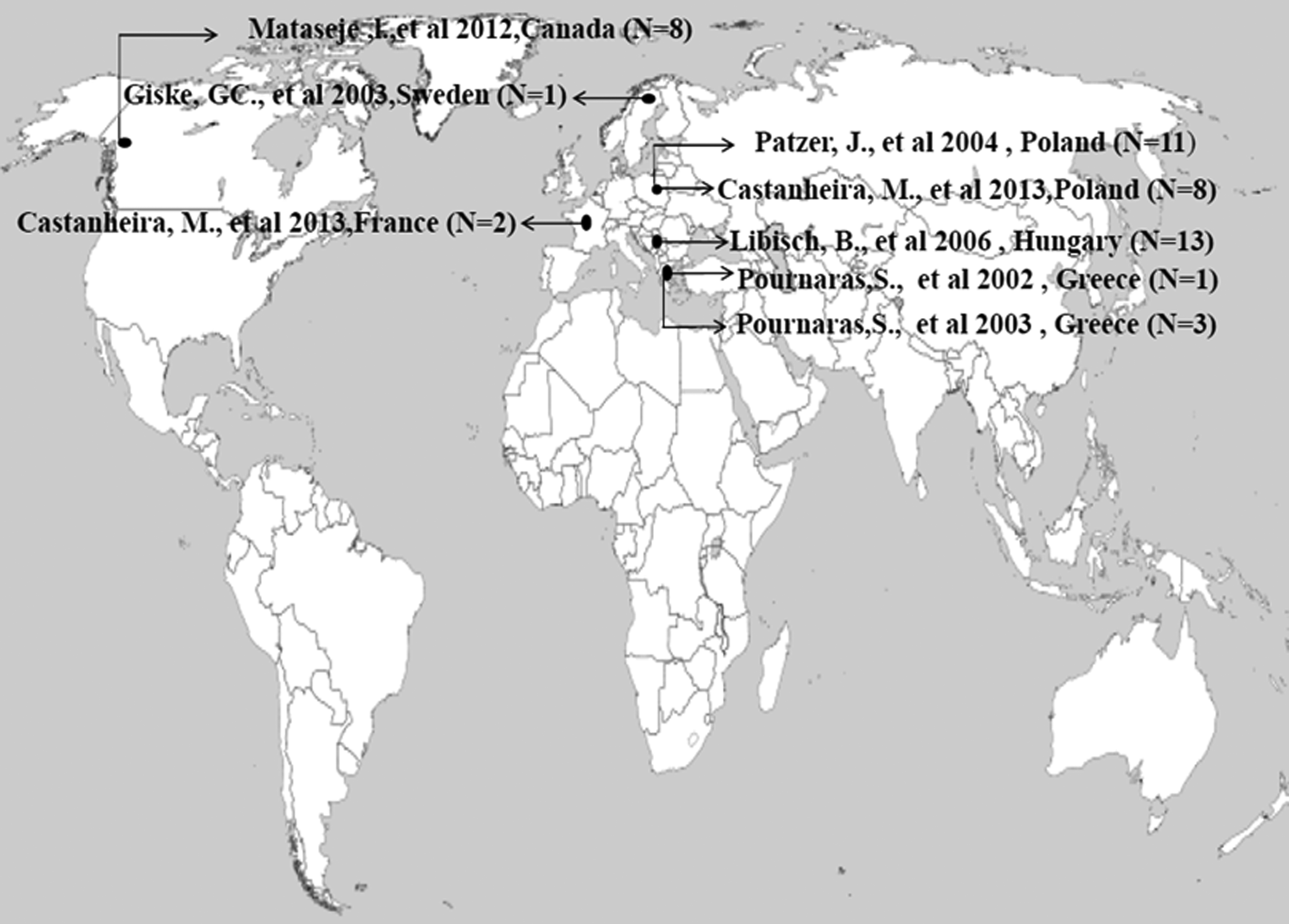
Worldwide spread of VIM-4-producing Pseudomonas aeruginosa.
Similarly, in carbapenemase class B, NDM-1, the first carbapenemase, was identified in A. baumannii from Algerian patients transferred to France 36 and Belgium. 37 Following this, this enzyme was reported in western Algeria, 16 in the Sétif and Algiers hospitals 9 (Table 4 and Fig. 1). In the present study, two A. baumannii isolates produced the NDM-1 enzyme. This is the first result, showing the beginning of the spread of this enzyme in Annaba and Skikda. Of the oxacillinase enzymes, OXA-23 was the first enzyme to be found in A. baumannii. 7 Following this, different groups of oxacillinases (OXA-24/72 and OXA-58) were described (Table 4 and Fig. 1). In the present study, five A. baumannii produced the OXA-23 enzyme, which has become endemic in Algeria. Finally, MLST analysis revealed the presence of two STs (2 and 85), which were found in A. baumannii from Algerian hospitals. 11 Our results suggest that these clones are now endemic within Algerian hospitals (Table 3).
In conclusion, our study reveals and confirms the dissemination of carbapenemase-producing gram-negative bacilli in Algerian hospitals and describes the first identification of VIM-4-producing P. aeruginosa ST 1076 and OXA-48-producing K. pneumoniae ST 404 and ST 219 in two cities (Annaba and Skikda) in northeastern Algeria. The emergence and spread of carbapenemase producers will limit the therapeutic options and threaten public health. Timely detection, implementation of infection control measures, formulation of an antibiotic policy, and preventive strategies to control dissemination of such strains are urgently required.
Data Access
The VIM-4 sequences of the two imipenem-resistant P. aeruginosa isolates have been deposited in GenBank under the accession numbers, KT698096 and KT698097.
Footnotes
Acknowledgments
The authors thank Linda Hadjadj for technical assistance and TradOnline for English corrections.
Funding Source
This work was partly funded by CNRS and IHU Méditerranée Infection.
Disclosure Statement
No competing financial interests exist.