




Abstract
This study was undertaken to detect the prevalence of CTX-M-producing Klebsiella spp. in healthy broiler, indigenous, and kuroiler birds reared in West Bengal (India) during November 2014–February 2015. In addition to CTX-M gene, the study was also conducted to reveal the occurrence of other β-lactamase and class I integron genes in Klebsiella spp. isolates along with their clonal relationship. A total of 321 cloacal swabs from healthy broiler, indigenous, and kuroiler birds were collected from different places of West Bengal, India. Klebsiella spp. isolation rate varies among different types of poultry birds (43.8–72.3%). In total, 33 (10.7%) Klebsiella spp. isolates were detected phenotypically as CTX-M producers and all the isolates possessed blaCTX-M in polymerase chain reaction. Whereas 17 (51.5%) and 16 (48.5%) Klebsiella spp. isolates possessed blaSHV, and blaTEM with blaCTX-M, respectively. None of the CTX-M-producing Klebsiella spp. isolates in this study possessed class I integron gene. Randomly amplified polymorphic DNA-based phylogenetic tree revealed the presence of clonal relationship among the CTX-M-producing Klebsiella spp. isolates, recovered from broilers and indigenous birds. This study identified broilers and indigenous game birds as a potential reservoir of CTX-M-producing Klebsiella spp., which could be transmitted to the human food chain directly or indirectly.
Introduction
F
Antimicrobial agents are frequently used in therapeutic and subtherapeutic doses in food animals and poultry for the treatment of infection and promotion of growth. Most of these antimicrobials are the same, or closely related, to antimicrobials used in human medicine. The commensal bacterial organisms present in food animals and exposed to the antimicrobial pressure developed survival strategies through evolutionary adaptations. Enterobacteriaceae organisms mostly produce β-lactamase enzymes to prevent the action of β-lactam antibiotics. There are more than 1,000 β-lactamase enzymes that can be classified into four main classes (A–D) under the Ambler classification system. 4 The most clinically important class A enzymes, found in Enterobacteriaceae, frequently in K. pneumoniae and Escherichia coli, are known as extended-spectrum β-lactamases (ESBLs). It can confer resistance to a variety of β-lactam antibiotics, including penicillins, second, third, and fourth-generation cephalosporins, and monobactams (e.g., aztreonam), but usually not the carbapenems or the cephamycins (e.g., cefoxitin). There are three classical ESBLs that are, TEM (except TEM-1), SHV (except SHV-1 and 2), and CTX-M. 5 Among them, CTX-M is observed as the most prevalent type in clinically infected humans throughout the world. 6
Since the isolation of ESBL-producing E. coli from animals in 1998, there has been an alarming increase in the detection of ESBLs, mainly of the CTX-M group, in Enterobacteriaceae strains in healthy animals. 7 Poultry are considered as a reservoir for ESBL/AmpC-producing Enterobacteriaceae all over the world. 8 ESBL-producing Klebsiella spp. infecting human population is genetically diverse and it is essential to characterize the origin of Klebsiella spp. strains, of which poultry may be an important reservoir.
In India, earlier studies conducted in healthy cattle, pigs, and broilers revealed the existence of ESBL-producing E. coli and K. pneumoniae.9–13 Besides broilers, the status of different kinds of poultry such as indigenous birds and kuroilers (synthetic dual type bird developed from broiler) as a reservoir of CTX-M-producing Klebsiella spp. is unexplored. The study was conducted in West Bengal state, as the state possessed the highest density of poultry population within India, 14 with highest number of indigenous/native breeds of fowls maintained by the free-range farming system. 15
This study was undertaken to detect the prevalence of CTX-M-producing Klebsiella spp. in healthy broiler, indigenous, and kuroiler birds reared in West Bengal, India. In addition to CTX-M gene, the study was also intended to reveal the occurrence of other β-lactamase and class I integron genes in Klebsiella spp. isolates along with their clonal relationship.
Materials and Methods
Sampling
A total of 321 cloacal swabs from broiler, indigenous, and kuroiler birds were collected from different places of West Bengal, India, during November 2014–February 2015. The details of samples are presented in Table 1. Samples were collected from apparently healthy birds of both sexes and of 6 weeks of age for broiler and 3 months to 1 year for indigenous poultry and kuroiler birds. The studied broilers were maintained in four small intensive farms keeping 2,000 birds at a time. The indigenous birds (Desi and crosses between Desi and Aseel breed) were kept mostly under the free-range system as a source of eggs and meat and as a game bird for cock fighting (common recreation in rural India). The indigenous birds often scavenged in the area of intensive broiler farms. The kuroiler birds were reared by both the intensive and semi-intensive systems. The samples were collected from 20 such separate units/households keeping indigenous birds and kuroilers. Each of the units maintained 5–15 of the indigenous birds or kuroilers. The intensive broiler farm and units/households keeping indigenous birds/kuroilers were selected according to convenience. Use of antimicrobials both for prevention and treatment of ailments was observed in broilers and indigenous birds, especially in game birds, as these birds were valuable items for the farmers. Birds for sample collection were also selected according to convenience from the intensive farms and kuroiler units/households.
ESBL production was detected phenotypically in Cefotaxime disk diffusion with or without clavulanate with CI at 95% (as recommended by CLSI).
Differs significantly (p = 0.0214, 95% CI).
Differs significantly (p = 0.0031, 95% CI).
ESBL, extended-spectrum β-lactamase.
Cloacal swabs were collected with the help of sterile cotton swab sticks (HiMedia, India). After collection, the cotton swab sticks were directly put into vials containing sterile peptone water (HiMedia, India) for transport. All the samples collected were immediately brought into the laboratory maintaining the cold chain for further examination.
Isolation of Klebsiella spp. from cloacal samples
The cloacal samples collected from the birds in peptone water were inoculated into Klebsiella selective agar (KSA, HiMedia, India) and incubated at 37°C for overnight. Next day, characteristic colonies (three colonies per sample) were picked and streaked on nutrient agar (HiMedia, India) slant for further morphological and biochemical confirmation as per the standard methods. 16
Polymerase chain reaction-based confirmation of Klebsiella spp. isolates
For polymerase chain reaction (PCR)-based confirmation of Klebsiella spp. isolates, DNA was extracted from all the morphological and biochemically confirmed Klebsiella spp. isolates. 17 The isolates were subjected to gyrA-based PCR for molecular confirmation as described earlier with some modifications, and the amplified product was visualized by gel documentation system (UVP, United Kingdom) after electrophoresis in 2% (W/V) agarose (Merck, India) gel containing ethidium bromide (0.5 μg/ml) (SRL, India).18,19
Phenotypical detection of CTX-M-producing Klebsiella spp.
Antibiotic disk containing cefotaxime (30 μg, HiMedia) with or without clavulanate (10 μg, HiMedia) was used and a difference of ≥5 mm between the zone diameters of the cefotaxime disk and cefotaxime/clavulanate disk was considered to be phenotypically positive for CTX-M production. 20 Double disk test with ceftazidime and ceftazidime/clavulanate was not carried out because detection of CTX-M-producing Klebsiella spp. was the major aim of the study.
Detection of β-lactamase genes (blaCTX-M, blaTEM, blaSHV) in Klebsiella spp.
All the phenotypically CTX-M-positive Klebsiella spp. isolates including controls were subjected to PCR for detection of blaCTX-M, blaTEM, and blaSHV genes using the primers and the cycle conditions as described earlier. The primers used in the study were designed to amplify blaCTX-M-9, blaTEM-1, and blaSHV-12.21,22 The selected PCR products (one product for each target gene) were sequenced from commercially available sources (Xcelris Genomics, India). The sequence homology searches were conducted using the BLAST algorithm (www ncbi. nlm. nih. gov/BLAST).
Detection of class I integron gene in CTX-M-producing Klebsiella spp.
All the β-lactamase genes possessing Klebsiella spp. isolates were subjected to PCR for detection of class I integron as described earlier. 23
PCR-based detection of K. pneumoniae among the CTX-M-producing Klebsiella spp. isolates
The CTX-M-producing Klebsiella spp. isolates were further tested for identification of K. pneumoniae by PCR as previously described. 24
Characterization of CTX-M-producing Klebsiella spp. by randomly amplified polymorphic DNA-PCR and enterobacterial repetitive intergenic consensus PCR
The molecular typing of all the CTX-M-producing Klebsiella spp. isolates was done by randomly amplified polymorphic DNA-PCR (RAPD-PCR) and enterobacterial repetitive intergenic consensus PCR (ERIC-PCR).25,26 All the images taken by the gel documentation system were analyzed by using the Doc-itLs image analysis software supplied with the system as per manufacturer's instruction (UVP, United Kingdom). By comparing the difference in the RAPD-PCR and ERIC-PCR banding pattern, phylogenetic relationship among the isolates were established. An unrooted phylogenetic tree was made by using the neighbor-joining method.
Statistical analysis
Occurrence of Klebsiella spp., CTX-M-producing Klebsiella spp., in different types of poultry birds was compared by chi-square test using SPSS software version 17.0 (SPSS, Inc.).
Results
Isolation and identification of Klebsiella spp. from cloacal samples
In this study, out of the 321 cloacal samples collected from broiler, indigenous, and kuroiler birds from different farms, 209 (65.1%) samples produced the characteristic purple-magenta mucoid colonies on KSA. The isolation rate varies among different types of poultry birds (43.8–72.3%). From the 209 samples positive for the presence of Klebsiella spp., a total of 307 presumptively Klebsiella spp. isolates were isolated (Table 1). All the presumptive Klebsiella spp. isolates showed gram-negative staining and presence of capsule, and biochemically they were catalase (+ve), oxidase (−ve), indole (−ve), methyl red (+ve), voges proskauer (−ve), citrate (−ve), and urease (−ve). All the 307 Klebsiella spp. isolates possessed gyrA gene in PCR. Rest of the selected colonies were not confirmed as Klebsiella spp. by biochemical tests or PCR.
Phenotypical detection of CTX-M-producing Klebsiella spp.
In total, 33 (10.7%) Klebsiella spp. isolates were detected phenotypically as CTX-M producers when tested with the antibiotic disks containing cefotaxime with or without clavulanate. Occurrence of CTX-M-producing Klebsiella spp. was detected in significantly higher proportion in indigenous birds than in kuroiler (p = 0.0031, 95% CI, Table 1) or broiler birds (p = 0.0214, 95% CI, Table 1).
Detection of β-lactamase (blaCTX-M, blaTEM, blaSHV) and class I integron genes in Klebsiella spp.
All the 33 Klebsiella spp. isolates detected phenotypically as CTX-M producers possessed blaCTX-M in PCR. Whereas 17 (5.5%) and 16 (5.2%) Klebsiella spp. isolates possessed blaSHV, and blaTEM with blaCTX-M, respectively (Table 2). The sequences of the PCR products were compared and found 98% cognate with blaCTX-M-9, blaSHV-12, and blaTEM-1 in BLAST search. Furthermore, none of the isolates was positive for the presence of class I integron gene.
Occurrence of the gene blaCTX-M was significantly (p < 0.01) higher in indigenous birds (20.9% CI: 13.33) followed by broilers (10.4%, CI: 6.6–15.8) and kuroilers (2.8%, CI: 0.007–9.5) (Tables 1 and 2).
PCR-based detection of K. pneumoniae among the CTX-M-producing Klebsiella spp. isolates
Only two isolates (6.1%) were confirmed as K. pneumoniae among the 33 CTX-M-producing Klebsiella spp. isolates tested by PCR.
Characterization of CTX-M-producing Klebsiella spp. by RAPD-PCR and ERIC-PCR
All 33 CTX-M-producing Klebsiella spp. isolates were typeable with the primer used in RAPD, and the isolates produced amplified fragment size between 190 and 2041 bp (Doc-itLs image analysis software, UVP, United Kingdom). Whereas in ERIC-PCR, fragment size of all 33 isolates ranged between 108 and 2045 bp (Doc-itLs image analysis software, UVP, United Kingdom).
Clonal relationship among the CTX-M-producing Klebsiella spp.
The phylogenetic analysis of CTX-M-producing Klebsiella spp. isolates after RAPD revealed that the isolates from indigenous birds (KP2, K20, K21, K23, K24, K27, K28) and broilers (K1, K2, K3, K4, K7, K9, K10, K11, K13, K14, K15, K17) belonged to a similar cluster (Fig. 1). Even though the RAPD banding patterns were not identical, the phylogenetic analysis revealed similarity between the isolates from different places and breeds of the birds. Similarly, the ERIC-PCR study with the CTX-M-producing Klebsiella spp. isolates revealed the clustering according to the types of birds screened (Fig. 2). K. pneumoniae (KP1 and KP2) isolates formed a separate cluster in ERIC-PCR, although they were found within the same cluster of Klebsiella spp. in RAPD-PCR.
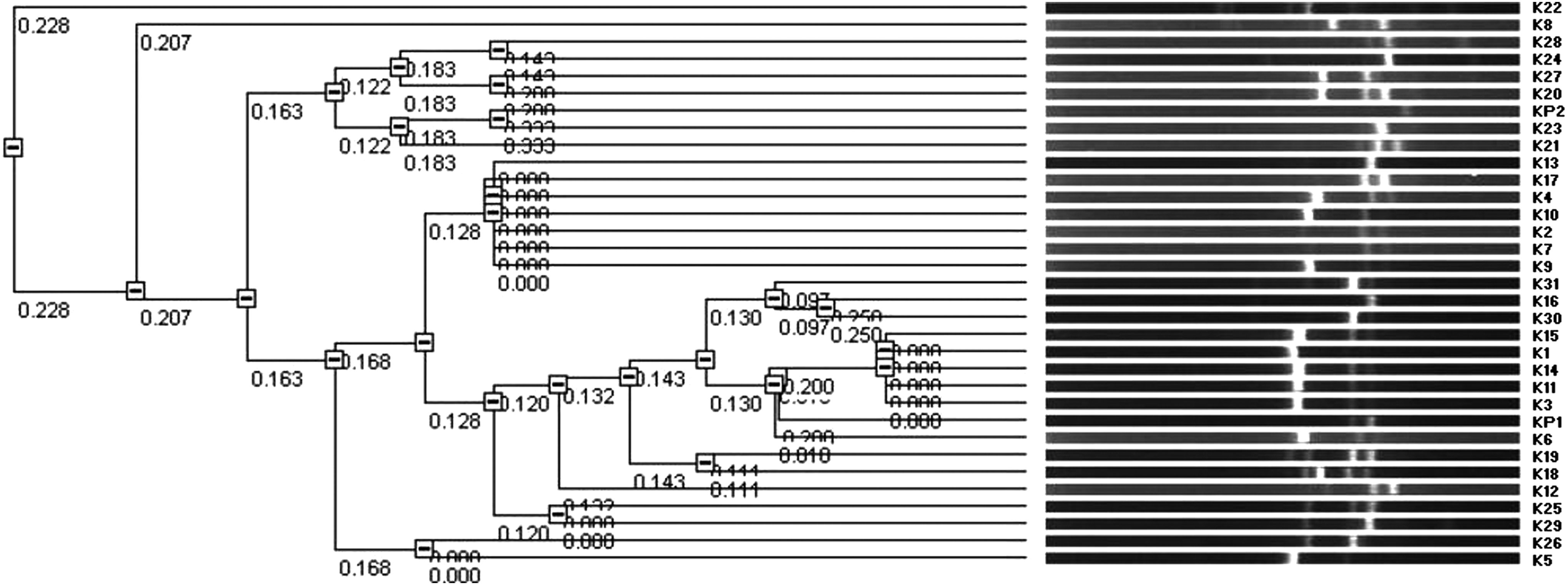
Phylogenetic analysis of CTX-M-producing Klebsiella spp. isolated from healthy broilers, kuroilers, and indigenous birds in West Bengal (India). The neighbor-joining method was used to summarize the similarity of randomly amplified polymorphic DNA-polymerase chain reaction profiles of CTX-M-producing Klebsiella spp. in a dendrogram (K1–K18: broiler Klebsiella spp. isolates; K19–K29: indigenous bird Klebsiella spp. isolates; K30–K31: kuroiler Klebsiella spp. isolates; KP1–KP2: indigenous bird Klebsiella pneumoniae isolates).
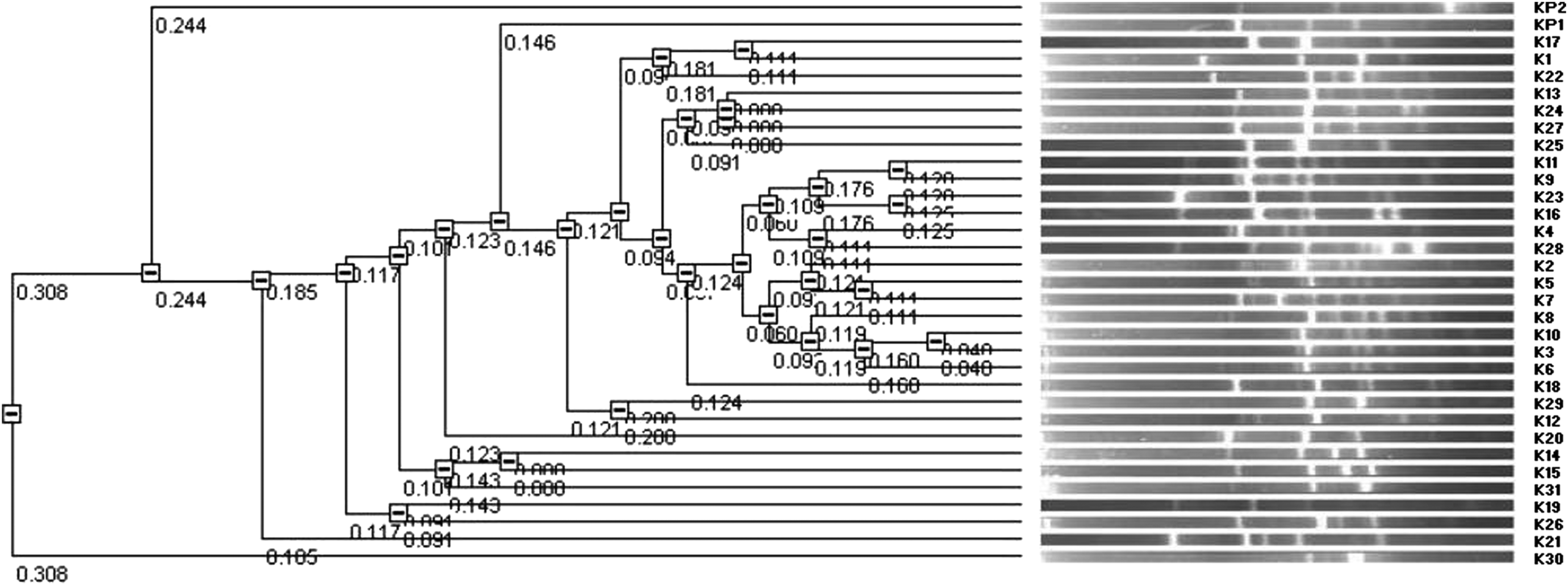
Phylogenetic analysis of CTX-M-producing Klebsiella spp. isolated from healthy broilers, kuroilers, and indigenous birds in West Bengal (India). The neighbor-joining method was used to summarize the similarity of Enterobacterial repetitive intergenic consensus-polymerase chain reaction profiles of CTX-M-producing Klebsiella spp. in a dendrogram (K1–K18: broiler Klebsiella spp. isolates; K19–K29: indigenous bird Klebsiella spp. isolates; K30–K31: kuroiler Klebsiella spp. isolates; KP1–KP2: indigenous bird K. pneumoniae isolates).
Discussion
Currently, CTX-M is the major ESBL enzyme produced by different clonal complexes of Klebsiella spp. which mostly replaced the SHV and TEM-type ESBLs during the last decade. 27 Broilers and the associated food chain (meat, eggs, and meat and egg-based products) represent a considerable source for the transmission of ESBL genes or ESBL-producing strains to the human intestinal bacterial flora. 28 So, this study was undertaken to reveal the occurrence of CTX-M-producing Klebsiella spp. in various types of poultry from West Bengal, India. The study also encompassed the indigenous and kuroiler birds because their status as a reservoir of CTX-M-producing Klebsiella spp. was unexplored.
In this study, 65% of the cloacal swabs collected from healthy broiler, indigenous, and kuroiler birds produced characteristic colonies in KSA. Similar higher occurrence of Klebsiella (60%) was detected in local birds in Nigeria. 29 In India, no previous study in healthy birds was apparently available to compare the present finding. Although in poultry birds with diarrhea, a lower prevalence of Klebsiella spp. (8.2%) was detected in the northeastern Indian state (Mizoram). 9 Use of selective medium for isolation of Klebsiella spp. is the probable reason for the higher isolation rate in this study. This is the first systematic study in the globe exploring the status of Klebsiella spp. in kuroiler birds. So no previous data are apparently available to compare the present finding.
This study revealed an overall prevalence of 10.7% of CTX-M-producing Klebsiella spp. in the studied birds from West Bengal, India. Similarly, a recent study revealed 13% prevalence of ESBL-producing K. pneumoniae and E. coli in healthy chickens in Nicaragua. 30 In this study, 300 fecal samples were collected during December 2012 from humans, poultry, and wild birds and were examined for ESBL-producing E. coli and K. pneumoniae. An earlier study in the Netherlands revealed 7.7% prevalence of ESBL-producing Klebsiella spp. in chicken meat samples collected randomly from groceries during August–October. 31 Remarkably higher prevalence (29–44%) of ESBL-producing Enterobacteriaceae was detected in retail chicken and calf meat in Germany and Turkey, respectively. In Turkey, chicken meat samples were purchased from various supermarkets and double disk synergy test was used to detect the occurrence of ESBL-producing Klebsiella. 32 In Germany, chicken meat samples were collected from supermarket stores, organic food stores, and butcher's shop during August 2011 and the isolates were phenotypically confirmed in ESBL-selective media. 33 Lower occurrence of ESBL-producing K. pneumoniae in broilers was reported from Japan (3%), 34 Nigeria (0.9%), 35 and Spain (1.2%). 36 In Japan, broiler samples were collected from 10 different farms between May and August 2007 and ESBL-producing K. pneumoniae were confirmed by the CLSI-recommended disk confirmatory tests. 34 In a cross-sectional prevalence study in Spain, live chickens from 10 selected farms were screened for ESBL-producing K. pneumoniae during November 2012 to February 2013. 36 Differences in geographical location, sampling pattern, and other factors could have influenced the prevalence estimate in this study.
Significantly higher occurrence of CTX-M-producing-Klebsiella spp. in studied indigenous birds than the kuroiler (p = 0.0031, 95% CI) or broiler birds (p = 0.0214, 95% CI) in this study was either due to extensive use of third-generation cephalosporins (cefotaxime) in indigenous game birds or may be associated with high mobilization of the encoding genes. 36 The indigenous game birds (Desi and cross between Aseel and Desi breed) in this study were used in cock fighting and were considered as a precious item in the household. The birds were often treated with costly antibiotics such as third-generation cephalosporins for both preventive and therapeutic purposes. ESBL-producing E. coli and Salmonella were not detected in backyard birds (RIR breed) reared in the same Indian state (West Bengal) due to lack of antibiotic exposure, 37 in kuroiler birds, mild occurrence (2.7%, Table 2) of CTX-M-producing Klebsiella spp. was observed although no history of antibiotic use was detected. Probably the contaminated environment could be the source of ESBL/β-lactamase-producing Klebsiella spp. or CTX-M gene in the kuroiler birds. Previously, contaminated environment was speculated as the source of ESBL-producing bacteria in organic poultry farm reared without antibiotic exposure. 38 Furthermore, among the class A β-lactamases, CTX-M (blaCTX-M) was detected to mobilize more frequently than others, 39 and CTX-M gene possessing E. coli can survive in the experimentally inoculated chicken intestinal tract even in the absence of selective pressure. 40
All the 33 Klebsiella spp. isolates detected phenotypically as CTX-M producers in this study possessed blaCTX-M-9. The primer for blaCTX-M-9 was selected as the reports of CTX-M-9-producing Enterobacteriaceae are not uncommon in healthy chicken. 39 Furthermore, 17 (5.5%) and 16 (5.2%) Klebsiella spp. isolates possessed blaSHV-12 and blaTEM-1 with blaCTX-M-9. Similarly, blaSHV-12 was detected as the most prevalent SHV-ESBL gene among Enterobacteriaceae isolates from broilers in the Netherlands, Belgium, France, England, and Japan and also in human isolates from Germany, Japan, and the Netherlands.8,28,33 K. pneumoniae possessing blaTEM (blaTEM-4 and blaTEM-1) and associated with clinical infection was detected in Spain, Poland, and France during 2007–2008, 41 and in Hungary during 2009–2011. 42 In corroboration with our findings, blaTEM-1 was also reported among K. pneumoniae isolates from chicken, turkey, cattle farms, and retail meat products in Oklahoma 43 and among K. pneumoniae and E. coli isolates from chicken meat in Brazil. 44 Klebsiella spp. isolates other than CTX-M producers were not considered for genotyping study.
Integrons are genetic elements present in plasmid or as a part of transposon and are responsible for carriage and spread of antibiotic resistance determinants, including ESBL enzymes. Among several categories, class I integrons are more commonly associated with clinical bacterial isolates. 45 None of the CTX-M-producing Klebsiella spp. isolates in this study possessed class I integron gene. Similarly, an earlier study reported absence of either class I or class II integron genes among ESBL/TEM-1-producing Enterobacteriaceae isolates recovered from healthy chickens. 46 Integron gene possessing Enterobacteriaceae isolates from healthy chicken or infected human mostly harbored blaCTX-M-1, blaSHV-2, blaTEM-52, and blaCTX-M-15 as ESBL genes.42,46 These ESBL genes (blaCTX-M-1, blaSHV-2, blaTEM-52, and blaCTX-M-15) and blaCTX-M-2, which was detected as a part of class I integron element, 44 were not prevalent among the CTX-M-producing Klebsiella spp. isolates in this study.
RAPD-based phylogenetic tree revealed the presence of clonal relationship among the CTX-M-producing Klebsiella spp. isolates, recovered from broilers and indigenous birds. This finding suggests the possibility of transmission between broilers and indigenous birds due to close vicinity of the broiler farm and indigenous bird rearing units and scavenging of the indigenous birds in the broiler farm area. A similar kind of cross-transmission of β-lactamase-producing E. coli was revealed earlier between the organized and backyard pig farms in India. 10
This study identified indigenous game birds and broilers as a potential reservoir of CTX-M-producing Klebsiella spp., which could be transmitted to the human food chain directly or indirectly. Earlier studies revealed the presence of genetically similar ESBL-producing Enterobactriaceae in poultry and human, suggesting their cross-transmission. 47 Such kind of further study highlighting the spread of ESBL-producing bacteria in human, animals, poultry, and, moreover, the environment in this part of the globe is necessary for effective control.
Footnotes
Acknowledgments
The authors sincerely thank Honorable Vice Chancellor, West Bengal University of Animal and Fishery Sciences, for the infrastructure. The work was carried out with the financial help of the Department of Biotechnology, Government of India.
Disclosure Statement
No competing financial interests exist.