




Abstract
Background:
Simultaneous use of genotypic and phenotypic diagnostic tools for detection of rifampicin (RIF) susceptibility may yield discrepant results.
Objective:
To measure the discordance between the RIF-susceptibility results by Xpert MTB/RIF and Mycobacterium Growth Indicator Tube (MGIT), to evaluate if application of both tests to the same sample affects the discrepancy, and to evaluate treatment outcome in patients with the discordant strains.
Design:
Sputa from patients with tuberculosis managed in the penitentiary system of Azerbaijan during 2011–2015 were examined for RIF susceptibility using Xpert MTB/RIF and MGIT. Strains with discrepant results were sequenced.
Results:
Of 532 patients included, 6.2% had discordant RIF-susceptibility results. No significant association of the discordant RIF-susceptibility results with application of both tests on one sample versus sequential samples was found. L511P mutation accounted significantly (p = 0.006) for the discrepancy among those RIF resistant on Xpert MTB/RIF, but sensitive on MGIT. No significant association was identified between the outcomes of treatment with the first- or second-line drugs and the presence of any mutation.
Conclusion:
The Xpert MTB/RIF and MGIT testing may be used in sequential sputum samples without increase in the RIF-susceptibility discordance rate. L511P mutation significantly accounts for discordant RIF-susceptibility results, but its clinical relevance may be low.
Introduction
T
RR-TB rates up to 33% and 67% among the new and previously treated TB patients, respectively, have been reported for correctional facilities of several former Soviet Union countries, including Azerbaijan.4,5 In the penitentiary system (PS) of Azerbaijan, the notification rate of all TB cases has decreased 2.5 times from 2002 to 2014, however, the TB and RR-TB rates are still considered as high.3,6 The Main Medical Department of the Azerbaijan Ministry of Justice implements a comprehensive TB Control program at the PS 6 that practices active case finding and early management of all identified cases of both susceptible and drug-resistant TB in the Special Treatment Institution (STI).
Compared with drug-sensitive TB, RR-TB is difficult and costly to treat with a markedly lower treatment success. 7 Since early detection of RIF resistance and prompt treatment are the cornerstones of effective TB control, the World Health Organization (WHO), along with the conventional phenotypic Lowenstein–Jensen (LJ) medium- and Mycobacteria Growth Indicator Tube (MGIT)-based drug susceptibility testing (DST), has endorsed Xpert MTB/RIF as a tool for rapid detection of TB.8–10 Xpert MTB/RIF allows to detect Mycobacterium tuberculosis (MTB) and RIF resistance within 2 hours with high sensitivity and specificity.11,12 However, sometimes Xpert MTB/RIF and phenotypic tests may show opposing RIF-susceptibility results. 13 To decrease such divergences, TB programs use the same sputum sample simultaneously for both phenotypic and genotypic examination, which is challenging, scientifically unproven, and costly.
Since 2013, the diagnostic algorithm in the Azerbaijan STI includes simultaneous examination of sputum samples from all cases with presumable TB with Xpert MTB/RIF- and MGIT-based culture and DST for the first-line anti-TB drugs (FLD) and second-line anti-TB drugs (SLD). 14 Assuming the presence of discordance between the RIF-susceptibility results obtained by Xpert MTB/RIF and MGIT in the Azerbaijan STI, we assessed its significance and determined, which method is more accurate in the detection of clinically relevant RIF resistance. We also evaluated if application of both tests to one and the same sputum sample decreases the level of discrepancy between the Xpert MTB/RIF- and MGIT-based results for RIF susceptibility in comparison with testing sequential samples.
We set the aim of the study as to identify if the rate of discordant RIF-susceptibility results is independent on whether the same sputum sample or sequential samples are used for molecular and phenotypic tests. We also aimed at detecting rpoB mutations in strains with the discordant RIF-susceptibility results and assess the treatment outcomes among the respective patients.
Materials and Methods
Study population
The study protocol was approved by the Ethics Committee on Human Research at the Ministry of Health (March 11, 2015, Baku, Azerbaijan). Two sequential sputum samples were collected before treatment initiation from each TB patient diagnosed as having either new or repeated episode of TB (relapse cases, cases after failure of the previous treatment course, and cases after loss-to-follow-up from the previous treatment course) in the PS of Azerbaijan from March 2013 to January 2015.
The first sputum sample was examined directly with Xpert MTB/RIF, and the second one was sent for culture and DST on MGIT. In addition, since 2010, all positive cultures processed at the STI laboratory were frozen and archived. The MGIT cultures were stored. Taking an advantage of this archive, Xpert MTB/RIF tests were done retrospectively on additional strains revived from frozen positive MGIT-based cultures performed from samples collected at patients' diagnosis. The obtained results were compared with the previously performed MGIT-based DST from the same culture.
All tests were primarily performed at the STI laboratory that performs all WHO-recommended laboratory diagnostic tests for TB in line with the good clinical laboratory practice standards and with external quality control provided by the Supranational Reference Laboratory (SNRL) in Borstel, Germany since 2007.15–17 The strains that showed discrepant RIF susceptibility were sent to SNRL in Borstel, Germany for retesting, determination of RIF susceptibility to different concentrations of RIF on LJ solid medium and sequencing of the rpoB gene. Patients with discrepant RIF-susceptibility results were enrolled to treatment with FLD or SLD based on DST result available at the time of enrollment, TB-treatment history, and clinical judgment on the risk of RR-TB. Individual patient data were captured from Epi-Info 6.04d (Centers for Disease Control and Prevention, Atlanta, GA) containing information from medical charts and bacteriological laboratory reports of all TB patients detected in the Azerbaijan PS.
Laboratory tests
Whenever discrepant results appeared, the tests were repeated by two different technicians.
Xpert MTB/RIF
The Xpert MTB/RIF test was performed using the G4 version of cartridges following manufacturer's instruction (Cepheid, Sunnyvale, CA). Starting from March 2013, unprocessed first sputum samples from patients admitted to STI for the diagnosis of TB were used for direct Xpert MTB/RIF testing. Xpert MTB/RIF testing was also done on strains revived from the frozen positive MGIT-based cultures of patients admitted to the STI from June 2011 to February 2013.
Sample decontamination
The samples were processed by the standard decontamination protocol using NALC-NaOH method with the final NaOH concentration of 1%. 18 Following centrifugation, the supernatant was discarded and the pellet was dissolved in 1–1.5 ml of phosphate-buffered saline.
Culture
The sputum samples were inoculated in MGIT for liquid culture and on two slopes of LJ solid medium for the quality assurance purposes. Capilia TB-Neo (Tauns Laboratories, Inc., Izunokuni, Japan) or SD-Bioline (Standard Diagnostics, Inc., Yongin, Korea) rapid tests for detection of AgMPT64 were used to identify the MTB isolates. RIF susceptibility was examined on MGIT as an indirect test by the proportion method with RIF (1.0 μg/ml). 19 The discordant strains were repeatedly cultured at the SNRL. RIF susceptibility was also examined on LJ solid medium using 16 and 32 μg/ml concentrations of RIF. The use of these concentrations was required by the standard operating procedures approved by the SNRL.
Genotypic characterization
The discordant strains repeatedly cultured at SNRL were analyzed by sequencing of the rpoB hot-spot region. The DNA extract was amplified with the primers TR8 and TR9 to amplify the 81-p region within the rpoB gene (Thermo Fisher Scientific, Waltham, MA). 20 The primers used for PCR were also used for direct sequencing of both strands of the amplification products using the automated ABI Prism 377 DNA Sequencer and corresponding kits (Thermo Fisher Scientific). Spoligotyping was performed with use of the standard membrane-based method and the patterns were assigned a Spoligo International Type number according to the SITVIT WEB International database.21,22 Direct sequencing of the PCR products was carried out with an ABI Prism 3100 capillary sequencer (Applied Biosystems, Carlsbad, CA) and the ABI Prism BigDye Terminator Kit v.1.1 (Applied Biosystems) according to the manufacturer's instructions.
Treatment
Standard category I or category II treatment with FLD was prescribed to patients with available RIF-sensitive result at the time of diagnosis. The treatment with SLD was prescribed to patients with available RIF-resistant result at the time of diagnosis obtained by MGIT or Xpert MTB/RIF. The SLD regimens were individually tailored according to the DST results and contained at least four effective anti-TB drugs. The treatment was started immediately after the RIF susceptibility was documented.
The empirical SLD treatment regimens were started in cases, where the full scale of DST result was not available at the start of treatment and consisted of one second-line injectable, a fluoroquinolone, pyrazinamide, and two or three drugs from cycloserine, prothionamide, and para-aminosalicylic acid. The treatment regimen was adjusted immediately after the full scale of the DST results became available. Linezolid, clofazimine, bedaquiline, and delamanid were not available in the PS during the study. The drugs were given under direct observation six times per week throughout the course of treatment. The injectables were continued for 4 months after bacteriological conversion by culture, but not less than for a total of 8 months. The overall duration of treatment with SLD was 12 months after culture conversion or at least 18 months.
Statistical analysis
Pearson's chi-square test was used for comparison between the proportions of discordant results obtained with Xpert MTB/RIF and MGIT done on sequential sputum samples versus the same sputum sample, as well as to reveal associations of discordant RIF-susceptibility results and treatment outcomes with the presence of various rpoB mutations. Mantel–Haenszel test was used to identify the contribution of the mutations, the treatment delay, and the different treatments to the treatment outcomes. In the analyses, “cured” and “treatment completed” were collectively defined as favorable treatment outcome. Death (of any cause) and failure were defined collectively as unfavorable treatment outcome. Individuals with the treatment outcome “lost-to-follow-up” were excluded from the analysis. All statistical analyses were performed with the STATA SE package (version 12, StataCorp LP, College Station, TX).
Results
The study included specimens from 532 patients; all specimens had RIF-susceptibility results available by both Xpert MTB/Rif and MGIT (Fig. 1). Out of the 286 patients in whom the Xpert MTB/RIF- and MGIT-based DST were done on sequential sputum samples, 19 (6.6%) had discordant RIF-susceptibility results. Of these 19 isolates, 12 (63.4%) were from new cases, 6 (31.6%) were from cases after loss-to-follow-up, and 1 (5.3%) from a relapse case, respectively. No isolates from cases after treatment failure were received. Out of a total 246 patients in whom the Xpert MTB/RIF and MGIT tests were performed from the same specimen, 14 (5.7%) had discordant RIF-susceptibility results. Of these 14 isolates, 9 (64.3%) were from new cases, 2 (14.3%) from relapse cases, 2 (14.3%) from cases after loss-to-follow-up, and 1 (7.4%) from treatment after failure, respectively. Ultimately, out of the 532 TB patients included into the study, 33 (6.2%) had discordant RIF-susceptibility results, 94 (17.7%) were RIF resistant, and 405 (76.1%) were RIF susceptible on both Xpert MTB/RIF and MGIT (Table 1). No statistically significant association of discordant RIF-susceptibility results with application of both tests on one sample versus sequential samples was found. When samples were retested on LJ solid medium with 16 and 32 μg/ml RIF, the results were completely concordant.
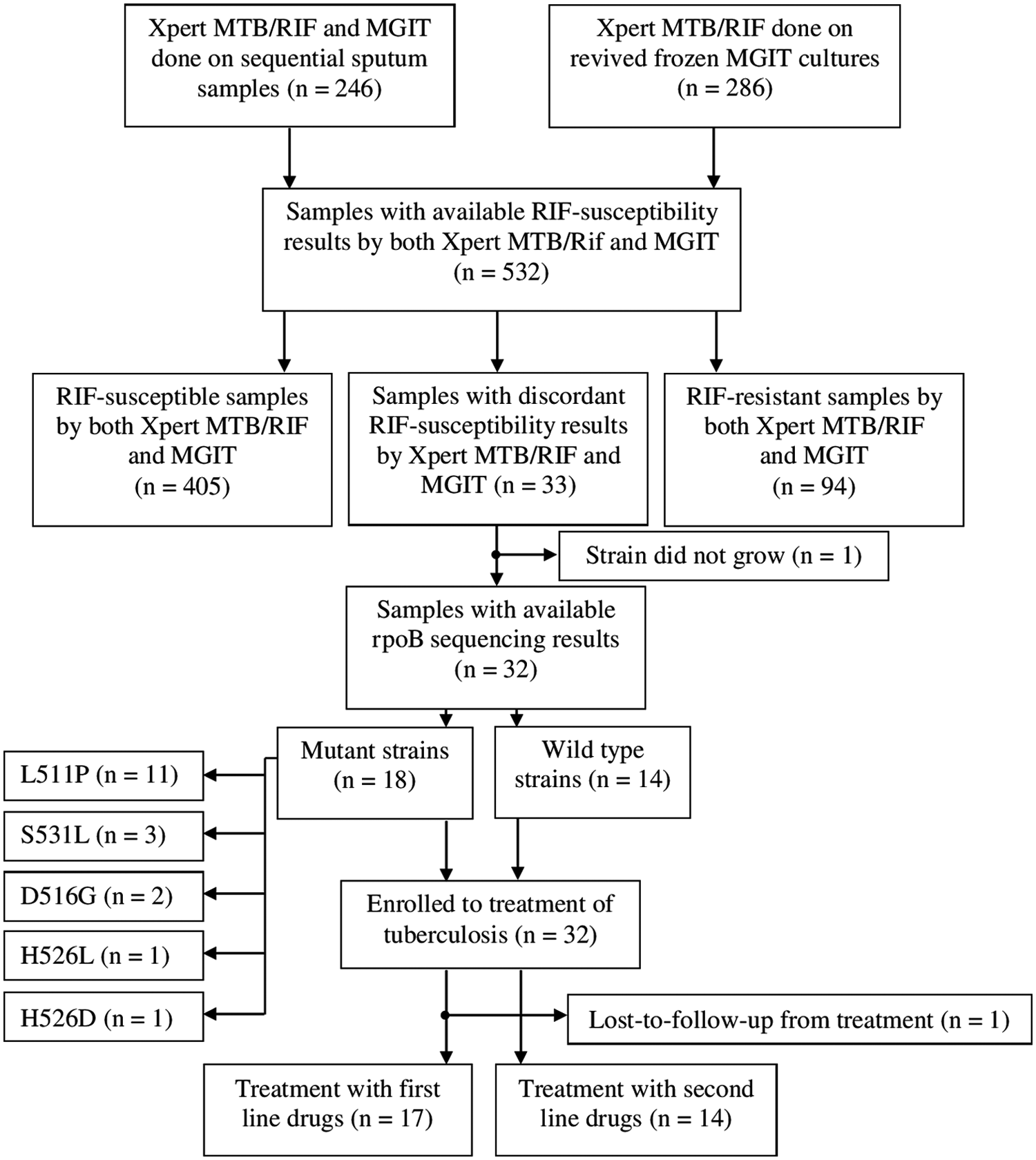
Flowchart of samples from patients with tuberculosis diagnosed in the penitentiary system of Azerbaijan, 2010–2015 (n = 532), that were included in the study.
MGIT, mycobacteria growth incubator tube; MTB, Mycobacterium tuberculosis; RIF, rifampicin; TB, tuberculosis.
A total of 32 cultures of the 33 strains with discordant RIF-susceptibility results were sequenced (one strain did not grow during repeated culture in the SNRL). Based on sequencing of the 32 strains, 14 (43.7%) were wild type, and 18 (56.3%) had mutations in the rpoB gene (Table 2). Out of the 18 strains with mutations in the rpoB gene, 11 (61.1%), 3 (16.7%), 2 (11.1%), 1 (5.6%), and 1 (5.6%) represented the L511P, S531L, D516G, H526D, and H526L mutations, respectively. Among the discrepant strains, the rpoB mutations were significantly more frequently present among those, who appeared RIF resistant on Xpert MTB/RIF in comparison to those, who were RIF sensitive on Xpert MTB/RIF (p = 0.044). The presence of the L511P mutation accounted significantly (p = 0.006) for the discrepancy, where the RIF resistance on Xpert MTB/RIF was coupled with RIF sensitivity on MGIT (Table 2).
Thirty-two mutant strains as a group were dichotomized as 1) “the RIF sensitive on Xpert MTB/RIF, but resistant on MGIT” (n = 10) and 2) “the RIF resistant on Xpert MTB/RIF, but sensitive on MGIT” (n = 22). One strain out of the 33 strains with discordant RIF-susceptibility results did not grow: 1 Xpert MTB/RIF resistant–MGIT RIF susceptible.
Signifies comparisons between the strains being RIF sensitive on Xpert MTB/RIF, but resistant on MGIT and those being RIF resistant on Xpert MTB/RIF, but sensitive on MGIT done on strains with various mutations, as well as on wild-type strains (Pearson's chi-square test).
Denominator used for calculation of the proportion was 18.
Denominator used for calculation of the proportion was 3.
Denominator used for calculation of the proportion was 15.
When MGIT-based DST was used as a reference, the sensitivity, specificity, and positive and negative predictive values of Xpert MTB/RIF in detection of RIF resistance on one sample versus on consequent samples were 90%, 96%, 79%, and 98% versus 91%, 93%, 81%, and 97%, respectively. When rpoB sequencing was used for resolving discordant RIF-susceptibility results by Xpert MTB/RIF and MGIT, the sensitivity, specificity, and positive and negative predictive values of Xpert MTB/RIF in detection of RIF susceptibility on one sample versus on consequent samples was 100%, 99%, 94%, and 100% versus 96%, 97%, 93%, and 98%, respectively.
The treatment outcomes of 31 patients of the 32 with discordant strains and available rpoB gene sequencing (one patient was lost-to-follow-up and was excluded from further analysis) were analyzed: 17 were treated with FLD and 14 with SLD (Fig. 1). Out of these patients, 28 and 3 had favorable and unfavorable treatment outcomes, respectively. When the rpoB-mutant and wild-type strains were analyzed together, no statistically significant association of the favorable treatment outcome with the strains being RIF resistant on Xpert MTB/RIF and RIF sensitive on MGIT and being vice versa was found (p = 0.76) (Table 3). However, Mantel–Haenszel test revealed that the treatment outcomes were not independent on the overall presence of the rpoB mutations and the L511P, S531L, D516G, H526L, and H526D mutations in particular (p = 0.84, p = 0.93, p = 0.68, p = 0.89, p = 0.85, and p = 0.73, respectively).
Out of the 32 patients with discordant RIF-susceptibility results, one patient with Xpert MTB/RIF-resistant/MGIT RIF-susceptible pathogen was lost-to-follow-up from treatment with first-line drugs and was excluded from the analysis.
Signifies comparisons between cases having strains being RIF sensitive on Xpert MTB/RIF, but resistant on MGIT and those having strains being RIF resistant on Xpert MTB/RIF, but sensitive on MGIT (Pearson's chi-square test).
Favorable: “Cured” and “Treatment completed” treatment outcomes; Unfavorable: “Death” (of any cause) and “failure” treatment outcomes; patients with the category “lost-to-follow-up” treatment outcomes were excluded from the analysis.
TB, tuberculosis.
Among the patients with the strains being RIF sensitive on Xpert MTB/RIF and RIF resistant on MGIT, 70% and 30% were treated with FLD and SLD, respectively, whereas treatment with FLD and SLD resulted in 81% and 87% favorable outcomes, respectively, in this group (Table 3). Among the patients with the strains being RIF resistant on Xpert MTB/RIF and RIF sensitive on MGIT, 38% and 62% were treated with FLD and SLD, respectively, that resulted in 100% and 80% favorable outcomes with these treatments, respectively. No significant association was identified between the type of discrepant resistance and the outcomes of treatment with FLD or SLD or any of the mutations (Table 3).
After completion of the treatment, all but nine patients with discordant RIF susceptibility, who were still on follow-up during the data analysis, were examined after 2 years. There were no relapses.
The treatment outcomes with FLD and SLD were not independent on the treatment delay before introduction of Xpert MTB/RIF into the diagnostic algorithm (p = 0.097 and p = 0.093, respectively, Mantel–Haenszel test). There were seven strains RIF resistant on Xpert MTB/RIF, RIF sensitive on MGIT and wild type on rpoB sequencing: six and one out of them started FLD and SLD treatment, respectively. Out of those, who started FLD treatment, 5 (83.3%) had favorable treatment outcome, while a patient, who started SLD treatment, had unfavorable outcome.
Discussion
The main finding from our study is that the proportion of obtained discordant RIF-susceptibility results is almost equal regardless of whether both Xpert MTB/RIF and MGIT are applied on the same sputum sample or on sequential samples. Hence, while the WHO recommends having at least two sputum samples tested, as well as having Xpert MTB/RIF and liquid culture-based DST done for TB diagnostic purposes, our finding has a certain practice-modifying implication. 23 The TB programs may build their diagnostic algorithms using Xpert MTB/RIF and MGIT on sequential sputum samples without expecting significant increase of the level of discrepant RIF-susceptibility results, thus, avoiding an additional practical difficulties to get enough sputum for using both tests on the same sample.
In our study, the number of discrepant strains at the group with RIF resistance on Xpert MTB/RIF and RIF sensitive on MGIT was more than twice of those, who were RIF sensitive on Xpert MTB/RIF and RIF resistant on MGIT. The presence of the L511P mutation, found previously in both RIF-susceptible and RIF-resistant isolates by various WHO-endorsed methods,24,25 appeared to significantly contribute to the discrepancy in our isolates. Although the protocol of our study did not include determination of MIC for RIF, several studies have shown that the MIC for RIF at isolates harboring L511P mutation was 4–10 times below the standard critical breakpoint, resulting in susceptible results by culture-based DST, the gold-standard for detection of clinically relevant resistance.26–29 Rigouts et al. indicated in a similar study that along with some other rpoB mutations, the L511P mutation is prone to be missed by MGIT. 30 We did not identify any significant association between the outcomes of treatment with FLD or SLD and either the certain mutations or the type of discrepant resistance. These results suggest that the clinical relevance of the mutations on one hand and the pattern of discrepant resistance on the other may be low. The latter treatment issue, however, needs further corroboration.
Resistance to RIF in MTB is associated in 95–98% of occasions with mutations in the 81-bp core region of the rpoB gene targeted by a range of commercial systems for drug resistance detection, including Xpert MTB/RIF.9,31–33 Our finding that 7 out of 10 discordant strains found to be RIF sensitive on Xpert MTB/RIF, but RIF resistant on MGIT, did not have mutations at the rpoB 81-bp region suggests that in discordant strains, the proportion of isolates possessing mutations outside the hot-spot region may be above the formerly reported 2–5%.32,33 Other mechanisms of RIF resistance, such as decreased cell wall penetrability to drugs and active efflux pumping, are also considered to be important in conferring resistance in the isolates without detectable target gene mutations.34,35 However, the recent findings indicate that efflux pumps play an important role in acquired resistance to isoniazid and less in RIF resistance. 36
Our findings on the sensitivity and specificity of Xpert MTB/RIF in detection of RIF resistance were concordant with the results of a recent meta-analysis that reported 95% sensitivity (95% confidence interval [CI] 90–97) and 99% specificity (95% CI 97–99). 37 Moreover, our results suggest that the sensitivity, specificity, and positive and negative predictive values of Xpert MTB/RIF in detection of RIF resistance are similar, when Xpert MTB/RIF and MGIT are used on one sample or sequential samples.
Among strains identified in our study, 1.3% was found to be RIF resistant on Xpert MTB/RIF, RIF sensitive on MGIT, and wild type on rpoB sequencing, which fits into the accepted specificity of Xpert MTB/RIF performance in detection of RIF resistance. The discrepancy among RIF-susceptibility results by molecular and phenotypic tests may also be influenced by heterogeneity of the examined sputum samples and detection of genetically different strains that might come from separate lesions in the lungs that contain different MTB strains and open simultaneously or consecutively, as reported elsewhere. 38 Increasing the number of collected and tested sputum samples might also increase the likelihood of detection of genetically different strains. 39
Since we were able to demonstrate that RIF-susceptibility results by molecular and phenotypic tests in high RR-TB burden settings are prone to about 6% discrepancy, the clinicians should be aware that the preliminary result reported by the molecular test may be discordant with the subsequently reported culture-based DST. There are recommendations available from the Clinical Laboratory Standards Institute, European Committee on Antimicrobial Susceptibility Testing, as well as from the WHO that the discrepant RIF-resistance results should be addressed by repeating the tests or referring the culture isolates for DNA sequencing.11,40,41 However, these procedures are time-consuming and not always feasible from programs' and patients' perspective. Although among the patients with the discrepant RIF-resistance results, the treatment outcomes did not significantly differ between those who received FLD and those who received SLD, in high-RR-TB burden settings, and in cases of uncertainty about RIF susceptibility, the clinical decision to initiate SLD treatment until the RIF resistance is determined by additional repeated tests may be justified.
To our knowledge, this study is reporting the largest number of discordant strains and is unique, because it is performed in high-burden TB/RR-TB prison settings and evaluates treatment outcomes of patients with discordant strains. The limitations of our study include its partially retrospective nature, the number of discrepant strains being still relatively small and that the whole genome sequencing was not done to demonstrate the mutations outside the hot-spot region. Nine out of the 33 patients with the discrepant RIF-resistance results did not complete their 2-year follow-up period by the time of the analysis.
Conclusions
The Xpert MTB/RIF and MGIT testing may be used in sequential sputum samples in diagnostic algorithms, since the rate of discordant RIF-susceptibility results is independent on whether the same sample or sequential samples are used. The most frequently observed pattern of discordant results include RIF resistance by Xpert MTB/RIF and RIF sensitivity on MGIT and is mainly due to the L511P mutation, which clinical relevance in terms of determining RR may be low. However, the clinicians should be aware of certain discrepancy between the results of molecular and phenotypic tests and consider SLD treatment with further adjustment after resolved RIF susceptibility of MTB.
Footnotes
Acknowledgments
The authors thank Dr. F. Huseynov, Main Medical Department of the Ministry of Justice and all staff of the STI for their dedicated work with TB Control in the PS of Azerbaijan. The authors are grateful to Dr. V. Popova for her high professionalism in laboratory-related matters.
Authors' Contribution
E.G., A.I., F.M., K.B., and A.A. were involved in conceiving and designing the study, as well as elaborating the methods; E.G., R.T. and D.H. were involved in data acquisition; E.G., K.B., and A.A. were involved in data analysis and interpretation, drafting of the article and revising for its intellectual content. R.M. was involved in revising the article for intellectual contents and final approval of this article.
Disclosure Statement
No competing financial interests exist.