




Abstract
This study was conducted to investigate the molecular epidemiology of resistance in Acinetobacter baumannii isolates collected at a hospital in Riyadh, Saudi Arabia, from January through December 2010. Twenty-seven A. baumannii were highly resistant (MIC90 > 256 μg/ml) to ceftazidime, cefepime, and aztreonam. Imipenem resistance was seen in 24 isolates, of which 18 had an minimum inhibitory concentration (MIC) >32 μg/mL. Ciprofloxacin, gentamicin, and amikacin resistance was found in 93%, 52%, and 37% of all the isolates, respectively. Moreover, 8 (30%) isolates showed colistin resistance, and 15 (56%) were found to have MICs ≥4 μg/mL for tigecycline. The frequency of ADC, GES-1, GES-11, and GES-5 were 96.3% (n = 26), 18.5% (n = 5), 11% (n = 3), and 3.7% (n = 1), respectively. OXA-23 was found in 63% (n = 17) of the isolates; ISAba1 was found upstream of OXA-23 in 16. OXA-24/40 was detected in only one strain. Multilocus sequence typing (MLST) and pulsed-field gel electrophoresis (PFGE) analysis revealed that the 27 strains were distributed in 8 sequence types (STs) and 16 clonal pulsotypes (A-P). Five singleton STs were identified, including ST15 and ST113–ST116. The emergence of multidrug-resistant A. baumannii is becoming a major concern in Saudi Arabia. Metallo-β-lactamases have no role in carbapenem resistance in this collection. The spread of OXA-23 in our strains occurred across different STs and pulsotypes, unlike what has been observed in many other countries. PFGE typing was more discriminatory than MLST. The high frequency of colistin and tigecycline resistance found in the isolates calls for continuous monitoring. This study describes the first identification of GES-5 conferring carbapenem resistance in A. baumannii.
Introduction
A
The prevalence of carbapenem-resistant A. baumannii (CRAB) has recently increased worldwide, reaching more than 50% in some clinical studies. 1 Several resistance mechanisms such as multidrug efflux pumps, permeability defects due to loss or downregulation of outer membrane proteins, mutation of penicillin-binding proteins, and β-lactamase production are responsible for the carbapenem resistance in A. baumannii. 4 Among the most common β-lactamases that confer carbapenem resistance in A. baumannii are carbapenem-hydrolyzing class D OXA-like enzymes such as OXA-23, -24/40, -48, -58, and -143 types and the less common class B metallo-β-lactamases (MBLs) such as VIM, IMP, NDM, and SIM.4,5 CRAB is usually associated with a multidrug-resistant (MDR) A. baumannii phenotype to aminoglycosides and fluoroquinolones, resulting in limited therapeutic options for A. baumannii infections. 6
In this study, we investigated the molecular epidemiology of CRAB isolates collected between January and December 2010 from different patients hospitalized in a tertiary hospital in Riyadh, Saudi Arabia.
Materials and Methods
Bacterial strains and susceptibility testing
A total of 27 ceftazidime-resistant A. baumannii isolates were collected through the 12-month period (January to December, 2010) from different patients in a tertiary hospital at Riyadh, Saudi Arabia. All the isolates were identified by positive PCR amplification for intrinsic blaOXA-51-like and were confirmed by sequencing of the rpoB gene as previously described. 7 The susceptibility of the isolates to 11 antibiotics (TZ, ceftazidime; PM, cefepime; AT, aztreonam; IP, imipenem; MP, meropenem; Dor, doripenem; CI, ciprofloxacin; GM, gentamicin; Ak, amikacin; TG, tigecycline; CL, colistin) was determined using Etest (bioMérieux, Craponne, France), and interpreted according to the Clinical and Laboratory Standards Institute (CLSI), 2015 breakpoints, 8 except for tigecycline, where the European Committee on Antimicrobial Susceptibility Testing (EUCAST) breakpoint for Enterobacteriaceae was used.
Phenotypic detection of the acquired β-lactamases
The production of MBLs was screened using the EDTA-disk synergy test, 9 in which a 10-μg imipenem disk was placed 10 mm apart from a 5-mM EDTA disk. Following incubation, a synergistic inhibition zone between the two disks indicated a positive result.
The cloxacillin test was performed to screen the upregulation of intrinsic blaADC in the isolates. An increase in the inhibition zones for cephalosporins in the presence of cloxacillin (200 mg/L)-containing Mueller Hinton indicates ADC overproduction. 10
Detection of resistance genes by PCR amplification
Genes for Ambler class A β-lactamase enzymes were detected by PCR using specific primers for blaGES, blaVEB, blaPSE, and blaKPC11–13 ; those for class B enzymes were detected using specific primers for blaIMP, blaVIM, and blaNDM 13 ; and those for class C β-lactamases were detected using specific primers for blaADC. 14 A multiplex PCR assay was used to detect the four groups of class D (OXA) carbapenemases, blaOXA-23, blaOXA-24/40, blaOXA-58, and blaOXA-51 in A. baumannii. 15 ISAba1 was also detected by PCR. 16 To determine if the insertion sequence ISAba1 was located upstream of blaOXA-23, PCR mapping was performed using the forward primer for ISAba1 and the reverse primer for the blaOXA-23 gene. Positive PCR reactions were followed by DNA sequencing.
Genotyping by pulsed-field gel electrophoresis (PFGE) and multilocus sequence typing (MLST)
To determine the similarity between the strains, PFGE using ApaI-restricted genomic DNA was performed according to a previously described protocol. 17 DNA patterns were analyzed using BioNumerics software (v. 2.5; Applied Maths, St-Martens-Latem, Belgium). The strains were considered related if they showed ≥85% similarity in the band patterns as previously recommended. 18 AB0 was used as a reference strain.
The clonal relatedness of the strains was also studied using MLST according to the Pasteur Institute scheme based on the DNA sequence of the internal regions of seven housekeeping genes (cpn60, fusA, gltA, pyrG, recA, rplB, and rpoB) for A. baumannii isolates (http://pubmlst.org/abaumannii/info/primers_Pasteur.shtml).
Results
Antibiotic susceptibility
Twenty-one of the 27 isolates (78%) were highly resistant to ceftazidime, cefepime, and aztreonam, with minimum inhibitory concentration (MIC) values >256 μg/mL (Table 1). Of the 27 isolates, 24 were resistant to one or more carbapenems (imipenem, meropenem, or doripenem) according to the CLSI guidelines. All the 27 A. baumannii strains were highly resistant to ceftazidime (48 to >256 μg/mL). Eight isolates (30%) showed resistance to colistin with MIC ≥4 μg/mL. For tigecycline, the MIC ranged between 0.064 and 24 μg/mL, and 15 isolates (56%) were found to have MIC values ≥4 μg/mL. All the isolates, except two, were resistant to ciprofloxacin and 21 had MIC ≥32 μg/mL. Moreover, resistance to aminoglycosides was detected in 24 isolates: 14 (52%) showed gentamicin resistance and 10 (37%) showed amikacin resistance.
PFGE, pulsed-field gel electrophoresis; TZ, ceftazidime; PM, cefepime; AT, aztreonam; IP, imipenem; MP, meropenem; Dor, doripenem; CI, ciprofloxacin; GM, gentamicin; Ak, amikacin; TG, tigecycline; CL, colistin; MBL, metallo-β-lactamases; MIC, minimum inhibitory concentration.
Resistance mechanisms
PCR experiments revealed the presence of blaGES gene variants in 9 of the 27 isolates [GES-1 (n = 5), GES-5 (n = 1), and GES-11 (n = 3)] (Table 1). All the isolates, except one, harbored the ADC enzyme, although only 12 strains showed positive results in the cloxacillin test for the detection of ADC overproduction. Although the PCR amplification of MBL genes showed negative results for all the strains, phenotypic detection of MBLs revealed 12 positive strains.
OXA-23 was detected in 17 isolates and the ISAba1 element was systematically found upstream from the blaOXA-23 gene in 16 of them. Two isolates (AB4 and AB17) were found to have ISAb1, but not OXA-23; one of them was an OXA-24/40 carrier. All the strains showed negative results in PCR for blaVEB,blaPSE, blaKPC, blaIMP, blaVIM, blaNDM, and blaOXA-58.
MLST and PFGE analyses of A. baumannii
The MLST results revealed that the 27 strains were distributed in 8 sequence types (ST), and PFGE showed the presence of 16 genotypes. Only 13 of the 27 isolates belonged to the two most prevalent global Clonal Complexes CC1 (ST1 “n = 7,” ST7 “n = 4”) and CC2 (ST2 “n = 2”). Five singleton STs were identified (ST15, ST113, ST114, ST115, and ST116) in the rest of the 14 isolates. The results of PFGE are shown in Table 1 and Figure 1. The most common clones were clones B, G, and J; each clone was represented by three isolates. Each of the five clones—A, H, I, N, and P—was represented by two isolates. The other eight clones (C, D, E, F, K, L, M, and O) were represented by one isolate each. The PFGE analysis showed no major clustering among the isolates. The results of the PFGE revealed that there was no outbreak or spread of one single pulsotype in the hospital. However, a definite degree of intrahospital spread was observed, as most of the clones were represented by up to three strains.
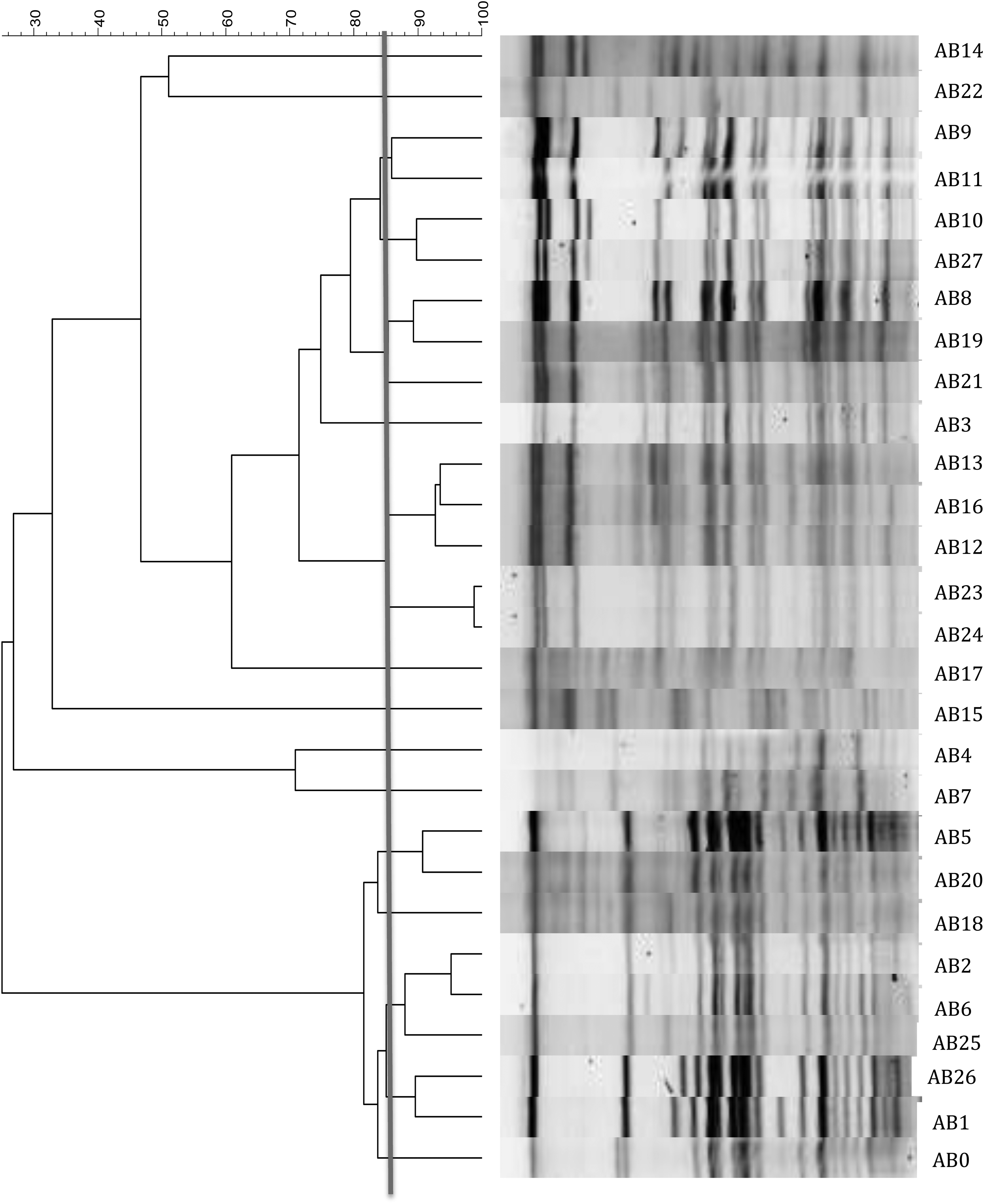
Pulsed-field gel electrophoresis (PFGE) dendrogram of Acinetobacter baumannii isolates from Saudi Arabia.
Discussion
Multidrug resistance, including carbapenem resistance, in A. baumannii is a challenge in treating hospital infections caused by the organism. In the current study, 27 ceftazidime-resistant A. baumannii isolates were collected in 2010 from a Saudi Arabian hospital in Riyadh. Colistin resistance was observed in 30% (8/27) of the isolates, which raises concerns about the need for more studies on the mechanisms responsible for colistin resistance in bacteria to explain the increasing resistance in light of the growing use of the drug. Colistin and tigecycline are considered potential alternatives to treat infections caused by MDR, specifically CRAB. In contrast to colistin, tigecycline resistance breakpoints for A. baumannii have not been reported in the CLSI guidelines. Instead, some studies have used tigecycline breakpoints (MIC >2 μg/mL) of the EUCAST for Enterobacteriaceae to identify resistant A. baumannii strains. By this definition, 56% (15/27) of the isolates in our study were tigecycline resistant. According to a manufacturer of tigecycline (http://labeling.pfizer.com/showlabeling.aspx?id=491), more clinical trials to study the efficacy of the drug in treating clinical infections caused by A. baumannii need to be conducted, although in vitro data have proved the efficacy of this drug in treating A. baumannii infections. Colistin and tigecycline resistance levels in A. baumannii have been previously reported in Saudi Arabia. Baadani et al. 19 reported that the overall resistance ratios for colistin and tigecycline were 1.8% and 9.7%, respectively, in 1,307 isolates (collected between 2010 and 2011) from two hospitals in Riyadh, like our hospital in the current study, which is also located in Riyadh. These ratios were far less than those reported in the current study (30% and 56% resistance to colistin and tigecycline, respectively). Several studies in Saudi Arabia have also reported colistin and tigecycline resistance levels in A. baumannii in the ranges of 0–4.4% and 0–30%, respectively.20–27 Moreover, the worldwide spread of colistin resistance in A. baumannii has been reviewed. 28 However, colistin resistance was found to be as low as 0% in some studies, whereas one study in Korea reported a ratio as high as 30.6%. 29 Nephrotoxicity during colistin therapy should be continuously monitored. For tigecycline, a worldwide study, including 22,005 meropenem nonsusceptible clinical isolates of A. baumannii, reported that the resistance levels for tigecycline were between 6% and 16%. 30 More recently, tigecycline resistance has also been evaluated in a review study, 31 which reported that the resistance frequency was highest in a study from Taiwan and reached 24%. 32
Although 24 of the 27 isolates in our study showed carbapenem resistance, the results revealed that neither the genes encoding for MBLs nor those encoding for KPC were responsible for this resistance. The production of MBLs such as IMP by A. baumannii was discovered as early as 1994 in Japan. 33 Subsequently, a great increase in MBL-producing organisms has become evident from the reports of many studies worldwide. However, the molecular mechanisms conferring carbapenem resistance in A. baumannii have only been recently studied in Saudi Arabia. Al-Arfaj et al. 34 and Alsultan et al. 23 were the earliest to identify the mechanisms of carbapenem resistance in CRAB from Saudi Arabia. In Al-Arfaj et al., 34 the authors tested oxacillinase genes only and showed that blaOXA-23 was the most common gene in the CRAB isolates studied (72.5% of the isolates carried blaOXA-23). In Alsultan et al., 23 the authors found that 93% of the strains isolated between 2008 and 2011 in their study carried the blaVIM gene and 55% harbored OXA-23. In comparison, in our study, 63% of the isolates harbored OXA-23, but no genes encoding for MBLs were detected in any of the isolates. Despite the lack of MBL genes, 12 strains in our study tested positive for MBLs, as determined by phenotypic detection. This discordance has been previously noticed in some other studies from Saudi Arabia35,36 and in other countries, 37 which indicates that the use of only phenotypic screening in clinical laboratories can result in the wrong choice of optimum drugs. In previous studies27,38 from Saudi Arabia, KPC was not previously detected in A. baumannii strains isolated from the kingdom of Saudi Arabia, but it has been recently identified in Iran, a neighboring country. 39 As expected, OXA-23 seems to play an important role in the carbapenem resistance of A. baumannii in Saudi Arabia and worldwide.1,40–43 Moreover, ISAba1 was detected upstream of blaOXA-23 in 16 of our 17 OXA-23-carrying isolates, thus confirming the dissemination of this resistance gene.
Like our study, other previous studies have also reported the detection of GES enzymes in A. baumannii isolates. Three variants of GES (-1, -5, and -11) were determined in our study. GES-5 and GES-11 are known to confer resistance and reduced susceptibility to carbapenems, respectively 44 ; GES-5 is more commonly found in Pseudomonas aeruginosa. 45 Although GES-11 has been identified in Saudi Arabia in a previous study, 42 to the best of our knowledge, this is the first report of the detection of GES-5 in A. baumannii. Surprisingly, GES-11 was detected in two of the imipenem-susceptible isolates (AB11 and AB12) in our study, but was harbored without OXA-23 in one imipenem-resistant isolate (AB26). Only one isolate (AB7) in our study was found to carry both GES-1 and OXA-23. On the other hand, four imipenem-resistant isolates in our study had no carbapenemase resistance gene: three of them carried GES-1 and ADC, and 1 harbored ADC only. This finding suggests the presence of other undetected carbapenem resistance mechanism(s) in these four isolates other than examined in the current study.
Few previous studies in Saudi Arabia have performed MLST typing for A. baumannii. Our MLST results revealed that CC1, containing ST1 “n = 7” and ST7 “n = 4,” was the most prevalent clonal complex in the isolates in our study. CC1 was also found in a previous study from Saudi Arabia, 24 where CC1 was detected in 30% of the A. baumannii isolates in several STs (ST1, ST20, ST49, ST141, and ST154). ST2 was the most prevalent ST in that study (39%). In contrast, only two isolates in our study were ST2. Moreover, none of the STs identified in our study were identified by Lopes et al. 42 and vice versa. The most prevalent STs in the study by Lopes et al. were ST236 (15 of 64) and ST208 (10 of 64). In contrast to their finding, no PFGE genotype could be clustered with specific STs in our study. Hamouda et al. 46 also noticed that the MLST typing was not always in concordance with the PFGE data analysis of their 44 A. baumannii isolates from 22 different countries.
Conclusion
The emergence of CRAB is a serious problem in Saudi Arabia. The high incidence of colistin and tigecycline resistance (30% and 56%, respectively) detected in our study raises concerns about the difficulty in prescribing efficient antimicrobials for the treatment of infections caused by MDR A. baumannii. OXA-23 was the most prevalent acquired carbapenemase that occurred in various STs, which is similar to what has been observed in other countries; however, only 4 of the 24 CRAB isolates in our study had unexplained carbapenem resistance mechanism(s). To the best of our knowledge, this is the first report on the identification of GES-5 conferring carbapenem resistance in A. baumannii. Genes encoding MBLs do not seem to be responsible for carbapenem resistance in the isolates investigated in our study, despite the inconsistent results of MBL phenotypic screening.
Footnotes
Acknowledgments
The authors extend their appreciation to the Deanship of Scientific Research at King Saud University for funding this work through research group project no. RGP-038.
Part of the study was presented in the European Congress of Clinical Microbiology and Infectious Diseases (ECCMID) conference, 2012.
Disclosure Statement
No competing financial interests exist.