




Abstract
Introduction
P
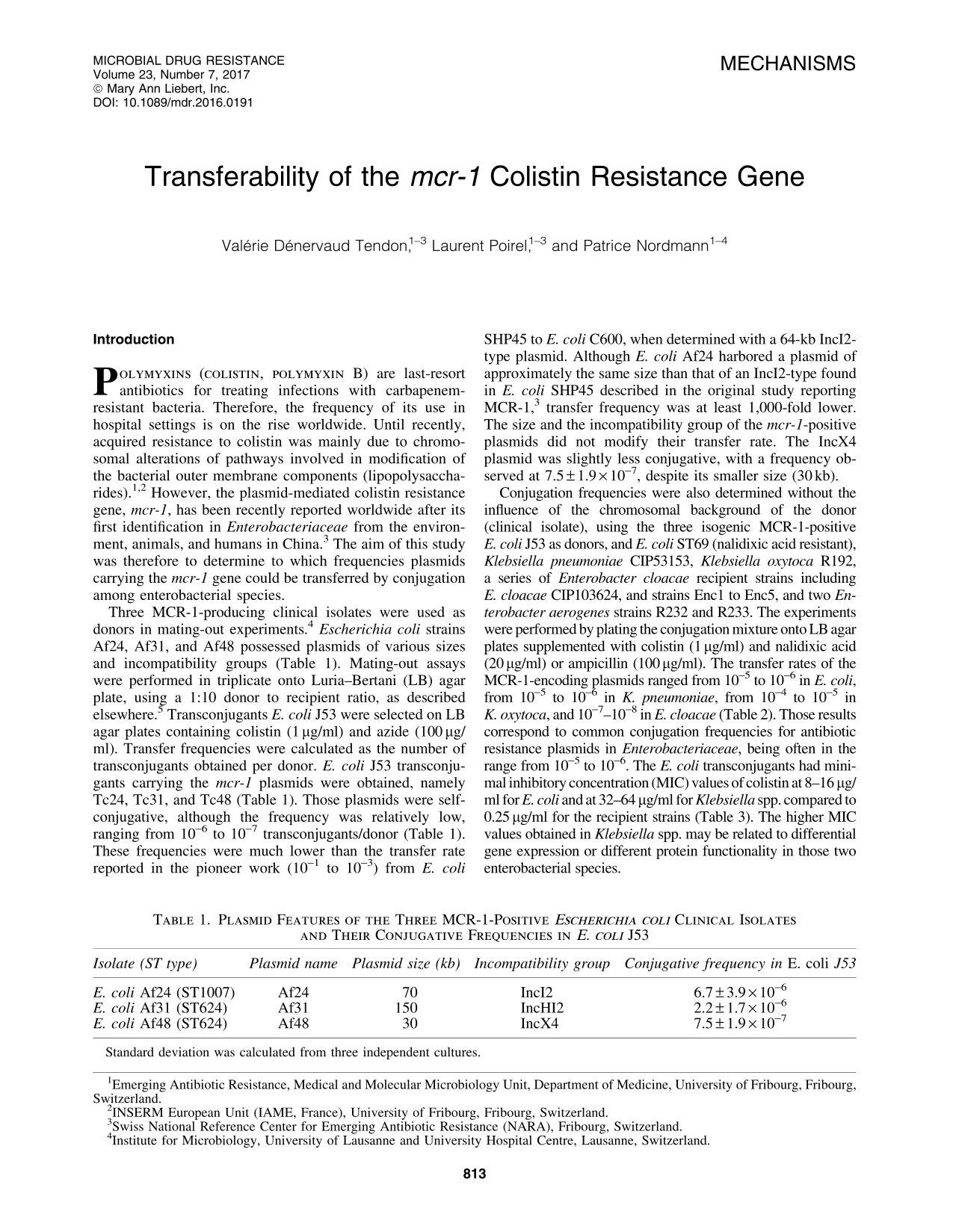
Three MCR-1-producing clinical isolates were used as donors in mating-out experiments. 4 Escherichia coli strains Af24, Af31, and Af48 possessed plasmids of various sizes and incompatibility groups (Table 1). Mating-out assays were performed in triplicate onto Luria–Bertani (LB) agar plate, using a 1:10 donor to recipient ratio, as described elsewhere. 5 Transconjugants E. coli J53 were selected on LB agar plates containing colistin (1 μg/ml) and azide (100 μg/ml). Transfer frequencies were calculated as the number of transconjugants obtained per donor. E. coli J53 transconjugants carrying the mcr-1 plasmids were obtained, namely Tc24, Tc31, and Tc48 (Table 1). Those plasmids were self-conjugative, although the frequency was relatively low, ranging from 10−6 to 10−7 transconjugants/donor (Table 1). These frequencies were much lower than the transfer rate reported in the pioneer work (10−1 to 10−3) from E. coli SHP45 to E. coli C600, when determined with a 64-kb IncI2-type plasmid. Although E. coli Af24 harbored a plasmid of approximately the same size than that of an IncI2-type found in E. coli SHP45 described in the original study reporting MCR-1, 3 transfer frequency was at least 1,000-fold lower. The size and the incompatibility group of the mcr-1-positive plasmids did not modify their transfer rate. The IncX4 plasmid was slightly less conjugative, with a frequency observed at 7.5 ± 1.9 × 10⁻⁷, despite its smaller size (30 kb).
Standard deviation was calculated from three independent cultures.
Conjugation frequencies were also determined without the influence of the chromosomal background of the donor (clinical isolate), using the three isogenic MCR-1-positive E. coli J53 as donors, and E. coli ST69 (nalidixic acid resistant), Klebsiella pneumoniae CIP53153, Klebsiella oxytoca R192, a series of Enterobacter cloacae recipient strains including E. cloacae CIP103624, and strains Enc1 to Enc5, and two Enterobacter aerogenes strains R232 and R233. The experiments were performed by plating the conjugation mixture onto LB agar plates supplemented with colistin (1 μg/ml) and nalidixic acid (20 μg/ml) or ampicillin (100 μg/ml). The transfer rates of the MCR-1-encoding plasmids ranged from 10−5 to 10−6 in E. coli, from 10−5 to 10−6 in K. pneumoniae, from 10−4 to 10−5 in K. oxytoca, and 10−7–10−8 in E. cloacae (Table 2). Those results correspond to common conjugation frequencies for antibiotic resistance plasmids in Enterobacteriaceae, being often in the range from 10−5 to 10−6. The E. coli transconjugants had minimal inhibitory concentration (MIC) values of colistin at 8–16 μg/ml for E. coli and at 32–64 μg/ml for Klebsiella spp. compared to 0.25 μg/ml for the recipient strains (Table 3). The higher MIC values obtained in Klebsiella spp. may be related to differential gene expression or different protein functionality in those two enterobacterial species.
Standard deviation was calculated from three independent cultures.
All recipient strains have a minimal inhibitory concentration (MIC) value of 0.25 μg/ml for colistin.
Since the occurrence of the mcr-1 gene was reported in E. cloacae, 6 and since our preliminary experiments indicated failed to detect conjugation into that species, we conducted additional experiments to evaluate the conjugation efficiency in additional strain backgrounds. Six E. cloacae and two E. aerogenes strains were therefore tested as recipients. A very low conjugation frequency (between 10−7 and 10−8 depending on the strains) was obtained with the different E. cloacae recipient strains. A higher conjugation rate was found with the different E. aerogenes strains (between 10−3 and 10−4).
The transfer frequency of the IncI2-type plasmid carrying the mcr-1 gene reported in the pioneer study was surprisingly high, ranging from 10−1 to 10−3 from E. coli to E. coli. Here our results do not support those latter observations, with conjugation frequencies being lower in the different enterobacterial backgrounds used. Regardless of their incompatibility types, plasmids carrying the mcr-1 gene could be transferred to several enterobacterial species (at least to E. coli, K. pneumoniae, K. oxytoca, and E. aerogenes) at a conjugation rate varying from 10−4 to 10−6.
The study further confirms that the mcr-1 gene may efficiently spread among most enterobacterial species, with variable frequencies depending on the recipient strains/species, rather than on the plasmid types. Low rates of transconjugants obtained in E. cloacae might be linked to a deleterious effect of mcr-1 gene expression in that species, considering that MCR-1 is a phosphoethanolamine transferase modifying the lipopolysaccharides structure, therefore modifying the bacterial surface.
There is a need to monitor the spread of the mcr-1 gene between E. coli on one hand and multidrug-resistant K. pneumoniae strains on the other hand, since it may possibly give rise to pandrug-resistant isolates such as those producing MCR-1 and carbapenemases. 7
Footnotes
Acknowledgments
This work has been funded by the University of Fribourg and by a grant of the ANIHWA ERA-NET project, Switzerland.
Disclosure Statement
No competing financial interests exist.