




Abstract
Carbapenemase-producing Klebsiella pneumoniae strains have emerged as a major problem for healthcare systems. The aim of this study was to determine the role and diversity of plasmids harboring carbapenemases encoding genes from a collection of K. pneumoniae isolates recovered between July 2011 and January 2012, with decreased susceptibility to carbapenems. Imipenem (IPM), ertapenem (ETP), meropenem (MEM), and doripenem (DOR) minimum inhibitory concentrations (MICs) were determined by E-test. Carbapenemase production was detected with the modified Hodge test. β-Lactamases encoding genes were amplified by PCR and sequenced. Plasmid incompatibility groups harbored by carbapenemases producers were investigated using the PCR-based replicon typing method and the clonal relationship of the isolates was investigated by pulse filed electrophoresis. IMP, ertapenem, meropenem, and doripenem MICs ranged between 0.25 and 16 mg/L. Carbapenemase activity was detected in 14 isolates. Two carbapenemases were identified: OXA-48 in 13 isolates and a new variant OXA-204 in 1 isolate, in combination with extended-spectrum β-lactamases, CTX-M-1, CTX-M-9, CTX-M-14, CTX-M-15, and VEB-8. One isolate produced CMY-2. OXA-48 and the new variant OXA-204 were confirmed as transferable plasmid encoded. The carbapenemase-producing K. pneumoniae harbored plasmids of the A/C, LVPK, and L/M replicon types. Thirteen different pulso types were observed. Three pairs of isolates showed a clonal relatedness. This diversity in β-lactamases, in pulso types and in plasmid content, shows the ability of OXA-type carbapenemase to disseminate. This is worrying for the control of the increase in antibiotic resistance frequency and necessitates that continuous investigations in the clinical setting remain a high priority to clarify the contribution of antimicrobial use into multiresistance bacterial dissemination.
Introduction
E
Ambler classes A, B, and D carbapenemases are found worldwide among Enterobacteriaceae. 3 In Klebsiella pneumoniae isolates, the main mechanism behind carbapenem resistance is the acquisition of KPC, NDM, and OXA-48-like carbapenemases. 4 OXA-48 is a carbapenem-hydrolyzing oxacillinase that was first isolated from clinical isolate of K. pneumoniae in Turkey in 2001. 5 Subsequently, OXA-48-producing Enterobacteriaceae have been observed in several countries in South America, Northern Africa, the Middle East, and Europe.2,6–9 This worldwide carbapenemase spread is becoming an important therapeutic challenge in the clinical setting.10,11 Detecting OXA-48-producing Enterobacteriaceae can be challenging as they tend to confer low carbapenem minimum inhibitory concentrations (MICs). Confirmation requires PCR amplification of the underlying gene. 12 To date, two cases of OXA-204 carbapenemases were reported worldwide. In K. pneumoniae isolate, the first case of blaOXA-204 gene was associated with an ISEcp1 element. 13 In the second case, blaOXA-204 was described in one Escherichia coli clinical isolate belonging to the widespread sequence type ST11, and coproducing CTX-M-15 and CMY-4. 14
Resistance traits can be chromosomally or plasmid located and then horizontal gene transfer plays a significant role in the introduction and dissemination of new genes into microbial populations especially from environmental bacteria with natural resistance to several antibiotics. 15
In this study, we evaluated the diversity of incompatibility groups of plasmids in OXA-48 and OXA-204-producing K. pneumoniae, showing their participation in the dissemination of blaOXA-48 and blaOXA-204 genes in a Tunisian hospital.
Materials and Methods
Bacterial strains
From July 2011 to January 2012, 17 isolates of K. pneumoniae were collected in military hospital of Tunis, showing a decreased susceptibility to carbapenems (IMP and/or ertapenem), according to Eucast 2015 criteria. 16
The isolates were identified using biochemical tests, Phoenix™ microbiology identification system (Becton Dickinson, Oxford, United Kingdom), and confirmed by matrix-assisted laser desorption and ionization time-of-flight mass spectrometry (MALDI-TOF MS) (IVD MALDI Biotyper; Bruker Biospin SAS, Wissembourg, France), as described by Guo et al. 17
MICs determination
MICs were determined by E-test on Muller–Hinton (MH) agar plates in accordance with Eucast 2015 guidelines. 16 MICs for penicillins, cephalosporins, etc. were also determined by broth microdilution agents in cation-adjusted MH broth as previously described, 18 they were inoculated and analyzed using Eucast 2015 criteria.
Screening of carbapenemases
Carbapenemase production was screened using the modified Hodge test. 19
The presence of class B metallo-β-lactamases (MBLs) was screened using a double disk test with IMP as a substrate and 0.5 M EDTA as an inhibitor. Additional inhibitors such as sodium mercaptoacetate (ADM) and 3-aminophenyl boronic acid (PBA) were used to differentiate other carbapenemase classes. 20
Plasmid extraction
Each isolate was grown from a single colony. An aliquot of the culture was used for preparing the plasmid DNA after the culture has been grown overnight at 37°C. Then 1.5 ml was transferred in a microcentrifuge tube and the centrifugation was conducted at 5600 g for 5 minutes, the supernatant was then removed. Pellet cells were resuspended in 0.2 ml of ice-cold solution of glucose, Tris, and EDTA and 0.4 ml of the solution of NaOH and sodium dodecyl sulfate (SDS) was then added, and the mixture was left for 5 minutes at room temperature. Second, incubation for 10 minutes was performed after addition of 0.3 ml of sodium acetate ice-cold solution. Tubes were then centrifuged for 5 minutes and a clean microcentrifuge tube was used to recover the supernatant. At this step, plasmid DNA was separated from the cellular debris and chromosomal DNA in the pellet. A volume/volume of isopropanol was subsequently added to the recovered supernatant and then left at room temperature for 2 minutes. After 5 minutes of centrifugation, the supernatant was discarded and the obtained milky white pellet was washed with 1 ml of 70% ice-cold ethanol. Finally, the tubes were dried for 5 minutes and the pellet was resuspended in 40 μl of Tris–EDTA solution and stored at −20°C for later use. 21
Control of plasmid extraction
Plasmid DNA electrophoresis was performed using a 0.8% agarose gel at 50–70 V for 2.5 hours with a 10 kbp DNA molecular weight marker (Vector). After completion of the run, the gel was placed on the UV transilluminator and the DNA bands were examined.
Conjugation experiments
Conjugation experiments were done using E. coli J53 (sodium azide resistant) as the recipient. Transconjugants were selected on brain heart infusion agar supplemented with cefotaxime (16 mg/L) and sodium azide (100 mg/L).
PCR amplification and sequencing
Single PCRs were used to screen total and plasmid DNA from the isolates under investigation for the existence of the blaTEM, blaSHV, blaCTX-M, blaOXA, blaVEB, blaIMP, blaVIM, and blaAmp-C genes using the primers listed in Table 1. Total DNA was extracted using the automate Nuclisens Easymag R. V2.0 method (bioMerieux, Marcy l'Etoile, France). PCR amplification was carried out under the following conditions: 95°C for 5 minutes followed by 35 cycles of 95°C for 1 minute, 60°C for 1 minute, 72°C for 1 minute, and a final extension step of 10 minutes at 72°C. PCR products were analyzed on 1% agarose gel and sequencing was performed using the same primers and an automated sequencer (377, ABI Prism; Perkin-Elmer, CT). Subsequently, the nucleotide sequences and their corresponding translated amino acid sequences were compared with other sequences submitted to databases using software from the National Center for Biotechnology Information (www.ncbi.nlm.nih.gov).
Plasmid incompatibility groups
Plasmid incompatibility groups of the 17 isolates and their transconjugants were determined using PCR-based replicon typing. Four multiplex PCRs were used for the detection of A/C, T, FIIAs, W, N, FIB, L/M, I1-Iγ, X, HI2, FIA, and Y replicons. Replicons P, R, U, F, FIC, HI1, B/O, and K were detected by simplex PCR. Replicons FII1K, FII2K, and NewXXX also named ZK, LVPK, and Amet were detected using the PCR method previously described.22,23
Pulsed-field gel electrophoresis
Clonal relatedness of the 17 isolates of K. pneumoniae was analyzed by pulsed-field gel electrophoresis (PFGE) as previously described. 24 Genomic DNA was digested using the restriction endonuclease XbaI (Fermentas, ABI, Germany), and DNA fragments were separated in a PFGE CHEF-DR III system (Bio-Rad Laboratories, Hercules, CA) in 0.5 × Tris–borate–EDTA (TBE) buffer at 120 V for 19 hours, with pulse times ranging from 2.2 to 54.2 seconds. The patterns were analyzed by GelCompar II software (Applied Math, Sint-Maten-Latem, Belgium) using the unweighted pair group method with arithmetic mean (UPGMA) algorithm and the Dice similarity coefficients. Cutoff lines at 65% and 80% were used to analyze genetic relatedness.
Results
Bacterial resistance profile
The antibiogramme results show that the 17 isolates are resistant to the almost tested antibiotics, these results confirmed that these isolates are multidrug resistant (MDR) bacteria (Table 2). MICs values of IMP, meropenem (MEPM), ertapenem (ETP), and doripenem (DOR) were above the breakpoint of “resistant” in 14 isolates of K. pneumoniae (Table 3). All the isolates were resistant to broad spectrum β-lactams antibiotics, including cefotaxime, ceftazidime, cefepime, and cefpirome, aminoglycosides, and fluoroquinolones.
CCAZ and CCTX were interpreted using the CAZ and CTX breakpoints.
IMP, imipenem; ETP, ertapenem; CAZ, ceftazidime; CCAZ, ceftazidime+ac clavulanique; CTX, cefotaxime; CCTX, cefotaxime+clavulanic acid; FEP, cefepime; CFE, cefepime+clavulanic acid; CPO, cefpirome; FOX, cefoxitine; DOR, doripenem; MER, meropenem.
MICs, minimum inhibitory concentrations.
Phenotypic detection of carbapenemases
The modified Hodge test shows positive results by deformation of the inhibition zone, suggesting the production of carbapenemases in 14 isolates (Table 2). None of them was positive with the IMP–EDTA synergy test, showing that the isolates do not produce class B carbapenemase as MBL.
The inhibition tests using ADM, EDTA, and 3-aminophenyl boronic acid (APB) for discrimination between the different β-lactamase classes produced by the isolates did not provide any information.
Identification of plasmid-encoded carbapenemases
Among the 17 plasmid preparations of K. pneumoniae and their transconjugants (Fig. 1), only 14 are carbapenemases positive. PCR products after amplification from the plasmid products were purified and sequenced using the BigDye terminator chemistry. The sequences obtained were analyzed using BlastN and BlastP against the NCBI database (www.ncbi.nlm.nih.gov). Carbapenemases were identified among the 14 positive isolates and their transconjugants as OXA-48 (13 cases) and OXA-204 (1 case in KPM5 isolate). These results confirm that OXA-48 carbapenemases are plasmid encoded and show also the first incidence of OXA-204 carbapenemase coproduced with CTX-M-14 in clinical isolates in Tunisia.

Plasmid profiles of 17 Klebsiella pneumoniae isolates. Lanes 1 and 19: 10 kpb DNA molecular weight; lane 2: KPM23BC; lane 3: KPM23BF; lane 4: KPM14; lane 5: KPM15; lane 6: KPM16; lane 7: KPM5; lane 8: KPM6; lane 9: KPM8; lane 10: KPM12; lane 11: KPM13; lane 12: KPM11; lane 13: KPM4; lane 14: KPM3; lane 15: KPM7; lane 16: KPM10; lane 17: KPM1; lane 18: KPM2.
Beta-lactamase identification
Carbapenemases were produced by 14 isolates (13 OXA-48, 1 OXA-204). ESBLs were identified as CTX-M enzymes (CTX-M-1 n = 5; CTX-M-9 n = 2; CTX-M-14 n = 2; CTX-M-15 n = 3) and VEB-8 (n = 1). Interestingly, KPM5 isolate, obtained from a patient in the ICU, coproduced OXA-204, CTX-M-14, and SHV. All the OXA-48-producing isolates coproduced other ESBLs such as TEM, SHV, and CMY. KPM15 isolate produced a plasmidic cephalosporinase, CMY-2, and no carbapenemase. Finally KPM-6 and KPM-12 produce only the ESBLs as CTX-M, SHV, and TEM (Table 3).
Using the conjugation experiments, carbapenemases were produced by 14 transconjugant isolates (13 OXA-48, 1 OXA-204). ESBLs transferred to the recipient strain were identified as CTX-M enzymes (CTX-M-1 n = 5; CTX-M-9 n = 2; CTX-M-14 n = 2; CTX-M-15 n = 3) and VEB-8 (n = 1). However, TEM and SHV were not transferred in any case, indicating that these ESBLs were chromosomally encoded or they are located on nonconjugative plasmids.
Identification of incompatibility group of blaOXA-48-positive plasmids
K. pneumoniae isolates KPM2, KPM8, KPM11, KPM14, and KPM23BF harbored simultaneously Inc A/C and Inc L/M. The isolates KPM23BC, KPM13, and KPM1 harbored Inc A/C and Inc R together. Other replicons were observed: LVPK, P, and New X in KPM2, KPM3, and KPM16. The OXA-204 producer (KPM5) harbored Inc L/M, Inc A/C, and Inc P plasmids. These results showed the diversity of plasmids harbored by the isolates, explained the high antibiotic resistance of these isolates, and showed their ability to disseminate these resistances (Table 3).
Using the conjugation experiments, IncR plasmids were transferred from KPM3, KPM10, and KPM16 to the recipient strain, IncA plasmids were transferred from KPM5 and KPM14 to the recipient strain. However, IncR and IncA plasmids were transferred together from KPM1, KPM2, KPM4, KPM6, and KPM13 to the recipient strain (Table 3).
Genetic relatedness between OXA-48-producing K. pneumoniae
The analyses of PFGE pattern showed a high diversity of the profiles among the carbapenemase-producing K. pneumoniae isolates. Using the UPGMA, genetic relatedness <60% was observed for all of the isolates but for the pair KPM23C/KPM23F and the pair KPM12/KPM13 isolates, which appeared to be clonal (Fig. 2). However, their associated β-lactams resistance phenotypes and plasmid content were partly different (Fig. 2). The analysis of the correspondent associate β-lactamases produced and the incompatibility group of blaOXA-48-positive plasmids demonstrates different profiles. For the first pair KPM23BC/KPM23BF, the acquisition of IncR plasmid is responsible for the production of CTX-M-1 in KPM-23BC isolate. This is the same case for the second pair KPM12/KPM13, the acquisition of IncR plasmid is associated with the production of CTX-M-1 in KPM13 isolate.
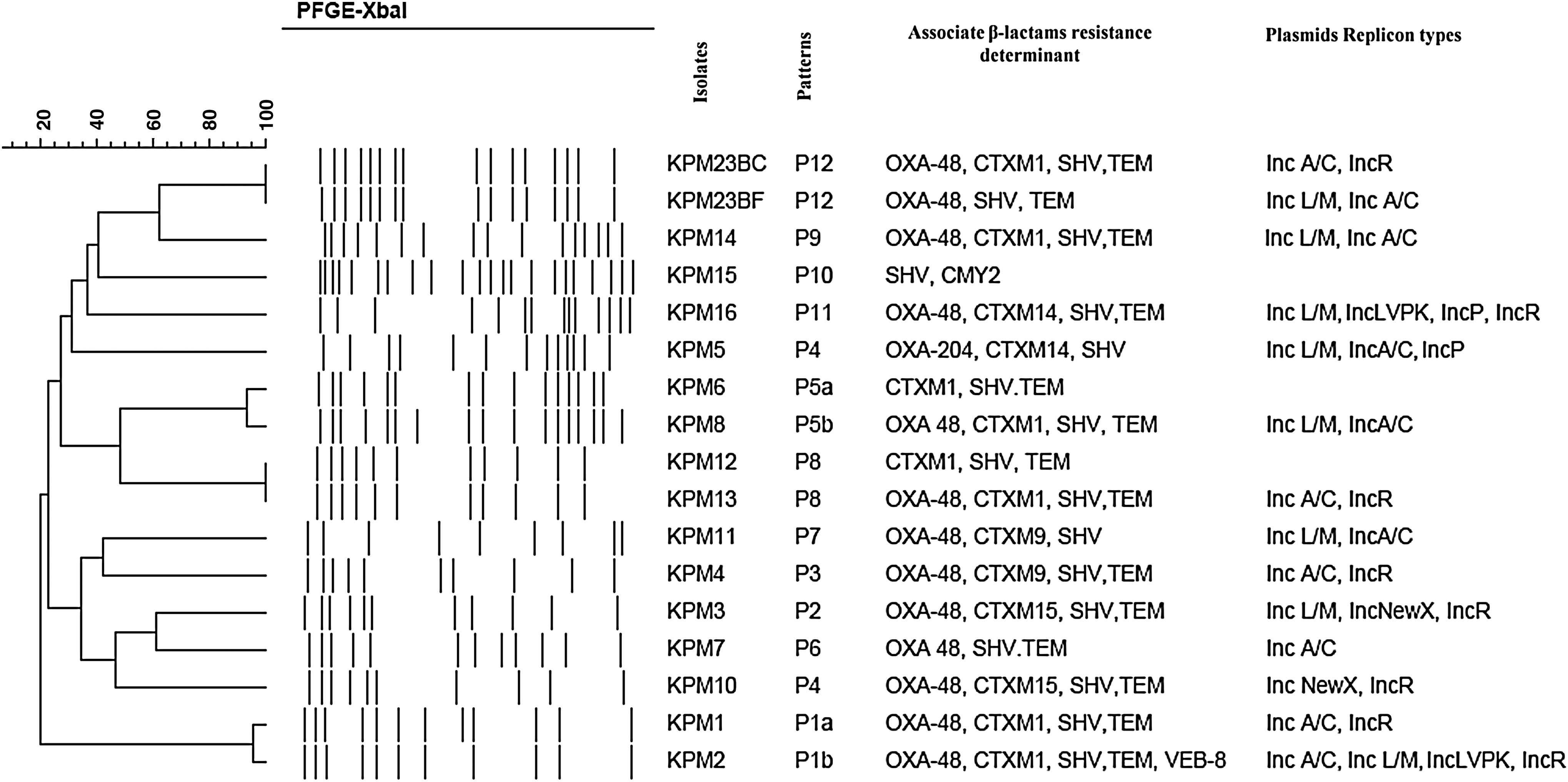
Dendrogram generated by GelCompar II software using the unweighted pair group method with arithmetic mean algorithm and the Dice similarity coefficients after analysis of PFGE patterns of the 17 K. pneumoniae genomic DNA after digestion by XbaI. PFGE, pulsed-field gel electrophoresis.
Discussion
In our study, carbapenem resistance in the 14 multi-drugs resistant (MDR) isolates was associated with the presence of the OXA-48 carbapenemase in the majority of isolates and in a single case with the OXA-204 variant explain the resistance to IMP. Worldwide, there are few reports about the incidence of OXA-204 carbapenemase variant. 25
OXA-48 type genes are commonly harbored in K. pneumoniae isolates on broad-host range conjugative IncL/M plasmids ∼62-kb in size. 23 In this plasmid, blaOXA-48 is located within the Tn1999-type composite transposon. 26
OXA-48 was revealed as plasmid encoded and was produced with different plasmid replicons content (Inc A/C, Inc L/M, IncLVPK, IncR, IncNewX, and IncP). Although β-lactamase encoding genes was often associated with the presence of IncA/C or IncR plasmids. These plasmids have a unique genetic structure compared with other enterobacterial plasmid types, a broad host range, and a propensity to acquire large number of antimicrobial resistance genes through their accessory regions such as blaOXA-48, blaNDM, and blaCMY. 27
Various replicon types of plasmids mediating carbapenem resistance are globally distributed in Enterobacteriaceae. 28 This study showed that two replicon types IncA/C and IncR of transferable plasmids encoding blaOXA-48 were responsible for the appearance of carbapenem-resistant K. pneumoniae in Tunisian patients. IncA/C and IncR plasmids encoding blaOXA-48 have been prevalent among a wide range of Enterobacteriaceae isolated from humans and animals worldwide. 9
The main frequently described worldwide replicon is the IncA/C family. Comparative sequence examination shows that the IncA/C plasmids derived from a common ancestor throughout stepwise integration of horizontal transfers. The outcome of this study confirms that the current variant of the IncA/C plasmid family acquired resistance genes integrated to a conserved plasmid backbone. Recently, blaCMY-2-like genes were frequently described among Enterobacteriaceae strains harboring IncA/C MDR plasmids. 28 Using PFGE experiments, IncA/C plasmids were found in three clones very closely related in Tunisia. Effectively, IncA/C harboring blaCTX-M-15 and blaCTX-M-52 genes was the plasmid with high incidence among clinical isolates of E. coli in Tunisia. 29
Worldwide, only two reports describe the incidence of OXA-204.13,25 Recently, Grami et al. confirm that blaOXA-204 was located on an IncA/C plasmid associated with blaCMY-4, showing an unusual combination for a plasmid known to be able to harbor blaOXA-48-like gene. 25 However, in our study, blaOXA-204 was located in IncA/C-transferable plasmid alone. Certainly IncA/C-type plasmids were known to be harbored by a multitude of bacteria species facilitating blaOXA-204 to disseminate between different K. pneumoniae clones, including potential transitional passages in other bacterial species. Therefore, the increase of OXA-204 producers should be vigilantly monitored in the future. 25 Here, we report the first carbapenem-resistant K. pneumoniae produced two types of transferable plasmids encoding carbapenemases OXA-48 and OXA-204 isolates in the military hospital of Tunis.
Enterobacteriaceae species and environmental bacteria were described as naturally cephalosporinase producers by chromosome encoding genes, which were also mobilized to conjugative plasmids able to easily disseminate to pathogenic strains. 30 Interestingly, in our study, KPM15 isolate produces CMY-2 but does not harbor any plasmid. This result can be explained if blaCMY-2 gene was integrated into the chromosome through an integron. Nevertheless, Carattoli et al. showed that the incidence of plasmid mediated blaCMY-2 encoding gene in Salmonella enterica. Furthermore, this plasmid was identified as IncA/C plasmid and carried two copies of blaCMY-2. 31 Genes that encode resistance to many different antimicrobial compounds were encountered in IncA/C plasmids, including blaCMY-2, which encodes an AmpC-like β-lactamase that confers resistance to extended-spectrum cephalosporins. 30
We reveal in this work that the acquirement of IncR plasmid was associated with the transfer of blaCTX-M type responsible for the high resistance to cefotaxime and ceftazidime. In Denmark, previous studies performed among porcine clinical E. coli isolates confirm the association between blaCTX-M-1 and the acquisition of IncN plasmids. 32 Other studies conducted in France showed that CTX-M-1 production was associated with other incompatibility groups, such as IncI1 in poultry with a low frequence. 33
Conclusion
To conclude, our work describes the prevalence of plasmid-encoded carbapenemases OXA-48 and the new variant OXA-204 among MDR K. pneumoniae clinical isolates in Tunisia. We also demonstrate that the diversity of incompatibility plasmid groups encountered in these clinical isolates of K. pneumoniae disseminated in the Tunisian Hospital. The worldwide increase of antibiotic resistance was especially contributed by these kinds of mobile genetic elements recognized to be easily mobilized and transferable between bacteria. For the purpose of understanding the increase of multi-drugs resistant bacteria dissemination, we need to accentuate studies focused on the description of the genetic environments of antibiotic resistance genes because of the high unpredictability of some resistance genes located on these incompatibility plasmid show the plasticity of these genetic platforms.
In this work, like in other studies conducted in the same field, we contribute to the extension of our knowledge on dissemination, distribution, and evolution of plasmid-encoded carbapenemases located in Inc plasmid. Furthermore, our findings emphasize the need to screen for transferable incompatibility plasmids harboring carbapenemases among clinical isolates of MDR K. pneumoniae to reduce the risks of nosocomial infections. Continuous investigations at the national level for β-lactam and especially carbapenems-resistant K. pneumoniae in clinical setting remain a high priority to clarify the contribution of antimicrobial use to the dissemination and increase of incidence of OXA-48 and OXA-204 carbapenemase.
Footnotes
Acknowledgments
This work was supported by the Tunisian Ministry of Higher Education and Scientific Research offering a scholarship to Miss. R. O. in Université de Reims Champagne-Ardenne. This work was supported by an annual grant from Université de Reims Champagne-Ardenne (EA 4687) France.
Disclosure Statement
No competing financial interests exist.