




Abstract
Carbapenem-nonsusceptible (Carba-NS) Acinetobacter baumannii has emerged as an important cause of nosocomial infections. In the present study, we characterized 91 Carba-NS A. baumannii isolates collected from patients of surgical departments and intensive care units at three hospitals in Moscow in 2012–2015. Multilocus sequence typing (MLST) using the Oxford (Oxf) scheme identified 16 sequence types (STs) of three clonal complexes (CCs), including CC92Oxf (67%), CC109Oxf (1%), CC944Oxf (29%), and the singleton ST1100Oxf (3%). CC944Oxf was composed of ST944Oxf (n = 16) and two of its newly described single locus variants ST1103Oxf (n = 3) and ST1104Oxf (n = 7); all the three STs were identical to the Pasteur (Pas) MLST scheme ST78. All CC944Oxf/ST78Pas isolates were blaOXA-40-like positive and all but one isolate harbored a bla CTX-M-like gene. ST944Oxf was the only ST found in each of the three study hospitals. Biofilm growth capacity was similar among Carba-NS and nonclonal carbapenem-susceptible isolates. Our data demonstrate the predominance of two clonal lineages among Carba-NS A. baumannii. One of these, the uncommon bla OXA-40-like /bla CTX-M-like -positive clone of CC944Oxf/ST78Pas, seems to be endemic in Russia.
Introduction
O
Multilocus sequence typing (MLST) is a valuable tool for studying of molecular epidemiology of A. baumannii. Sequence types (STs) are determined by sequencing of fragments in seven housekeeping genes; STs having at least five of the seven alleles in common form a clonal complex (CC). The majority of carbapenem-nonsusceptible (Carba-NS) A. baumannii isolates belong to a few international clones (ICs) that are disseminated worldwide.12,13 Two available MLST schemes for A. baumannii, the Oxford (Oxf) and Pasteur (Pas) schemes, produce similar typing results, 14 although a higher discriminatory power of the Oxford scheme has been reported. 15 In addition, a PCR-based method for assignment of A. baumannii isolates to ICs has been developed and proved to be convenient.12,13 A number of studies demonstrate associations between genotype and important clinical traits of A. baumannii, including increased colonization, epithelium invasion, and biofilm formation.16,17 Biofilm formation is considered among the principal virulence factors of A. baumannii that promote persistence and spread of this pathogen in the hospital environment. 17 Thus, monitoring of circulating A. baumannii genotypes is important for local epidemiology, as well as for global comparisons.
According to data from a multicenter study performed in Russia, the rate of A. baumannii among nosocomial pathogens increased from 10.2% in 2002–2004 to 13.9% in 2011–2012. 18 Worryingly, within this time period, the prevalence of Carba-NS isolates demonstrated a more than twofold elevation reaching 67.5%. However, molecular epidemiology of A. baumannii in Russia has not yet been studied, except sporadic reports describing single isolates.19–21 In the present work, we characterized Carba-NS A. baumannii isolates obtained from patients in three hospitals in Moscow in 2012–2015.
Materials and Methods
Bacterial isolates
This study included 91 consecutive, nonduplicate Carba-NS A. baumannii isolates recovered from patients of surgical departments and ICUs at three hospitals in Moscow, Russia. Hospital 1 (Scientific Center of Children's Health; H1) and hospital 2 (Scientific Research Institute for Children's Surgery and Traumatology; H2) served for pediatric patients; hospital 3 (Filatov Moscow City Clinical Hospital No. 15; H3) cared for adult patients. At H1 and H2, isolates (n = 28 and n = 41, respectively) were collected from May, 2012 to April, 2015; H3 isolates (n = 22) were recovered for this study in November, 2014. In addition, for biofilm experiments, 12 nonduplicate carbapenem-susceptible A. baumannii isolates recovered in H1 and H2 were included. All laboratory examinations for collected isolates were performed at the Scientific Center of Children's Health. A. baumannii was identified on the basis of characteristic proteomic profiling, as determined by matrix-assisted laser desorption-ionization time-of-flight (MALDI-TOF) mass spectrometry (Bruker Daltonics; MALDI Biotyper).
MLST analyses
The ST was determined using standard procedures for the Oxford and Pasteur MLST schemes. 14 Analysis of the STs and assignment to CCs were performed, including all STs found in the online database using the eBURST program. The STs that shared at least five of seven allelic variants composed a CC.
Antimicrobial susceptibility testing and detection of β-lactamase gene carriage
Antimicrobial susceptibility for imipenem (IPM), meropenem (MEM), gentamycin, netilmicin, ciprofloxacin, and colistin was examined by the E-test (bioMerieux); in addition, colistin susceptibility was tested using the semiautomated VITEK 2 assay (bioMerieux). Results were interpreted according to updated standards EUCAST-2015. Isolates with intermediate and resistant categories for IPM and/or MEM were regarded as Carba-NS. Detection of β-lactamase genes blaOXA-23-like, blaOXA-40-like, and blaOXA-58-like was performed by PCR using the AmpliSens A.b.-OXA Kit (InterLabService) according to manufacturer's instructions. The presence of blaCTX-M-like genes was tested by PCR using primers that amplified a 544-kb fragment of all the known blaCTX-M groups, as described elsewhere. 22 The carriage of blaCTX-M-like genes was examined in all the isolates of CC944Oxf and in at least one isolate of each remaining non-CC944Oxf ST from each study hospital.
Biofilm formation assay
Biofilm formation was evaluated in a brain-heart infusion broth (BHB; Becton Dickinson) culture on abiotic solid surface, as previously described, 23 with modifications. A 200 μl aliquot of 24-hour bacterial culture diluted to an optical density (OD) corresponding to 0.5 McFarland standard was inoculated in a sterile 5-ml dual snap-cap round bottom polystyrene tube (Falcon, Becton Dickinson) containing 1.8 ml of the BHB with 1% glucose. After a 24-hour incubation at 37°C (no shaking), the broth was carefully removed, and tubes were gently washed twice with 4 ml of Hank's buffered salt solution and fixed with 5 ml 4% formaldehyde for 5 minutes at room temperature. After rinsing with distilled water, 5 ml of crystal violet (1% solution in 20% ethanol [Sigma-Aldrich]) was added to each tube and left for 4 minutes at room temperature. After pouring out the stain, tubes were washed five times with 4 ml of distilled water and dried. The bound dye was solubilized and eluted with 4 ml of 95% ethanol for 1 hour. Dye eluates (200 μl) were transferred to a transparent, flat bottom 96-well plate (TPP) followed by the absorbance (OD) measurement at 590 nm using a microplate reader (Infinite 200 M, Tecan Systems, Inc.). All isolates were tested in duplicates in three separate experiments; mean OD values were used as a measure of biofilm growth. Isolates with OD values ≥0.6 or <0.6 were regarded as having high or low biofilm growth capacity, respectively.
Statistics
The statistical analysis was performed using IBM SPSS Statistics for Windows, version 20.0 (IBM Corp.). Contingency table analysis for comparing proportions was done by the χ2 test, or by means of the z-test, where appropriate. Biofilm growth capacity between different CCs and STs was compared using the Kruskal–Wallis H test followed by the Mann–Whitney U test with Bonferroni correction for multiple pairwise comparisons. The tests were considered statistically significant at p < 0.05.
Results
CC and ST distribution by the Oxford and Pasteur MLST schemes
A total of 91 Carba-NS A. baumannii isolates were examined in this study. Invasive (14%), respiratory (48%), wound (9%), and rectal/throat swab (29%) isolates composed the study collection. Initially, all isolates were subjected to MLST using the Oxford scheme. This analysis discovered 16 STs that were distributed among three CCs: CC92Oxf (n = 61), CC109Oxf (n = 1), and CC944Oxf (n = 25); ST1100Oxf (n = 3) was a singleton (Table 1). The vast majority of isolates (96%) belonged to CC92Oxf and CC944Oxf. CC92Oxf (67%) was represented by three single locus variants (SLVs) and eight double locus variants (DLVs) of ST92Oxf. ST348Oxf (n = 30) was the most abundant genotype comprising 33% of the entire collection. CC944Oxf consisted of 26 isolates (29% of the entire collection) of three STs, including ST944Oxf (n = 16), the lineage founder, and two of its SLVs, ST1103Oxf (n = 3) and ST1104Oxf (n = 7). One isolate of ST441Oxf belonged to CC109Oxf. There was no association between ST and specimen type (data not shown).
All isolates of a given ST carried the indicated blaOXA-like gene, if not otherwise stated.
MLST typing using the Pasteur scheme was performed for at least one isolate of each different Oxford ST from each study hospital.
STs are organized in the order of descending prevalence. The boldface indicates newly documented STs.
blaCTX-M-like negative.
One isolate carried the blaOXA-23-like gene in addition.
The variant of ST493 with an 18-bp deletion Δ229–246 in the rpoD allele.
ST45, two isolates (H3); ST570, one isolate (H2).
blaCTX-M-like positive.
Of the three isolates, one carried blaOXA-40-like and blaCTX-M-like (H2); one carried blaOXA-40-like, blaOXA-23-like, and blaCTX-M-like (H3); and one carried blaOXA-40-like only (H3).
All three isolates had intermediate MICs for imipenem and meropenem (4–6 mg/L). Of the three isolates, none carried blaCTX-M-like; one carried both blaOXA-40-like and blaOXA-23-like (H1); one carried blaOXA-40-like (H3); and in one isolate no blaOXA-like was found (H3).
DLV, double locus variant; MIC, minimum inhibitory concentration; MLST, multilocus sequence typing; SLV, single locus variant.
Among the 16 discovered Oxford STs, 7 STs were not documented in the online MLST A. baumannii database 14 before (Table 1). Five of the seven newly described STs had novel allele combinations; ST1128Oxf possessed a new gpi allele. Among 11 isolates of ST493Oxf, 8 isolates carried an 18-bp deletion in the rpoD allele (positions 229–246). This ST493Oxf variant, which we designated as ST493ΔrpoDOxf, was recovered only in one study hospital (see below). In CC944Oxf, isolates of new ST1103Oxf and ST1104Oxf comprised a 38% proportion (10/26).
To elucidate potential connection of CC944Oxf to internationally known lineages, we performed additional typing of selected A. baumannii isolates using the Pasteur scheme of MLST. All three STs composing CC944Oxf appeared to be identical to ST78Pas (Table 1), which has been described earlier.3,6,24,25
We further compared the Oxford and Pasteur MLST schemes performing the Pasteur scheme typing for at least one isolate of each different Oxford ST from each study hospital (Table 1). Both schemes assigned the study isolates to three clonal groups and one singleton ST1100Oxf/ST400Pas. The former included CC92Oxf/CC2Pas and CC109Oxf/CC1Pas, which corresponded to IC2 and IC1, respectively,12,13 and CC944Oxf/ST78Pas. At the same time, the Oxford scheme divided the study isolates in 16 STs, whereas only 6 Pasteur STs were discovered. The single Pasteur ST2 covered 7 of the 11 CC92Oxf STs; ST78Pas was distributed among 3 Oxford STs. ST493Oxf had two Pasteur equivalents, ST45Pas and ST570Pas; the latter corresponded to ST493ΔrpoDOxf (Table 1).
Due to the apparently higher discriminatory power of the Oxford scheme, we used this method for analysis of the Carba-NS A. baumannii genotype diversity at the hospital level. Although the prevalence of clonal groups was similar among the three study hospitals (χ2 = 7.3; p = 0.294), the distribution of given STs was significantly different (χ2 = 123; p < 0.001). Ten of the 16 STs recovered among study isolates had a single hospital-restricted dissemination, 5 STs were found in two hospitals, and only ST944Oxf was evident in all three study hospitals (Table 1). For instance, all isolates of ST450Oxf (n = 9) and ST1104Oxf (n = 7) were recovered in H1; ST493ΔrpoDOxf (n = 8) and ST1128Oxf (n = 3) were observed only in H3. Interestingly, all isolates of ST1104Oxf (n = 7) were recovered at the ICU of H1 within a 5-week period (in November–December, 2014) indicating an outbreak, whereas the nine ST450Oxf isolates were present during almost the entire study period, from September 2012 till December 2014. Twenty-seven of the 30 ST348Oxf isolates occurred in H2 making this genotype to be a predominant ST in H2; these isolates were uniformly distributed over the study time.
Antimicrobial susceptibility and β-lactamase gene carriage
All but three examined A. baumannii isolates had a carbapenem minimum inhibitory concentration (MIC) ≥32 mg/L. All isolates were resistant to ciprofloxacin (MIC >1 mg/L); 88% and 82% isolates conferred resistance to gentamycin and netilmicin, respectively. All Carba-NS isolates were susceptible to colistin with an MIC <2 mg/L. The three Carba-NS isolates displayed IPM and MEM MICs within an intermediate range (4–6 mg/L) and were singletons of ST1100Oxf.
In 90 of the 91 examined Carba-NS isolates, a blaOXA-like carbapenemase gene was detected; 1 isolate with intermediate MICs to IPM and MEM (4 and 6 mg/L, respectively) carried neither of the tested blaOXA-like genes (Table 1). The majority of isolates (73/91; 80%) carried blaOXA-40-like; 15% (13/91) was blaOXA-23-like-positive; three isolates (5%) carried both carbapenemase genes. No blaOXA-58-like carriage was found in any isolate. The carriage of either blaOXA-40-like (75%, 46/61) or blaOXA-23-like (23%, 14/61) genes was common among CC92Oxf isolates; however, representatives of CC944Oxf carried exclusively blaOXA-40-like genes (one isolate harbored blaOXA-23-like in addition).
Notably, within a given ST, the carriage of a particular blaOXA-like gene group was evident, with a few exceptions (described below) (Table 1). For example, all isolates of ST348Oxf (n = 30) or ST944Oxf (n = 16) carried blaOXA-40-like genes, whereas all isolates of ST493ΔrpoDOxf (n = 8) and ST1128Oxf (n = 3) carried blaOXA-23-like genes. The exceptions included isolates of ST493Oxf that possessed blaOXA-40-like (2/3) or blaOXA-23-like (1/3) genes and three isolates that carried both carbapenemase genes (one isolate each of ST450Oxf, ST1100Oxf, and ST1103Oxf). Three singletons of ST1100Oxf composed an awkward group of isolates with a variable blaOXA-like carriage pattern (Table 1); these isolates had intermediate carbapenem MICs, but were resistant to netilmicin and ciprofloxacin conferring a MDR phenotype.
While this article was in preparation, we came across a research letter reporting the combined carriage of a blaOXA-40-related gene and the gene of blaCTX-M-115 extended spectrum β-lactamase in two Carba-NS A. baumannii isolates of ST78Pas recovered from Russian patients treated in two different German hospitals. 21 This finding encouraged us to check the presence of blaCTX-M-like genes in our A. baumannii collection. All but one CC944Oxf/ST78Pas isolate did carry a blaCTX-M-like gene (Table 1). In contrast, none of the remaining isolates, with the exception of one isolate of ST558, was blaCTX-M-like-positive.
Biofilm growth
Biofilm growth was examined in 73 (80%) Carba-NS A. baumannii isolates (Table 2 and Fig. 1). Isolates of CC92Oxf had a significantly higher median value for biofilm growth comparing to CC944Oxf and other isolates (Table 2). Nineteen of 20 (95%) isolates with high biofilm growth capacity (OD ≥0.6) belonged to CC92Oxf. Kruskal–Wallis H test demonstrated significant differences in biofilm production capacity between STs (H = 30.8, p = 0.006). A ST-wise analysis revealed that ST493ΔrpoDOxf (CC92Oxf) produced significantly greater biofilm yields than the three STs assigned to CC944Oxf and the singleton ST1100Oxf (Table 2 and Fig. 1). The latter demonstrated the lowest biofilm growth. In addition, we examined biofilm growth in 12 carbapenem-susceptible A. baumannii isolates of nonclonal singleton STs, including Oxford STs 1107–1110, 1127, 1129, 1098, 1099, and 1132. 14 The difference in biofilm growth capacity between carbapenem-susceptible isolates and Carba-NS A. baumannii of CC92Oxf and CC944Oxf was not statistically significant (p = 0.470 and p = 0.177, respectively; Table 2 and Fig. 1).
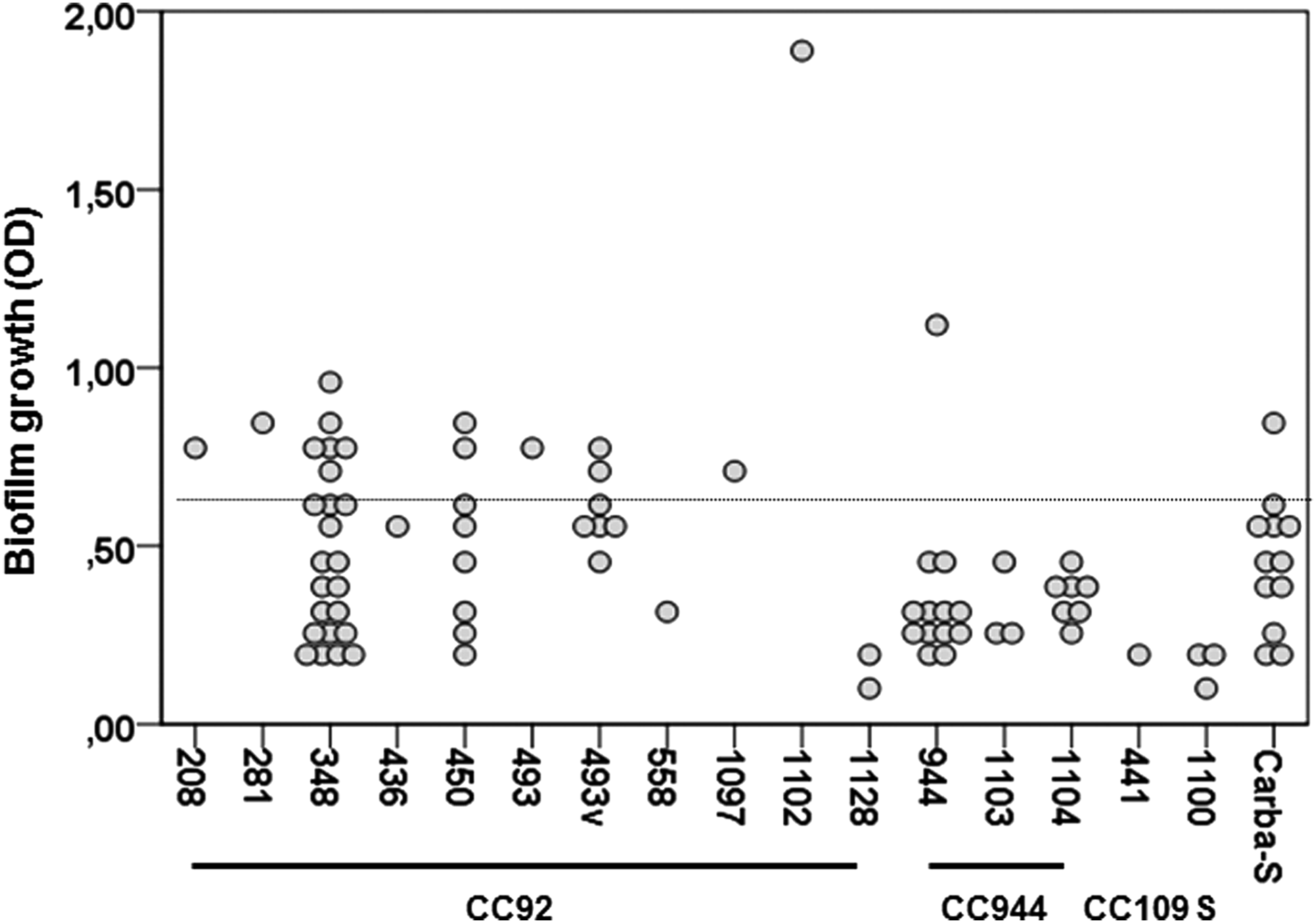
Biofilm growth represented by individual isolates. Each circle represents an isolate. STs and CCs are named on the x-axis. Dotted line depicts OD = 0.6 that discriminates high (above the line) and low (below the line) biofilm producers. 493v, ST493ΔrpoDOxf; Carba-S, carbapenem-susceptible; CC, clonal complex; OD, optical density; S, singleton.
Individual ST median values among carbapenem-nonsusceptible isolates were calculated only for STs represented by ≥3 isolates.
High biofilm producers had OD ≥0.6.
p = 0.024 versus CC944 (Mann–Whitney U test).
p = 0.003 versus ST944 and ST1104; p = 0.022 versus ST1103 (Mann–Whitney U test).
CC, clonal complex; OD, optical density; P, percentile; ST, sequence type.
Discussion
In the present study, we performed molecular analyses of Carba-NS A. baumannii recovered in three hospitals in Moscow. The vast majority of isolates related to two clonal lineages, CC92Oxf/CC2Pas and CC944Oxf/ST78Pas, representing 14 different Oxford STs. Only one isolate of IC1 (CC109Oxf; ST441Oxf) and one singleton ST1100Oxf were recovered. CC92Oxf/CC2Pas is related to IC2 and has global dissemination.12,13 In contrast, the CC944Oxf/ST78Pas clone is uncommon. Originally, this clone has been described in several Italian hospitals in 2010 as the singleton ST78Pas and, thus, designated the “Italian clone.”3,6,24,25 ST78Pas has occasionally been reported from other Mediterranean countries, 4 as well as from the United States (a single isolate from Miami in 2009), 5 Germany (recovered in 2012–2013), 21 Kuwait (isolates from 2011 to 2012), 26 and French Guiana (reported isolates were recovered during an ICU-associated outbreak in 2010). 27 ST78Pas has been proved to be the equivalent of ST944Oxf. 14 Carba-NS A. baumannii of ST944Oxf and its two newly described SLVs, ST1103Oxf and ST1104Oxf, all being identical to ST78Pas, comprised a 29% proportion in the present collection. CC944Oxf isolates were recovered in all three study hospitals. Thus, the CC944Oxf/ST78Pas clone appeared to be one of the two predominant lineages among Carba-NS A. baumannii circulating in Moscow hospitals in the study period 2012–2015.
In the present study, all isolates of the CC944Oxf/ST78Pas clone carried blaOXA-40-like carbapenemase genes with one isolate harboring a blaOXA-23-like gene in addition. The originally described that “Italian clone” of ST78Pas was found to carry OXA-58 and, later on, OXA-23-like carbapenemases.3,24,25 The ST78Pas isolates from French Guiana also possessed an OXA-23-like carbapenemase, 27 whereas the reported ST78Pas Carba-NS A. baumannii from Miami, Germany, and Kuwait harbored a blaOXA-40-like carbapenemase gene.5,21,26 Among our study A. baumannii isolates, the production of an OXA-40-like carbapenemase was the most frequent mechanism of nonsusceptibility to carbapenems. Twelve of the 16 detected Oxford STs that represented 85% of isolates carried a blaOXA-40-like gene.
The molecular characteristics of the CC944Oxf/ST78Pas clone presented in this study were equivalent to those described by the German authors in two Russian isolates. 21 These isolates belonged to ST78Pas and carried the blaOXA-40-related carbapenemase gene blaOXA-72 and, in addition, the blaCTX-M-115 gene. Moreover, in our laboratory, we had performed MLST for two Carba-NS A. baumannii isolates recovered at two different hospitals in the city of Perm (the Eastern part of European Russia) in 2014 and revealed that these isolates belonged to ST944Oxf/ST78Pas too (isolates #945 and #946 in the online MLST A. baumannii database). 14 Hence, the clone of CC944Oxf/ST78Pas carrying genes of blaOXA-40-like (presumably, blaOXA-72) and blaCTX-M-like β-lactamases seems to be endemic among Carba-NS A. baumannii in Russia.
Mechanisms that favor the acquisition and dissemination of a particular OXA-type are not clear. The genetic environment and plasmid types of blaOXA-40 seem to be different from those described for blaOXA-23 or blaOXA-58. Specifically, blaOXA-40-like genes are located not only on chromosomes but also on self-transmissible plasmids providing a potential for horizontal dissemination of these genes. 11 Next, Rumbo et al. 28 provided experimental evidence that the plasmid-encoded blaOXA-40-like could be released within outer membrane vesicles. Moreover, the plasmids carrying blaOXA-40 have been demonstrated to harbor genes involved in the toxin/antitoxin system suggesting their stability. 29 High transmissibility in conjunction with the stability of the plasmids containing blaOXA-40-like genes may explain the emergence and spread of OXA-40-like carbapenemase-producing A. baumannii clones with a variable basic genetic context. Our present finding of high genotype diversity among blaOXA-40-like-carrying isolates represented by 12 different STs supports this speculation. Furthermore, in the present study, one isolate of the singleton ST1100 with an intermediate resistance to carbapenems carried none of the tested carbapenemases. This finding shed light on nonenzymatic mechanisms like antimicrobial efflux activity and alterations in outer membrane porins or penicillin-binding proteins that may confer resistance to carbapenems in A. baumannii. 13
In addition to antimicrobial susceptibility, a number of other bacterial factors facilitating the spread of epidemic A. baumannii clones have been discussed. Increased resistance to desiccation and enhanced capacity of adhesion to host epithelium in conjunction with high biofilm growth capability have been suggested to favor the diffusion and persistence of such bacteria in the hospital environment. 16 In the present study, Carba-NS and carbapenem-susceptible nonclonal A. baumannii isolates demonstrated similar overall biofilm growth rates. This finding may suggest that the biofilm formation capacity has limited significance for the clonal expansion of Carba-NS A. baumannii.
In conclusion, our results demonstrated the predominance of two clonal lineages among Carba-NS A. baumannii circulating in Moscow. While CC92Oxf/CC2Pas-related bacteria are disseminated globally, the spread of the CC944Oxf/ST78Pas clone carrying blaOXA-40-like and blaCTX-M-like genes described in the present study seems to be endemic in Moscow region and, maybe, the whole of Russia. Thus, specific A. baumannii clones harboring a favorable genetic background are likely to sporadically occur in different parts of the world and evolve separately acquiring additional competitive advantages such as antimicrobial resistance genes. Apparently, such clones could be transferred to other regions within a country or in other parts of the world. Further studies are needed for better understanding of the changing epidemiology of Carba-NS A. baumannii to control the spread of these threatening bacteria.
Footnotes
Acknowledgments
This work was partially supported by the Ministry of Education and Science of the Russian Federation (grant number RFMEFI60714X0064). The authors thank Prof. Irina Feldblum from Perm State Medical Academy for providing isolates.
Disclosure Statement
No competing financial interests exist.