




Abstract
The aim of the study was to characterize multidrug-resistant (MDR) Escherichia coli isolates collected in Serbia from bovine clinical mastitis cases and diseased pigs, mainly with molecular methods. A total of 48 E. coli isolates was collected during the years 2013–2014, of which 22 were MDR and were included in further analysis. Phylogenetic typing showed that 17 isolates belonged to group A, while two isolates were classified in group B1 and a single one in group D. All isolates showed unique macrorestriction patterns. Phenotypic susceptibility testing revealed resistances of the isolates against up to 13 antimicrobial agents, including resistance to fluoroquinolones. A wide variety of resistance genes was detected by PCR amplification and sequencing of amplicons. Sequence analysis of the quinolone resistance determining regions of topoisomerase genes revealed mutations in gyrA, parC, and/or parE. Plasmid-mediated quinolone resistance genes were detected in two porcine (aac-6’-Ib-cr and qnrS, respectively) isolates and a single bovine (aac-6’-Ib-cr) isolate. Resistance genes were found to be located on conjugative plasmids in 16 cases, many of which conferred a multidrug resistance phenotype. In conclusion, the plentitude of resistance genes located on conjugative plasmids and integrons in E. coli from cows and pigs in Vojvodina, Serbia, pose a high risk for horizontal gene transfer in bacteria from livestock husbandry.
Introduction
E
As it is known that the E. coli genome is able to evolve constantly, the exchange of genetic material may lead to further transmission of resistance genes. 2 There are reports demonstrating the occurrence of horizontal gene transfer in the gastrointestinal tract, and the localization of resistance genes on plasmids, transposons, or gene cassettes may facilitate the spread of these determinants through bacterial populations. 3
The treatment of severe and extraintestinal E. coli infections is often challenging, since many E. coli strains have developed a multidrug-resistant (MDR) phenotype. Therefore, continuous monitoring of antimicrobial resistance in E. coli isolates is needed. Isolates collected from pig herds in European countries between the years 2002 and 2004 showed significant differences in the antibiotic susceptibility between the countries. However, overall high resistance rates were detected for the antibiotics, ampicillin, nalidixic acid, streptomycin, and tetracycline. Interestingly, it has been found that resistance rates of E. coli isolates from diseased pigs were higher compared to healthy pigs. 4 An Australian study investigating E. coli resistance phenotypes of a large number of commensal isolates from pigs (n = 5,003) revealed a great variation in the prevalence of resistances between farms. Although none of the isolates was resistant to third-generation cephalosporins, resistance to ampicillin, florfenicol, and gentamicin was frequently detected. 5
E. coli is also among the major causes of bovine mastitis, and resistant isolates from dairy farms have been increasingly reported over the past years. The isolates often belong to the phylogenetic groups A and D, however, isolates assigned to groups B1 and B2 have also been detected.6,7 In a recently published study, a high percentage of E. coli isolated from bovine milk samples in China showed an extended-spectrum β-lactamase (ESBL) phenotype as well as resistance to common non-β-lactam antibiotics. Although class 1 integrons were frequently detected (83% of isolates), no ESBL gene was present in the integron cassettes. Instead, the dfrA17-aadA5 cassette array (conferring trimethoprim and aminoglycoside resistance) was the predominant combination present in the variable regions. 6 Similar results were reported in a study from Germany. Only dfrA1-aadA1 and dfrA1-orfF-aadA2 cassette arrays were found in class 1 integrons on ESBL gene-carrying plasmids from bovine E. coli mastitis cases. 7
MDR E. coli isolates from poultry, pigs, and cattle collected on farms in the northern part of Serbia (the Vojvodina Province) have recently been reported. 8 Therefore, the aim of the following work was to characterize antibiotic resistance genes and their localization on mobile genetic elements in MDR E. coli isolates obtained from bovine clinical mastitis cases and pigs raised in farms from Vojvodina.
Materials and Methods
Animal farms and sampling
From 104 cases of clinical mastitis diagnosed during the years 2013–2014, E. coli was detected in nine samples. Among the nine isolates, seven were MDR (defined as resistant to ≥3 classes of antibiotics) and were included in this study. In addition, a total of 283 diagnostic samples from pigs were delivered to the laboratory during the years 2013–2014 for bacteriological, mycological, and parasitological investigations. The fecal samples were taken from diseased pigs, which were known to have received an antibiotic therapy (39 cases total). Only MDR E. coli isolates (15 isolates) collected on the basis of one isolate per pig farm were included in the current work. The diseased animals from which samples were taken for this work were raised on four small farms (up to 10 cows in barns), 3 larger farms (up to 300 cows on each farm), 15 pig farms (5 smaller farms with a total of 10–100 animals), and 10 large pig farms (with more than 100 animals). All farms are located in the northern part of Serbia, the Vojvodina Province, Serbia.
Isolation of E. coli and species confirmation
Milk samples for microbiological examinations were obtained separately from each of the four quarters. The disinfection of teats was performed using 70% ethanol, and the milk was collected into sterile plastic tubes, cooled, and directly transported to the laboratory. For isolation of bacteria, aliquots of 50 μL each were streaked onto a Columbia blood agar plate (CM0331; Oxoid, Basingstoke, United Kingdom) supplemented with 5% defibrinated sheep blood and onto a MacConkey agar plate (CM0007; Oxoid).
Rectal swabs from pigs were inoculated into a volume of 9 ml buffered peptone water (CM0509; Oxoid) and vigorously vortexed for 20–30 sec. Subsequently, each fecal homogenate was streaked onto a MacConkey agar plate (CM0007; Oxoid). The plates were incubated for 24–48 hr at 37°C.
The colonies with a typical appearance of E. coli were subcultured onto nutrient agar plates (CM0003; Oxoid) to obtain pure cultures. After overnight incubation at 37°C, the bacterial species was confirmed by biochemical assays, including an oxidase (negative) and catalase (positive) test; fermentation of glucose and lactose using triple sugar iron agar; production of indole; methyl red test (positive); Voges-Proskauer test (negative); and the inability to use citrate as a carbon source (IMViC test). Definitive confirmation of each E. coli isolate was performed by using the BBL Crystal Enteric/Nonfermenter ID Kit (Becton, Dickinson and Company, Sparks, MD).
Antimicrobial susceptibility testing and determination of minimal inhibitory concentrations
Susceptibility testing was performed by the disk diffusion method according to the recommendations of the Clinical and Laboratory Standards Institute.9,10 The following discs and concentrations of antibiotics were used: ampicillin 10 μg (AMP), amoxicillin/clavulanic acid 20 + 10 μg (AMC), chloramphenicol 30 μg (CHL), ciprofloxacin 5 μg (CIP), gentamicin 10 μg (GEN), nalidixic acid 30 μg (NAL), streptomycin 10 μg (STR), sulfonamides 300 μg (SA), tetracycline 30 μg (TET), trimethoprim/sulfamethoxazole 1.25/23.75 μg (SXT), trimethoprim 5 μg (TMP), cefpodoxime 10 μg (CPD), cefotaxime 30 μg (CTX), and ceftazidime 30 μg (CAZ) (BioRad, Marnes-la-Coquette, France). For determinations of minimal inhibitory concentrations (MICs) of selected antibiotics, the broth microdilution method with polystyrene microtiter plates (Sarstedt, Nümbrecht, Germany) was used as recommended in the CLSI document M07-A10 (2015). 9 Antibiotics were purchased as powders from Sigma Aldrich (Taufkirchen, Germany). The E. coli strain ATCC 25922 was used for quality control purposes.
Isolation of whole-cell DNA, polymerase chain reaction, and sequence analysis
A whole-cell DNA was extracted by boiling bacteria for 5 min. After 10 min on ice, the suspension was centrifuged (Witeg Labortechnik GmbH, Korea) at 13,000 rpm and the supernatant was collected and stored in a freezer at −20°C. For PCR experiments, a commercially available kit (Qiagen, Hilden, Germany) was used. The master mix contained the following: 1.5 mM MgCl2, 200 μM of each dNTP, 2.5 U of HotStartTaq DNA polymerase in a ready to go 1 × PCR buffer. PCR assays were performed as described earlier.11–41 For the detection of the major E. coli phylogenetic groups (A, B1, B2, and D), a typing scheme based on a triplex PCR according to Clermont et al. 13 was used. Integrons of classes 1 and 2 and inserted gene cassettes were amplified by using the primer pairs 5′3′CS and Hep74/Hep51 and variable regions were sequenced as described earlier.14,15 Furthermore, the previously described primers specific for the PCR detection of the quinolone resistance determining regions (QRDRs) of the topoisomerase genes gyrA, gyrB, parC, and parE were used.16–19 Amplicons were sequenced and analyzed. The primer sequences, annealing temperatures, sizes of amplicons, and references are provided as Supplementary Data (Supplementary Table S1; Supplementary Data are available online at www.liebertpub.com/mdr). The primer walking method was used for sequencing of PCR amplicons. Sequencing was performed at GATC Biotech AG (Cologne, Germany) and Eurofins Genomics (Ebersberg, Germany), and sequence alignments were done with the Basic Local Alignment Search Tool-BLAST program or with the DNAMAN version 7 software program (Lynnon Corporation, Quebec, Canada).
Pulsed-field gel electrophoresis
PFGE was performed with the CHEF DR-III (Bio-Rad Laboratories, Hercules, CA) system using a 1% SeaKem gold agarose gel (Lonza, Rockland, ME) and 2.0 L of 0.5 × Tris-EDTA running buffer. The electrophoresis conditions were chosen according to a 1-day (24–26 hr) standardized laboratory protocol for molecular subtyping of E. coli O157:H7, E. coli non-O157 STEC, and Salmonella, Shigella sonnei and Shigella flexneri (www.cdc.gov/pulsenet/pdf/ecoli-shigella-salmonella-pfge-protocol-508c.pdf). Fingerprints were based on the separation of XbaI (Thermo Scientific, Vilnius, Lithuania)-digested genomic DNA. The Salmonella enterica serotype Braenderup H9812 CDC PFGE marker was used as the molecular size standard.
Conjugation experiments
Conjugation experiments were done with the E. coli recipient strain HK225, which is resistant to rifampicin. The mating was performed by the filter method and during 8 hr of shaking bacterial suspensions in Luria Bertani (LB) broth (Becton Dickinson, Le Pont de Claix, France) at 37°C, followed by overnight incubation of the suspensions at 37°C. Transconjugants were selected on LB agar plates supplemented with 100 mg/L rifampicin (Sigma Aldrich, Munich, Germany) and 100 mg/L ampicillin or tetracycline (Sigma Aldrich, Munich, Germany). Presumptive transconjugants were confirmed by comparing PFGE patterns of donor strains, recipient strains, and transconjugants. In addition, transconjugants were subjected to susceptibility testing and resistance gene detection by PCR amplification.
Results
Phylogenetic typing and PFGE analysis
Phylogenetic typing showed that six out of the seven E. coli isolates from cases of bovine clinical mastitis belong to the group A, while one isolate was classified in group B1. Of the 15 E. coli isolates from pigs, 11 were assigned to group A, and 2 isolates each were classified in groups B1 and D. Analysis of PFGE patterns showed unique fragment patterns for all isolates (Fig. 1).
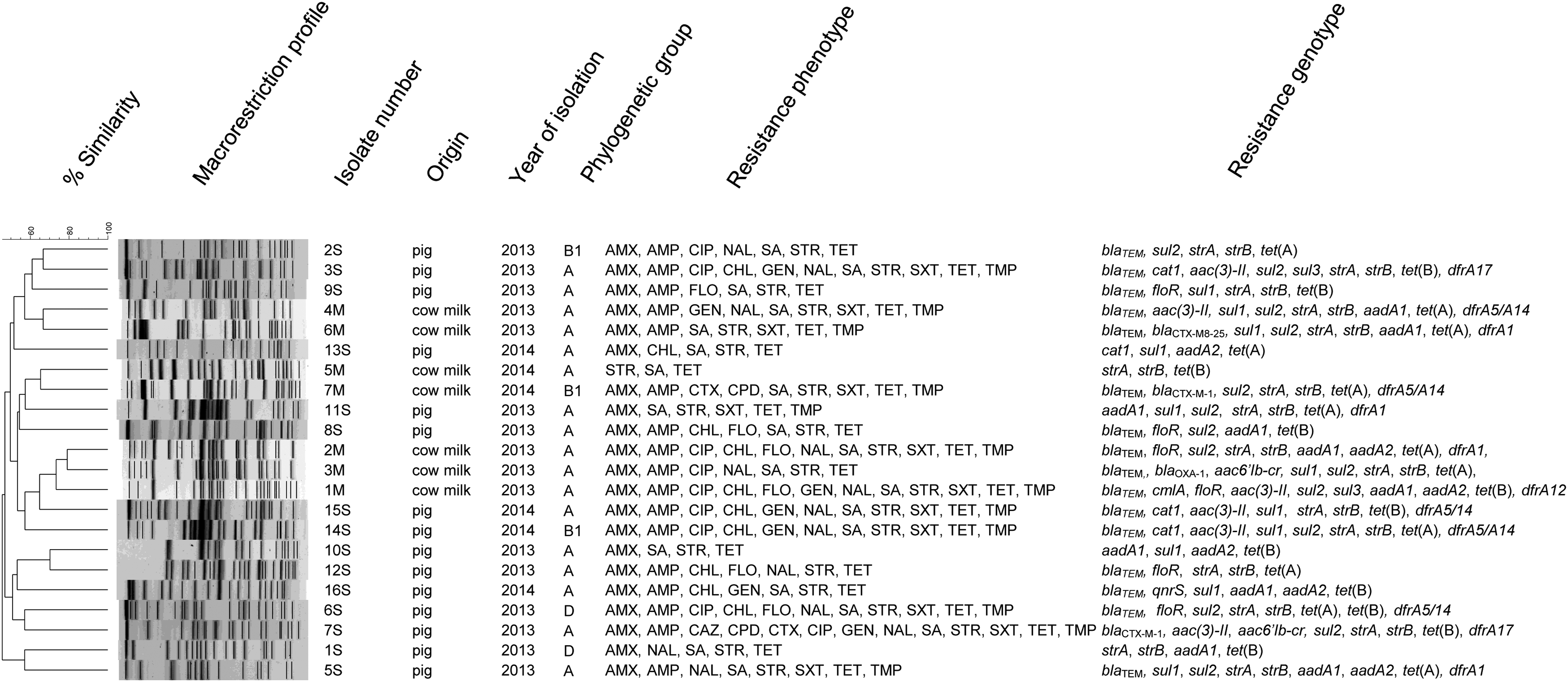
Macrorestriction profiles, phylogenetic groups, and resistance phenotype and genotype in Escherichia coli isolates from pigs and cow milk.
Resistance to fluoroquinolones
Among all of the 22 isolates included in further analysis, nine (41%) were resistant to CIP according to CLSI breakpoints with MICs ranging between 4 and ≥128 mg/L CIP. All but one CIP-resistant isolate exhibited mutations that resulted in changes of the amino acid sequences at positions Ser83→Leu and Asp87→Asn in GyrA and at position Ser80→Ile in ParC. The only exception was isolate number 6S-13 (from a pig), in which base pair exchanges leading to Ser83→Leu and Asp87→Gly amino acid substitutions were identified in gyrA, and a Glu84→Lys substitution was detected in ParC. In five isolates with MIC of ≥16 mg/L CIP, additional mutations were found in the parE gene, leading either to a Ser458→Ala or to a Ser458→Thr amino acid exchange. However, single-point mutations in gyrA were also detected in isolates with MIC values between 0.125 and 0.5 mg/L CIP. Three of these isolates had an alteration in the gyrA gene, resulting in a Ser83→Leu substitution, while in a single isolate, the Asp87→Asn transition in GyrA was identified (Table 1). In two isolates (isolate numbers 3M-13 and 7S-13) with a high level of CIP resistance (MICs of 32 and >128 mg/L CIP, respectively), the plasmid-borne quinolone resistance gene aac(6’)-Ib-cr was detected by PCR assays and sequencing, concomitantly with mutations in the target genes. In contrast, no mutations were found in the topoisomerase genes of E. coli isolate 16S-14, which carried the plasmid-borne qnrS gene and exhibited an MIC value of 0.125 mg/L CIP (Fig. 1 and Table 1 and Supplementary Table S2).
Mutations in the gene gyrB were not detected.
CIP, ciprofloxacin; MIC, minimal inhibitory concentration; ND, not determined.
Resistance to β-lactam antibiotics, aminoglycosides, sulfonamides, chloramphenicol, and trimethoprim and transferability of resistance genes via conjugative plasmids
All E. coli isolates resistant to AMP (17 isolates) carried the blaTEM-1 gene, which was located on a conjugative plasmid in 15 isolates. Phenotypic detection of ESBL production was done by using the screening and confirmatory tests with cefotaxime and cefotaxime with and without clavulanic acid. 10 An ESBL phenotype was confirmed in two isolates (No 7M-14 and 7S-13). Of these, the isolate number 7M-14 carried the blaCTX-M-1 gene on a plasmid, which was transferable to a plasmid-free recipient strain. The genes blaTEM-1 and sul2 were found to be colocated on the same plasmid in isolate number 7M-14 (Fig. 1 and Table 2).
Antibiotics are abbreviated as follows: AMP, ampicillin; AMX, amoxicillin; CHL, chloramphenicol; CIP, ciprofloxacin; CPD, cefpodoxime; CTX, cefotaxime; FLO, florfenicol; GEN, gentamicin; NAL, nalidixic acid; SA, sulfonamides; STR, streptomycin; SXT, trimethoprim/sulfamethoxazole; TET, tetracycline; TMP, trimethoprim.
Six isolates from pigs exhibited phenotypic resistance to gentamicin. The aac(3)-II gene encoding an aminoglycoside modifying enzyme was found in all cases (Fig. 1). Notably, in one isolate (isolate number 1M-13), the aac(3)-II gene was transferred together with the genes blaTEM, aadA1, aadA2, cmlA, floR, sul2, and dfrA12 via the same plasmid to the plasmid-free recipient strain HK225, conferring an MDR phenotype (Table 2). In 17 isolates, the strA/strB pair of genes was detected, while the aadA1 gene, single or in combination with aadA2, was found in 11 isolates.
Resistance to sulfonamides was mediated either by the genes sul1 (five isolates), sul2 (six isolates) or the combinations of sul1 and sul2 (six isolates) or sul2 and sul3 (two isolates) (Fig. 1). The sul1 and sul2 genes from 11 isolates were transferable to the recipient strain by conjugation. In one isolate (isolate number 2M-13), resistance to sulfonamides was cotransferred to the recipient strain together with resistance to AMP (mediated by the blaTEM gene), while the other 10 transconjugants revealed an MDR phenotype (Table 2).
Resistance to chloramphenicol was seen in 11 isolates, while combined resistance to CHL and its fluorinated derivative florfenicol (FLO) was detected in six isolates (Supplementary Table S2 and Fig. 1). In isolate number 1M-13, which was obtained from a cow milk sample, both genes, cmlA and floR, were detected and were cotransferred to the recipient strain HK225 via the same plasmid in the course of conjugation experiments. The cmlA- and floR-carrying isolate exhibited MIC values of 128 mg/L CHL and 512 mg/L florfenicol (Supplementary Table S2 and Table 2). Five isolates (one from a cow milk sample and four from pigs) carried a single floR gene, while the cat1 gene was detected in three isolates sampled from pigs (Fig. 1). Results from conjugation experiments revealed that the floR genes from other four isolates (isolate numbers 6S-13, 8S-13, 9S-13, and 12S-13) could be successfully transferred to the recipient strain (Table 2).
Resistance to trimethoprim was found in 12 out of 22 isolates (Supplementary Table S2) and was mediated by dihydrofolate reductase (dfr) genes. In five E. coli strains (isolates nos. 4M-13 and 7M-14) from cow milk samples and isolates 6S-13, 14S-14, and 15S-14 from pigs, the dfrA5/A14 gene was detected. In a single isolate obtained from a cow milk sample (isolate number 1M-13), the dfrA12 gene was found. Positive results from dfrA1-specific PCR assays were obtained from two isolates from cow milk (2M-13 and 6M-13) and from two isolates collected from pigs (5S-13 and 11S-13). In addition, the dfrA17 gene was found in isolate numbers 3S-13 and 7S-13 from pigs (Fig. 1). A plasmid localization of the genes dfrA12 and dfrA5/A14 was confirmed in two cases (isolate numbers 1M-13 and 4M-13) by conjugation experiments. In these cases, the genes could be easily transferred to the recipient strain via a plasmid that mediated multidrug resistance (Table 2).
Integron analysis
Altogether, class1 integrons were found in 12 E. coli isolates (three from cow milk samples and nine from pigs), while a single class 2 integron was detected in an isolate obtained from a pig. In the class 1 integron environment, the aadA1 gene cassette (isolate number 4M-13 and 1S-13), the aadA23 gene cassette (isolate number 13S-14 and 16S-14), or a combination of aadA and dfr gene cassettes was found. The dfrA1/aadA1 gene cassette array was observed in three isolates (isolate number 6M-13, 5S-13, and 11S-13), while the dfrA17/aadA5 gene cassette combination was present in four isolates (isolate number 3S-13, 7S-13, 14S-14, and 15S-14). In the class 1 integron of isolate 1M-13, the aadA2/linF gene cassette combination was found, while the aadA1/sat2 gene cassette array was identified in the class 2 integron environment of isolate number 16S-14. The sequences of the gene cassettes and arrays were submitted to the GenBank database and the following accession numbers were assigned: KU956956, KU956957, KU956958, KU948603, KU948604, KU948605, KU948606, KU948607, KU948608, KU948609, KU948610, KU886319, KY284051 (Table 1).
Discussion
A considerable number of MDR E. coli were isolated from samples of cow milk and pig feces. Phylogenetic typing has shown that most E. coli isolates belong to phylogroup A, which represents the group of commensals. 13 However, as shown by the PFGE pattern analysis, all isolates had unique fragment patterns and were consequently considered as genetically unrelated. Among the isolates, the most frequently detected resistances were resistance to ampicillin, amoxicillin, streptomycin, sulfonamides, tetracycline, and trimethoprim.
What is truly alarming is the high frequency of resistance to fluoroquinolones, which was detected in nine out of 22 E. coli isolates. This resistance phenotype was mediated by multiple mutations in the QRDRs of the topoisomerase genes. While mutations in these regions have been identified as major mechanisms of resistance, overproduction of the AcrAB-TolC efflux pump and the loss of outer membrane proteins might contribute to decreased fluoroquinolone susceptibility as well. 42 In addition, the plasmid-mediated quinolone resistance (PMQR) determinants qnrS and aac(6′)-Ib-cr were detected in three isolates, two of them exhibiting high MIC values (≥32 mg/L) of ciprofloxacin. Although PMQR genes mediate only moderate increases in MIC values of fluoroquinolones, there is experimental evidence that carriage of qnrA genes supports mutational-based resistance to fluoroquinolones. 43 Therefore, a selection of higher resistance levels might occur.
Two E. coli isolates of the present study were identified as blaCTX-M-1-mediated ESBL producers and the blaCTX-M-1 gene could be transferred to a plasmid-free E. coli recipient strain. However, to investigate the prevalence of ESBL-producing E. coli among isolates from livestock in Serbia requires examining a larger collection of isolates.
In the present study, resistance to gentamicin in E. coli isolates from cows and pigs was encoded by the gene aac(3)-II. This finding is in contrary to other European countries, where the aac(3)-IV gene often confers resistance to gentamicin. This might reflect the use of aminoglycoside antibiotics in different countries, since the aac(3)-IV gene confers combined resistance to gentamicin and apramycin. However, apramycin is not used for therapy of food producing animals in Serbia
Resistance to sulfonamides was mediated by sul1, sul2, or sul3 genes, or by a combination of the genes. Nearly half the resistance genes were transferable to the recipient strain in the course of conjugation experiments. This is no surprise since sulfonamide resistance genes are detected in the chromosomal DNA of bacteria as well as on plasmids. 21 Resistance to trimethoprim was detected in 12 out of 22 isolates and was mediated by dihydrofolate reductase encoding genes (dfr). The detection of three types of dfr genes, namely dfrA1, dfrA17, and dfrA5/A14, in E. coli from pigs and cow milk was similar to results from Seputiené et al., 44 who frequently found these genes in clinical E. coli from Lithuania.
Chloramphenicol is an antibiotic with a broad spectrum of activity. The most common resistance mechanism is acetylation of the substance by chloramphenicol acetyltransferases encoded by a number of different cat genes. 45 In this study, floR and cat1 genes were detected most frequently. In one isolate from cow milk, two resistance genes, floR and cmlA, were found and were transferable by conjugation.
To the best of our knowledge, this is the first characterization of gene cassette arrays and integrons in E. coli isolates from Serbia. Furthermore, a class 1 integron with an aadA2 and linF cassette array was detected for the first time in an E. coli isolate from bovine mastitis milk. The aadA2/linF cassette array was recently identified in a multiresistant E. coli from a patient in Malaysia. 46 In the present study, a porcine E. coli isolate harbored an aadA1/sat2 array (class 2 integron) and a class1 integron with an integrated aadA23 gene cassette. Colocated aadA1/sat2 gene cassettes in class 2 integrons were first reported by Kadlec and Schwarz and were detected in German E. coli isolates from domestic animals. It was postulated that colocation of the streptothricin resistance gene (sat2) with additional resistance determinants on the same plasmid might be the reason for the persistence of the sat2 gene. 47 Intensive importing of pigs started in Serbia in 2007, and it is possible that trade and traveling may have facilitated the spread of resistance genes from animal and environmental sources.
In conclusion, this is the first report on resistance genes in E. coli isolates originating from cattle and pigs in Serbia. Multiple resistances to important classes of antibiotics used in clinical practice were detected and included resistance to fluoroquinolone antibiotics, which are of prime importance. In 73% of the isolates, resistance genes were found to be located on conjugative plasmids and 55% of isolates harbored integrons with gene cassettes and cassette arrays. Altogether, the presence of mobile genetic elements in E. coli from Serbia bears the risk of horizontal gene transfer of antibiotic resistance genes in animal husbandry.
Footnotes
Acknowledgments
The authors thank Dr. Cavaco, Technical University of Denmark, Copenhagen, for providing qnrA, qnrB, qnrC, qnrD, qepA, and aac(6’)-Ib-cr PCR-positive controls. They also thank Dr. Radoslav Došen, for providing data about the pig farms and antibiotic use in the livestock industry in the Vojvodina Province. This work was financially supported by a grant from the Ministry of Education, Science and Technological Development, Republic of Serbia, Project number TR 31071.
Disclosure Statement
No competing financial interests exist.
References
Supplementary Material
Please find the following supplemental material available below.
For Open Access articles published under a Creative Commons License, all supplemental material carries the same license as the article it is associated with.
For non-Open Access articles published, all supplemental material carries a non-exclusive license, and permission requests for re-use of supplemental material or any part of supplemental material shall be sent directly to the copyright owner as specified in the copyright notice associated with the article.
