




Abstract
Of great concern is the increased frequency of carbapenem-resistant Acinetobacter baumannii (CRAB) causing healthcare-associated infections. Different classes of β-lactamases are involved in this resistance through hydrolyzing carbapenems. Multilocus sequence typing (MLST) has been applied successfully for characterizing different varieties of bacterial pathogens epidemiologically. In the present study, we aimed to type and characterize the resistance profile of clinical isolates of CRAB causing healthcare-associated infections in patients admitted to Kasr Al-Aini hospital, using MLST, and compare with sequence types (STs) from other countries. A total of 50 isolates were collected from clinical samples (predominantly wound and blood), then identified by blaOXA-51-like gene PCR, and subjected to Oxford MLST scheme. The ST was designated according to PubMLST database, and e-BURST algorithm was used to assign clonal complexes. Four sets of multiplex PCR were performed to detect common carbapenem resistance genes. ST391 was the predominant ST detected in 17 cases, 70.5% of which harbored blaOXA-23 alone, both blaOXA-23 and blaKPC in 11.8%. Newly recognized 13 STs were submitted to the PubMLST database. Carbapenem resistance due to blaOXA-23 carbapenemase was detected in 36/50 (72%), followed by blaOXA-23 concomitant with blaKPC in 7/50 (14%), while blaNDM with blaOXA-58 in 3/50 (6%) and blaNDM alone in 1 case (2%). To conclude, this study demonstrates the propagation of highly resistant clone of STs 391 and 1151, carrying blaOXA-23 genes, with the first report of blaKPC in blaOXA carrying CRAB and the presence of new STs by performing the MLST technique in an Egyptian laboratory facility.
Introduction
A
A. baumannii possesses different antimicrobial resistance mechanisms to β-lactam antibiotics, including enzymatic inactivation through the production of extended spectrum β-lactamases, carbapenemases, and AmpC-type enzymes. The β-lactamases of gram-negative bacteria belong to Ambler classes A to D, with the documented ability to hydrolyze carbapenems.5,6 Of the earliest oxacillinases (OXA)-lactamases (class D) are the plasmid-encoded OXA-23, OXA-24, and OXA-58 that are the most widely spread carbapenemases in A. baumannii. 7
Human mobility across countries, immigrants, displaced refugees, and tourists and travelers visiting friends and relatives, has played a critical role in the dissemination and subsequent importation of pathogens of public health importance from one region to another. 8
Multilocus sequence typing (MLST) is a discriminative method for population studies where the genetic relationship of strains can be investigated and has been applied successfully for characterizing different varieties of bacterial pathogens epidemiologically, offering the possibility of transfer of data between different laboratories and comparing their results.9,10
The sequence type (ST) of a clinically important microorganism is now considered as an extension to its species name in the context of identification. This is especially important for known highly resistant microorganisms that have a well-defined MLST database as CRAB. Specific STs are endemic in certain countries, while others are regarded as part of a global clonal complex (CC) or clonal groups that propagate worldwide. Countries with unknown molecular epidemiology of microorganisms are considered spots of mysterious danger.11,12 A. baumannii database contains 1,559 STs (Oxford) and 1,064 STs (Pastuer); STs belonging to international clone II, the most widely distributed highly resistant clone worldwide, were also found in Egypt.13,14
The aim of the present study was to type and characterize the resistance profile of clinical isolates of CRAB causing healthcare-associated infections in patients admitted to Kasr Al-Aini hospital. By using MLST, the propagating STs in our tertiary care hospital were compared with those from different countries.
Materials and Methods
From November 2013 to December 2014, a total of 374 clinical isolates of CRAB were isolated at the main microbiology laboratory from patients admitted to Kasr Al-Aini hospital. Sixty-six isolates of which were selected for the study fulfilling the criteria of having healthcare-associated infections, 15 excluding colonization and duplicate isolates from the same patient. Patients' data were recorded from the request form: patient's demographics, clinical diagnosis, location of the patient at time of infection, the presence of underlying diseases or conditions (e.g., diabetes mellitus or malignancy), presence of fever, prior use of antibiotics, number of hospital days, appropriate antibiotic therapy, and site of infection. The follow-up of patients with infections caused by CRAB was done.
All specimens were processed in the microbiology laboratory according to the standard procedures. The isolates were initially identified phenotypically using standard microbiological techniques and by using the API® 20NE system (BioMérieux, France). 16
Susceptibility of the isolates to various antibiotics was tested by using the modified Kirby–Bauer disk diffusion method. Escherichia coli ATCC 25922 and Pseudomonas aeruginosa ATCC 27853 were used as quality control reference strains for antimicrobial susceptibility testing. Susceptibility testing was performed and interpreted following the Clinical and Laboratory Standards Institute (CLSI) to determine carbapenem nonsusceptibility. 17
Fifty isolates were selected for further investigation after genotypic identification of A. baumannii by detection of the blaOXA-51-like gene as previously described. 18
Four sets of multiplex PCR were performed, including common genes that cause carbapenem resistance; multiplex 1 included blaOXA-23, blaOXA-24, and blaOXA-58, multiplex 2 included blaVIM, blaKPC, and blaIMP, multiplex 3 included blaGES, blaPER, and VEB, while multiplex 4 contained blaGIM, blaSIM-1, blaSPM, and blaNDM-1. Primers, PCR mixtures, and PCR conditions were set as described previously.19–21 PCR was performed using PCR-EZ D-PCR Master Mix (Bio Basic, Inc., Canada) in an Applied Biosystems 2720 Thermal Cycler.
MLST was performed according to Oxford MLST scheme, as previously described. 22 The ST was designated according to the allelic profiles in the PubMLST database (http://pubmlst.org/abaumannii/). STs were assigned to CCs and the genetic relationship of groups was assessed (groups were defined by those that share alleles at ≥6 of 7 loci), using the eBURST algorithm (version 3) (http://eburst.mlst.net/). The CC contains a common ancestor, namely a founding ST, as well as several other closely related STs descending from the predicted founding genotype.
Data were coded and entered using the statistical package SPSS (Statistical Package for the Social Science) version 22. For comparing categorical data, the chi-square (χ2) test was performed. Exact test was used instead when the expected frequency was less than 5. p-Values less than 0.05 were considered as statistically significant.
Results
CRAB was isolated from different specimens, including wound swabs 38% (n = 19), blood 36% (n = 18), urine (n = 9), bronchoalveolar lavage (n = 2), pleural fluid from chest tube (n = 1), and pus from drain (n = 1). The 50 A. baumannii isolates were collected from different hospital wards: 86% (n = 43) from intensive care units (ICU) and 14% (n = 7) from general wards (non-ICU).
Previous antibiotic intake was found in 94% (47/50) of the patients, who were immune compromised in 34% (17/50) and 34/50 (68%) had a device inserted.
In addition to resistance to β-lactam drugs, antimicrobial susceptibility of isolates showed high resistance to most antimicrobial agents; quinolones 98%, gentamicin 100%, amikacin 94%, and cotrimoxazole 90%.
blaOXA-23 carbapenemase was detected in 36/50 (72%), followed by blaOXA-23 and blaKPC in 7/50 (14%), while blaNDM co-occurrence with blaOXA-58 in 3/50 (6%) and blaNDM alone in 1 case (2%). Other genes included in the multiplex used, blaOXA-24, blaVIM, blaIMP, blaGES, blaPER, blaVEB, blaGIM, blaSIM-1, could not be detected in any isolate.
By MLST, 14 distinct STs were identified, 13 of which were novel and assigned as ST1146–ST1158. Details of STs and the distribution of resistance genes in each are shown in Table 1.
Newly assigned STs.
Isolates negative for blaOXa-23, blaOXA-58, blaNDM, and blaKPC.
BAL, broncho-alveolar lavage; CVL, central venous line; ICU, intensive care unit; STs, sequence types.
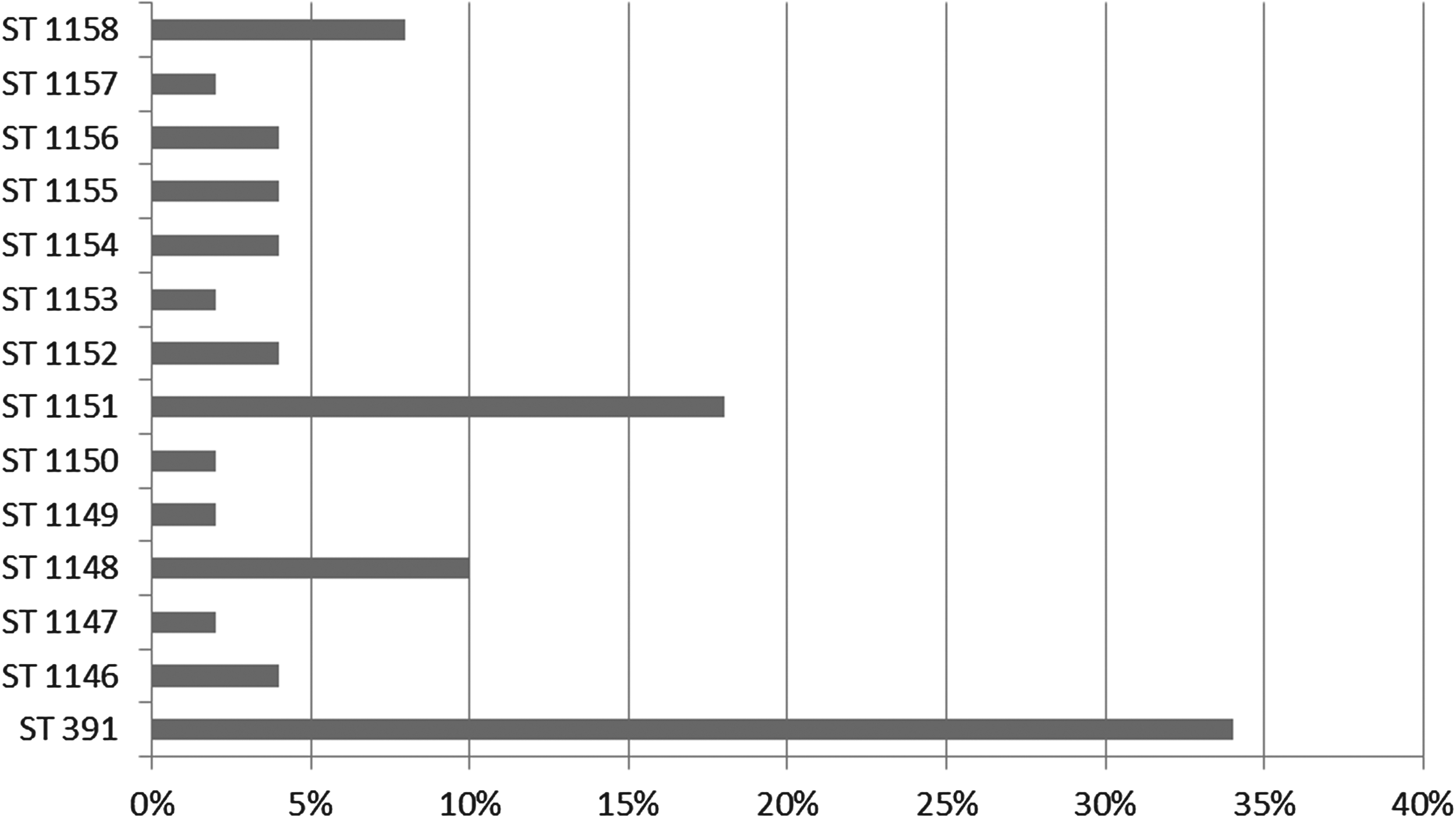
ST391 was the predominant ST detected in 17 cases (34%) followed by ST1151 found in 9 cases (18%). ST1148 was found in five cases (10%) and ST1158 in four cases (8%) while ST1146, ST1152, ST1154, ST1155, and ST1156 each was found in two cases (4%). Each ST1147, ST1149, ST1150, ST1153, and ST1157 was found in one case only (2%). This distribution is shown in Fig. 1.
The distribution of STs among the 50 Acinetobacter baumannii isolates. ST, sequence type.
ST391, the most common ST found in this study, showed no statistically significant difference with patients' age (p = 1) or sex (p = 0.373), type of specimen (p = 0.569), ICU admission (p = 0.398), fever (p = 0.327), antibiotic intake (p = 1), duration of hospitalization (p = 0.531), or patient outcome (p = 0.21). Details of patient characteristics are shown in Table 2.
ST391 isolates harbored the blaOXA-23 alone in 12/17 (70.5%), 2 isolates harbored both blaOXA-23 and blaKPC (11.8%), 1 isolate harbored blaNDM gene (5.9%), while no common resistance genes were detected in 2 isolates. ST1151 was the second most common ST found in this study and all isolates of which were blaOXA-23 positive.
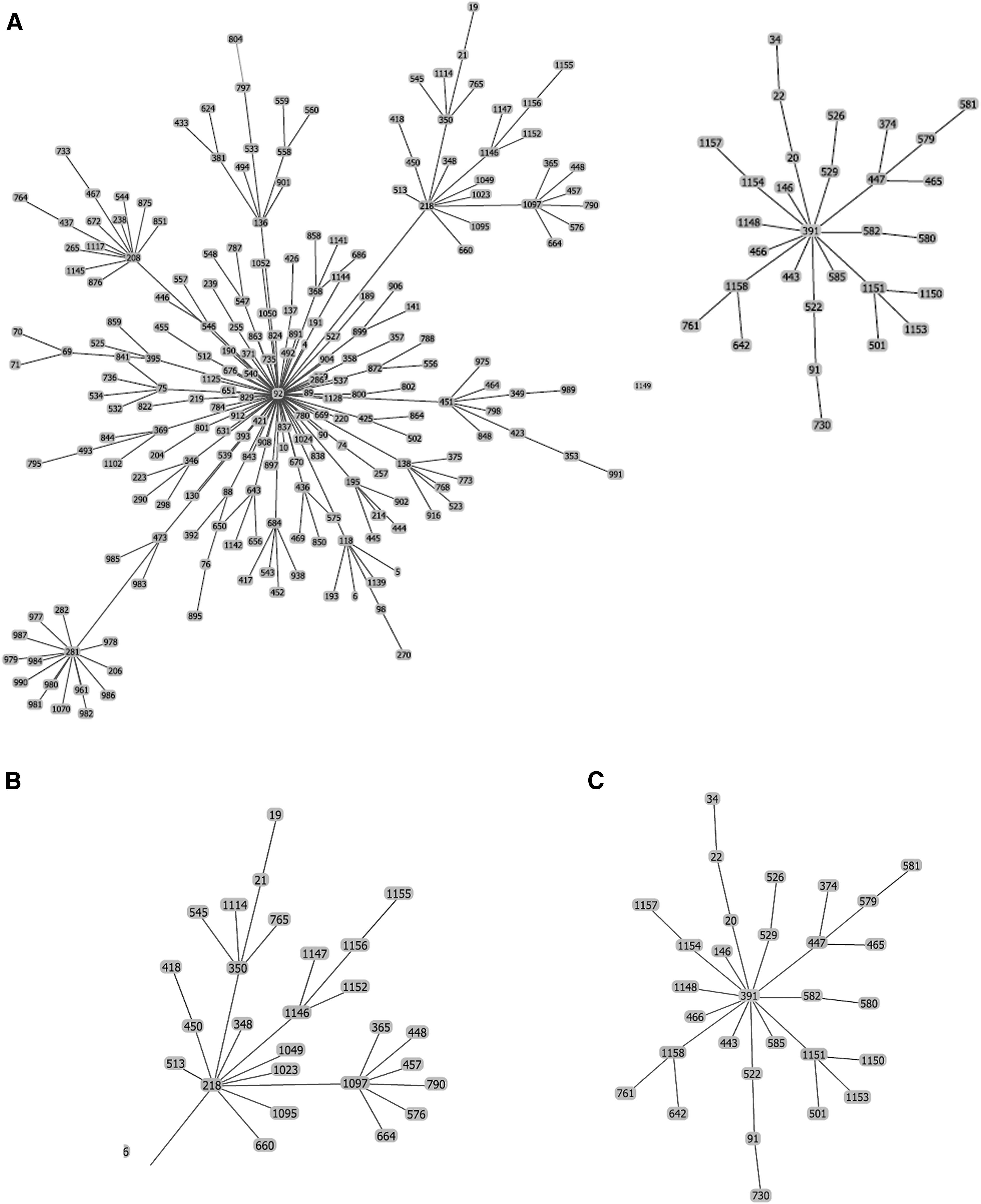
e-BURST analysis using the geoBURST 1.2.1 program for STs found in the present study and the corresponding CCs are shown in Fig. 2. The phylogenetic tree, generated from the identified 14 STs of all 50 CRAB isolates from different samples and departments of Kasr Al-Aini hospital with their resistance profile, is shown in Fig. 3.

The phylogenetic tree generated from concatenated sequences of the seven housekeeping genes of the identified 14 STs of all 50 Acinetobacter baumannii isolates from different samples and departments of Kasr Al-Aini hospital. The evolutionary history was inferred using the neighbor-joining method. The tree is drawn to scale, with branch lengths in the same units as those of the evolutionary distances used to infer the phylogenetic tree. Evolutionary analyses were conducted using MEGA6.
Discussion
A. baumannii is one of the most popular problematic pathogens, and its strong ability to develop drug resistance has made it an important pathogen, causing nosocomial infections, especially ventilator-associated pneumonia, wound infection, bacteremia, and urinary tract infection. Although an increasing number of studies in the world have paid attention to A. baumannii, there are barely any good treatments for A. baumannii due to its diverse genotypes and complicated drug resistance mechanisms. 3
CRAB was mostly isolated from wound and blood samples in 38% and 36%, respectively. This may be attributed to the fact that 86% of isolates were from ICU patients, with indwelling devices in 68% of cases. Isolates demonstrated a high level of coresistance to other antimicrobial agents, quinolones 98%, gentamicin 100%, amikacin 94%, and cotrimoxazole 90% as reported previously. 23
The dominance of class D oxacillinases in the present study, with the detection of blaOXA-23 in 86% and blaOXA-58 in 6% of CRAB isolates, was in accordance with other studies conducted in Egypt. blaOXA-23 was detected in 52.9% of isolates and blaOXA-58 in 14.7%, in one study, 14 while 76.7% of isolates were positive for blaOXA-23-like gene in another study. 24 Although a higher percentage was detected in our study indicating endemicity and propagation of blaOXA-23 among isolates from patients admitted in our hospital.
In the present study, blaNDM gene was detected in 8% of isolates, and in other studies conducted in Egypt, blaNDM-1 gene was detected in 19.2% of A. baumannii metallo-β-lactamase producing isolates by the molecular method, 25 while another could not detect the presence of NDM-1 in A. baumannii, 26 although blaNDM was reported in European countries from patients with history of travel to Egypt.27,28 Another study demonstrated a high prevalence rate of blaNDM-1 among A. baumannii clinical isolates, with 59/150 (39.3%) isolates being blaNDM-1 positive and the co-occurrence of blaNDM-1 with blaOXA-23-like genes in 53/150 (35.3%) of the isolates. 24 In our study, blaNDM propagated with blaOXA-58 in isolates with different STs (2 isolates with ST1158 and 1 isolate with ST1146), while blaNDM was found solely in one isolate from the predominant clone, ST391.
In the present study, blaKPC was detected in 14% (7/50) of CRAB isolates with diverse STs, of which 5/7 isolates were from patients admitted to ICU. No previous reports from Egypt exist except a study conducted on a collection of 215 gram-negative bacterial isolates of which in 2 out of 7, A. baumannii was identified as Klebsiella pneumoniae carbapenemase (KPC) producer using CHROM agar KPC and phenylboronic acid test. 29 Previous reports of blaKPC from our hospital were found in Klebsiella pneumoniae, 30 but no reports from A. baumannii; here we report the first cases for acquisition of blaKPC in blaOXA carrying CRAB.
In another study conducted in South Africa, none from a collection of 100 A. baumannii isolates contained the blaGES, blaGIM, blaIMP, blaKPC, blaNDM, blaOXA-24, blaOXA-58, blaPER, blaSIM, blaSPM, blaVEB, and blaVIM genes. 31
Out of the 50 isolates tested, 13 (34%) isolates belonged to a known ST “ST391” and was the most common ST isolated. This ST has been first isolated and only reported in India.32,33
Isolates within the same ST showed differences in the type of specimen and the ward from which they were isolated. Other studies demonstrate this diversity among isolates from the same hospital causing nosocomial infections as well.33,34
ST391 was found to be the founder of CC391 and shares six alleles with STs found in Germany, China, and India, as well as four STs newly discovered in our study (ST1148, ST1151, ST1154, and ST1158) (http://pubmlst.org/abaumannii/). Furthermore, within CC391, two STs (ST1151 and ST1158) were found to be subgroup founders within CC391.
On the contrary, five other new STs in this study (ST1146, ST1147, ST1152, ST1155, and ST1156) were found to belong to CC92 (international clone II lineage). CC92 contains more than 239 STs. Its founder ST92 is the most common ST, with 77 isolates distributed in several countries with predominance in China (n = 32) and Australia (n = 30). 35
Class D oxacillinases were commonly found in the predominant STs, ST391 and ST1151, while other carbapenem resistance genes were diversely detected among different STs.
In a study conducted in Egypt, where MLST was performed on A. baumannii, 10 distinct STs were identified, 7 of which were novel and assigned from ST408 to ST414 in the PubMLST database. The remaining three STs were previously known, ST331, ST108, and ST208. 14
The MLST database contains isolates from Egypt as shown from other studies as well as the present study, and the studies by Al-Hassan et al. and El-Sayed-Ahmed et al. These studies showed diversity among their isolate collection, and therefore, the prevalence of STs in Egypt could not be ascertained. Thus, further studies are required to characterize isolates from different parts of the country.14,24
In the present study, isolated lineages differ from other Arabian countries such as Saudi Arabia 36 but share belonging to CC92 (international clone II) isolated from the Gulf States. 37 Variation of climate, environment, equipment, sterilization, disease, and treatments in different regions might lead to diverse clinical features, drug resistance, and prognoses of A. baumannii.
CRAB isolates in the present study have different genetic origin indicated by diverse STs, but their molecular epidemiology of carbapenem resistance is almost the same with high prevalence of blaOXA-23 (86%) either alone or accompanied by blaKPC gene, most of which are from patients admitted to ICU (41/46). Three isolates in the present study did not harbor any of the carbapenemase genes investigated except inherent blaOXA-51, suggesting probable overstimulation of which by an insertion sequence or may be other oxacillinases not included in the multiplex used (e.g., blaOXA-143).
To conclude, the present study demonstrates the propagation of highly resistant clone of STs 391 and 1151, carrying blaOXA-23 genes, with the first report of blaKPC in blaOXA carrying CRAB. Diverse STs seen in the current study may be attributed to the hospital being a tertiary care hospital, where the isolates have consequently been brought to the hospital by patients from different regions in Egypt. The lack of adequate infection control measures together with the lack of reporting and the limited funds in developing countries all contribute to developing strains with new STs and spread of clones with highly resistant genes.
Footnotes
Acknowledgment
This work was partially funded by the Faculty of Medicine, Cairo University, research funds for young researchers, 2014.
Disclosure Statement
No competing financial interests exist.