




Abstract
Man-made rivers, owing to proximity to human habitats, facilitate transmission of salmonellosis to humans. To determine the contamination situation by Salmonella in flooded man-made rivers and thereafter the exposure risk to public health, we investigated the prevalence of Salmonella species and their antimicrobial resistance in such rivers, as well as the relationship between the incidence of local infectious diarrhea cases and the number of Salmonella isolates from patients. After a heavy flood, 95 isolates of 13 Salmonella serotypes were isolated from 80 river water samples. The two most prevalent serotypes were Typhimurium and Derby. Eight Salmonella serotypes were newly detected after the flood. Overall, 50 isolates were resistant to ampicillin and/or cefotaxime and carried at least blaTEM. Twelve isolates of serotypes Typhimurium, Derby, Rissen, and Indiana were extended-spectrum β-lactamase (ESBL) producing and carried at least one of blaOXA and blaCTX-M-like genes. Twelve isolates of serotypes Typhimurium, Derby, Agona, Rissen, and Indiana were resistant to ciprofloxacin and had gyrA mutations. Isolates of Typhimurium, Derby, and Indiana were concurrently ciprofloxacin resistant and ESBL producing. Pulsed-field gel electrophoresis illustrates the circulation of two dominant clones of Salmonella Typhimurium isolates among patients, river, and food. High prevalence of various highly pathogenic and antimicrobial-resistant Salmonella serotypes shows that man-made rivers are prone to heavy contamination with Salmonella, and as a result put public health at greater risk.
Introduction
M
In transmission of salmonellosis to humans, there are two factors making the Salmonella-contaminated river water more noticeable. One is the greater diversity of Salmonella serotypes existing in river water than in usual animal hosts 7 ; the other is the increased number of humans, as well as the long duration of their exposure to the contaminated river water. 8 As a special type of river, a great deal of man-made rivers are built for irrigation, sightseeing, and other purposes. These man-made rivers are usually close to human habitats and tend to become contaminated and then transmit food-borne diseases, including salmonellosis. Even worse, if man-made rivers as well as nearby soil and drainage systems are flooded, the contamination and transmission of Salmonella species may be dramatically increased.
On October 6, 2013, Ningbo China was hit by a catastrophic 500-mm of rain in 12 hr due to a typhoon, flooding many parts of the city for over 10 days. In this study, to determine the extent of contamination by Salmonella species in the flooded man-made rivers and the subsequent exposure risk to public health, we investigated the prevalence of Salmonella species and their antimicrobial resistance in the man-made rivers, as well as the relationship between the incidence of local infectious diarrhea cases and the number of Salmonella isolates from patients.
Materials and Methods
Study design
To determine whether and to what degree the heavy flood increased Salmonella contamination in the man-made rivers, we prospectively investigated the presence and antimicrobial resistance of Salmonella species from these rivers. We collected river water samples and isolated Salmonella species from the river water. There was a continual environmental surveillance project monitoring enteric pathogens, including Salmonella in the rivers. Before the flood, sampling twice a year, from May to October every year, was conducted at five sites along the rivers. We included Salmonella serotypes that were isolated during 5 years before the flood as a control. Those serotypes detected only after the flood were considered to be newly identified. Subsequently, we tested the Salmonella isolates for resistance to commonly used antibiotics. We further detected genetic mechanisms for quinolones and β-lactam resistance because these drugs are mostly used for the treatment of salmonellosis and, especially in recent years, quinolone- and/or β-lactam-resistant Salmonella species have often been observed in many countries.9,10 Finally, to determine whether and to what degree the flood put public health at risk, we investigated the relationship between the incidence of infectious diarrhea cases and the number of Salmonella isolates from diarrhea patients in the local surveillance system.
Sampling and processing of river water
During October 2013–2015, 80 samples, 2 samples per site every quarter, were collected at 5 sites of the186-kilometer man-made rivers crisscrossing along streets or villages. The distance between every two sites was over 1000 m. These samples were taken from 10 cm below water surface with sterile glass bottles and processed within 2 hr. To concentrate Salmonella usually with low bacterial counts in the river water, 500 mL of water per sample was filtrated using membranes of 0.45 μm pore size (Merck Millipore). 11 Salmonella isolates were isolated and identified based on the previous literature. 12 In short, the membranes were cut into pieces, placed in 225 mL of buffered peptone water (Difco), vortexed, and incubated at 35°C for 24 hr. Then, 1 mL of the enriched culture was transferred to 10 mL of selenite cystine (SC; Difco) broth and 10 mL of tetrathionate (TT; Difco) broth, respectively, and another 0.1 mL of the enriched culture to 10 mL of Rappaport-Vassiliadis (RV; Difco) broth. After the TT broth and SC broth were incubated at 35°C for 24 hr, and the RV broth at 42°C for 24 hr, these broths were streaked onto bismuth sulfite (Difco) agar, xylose lysine desoxycholate (Difco) agar, and Hektoen enteric (Difco) agar, respectively. Typical Salmonella colonies were identified by the API20E biochemical identification system (bioMerieux, Paris, France) and serological agglutination test using Salmonella-specific antisera (Denka Seiken, Japan).
Antimicrobial susceptibility testing
We tested all isolates for susceptibility to 11 commonly used antibiotics (Oxoid, England), representing 8 classes of antimicrobial drugs, including tetracycline, ampicillin, chloramphenicol, gentamicin, ciprofloxacin, nalidixic acid, meropenem, cefotaxime, cefotaxime–clavulanate, azithromycin, and trimethoprim–sulfamethoxazole. Antimicrobial susceptibility testing (AST) was performed using the disc diffusion method specified in the Clinical and Laboratory Standards Institute (CLSI) document M02-A12 and AST results were interpreted according to the guidelines in the CLSI document M100-S25.13,14 Isolates with ≥5 mm increase in the zone diameter for cefotaxime–clavulanate versus the zone diameter for cefotaxime were defined to be extended-spectrum β-lactamase(ESBL) producing. Strains resistant to at least ampicillin, chloramphenicol, and trimethoprim–sulfamethoxazole were defined to be multidrug resistant (MDR). 15
Polymerase chain reaction assays for the detection of genetic determinants of antimicrobial resistance
To explore genetic mechanisms for quinolones and β-lactam resistance, we detected integrons, gyrA mutations, and genes encoding β-lactamase with primers previously described or designed in this study (Table 1). In the isolates resistant to any β-lactam, β-lactamase genes (blaCTX-M-like, blaTEM, and blaOXA) were amplified and then sequenced for verification. In the isolates resistant to ciprofloxacin or showing reduced ciprofloxacin susceptibility, the gyrA gene was amplified and sequenced. gyrA mutations were subsequently determined by aligning the amplified sequences against the homologous sequence of Salmonella Typhimurium LT2 using the ClustalW software (European Bioinformatics Institute). In addition, to assess transmissible elements of drug resistance, two types of integrons, class 1 and class 2, were detected using primers for 5′-CS segment of integrons, because these integrons are often found to help spread antimicrobial resistance among Salmonella species. 18 Primers for sul1 and qacEΔ1 genes at conserved 3′-CS segment of class 1 integron were used to verify integron completeness.
Pulsed-field gel electrophoresis
The isolates of the dominant serotype from the studied rivers, food, and patients were subtyped by pulsed-field gel electrophoresis (PFGE) to determine genetic relatedness using the restriction enzyme XbaI following the PulseNet standardized protocol. 19 PFGE patterns were defined by groups of the bands formed at 90% Dice similarity cutoffs and interpreted using the BioNumerics software (Applied Maths, Belgium). A dendrogram of PFGE patterns was constructed using the unweighted pair-group method with a position tolerance of 1.2%.
Regional epidemiological data on enteric diseases
To assess the possible risk incurred by the flood on the population in the study area, we obtained the 2012–2015 monthly incidence report of infectious diarrhea cases by the local infectious disease surveillance system and performed a surveillance plan for the Salmonella cultures from diarrheal patients in four local hospitals. We also conducted a questionnaire survey of local residents to find the risk factors which might contribute to link the diarrheal cases to the contaminated rivers.
Statistical method
Pearson chi-square test was used to compare the proportions between two groups. Statistical significance was accepted at p-value <0.05.
Results
Isolates collected
The present study found high prevalence of a variety of pathogenic Salmonella serotypes in the flooded man-made rivers (Table 2). A total of 95 isolates were recovered from 80 river water samples between October 2013 and 2015. The average positive detection rate of Salmonella at each site was 90%. Of the 95 isolates, 67 were completely serotyped, representing 13 different serotypes in Salmonella serogroups A–F, and the rest (28 isolates) were partially serotyped or untypeable. Compared with the previous surveillance data on Salmonella serotypes detected in the rivers, eight Salmonella serotypes were newly detected after the flood. The top two most isolated serotypes were Typhimurium (25 isolates) and Derby (11 isolates). The number of isolates of the remaining 11 serotypes varied from 1 to 4. Except for a slight decrease in the number of isolates at two sampling points in time in January, the number of isolates at the remaining six sampling points in time showed no distinct temporal trend. In addition, most serotypes were important food-borne pathogens for humans, such as Typhimurium, Paratyphi B, Enteritidis, Rissen, and Derby.
Found before refers to whether the same Salmonella serotype was detected in the same river by surveillance before the flood in October 2013.
AST results
In the 95 isolates, the present study also found a high level of antimicrobial resistance to several antibiotics, especially to β-lactams and quinolones (Table 3). High prevalence of resistance to two β-lactams was observed: ampicillin (53%, 50 isolates) and cefotaxime (19%, 18 isolates). Twelve isolates of serotypes Typhimurium, Derby, Rissen and Indiana were ESBL producing.
MDR, resistant to ampicillin, trimethoprim–sulfamethoxazole, and chloramphenicol; β-lactam, resistant to any β-lactam, here ampicillin or/and cefotaxime; ESBL, extended-spectrum β-lactamase; CIP, ciprofloxacin; reduced CIP susceptibility, intermediate to ciprofloxacin and resistant to nalidixic acid.
TCC83TCT is a silent mutation producing the same amino acid Ser.
As the wide use of quinolones in both humans and animals and the subsequent residues of quinolones in the environment complicate the quinolone resistance issue, to describe this resistance situation more accurately, we classified the quinolone resistance results into three levels: ciprofloxacin resistant (resistant to both nalidixic acid and ciprofloxacin), reduced ciprofloxacin susceptible (resistant to nalidixic acid and intermediate to ciprofloxacin), and susceptible to both. Overall, 12 (13%) isolates of serotypes Typhimurium, Derby, Agona, Rissen, and Indiana were ciprofloxacin resistant, and 38 (40%) isolates were reduced ciprofloxacin susceptible. It is important to note that three serotypes Typhimurium (3 isolates), Derby (1 isolate), and Indiana (3 isolates) were concurrently ciprofloxacin resistant and ESBL producing. All isolates were highly resistant to the following drugs: tetracycline (44%, 42 isolates), trimethoprim–sulfamethoxazole (32%, 30 isolates), chloramphenicol (27%, 26 isolates), and gentamicin (23%, 22 isolates). For the other drugs, the isolates showed intermediate level of resistance and susceptibility: azithromycin (8%, 8 isolates) and meropenem (0 isolate).
Additionally, 24 (25%) isolates were MDR, comprising isolates of seven serotypes, Typhimurium, Derby, Agona, Rissen, Enteritidis, Indiana, and Newport, and five untypeable isolates.
Various resistance genes
In the 95 isolates, there also existed high prevalence of various resistance genes conferring β-lactam and quinolone resistance (Table 3). In 50 β-lactam-resistant isolates, three types of β-lactam resistance genes, blaTEM (49 isolates), blaOXA (9 isolates), and blaCTX-M-like (10 isolates), were detected, and 12 ESBL-producing isolates were identified to carry at least1 of blaOXA and/or blaCTX-M-like genes. In 12 ciprofloxacin-resistant isolates, 3 different mutations in gyrA gene, Ser83Leu (3 isolates), TCC83TCT (3 isolates), and Asp87Asn (8 isolates), were found. Each ciprofloxacin-resistant isolate had at least one gyrA mutation, except for one Rissen isolate. Ser83Leu and Asp87Asn were concurrently detected in three Indiana isolates.
In addition to high prevalence of resistance genes, the isolates also carried a high rate of integrons, indicating high transmission ability of antibiotic resistance. Overall, 57 isolates (86%) carried class 1 integrons (Table 3). In 65 any-antibiotic-resistant isolates, the carriage rate (78%) of class 1 integron was significantly higher than that (20%) in 30 all-susceptible isolates (p = 0.003). Class 2 integron was not detected in any isolate.
PFGE
Since Salmonella Typhimurium was the most common serotype among the isolates from the rivers, 22 (3 failed PFGE) S. Typhimurium isolates from the rivers, 12 isolates randomly selected from patients, and 5 isolates from food, were further subtyped using PFGE (Fig. 1). There were two small groups (Cluster 1 and Cluster 2) of 14 isolates from the rivers, patients, and food. The food was obtained from a village market, where the cement platforms were washed with the river water. The clustering suggested that there were isolates circulating among food, patients, and the rivers. The remaining 25 isolates were endemic.
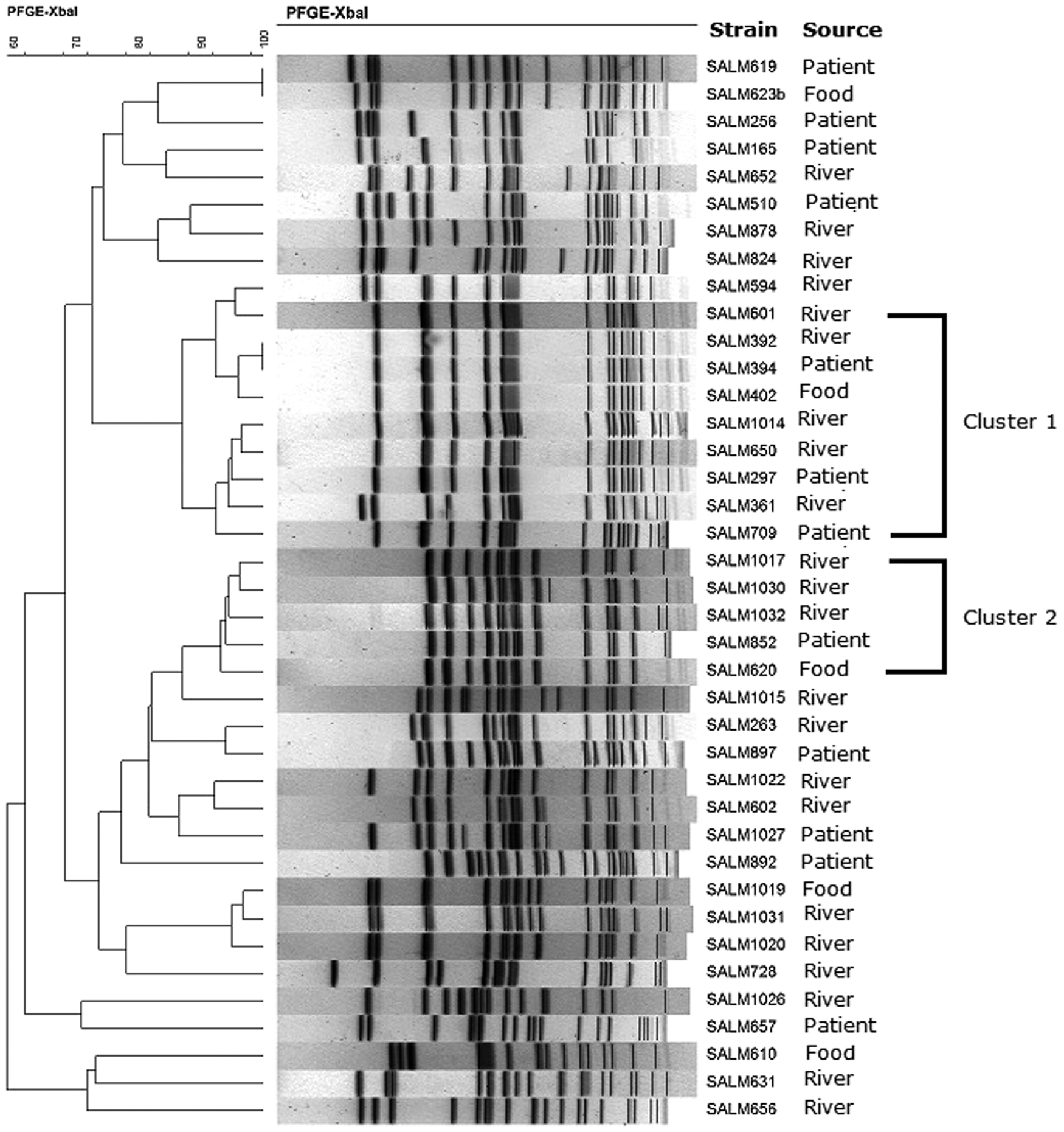
Dendrogram of PFGE patterns for 39 Salmonella Typhimurium isolates recovered from the rivers, patients, and food. PFGE, pulsed-field gel electrophoresis.
Regional epidemiology data on enteric diseases
Finally, more infectious diarrhea cases and Salmonella isolates were reported yearly after October 2013 than in 2012 (Fig. 2). In each year, we could locate a high-epidemic period roughly during October–December, a period when both the monthly diarrhea incidence and the monthly number of recovered Salmonella isolates were higher than in the other months. Compared with the monthly incidence in the high-epidemic period in 2012, we found the corresponding incidence increasing by 82% in 2013, by 194% in 2014, and by 181% in 2015. Similarly, we collected more isolates in 2013, 2014, and 2015 than in 2012. There was a similar upward trend in four low-epidemic periods roughly during February–June in each year. The questionnaire survey found that the residents were exposed to some risk factors, including washing vegetables and platforms in the market with river water, boating, and fishing.
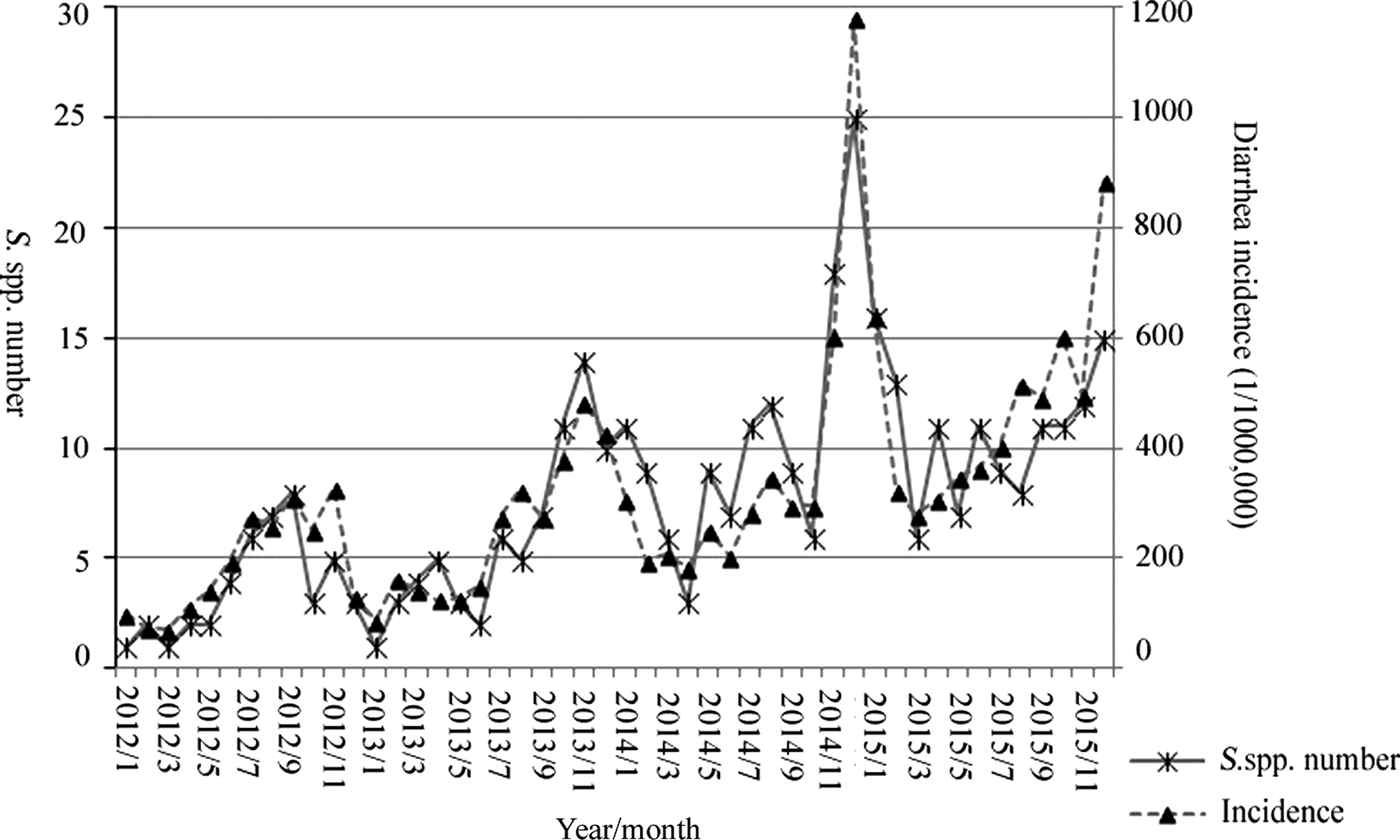
Monthly trend in the incidence of reported infectious diarrhea cases and the number of isolated Salmonella species in Ningbo, China, 2012–2015.
Discussion
The present study shows that the heavy flood greatly increased Salmonella contamination in the man-made rivers and thereafter put the public health at greater risk. The main evidence to support the increase is that a variety of pathogenic Salmonella serotypes were highly prevalent in the flooded man-made rivers specifically, eight new Salmonella serotypes were detected after the flood (Table 2).
In this study, we monitored Salmonella contamination for 2 years, intending to assess the contamination in different seasons. Except for a slight decrease in the number of isolates in January probably because of low temperatures in winter, high prevalence of Salmonella species remained at most of the sampling points in time. The most common serotypes, Typhimurium and Derby, could be detected almost at every sampling point in time. Two small dominant groups (Cluster 1 and Cluster 2) of S. Typhimurium isolates with similar PFGE pattern illustrate circulation of the same clone among patients and the environment (river and food) (Fig. 1). Contaminated water can serve as a long-term reservoir for Salmonella bacteria, continuously contaminating food and thus infecting humans and animals. Infected hosts in return discharge excrement to pollute the river. In the study, the persistently high prevalence of Salmonella species signaled the long survival of such bacteria in the river water, as indicated by a previous study. 20 This persistence might be linked to several causes. One was that the study rivers were stagnant and located in a highly populated plain. Another was that poor hygiene in some areas and local animal-based agriculture might greatly contribute to bacterial spread and contamination. When the flood took place, drainage and soil were underwater for days, effectively spreading pathogens between the environment and hosts.
As a result of the increasing Salmonella contamination, the local public health was put at greater risk in several ways. First, most of the detected serotypes were important food-borne pathogens for outbreaks and salmonellosis in humans (Table 2).21,22 Furthermore, because a large number of humans were exposed to pathogens from the rivers over a long period, the pathogens in the river water would substantially increase the risk of infection. Second, a great many isolates were highly resistant to commonly used antibiotics, especially to β-lactams and quinolones that are the first choice of drugs to treat salmonellosis (Table 3). Of note, several isolates of Typhimurium, Derby, and Indiana were concurrently ciprofloxacin resistant and ESBL producing. In addition, the high prevalence of antibiotic resistance was observed for tetracycline and chloramphenicol, two drugs that are broadly used in animal husbandry, suggesting a potential source of antibiotic environmental contamination. Although previous literature has demonstrated that Salmonella strains from clinical and environmental samples, mainly Typhimurium and Indiana isolates, are resistant to ciprofloxacin and/or third-generation cephalosporin,23,24 the present rates of β-lactam and ciprofloxacin resistance are much greater than the corresponding rates of 11% and 3% that were previously obtained in 384 strains from an aquatic environment. 8
The present study illustrated that the β-lactam and quinolone resistance might be attributed to various molecular mechanisms. In β-lactam-resistant Salmonella isolates, blaTEM is considered the most commonly encountered β-lactamase gene, 25 and in contrast, blaCTX-M-like and blaOXA are not found as often as blaTEM. Both blaCTX-M-like and blaOXA are found in S. Typhimurium, and their encoded β-lactamases have great activity against cefotaxime and can give ESBL phenotype.26–28 In this study, blaTEM was found in almost all of the ampicillin-resistant isolates, whereas blaOXA and blaCTX-M-like were found in the ESBL-producing isolates. These findings may explain the characteristic features of β-lactam resistance in this study. In addition, three types of mutations in gyrA gene were found to be related to ciprofloxacin resistance. Interestingly, we found a silent mutation in gyrA gene, TCC83TCT, which encoded the same amino acid Ser as the wild type and has not been reported previously. Further research is needed to study the effect of the silent mutation on quinolone resistance. Due to the ability of class 1 integrons to help spread resistance determinants among bacteria, its high prevalence greatly increased the possibility of resistance among bacteria.
Finally, epidemiological data demonstrated that public health is at greater risk due to the spread of these drug-resistant pathogens. The distinct upward trend in the number of infectious diarrhea cases consistently corresponded with the occurrence of the flood (Fig. 2). The trend in the number of Salmonella isolates was parallel to the trend in the number of infectious diarrhea cases, suggesting that pathogenic Salmonella isolates were among the causative agents. The questionnaire survey identified that a large number of humans were at greater risk of exposure to pathogenic bacteria by various ways of contact with the contaminated river water.
The main drawback of the study is how to choose a suitable control. Although the best control would be that the detection of Salmonella before and after the flood was conducted at the same sites by the same personnel using the equal detection intensity. However, before the flood we could not afford to carry out a surveillance on all rivers with the same intensity as after the heavy flood. We thus used data from the routine surveillance system as a control. We used the five years' isolated Salmonella serotypes before the flood as an approximate control and regarded those serotypes detected only after the flood as an indication of increased contamination. The increased number of Salmonella isolates from the diarrhea surveillance system after the flood was evidence of the risk for public health.
In summary, the present study indicates that the heavy flood greatly increased Salmonella contamination in man-made rivers and as a result has put public health at greater risk. It is imperative to carry out continual surveillance on Salmonella contamination in such aquatic environments and implement health education for residents at risk about the potential transmission routes when handling river water.
Footnotes
Acknowledgment
This study was supported by the Natural Science Foundation of Ningbo (no. 2012A610235) and the Science and Technology Projects of Medicine and Health of Zhejiang (no. 2016KYB274).
Disclosure Statement
No competing financial interests exist.