




Abstract
Purpose:
Future physicians and pharmacists have to be educated and prepared to rationally manage the use of antimicrobials. The aim of this study was to evaluate attitudes and knowledge regarding the use of antimicrobials and antimicrobial resistance of medical and pharmacy students.
Methods:
We conducted a survey-based cross-sectional study at the University of Split School of Medicine (USSM). The survey consisted of 50 items. A total of 161 students participated in the study across 3 study programs as follows: Medicine (N = 78), Medical Studies in English (MSE; N = 37), and Pharmacy (N = 46).
Results:
Majority of students believe that antimicrobials are overused (90.7%). Keeping a stock of antibiotics at home is a practice more commonly seen among students who have a family member working in a health related field (58.5% vs. 25.0%, p < 0.001). There was no difference in average knowledge score among medical, MSE, or pharmacy students (p = 0.416). Students who achieved higher knowledge score were more likely to rate their education about antimicrobial use and resistance as very useful (p < 0.001).
Conclusion:
This study reveals that medical and pharmacy students at the USSM have a relatively good understanding of antibiotic resistance. However, more education on the appropriate use of antimicrobials is needed.
Introduction
O
A study conducted across European hospitals accentuated prescriber education as one of the key elements of antimicrobial stewardship program. 7 Furthermore, a study by Alothman et al. showed that physicians consider education to be among the most effective tools for reducing the problem of antimicrobial resistance and improving prescribing practices. 8 Greater emphasis on infectious disease education is urgently needed to improve antimicrobial use by the future medical workforce in clinical practice. 9 Some authors suggest including social media as a tool for health-related education in this area. 10 Improving awareness of antimicrobial resistance through communication, education, and training was introduced as one of the five objectives of a global action plan on antimicrobial resistance by the World Health Organization (WHO). 11 In 2013 WHO introduced annual campaign World Antibiotic Awareness Week to increase public awareness of antibiotic resistance. World Antibiotic Awareness Week serves as a continuation of two separate events, European Antibiotic Awareness Day and the United States' Centers for Disease Control and Prevention's (CDC's) Get Smart About Antibiotics Week. This campaign aims to illustrate antibiotics as a precious and finite resource. 12
Majority of pharmacy students perceive antimicrobial resistance as a feature of urban social change. 13 According to a recent study conducted among students of different healthcare courses, students perceived antibiotic resistance to be a more important global challenge than climate change, obesity, food security, or gender inequality. 14 Future physicians and pharmacists have to be prepared to rationally manage the use of antimicrobials and to promote patient awareness and knowledge regarding rational use of antimicrobials. 15 Like in many other countries, in Croatia there is an increasing number of pathogens that are resistant to more than one antimicrobial.16,17 Multiple resistant Pseudomonas aeruginosa has been a major problem for many years in Croatia. According to data from 2016, nonsusceptibility of P. aeruginosa to imipenem is 20% and to meropenem is 21%. Furthermore, the rate of Methicillin resistant Staphylococcus aureus (MRSA) isolates with inducible clindamycin resistance is rising what could be indicative of rise in community acquired MRSA. In 2016, resistance to ampicillin in Salmonellae reached 14%. 18 Consumption of antibiotics in Croatia remains slightly below European Union (EU) average and was 20.7 versus 21.9 DDD per 1,000 inhabitants per day. However, trends in consumption of carbapenems and polymyxins in the hospital sector are higher in Croatia than EU average. 19 We hope to see a more rational use of antibiotics among the future generations of healthcare workers. Therefore, the aim of this study was to assess attitudes and knowledge regarding the use of antimicrobials and the antimicrobial resistance among medical, Medical Studies in English (MSE), and pharmacy students of University of Split School of Medicine (USSM).
Materials and Methods
We conducted a survey-based cross-sectional study to assess final year medical and pharmacy students' attitudes and knowledge about antimicrobial resistance, as well as their behavior, education satisfaction, and self-estimated preparedness for specific actions regarding antimicrobial resistance. After an extensive literature review of previous studies evaluating students' attitudes on this topic,20–24 we designed a 58 item survey. A pharmacist and a medical doctor reviewed the draft version of the survey and agreed on the final survey suitable for both medical and pharmacy students counting a total of 50 items divided in 7 sets. Due to a small number of male students enrolled in Pharmacy program, gender question was left out in the final version of the survey to ensure anonymity of the study participants. The survey was translated into Croatian and then back-translated by a fluent English speaker blinded to the original wording. The study received approval of USSM Ethics Committee and was carried out in March and April of 2017. The survey was pilot tested among seven students for readability and length. None of the pilot study participants reported any difficulties understanding the survey.
First set of questions gathered information about students' study program, year of study, satisfaction with present education regarding appropriate use of antimicrobials and antimicrobial resistance, and personal experience relevant to antimicrobial resistance (yes/no questions). Second set questioned students' attitudes regarding the use of antimicrobials, antimicrobial resistance, and education addressing these subjects. Students were asked to indicate their level or agreement or disagreement with 15 statements on a 5-point Likert scale. In the third set students answered how often they use different sources available to them to learn about antimicrobial use and resistance. The following set questioned students' education recall rate about lectures relevant to the use of antimicrobials (four yes/no questions). Fifth set gathered students' opinions on the possible contributors to resistance (4-point scale), while students' perceptions of how well they feel their education has prepared them to actions relevant for the use of antimicrobials were questioned in the sixth set of questions. To ensure that the survey completion time is left under 20 minutes after an extensive literature review, the authors agreed to offer students six true/false statements in the final set used to evaluate their knowledge about the use of antimicrobials or antimicrobial resistance. The questions referred to the dosing of antimicrobials, treatment duration and patient adherence, efficacy and cost of antimicrobials, as well as treatment recommendations, and were implemented from previously conducted studies evaluating students' knowledge on this topic.
Students eligible for the study were USSM fifth and sixth year medical and fourth and fifth year pharmacy students who had completed their Microbiology and Pharmacology courses. USSM was across three study programs: Medicine (N = 78), MSE, and Pharmacy. Medicine and Pharmacy programs are taught in Croatian. In the academic year 2016/2017 USSM enrolled 27 students in 4th and 28 in 5th year of Pharmacy program, 61 students in 5th and 92 in 6th year of Medicine program, and 28 students in 5th and 14 in 6th year of MSE program. Medicine and MSE program have equal 6-year curricula, while Pharmacy program lasts 5 years.
A total of 161 students (64.4% response rate) participated in this study: 46 pharmacy students, 78 medical students, and 37 MSE students. Students were offered participation in the study during regular lectures that took place at the time of the study. Participation in the study was completely voluntary, and students received no compensation or benefits for participation. Survey used in the study was anonymous and did not gather data that could be used to reveal the identity of the student except study program and year of study.
Before analysis answers to second and sixth set of questions were condensed into three categories (strongly agree/agree, not sure, disagree/strongly disagree) and answers to third and fifth set of questions were condensed into two categories. Statistical analysis was performed using MedCalc software for Windows (v. 11.5.1.0; MedCalc Software, Mariakerke, Belgium). Results are presented as numbers (proportions) or mean ± standard deviation where appropriate. Chi-square test was used to determine the differences among students' perceptions and attitudes and one-way analysis of variance to evaluate students' knowledge score. The statistical significance level was set at p < 0.05 level.
Results
A total of 58 (36.0%) students from 161 who completed the survey stated that they keep a stock of antibiotics at home because they believe that they might be useful in the future. Moreover, 53 (32.9%) students have at least 1 family member (parents, siblings) working in a health related field, and these students kept a stock of antibiotics at home more often than students who don't have a family member working in a health related field (58.5% vs. 25.0%, p < 0.001) (Fig. 1). In total 28 (17.4%) students stated that they have taken antibiotics for a common cold, 22 (13.7%) students stated that they bought antibiotics without medical prescription, and 16 (9.9%) admitted that they stop taking antibiotics when they start feeling better.
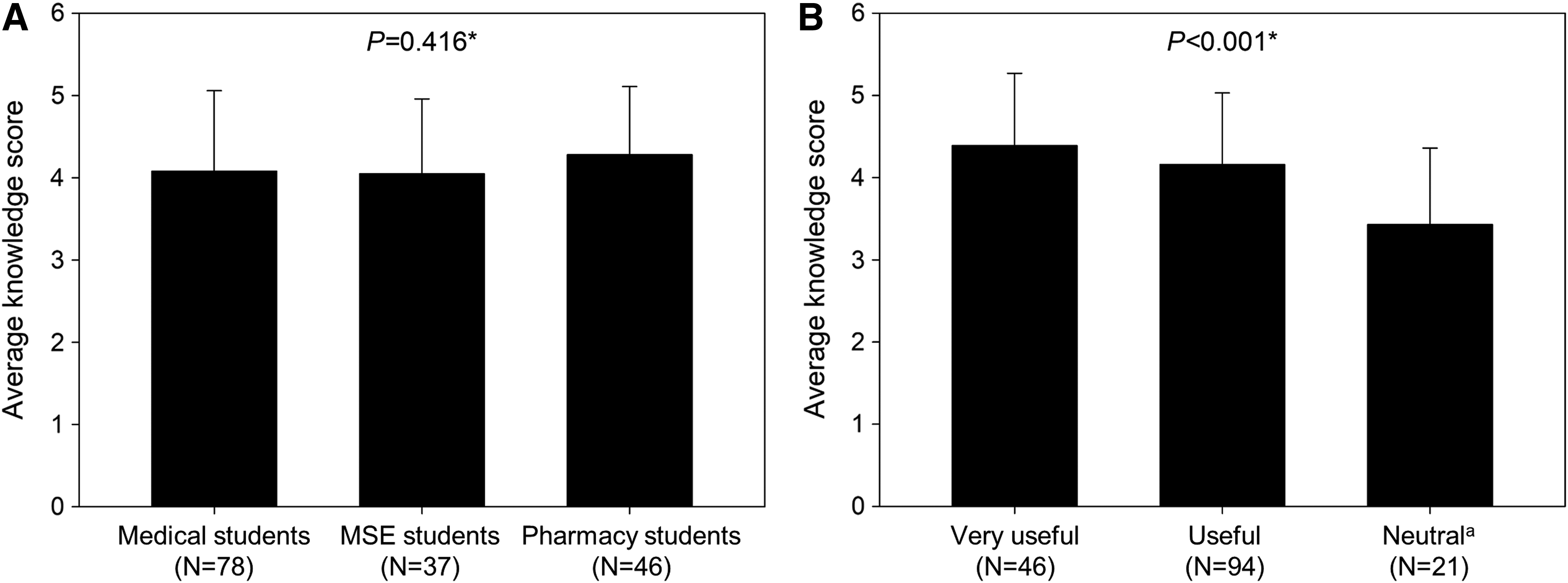
Average knowledge score about antimicrobial resistance of students in relation to study program
Students' attitudes regarding antimicrobial resistance and education are shown in Table 1. Students agreed that strong knowledge of antimicrobials is important in their career (92.5%), that antimicrobials are overused (90.7%), and that the better use of antimicrobials will reduce problems with antimicrobial resistant organisms (90.1%). All of MSE students and 82.1% of medical students agreed that inappropriate use of antimicrobials causes antimicrobial resistance (p = 0.009). In addition all of MSE students agreed that the antimicrobials are overused. We found significant difference among students' agreement with the statement they would like more education on the appropriate use of antimicrobials, with only 64.9% of MSE students agreeing with this statement (83.3% medical students, 87.0% pharmacy students, p = 0.042).
Students Who Agree/Strongly Agree with Statements Regarding Attitudes About Antimicrobial Resistance
Chi-square test.
MSE, Medical Studies in English.
Students rated textbooks and study guides as most frequently used source of information on this topic with 146 (90.7%) students who use them often or sometimes. Smartphone applications (apps) follow with 112 (69.6%) students who stated using them often or sometimes. A summary of the sources students use to learn about the use of antimicrobials and antimicrobial resistance with reference to their study program is presented in Table 2.
Students Who Stated They Use Often/Sometimes the Following Sources to Learn About Antimicrobial Use and Resistance
Chi-square test.
Regarding formal lectures, 116 (72%) students recalled attending lectures that addressed rational use of antibiotics in general, 109 (67.7%) students recalled attending lectures about when to start antibiotics, and 88 (54.7%) students stated that they attended lectures that addressed selecting the right duration of treatment for specific infections. Only 61 (37.9%) students recalled attending lectures that addressed correct dosing of antimicrobials.
Students' opinions about potential contributors to antimicrobial resistance are shown in Table 3. Among offered potential causes for resistance, students most frequently rated the use of antibiotics for shorter than standard duration as very important or moderately important (93.2%). Students least frequently rated the empirical antibiotic therapy as very important or moderately important (75.8%) potential cause for resistance.
Students Who Rated Each of the Following Contributors to Antimicrobial Resistance as Very Important/Moderately Important
Chi-square test.
We found significant difference among students regarding how they feel their education has prepared them to describe the correct spectrum of different antimicrobial therapies (p < 0.001), to find reliable sources of information to treat infections (p = 0.013), to handle patient who demands antimicrobials (p = 0.010), and to understand basics of antimicrobial resistance (p = 0.043) (Table 4).
Students Who Feel Their Education Has Prepared Them Well/Very Wellfor Practice Related to Antimicrobial Resistance
Chi-square test.
There was no difference in students' mean knowledge score (Fig. 1), with medical students achieving an average knowledge score of 4.08 ± 0.98, MSE students 4.05 ± 0.91, and pharmacy students 4.28 ± 0.83 (p = 0.416). However, students who rated their education regarding appropriate use of antimicrobials and antimicrobial resistance so far as very useful achieved significantly higher mean knowledge score, as presented in Fig. 1 (very useful 4.39 ± 0.88 vs. useful 4.16 ± 0.87 vs. neutral 3.43 ± 0.93, p < 0.001).
Discussion
In this study, we assessed attitudes and knowledge of medical and pharmacy students with reference to antimicrobial use and resistance. The proportion of students keeping antibiotics at home was lower than reported in 2013 among medical students of University of Torino (36.0% vs. 62.0%). 25 Students who have a family member working in a health related field more often kept a stock of antibiotics at home which is consistent with the study conducted in Torino. 25 The concept of residual antibiotics may not necessarily be of the student; it may reflect apprehension of the family member in the student's family who may be working in a health related field who is extremely concerned about infections and likes to keep a “standby” strip of antibiotics. This represents an interesting finding to address, as it can be observed as both expected and unexpected. It can partially be explained by greater availability of antimicrobials to healthcare professionals in general; however, it also represents hazardous behavior with reference to antimicrobial resistance which would not be expected from healthcare professionals. However, we do not expect that this reflects behaviors healthcare professionals implement at workplace, but it does indicate an opposite than professional behavior in private setting. Healthcare professionals have a wider knowledge of antimicrobial use and resistance than general population; therefore, whether keeping antibiotics at home by healthcare professionals influences the likelihood of their misuse remains unknown.
Furthermore, the study conducted at the University of Torino has demonstrated that having a family member who is a healthcare professional lowered the likelihood of taking antimicrobials without medical examination. 25 Previous studies have shown that medical students more often engage in hazardous behavior regarding the use of antimicrobials compared to nonmedical students 24 and that it inversely correlates to the time spent at medical school. 25 A study investigating Chinese university students' antimicrobial use and behavior reported that over 60% of medical students kept antibiotics at home and that 15% took them prophylactically. 26 Among our students, we found a relatively high frequency of antimicrobial consumption for a common cold (17.4%). It remains unclear whether these antimicrobials were obtained through a physician's prescription or was consumption of antimicrobials for common cold a result of having a stock of antimicrobials at home. In comparison, a Chinese study that included 1,236 medical students reported that 13.6% of them took antimicrobials for common cold. 24 We suggest further research on practicing healthcare professionals' behaviors at a private setting in relation to antimicrobial resistance.
This study showed that pharmacy students are significantly more confident in understanding the basics of antimicrobial resistance and describing the correct spectrum of different antimicrobial therapies than their medical or MSE colleagues. This indicates that ideally the two professions should collaborate and complement one another in responsible antimicrobial use and management. Community pharmacists can monitor antimicrobial prescriptions and support prescribers to prevent inappropriate use of antimicrobials.27,28 Overall, our students felt more confident in most actions questioned compared to their U.S. colleagues. However, our students are less confident in knowing when to start antimicrobial therapy (43.5% vs. 54.0%). 20 More than half of pharmacy students feel prepared to handle patients demanding antimicrobials, which is consistent with U.S. medical and pharmacy students,20,29 while only 21.6% of MSE students felt they will be able to handle such patients. With an emerging misuse of antimicrobials for viral infections,28,30 we believe this skill will be valuable in students' careers, both pharmacists and medical doctors. In a study conducted among Malaysian pharmacy students 50.3% of students thought pharmacists should dispense according to patient demands. 13 A recent study demonstrated that interprofessional workshops, including pharmacy and medical students, increased students' perception of patient demand being among the major reasons physicians prescribe unnecessary antibiotics. 31 Therefore, we suggest for it to be addressed and emphasized during lectures discussing the use of antimicrobials.
Use of antibiotics for shorter than standard duration is most often perceived as very or moderately important contributor to antimicrobial resistance by students. As many as 95.7% pharmacy students rated the use of antibiotics for shorter than standard duration as very or moderately important contributor to antimicrobial resistance. Although there are authors questioning “finishing the course of antimicrobials,”5,32,33 we believe this finding to be relevant and positive since pharmacists carry an important role in patients' medication adherence. 27 In addition, study by Duffy et al. reported that community antibacterial consumption in Croatia equaled to 91.1% of total (community and hospital) antibacterial consumption. 34 This indicates that community pharmacists and general practitioners may significantly impact total antibacterial consumption. Excessive use of antibiotics in livestock was rated as very or moderately important contributor to antimicrobial resistance by 87.0% of students, which is higher than previously reported.22,35 However, this is not something we expect medical or pharmacy students will be able to actively influence in their careers.
Overall, students relied on whatever sources of information about antimicrobials. They most frequently used textbooks or study guides followed by smartphone apps, Wikipedia®, official guidelines by professional organizations, and medical journals. MSE students reported using smartphone apps (89.2%) in large proportion. Frequent use of these sources is in accordance with previous studies. 36 Study by Fralick et al. has demonstrated that use of smartphone apps results in positive change in knowledge score regarding antimicrobials, 37 and Tuon et al. demonstrated that it could lead to changes in antimicrobial consumption and cost when implemented among practicing physicians. 38 Medical journals are a source for as little as 37.9% of our students, while in the article presented by Abbo et al. 55.0% of students marked medical journals as often or sometimes used source. 20 This can partially be explained by the limited availability of subscription academic databases to our students. Medical students more frequently use textbooks or study guides (91.0% vs. 46.0%) and Wikipedia (62.8% vs. 41.0%) than their U.S. colleagues, 20 as well as pharmacy students (58.7% vs. 36.0%). 29 Optimal format and content of education material granting future healthcare practitioners the competence to manage the use of antimicrobials judiciously remains to be determined. Furthermore, we argue that the likely cause of lower confidence about starting antimicrobial therapy among our students compared to their U.S. colleagues lies in the limited availability of subscription academic databases to our students.
In general, students showed less positive attitudes about antimicrobial resistance than their U.S. colleagues.20,29 In a study by Dyar et al. conducted among French medical students 95.0% of students felt prescribing inappropriate or unnecessary antibiotics to be professionally unethical. 22 This is in accordance with our result for pharmacy students (95.7%); however, overall only 84.5% of our students perceived that prescribing inappropriate or unnecessary antimicrobials is professionally unethical, which is consistent with a study conducted among Malaysian medical students. 35 We found that MSE students had more positive attitudes toward antimicrobial resistance then their Croatian colleagues. Furthermore, there was no difference in students' mean knowledge score, suggesting that a portion of attitudes is formed before college education or at least that it is not solely under influence of medical education. Interestingly, students who felt their education about antimicrobials has been very useful so far achieved significantly higher knowledge score than students who rated their education as useful or neutral (p < 0.001). This finding suggests that students' education satisfaction could indicate their knowledge levels. However, further research is necessary.
We would like to emphasize the importance of education about antimicrobial use and resistance. A recent study that included mostly pharmacy students, but also medicine, veterinary medicine, dentistry, and nursing students, demonstrated that only a fifth of them felt they had sufficient knowledge of antimicrobial use for their future career. 14 Furthermore, according to an Australian study relatively more students reported their education in cardiology to be “sufficient” or “more than sufficient” compared to their education in infectious diseases. 9 Practice demonstrated to students during formal education strongly influences their knowledge, attitudes, and perception of antimicrobial use and resistance which they are likely to transfer to their future practice. We believe that the formal education addressing this topic is of greater importance for pharmacy students than for their medical colleagues since medical studies are followed by internship and residency, offering medical students more opportunities for expanding knowledge on this issue. Most of our pharmacy students turn to community pharmacy right after their studies, and only minority of them pursue postgraduate training. A study by MacDougall et al. demonstrated that introducing an antimicrobial stewardship curriculum that combined medical and pharmacy students can positively impact students' knowledge and attitudes toward both antimicrobial management and interprofessional collaboration. 31 Introducing changes in curricula with modern teaching methods, including real world case-based scenarios and implementing new healthcare technologies, can advance students' approach to issues they will need to address in their future career.
Limitations
This study was conducted at a single university; therefore, the findings may not be easily generalizable. One of the limitations of this study is that the evaluation of students' preparedness to specific actions in practice is based solely on self-evaluation and represents students' confidence rather than actual students' preparedness. We expect that students who feel more confident in their preparedness for specific actions will translate this into practice; however, students' actual performance was not assessed and cannot be estimated. Based on the finding that students who are more satisfied with education regarding antimicrobials achieved higher knowledge scores, we argue that student's self-evaluation can be taken into consideration as a likely predictor of their competence. In questions regarding preparedness, MSE students significantly differed from their Croatian colleagues in at least three actions. Since we found no significant difference in mean knowledge score, it remains unclear whether this finding is caused by greater self-criticism among MSE students, different levels of knowledge, or even different sources of information. Questions regarding the topics addressed during formal lectures are subject to recall bias. Furthermore, some of the wordings of survey items may yield biased answers from respondents (e.g., “excessive use of antibiotics in livestock” may lead more students to agree that this is a problem contributing to resistance). The survey was anonymous and voluntary; therefore, we do not expect that the participants provided socially desirable answers. It is likely that the students who did not participate in the study somewhat differ from the students who did; therefore, this study is subject to volunteer bias. Despite stated limitations, our findings are consistent with previous studies and support the conclusion that core elements of antimicrobial resistance management deserve greater attention.
Conclusion
This study reveals that medical and pharmacy students at the USSM have a relatively good understanding of antibiotic resistance. Knowledge given through training in medicine and pharmacy could be one of the important ways of educating future doctors and pharmacists in the field of antimicrobials and antimicrobial resistance. Therefore, more education on the appropriate use of antimicrobials is needed. Limiting the impact of antimicrobial resistance requires interdisciplinary approach of all included healthcare professionals, and therefore, we suggest implementing interprofessional education in curricula of healthcare study programs. Furthermore, we suggest that social and communication skills such as handling a patient demanding antimicrobials be addressed during both pharmacy and medical studies as they might, to some extent, prevent misuse of antimicrobials.
Footnotes
Acknowledgment
The authors thank Tonci Modric, PhD, for technical editing and proofreading.
Disclosure Statement
No competing financial interests exist.