




Abstract
Aim:
To characterize mutations in penA, mtrR, ponA, and porBIB, considered target genes for antimicrobial resistance, in Neisseria gonorrhoeae isolates with elevated minimum inhibitory concentrations (MICs) of ceftriaxone cultured from patients in New Zealand.
Results:
Out of 28 isolates supplied by the Institute of Environmental Science and Research Limited (ESR), Porirua, New Zealand, 14 were found to show reduced susceptibility to ceftriaxone (MIC of 0.06 mg/L) according to criteria used by the ESR and the Australian Gonococcal Surveillance Programme (AGSP) when tested in our laboratory. Rates of resistance to ciprofloxacin, azithromycin, penicillin, and tetracycline were 100% (28/28), 7% (2/28), 36% (10/28), and 25% (7/28), respectively. Ten different penA (Penicillin binding protein 2 [PBP2]) sequences were observed. The most common mosaic penA M-1 resembled mosaic penA XXXIV, which has been associated with ceftriaxone treatment failures in other countries. Four semimosaic PBP2 sequences were observed and may be novel PBP sequences, while four out of five nonmosaic PBP2 sequences were similar to PBP2 sequences reported in Australia. Twenty-one isolates harbored mutations in all 4 genes (penA, mtrR, porBIB, and ponA), and 13 of these exhibited reduced susceptibility to ceftriaxone.
Conclusion:
Mutations in penA, mtrR, porBIB, and ponA observed in this study may have contributed to reduced susceptibility to ceftriaxone among New Zealand gonococcal isolates. Over half (16/22) of mosaic penA sequences from the gonococcal isolates resembled penA XXXIV.
Introduction
Gonorrhea, due to the Gram-negative pathogen, Neisseria gonorrhoeae, can cause a substantial impact on the well-being of those who have been infected if treatment is unsuccessful. Long-term effects range from pelvic inflammatory disease, ectopic pregnancy, infertility (in both men and women), and gonococcal ophthalmia to an increased risk of HIV infection.1–3 Effective treatment of gonorrhea has proven to be challenging due to the rapid emergence of multidrug-resistant N. gonorrhoeae. Currently, the cephalosporin, ceftriaxone, is recommended to treat gonorrhea empirically, in combination with azithromycin or doxycycline. 4 Dual treatment is advised because of the likelihood of concurrent Chlamydia trachomatis infection and to slow down the emergence of ceftriaxone-resistant N. gonorrhoeae.
Alarmingly, therapeutic failure with ceftriaxone has been reported in several countries such as Australia, 5 Slovenia, 6 Sweden,7,8 and Japan. 9 In vitro resistance to ceftriaxone is defined as a minimum inhibitory concentration (MIC) >0.125 mg/L by the European Committee on Antimicrobial Susceptibility Testing (EUCAST) 10 or an MIC >0.25 mg/L by the Clinical Laboratory Standards Institute (CLSI). 11 Based on either of these breakpoints, N. gonorrhoeae strains expressing full resistance to ceftriaxone have been isolated from Japan,9,12 France, 13 Spain, 14 Australia, 15 and Argentina. 16 In addition, the number of N. gonorrhoeae strains with reduced susceptibility to extended-spectrum cephalosporins (ESCs) has been increasing globally.
Reduced susceptibility is no longer recognized by EUCAST but CLSI defines it as an MIC of 0.125 mg/L for ceftriaxone. 17 By contrast, the Institute of Environmental Science and Research Limited (ESR), Porirua, New Zealand, and the Australian Gonococcal Surveillance Programme (AGSP) have defined reduced susceptibility as an MIC of 0.06 to 0.125 mg/L.18–20 Reduced susceptibility to ceftriaxone among gonococcal isolates is frequently due to chromosomally-mediated resistance which involves penA, mtrR, porBIB, and ponA. Penicillin binding protein 2 (PBP2) which is responsible for linking peptidoglycan strands to build the inner layer of the cell wall of the gonococcus is encoded by penA. PBP2 is also a lethal target of β-lactam antibiotics.
Various mutations in penA which lead to multiple amino acid changes in PBP2 (i.e., a mosaic sequence) or fewer nonmosaic changes have been reported to be the primary causes of reduced ESC susceptibility in N. gonorrhoeae. 21 The alterations reduce the binding affinity between PBP2 and β-lactam drugs. Similarly, the amino acid substitution of Leu-421 for Proline (L421P) in penicillin binding protein 1 (PBP1), encoded by ponA, also reduces the binding affinity between PBP1 and β-lactam drugs. 22 However, PBP2 has a 10-fold greater binding affinity than PBP1 for penicillin. 23 Ceftriaxone susceptibility can be reduced further by other mutations, such as an adenine (A) deletion in the mtrR promoter, which leads to the overexpression of the MtrCDE efflux pump, 24 and alterations at codons 120 and 121 of PorBIB, which reduce the outer membrane permeability of the strains.25,26
In New Zealand, N. gonorrhoeae isolates with reduced ceftriaxone susceptibility, typically with an MIC of 0.06 mg/L, have been reported sporadically; for example, from patients in Auckland in 2010, 2011, and 2013,27–29 in Waikato in 2013, 29 and in Canterbury districts in 2014. 18 Heffernan et al. found that 11 (2.6%) out of 425 isolates collected from October 2014 to May 2015 had decreased susceptibility to ceftriaxone. 19 Likewise Nicol et al. reported that mosaic penA was detected in 5% of the residual DNA samples positive for N. gonorrhoeae and obtained from patients in Auckland and Wellington. 30 However, viable isolates were not available for phenotypic characterization. The aim of the current study was to characterize mutations in penA, mtrR, porBIB, and ponA genes in 28 isolates of N. gonorrhoeae with elevated MICs to ceftriaxone.
Materials and Methods
Bacterial isolates and culture conditions
Twenty-eight N. gonorrhoeae isolates thought to exhibit elevated MICs to ceftriaxone (MIC range values: 0.03–0.12 mg/L), collected between 2012 and 2015, were supplied by the ESR, Porirua, New Zealand with all patient details removed. Twenty-six isolates were from Auckland, one from Taranaki, and one from Wellington.
N. gonorrhoeae reference isolates WHO K, WHO F, WHO L, and ATCC 49226 were used as recommended for the antimicrobial susceptibility testing.31,32
Determination of MIC
The MICs (mg/L) of penicillin G, tetracycline, ciprofloxacin, azithromycin, and ceftriaxone were determined using the MIC test strips (Liofilchem s.r.l, Italy) based on the manufacturer's instructions and interpreted using the EUCAST version 8.1. 10 The MIC range used for reduced susceptibility for ceftriaxone was 0.06 to 0.125 mg/L as defined by the ESR and the AGSP.18–20 The 2008 WHO N. gonorrhoeae reference strains were used for quality control in all antimicrobial susceptibility testing. 32 Nitrocefin discs (Remel) were used to detect β-lactamase production.
DNA extraction
Approximately 10 colonies of bacterial isolates were suspended in 1 mL of 2% Chelex® 100 (Bio-Rad, Hercules, CA) and vigorously vortexed to mix. The suspension was brought to boil at 100°C for 10 minutes. After centrifugation for 1 minute at 12,500 g, the supernatant was used as template DNA for PCRs.
penA PCR screening
Amplification of the penA gene was performed under the following conditions: 1X KAPA 2G Robust mastermix (KAPA), 10 μM of each forward and reverse primer (NG89-F2 and NG89-R133), and 5 μL of template DNA in a final volume of 25 μL. The optimized thermal cycling conditions were as follows: denaturation for 5 minutes at 95°C, followed by 40 cycles of 95°C for 30 seconds, 62°C for 15 seconds, and 72°C for 30 seconds, with a final extension for 7 minutes at 72°C. PCR amplicons were visualized on a 1% w/v agarose (Bioline, MA) gel. WHO reference strain K and ATCC 49226 were used as positive and negative controls, respectively. 32
In the partial penA analysis, the regions of interest that were reported as hot mutation sites were amplified and analyzed separately. Two set of primers (PenA-A2 and PenA-B2 and PenA-A4 and PenA-B3) were used to amplify region B (597–1,177 bp) and region D (1,376–1,865 bp) of penA, respectively. 34 PCR conditions for the partial penA analysis were identical to those described above.
mtrR, porBIB, and ponA PCR screening
Amplification of mtrR, porBIB, and ponA regions of N. gonorrhoeae was performed using the following primers: MTR1 and MTR2, 35 PorB1 and PorB2, 36 and PonA1 and PonA2. 22 The PCR protocol used for porBIB was the same as that used for penA. This PCR protocol was also used for mtrR except that annealing was carried out for 15 seconds at 55°C. For the ponA gene, the penA PCR protocol was used, with an adjustment for extension (60 seconds at 72°C).
Sequencing analysis of the genes considered key resistance determinants
PCR products of the appropriate size from all amplifications were excised from the gel and purified for DNA sequencing. This was done by the Massey Genome Service (Palmerston North, New Zealand).
Multiple sequence and amino acid alignments were performed using Multalin 37 and Tree-based Consistency Objective Function for Alignment (T-Coffee) software. 38
Nucleotide sequence accession numbers
Nucleotide sequence data for the penA gene, encoding incomplete PBP2 protein, the mtrR gene, encoding MtrR protein, the porBIB gene, encoding partial PorBIB protein, and ponA gene, encoding partial PBP1 protein, were submitted to the National Center for Biotechnology Information (NCBI) for curation. The following accession numbers were assigned KX378832–KX378859 (penA), KX378748–KX378775 (mtrR), KX378804–KX378831 (porBIB), and KX378776–KX378803 (ponA).
Results
Antimicrobial susceptibility testing
Of the 28 isolates supplied by the ESR, 14 were found to show reduced susceptibility to ceftriaxone (MIC values: 0.06 mg/L) according to the criterion used by the ESR and the AGSP18–20 when tested in our laboratory. Nine other isolates had an MIC of 0.03 mg/L and the remaining five an MIC of 0.01 or 0.008 mg/L of ceftriaxone. All isolates were resistant to ciprofloxacin, while the rates of resistance to penicillin G, azithromycin, and tetracycline were 36% (10/28), 7% (2/28), and 25% (7/28), respectively. In contrast, 64% (18/28), 54% (15/28), and 36% (10/28) of isolates showed intermediate susceptibility to penicillin G, azithromycin, and tetracycline, respectively. Isolates 264 and 1380 were resistant to azithromycin, with MICs of 4 and 12 mg/L. Of the 28 isolates, 6 were positive for β-lactamase production (Table 1).
Antimicrobial Susceptibility Testing and Alterations in PBP2, MtrR, PorBIB, and PBP1 of 28 Neisseria gonorrhoeae Isolates
Isolates 263, 724, 729, 824, 119, and 1641 were penicillinase positive, while the rest of the isolates were negative.
EUCAST guidelines were used to interpret MIC Test Strip results. However, for ceftriaxone, the MIC range for RS was from 0.06 to 0.12 mg/L.18–20
Mosaic-1 (Mos-1) is a full mosaic PBP2, while Mosaic-2 (Mos-2), 3 (Mos-3), 4 (Mos-4), and 5 (Mos-5) are semimosaic sequences.
Del A: Nucleotide adenine (A) deletion within the 13 bp inverted repeat located between the −10 and −35 sequences of the mtrR.
AZM, azithromycin; CIP, ciprofloxacin; CRO, ceftriaxone; Del A, deletion of nucleotide adenine (A) in mtrR promoter; EUCAST, European Committee on Antimicrobial Susceptibility Testing; I, intermediate; MIC, minimum inhibitory concentration; Mos, mosaic; Nonmos, Nonmosaic; PBP2, penicillin binding protein 2; PEN, penicillin G; R, resistant; S, susceptible; RS, reduced susceptibility; TET, tetracycline; WT, wild type.
Alterations in PBP2
Based on partial PBP2 sequences (amino acid residues 282–325 and residues 430–560), 10 PBP2 sequences were observed (Fig. 1 and Table 2). Five mosaic or semimosaic PBP2 sequences (labelled M-1 to M-5) were found among 22 isolates, while 5 other nonmosaic PBP2 sequences (labelled NM-1 to NM-5) were detected in the remaining 6 isolates (Table 2). PBP2 M-1 (i.e., KX378832) was the only fully mosaic PBP2 pattern, observed in 16 isolates. Comparison of the PBP2 M-1 with published mosaic PBP2 X (AB071984) 21 and XXXIV (ADE2248.1) 39 revealed that the sequence is identical to that of the mosaic PBP2 XXXIV (Fig. 1). At least 13 PBP2 alterations commonly observed in mosaic PBP2 X and XXXIV, including the G545S, were missing in semimosaic PBP2 M-2 (i.e., KX378843), M-3 (KX378838), M-4 (KX378840), and M-5 (KX378852) sequences. In addition, alterations at position 501 were observed in semimosaic M-2 (A501V), M-3 (A501T), and M-4 (A501V) PBP2 sequences.
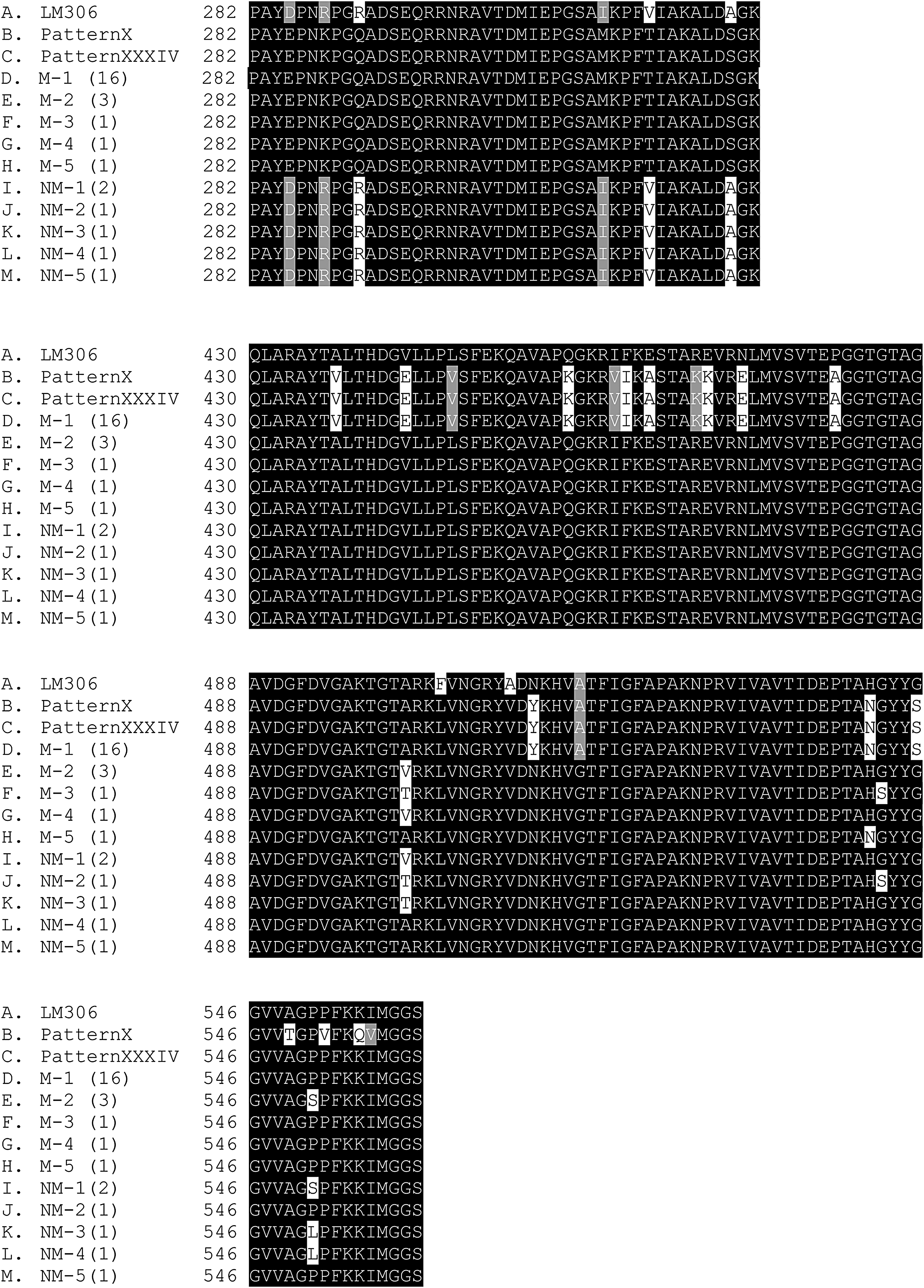
Two sets of partial PBP2 sequences from 23 Neisseria gonorrhoeae isolates with reduced susceptibility to ceftriaxone. PBP2 sequence from positions 282 to 325 and PBP2 sequence positions 430 to 560. The sequences are classified into different amino acid patterns (pattern M-1 to M-5 for mosaic or semimosaic PBP2 and pattern NM-1 to NM-5 for nonmosaic PBP2) and are aligned with (A) penicillin-susceptible strain LM306 (GenBank accession no. M32091.1), 21 (B) N. gonorrhoeae NG-3 with reduced susceptibility to oral cephalosporins isolated in 2000 from Japan (mosaic pattern X) (GenBank accession no. ABO71984.1), 21 and (C) N. gonorrhoeae with reduced susceptibility to oral cephalosporins isolated in 2009 from Canada (mosaic pattern XXXIV) (GenBank accession no. ADE2248.1). 39 The numbers of isolates with each pattern are indicated in parentheses. The key mosaic PBP2 replacements of isoleucine with methionine at position 312 (I312M) and valine to threonine at position 316 (V316T) were found in all mosaic PBP2 sequences; however, M-2, M-3, M-4, and M-4 (which are semimosaic PBP2) lack specific mosaic alterations from residue 430 onward. Some residues not sequenced in this research were removed to produce a precise alignment. PBP2, penicillin binding protein 2.
Summary of PBP2 Patterns in Neisseria gonorrhoeae Isolates
Mosaic-1 (M-1) is a full mosaic PBP2, while Mosaic-2 (M-2), 3 (M-3), 4 (M-4), and 5 (M-5) are semimosaic sequences.
Total amino acid alterations were based on alterations observed in part B PBP2 region (residues 276–329) and part D PBP2 region (residues 430–520).
Association with elevated MIC of ceftriaxone for I312M and V316T, 52 A501V/T/P,13,41 N512Y, 41 G542S, 43 G545S, 50 and P551S/L. 42
Isolate 1848 has a total of 27 amino acid changes due to two additional alterations: P552V and K555Q.
A comparison of partial nonmosaic PBP2 sequences with the published nonmosaic PBP2 sequences12,40 and penA alleles listed in N. gonorrhoeae Sequence Typing for Antimicrobial Resistance (NG-STAR) typing scheme 41 revealed that the nonmosaic PBP2 NM-1 (i.e., KX378859), NM-2 (KX378855), NM-3 (KX378858), NM-4 (KX378854), and NM-5 (KX378857) were identical to PBP2 patterns XIII, XVIII, Type 44 Nonmosaic, IX, and II, respectively. All nonmosaic sequences except for NM-5 harbored PBP2 alterations that have been associated with decreased susceptibility to ceftriaxone although, with the exception of isolate 792, these isolates were susceptible to ceftriaxone (Table 2).42–44
Mutations in mtrR, porBIB, and ponA
Sequence analysis of mtrR revealed that an adenine (A) deletion in the −10 and −35 promoter region of mtrR was observed in 93% (26/28) isolates. The amino acid substitutions H105Y, G45D, A39T, and T86A in the MtrR coding region were seen in 68% (19/28), 18% (5/28), 11% (3/28), and 7% (2/28) of the gonococcus isolates, respectively (Table 1).
Twenty-one out of 28 isolates (75%) harbored double substitutions at positions 120 and 121 in PorBIB. Both G120K and A121D were observed in 32% (9/28) of isolates, while 29% (8/28) of isolates harbored both G120K and A121N, and 14% (4/28) harbored both the G120K and A121G (Table 1).
For the amino acid sequence of PBP1 (ponA), all 28 (100%) isolates exhibited the L421P alteration (Table 1).
Overall, 21 out of 28 isolates (75%) harbored mutations in all four genes examined and 13 of these exhibited reduced susceptibility to ceftriaxone (MIC: 0.06 mg/L).
Discussion
Currently, many countries, including New Zealand, recommend a single intramuscular injection of 500 mg of ceftriaxone in combination with 1 g azithromycin or 100 mg of doxycycline (orally twice daily for 7 days) to treat gonorrhea.4,45 This is one of the few treatments available, since N. gonorrhoeae has developed resistance to alternative drugs. However, reports from several countries5,6,8,46–50 have shown that ceftriaxone and azithromycin are becoming less effective.
Two of the isolates included in this study were resistant to azithromycin (Table 1), which is consistent with the report by Heffernan et al. that 1.7% of gonococcal isolates in New Zealand are resistant to azithromycin and 9.4% showed intermediate resistance. 19 Gonococcal isolates that exhibit azithromycin resistance have been reported in Scotland, England, Argentina, Italy, United States, and Sweden. 51 Although the adenine (A) deletion in the mtrR promoter and other MtrR alterations such as A39T, G45D, and H105Y have been reported to be associated with decreased susceptibility to azithromycin,52,53 these alterations were also present in susceptible strains in the current study. Other mutations, such as alterations in the 23S rRNA, erm genes, MacAB, or mef-efflux pump, might be involved. 51
Consistent with the report of Ito et al., mosaic PBP2 sequences were observed in over half of the New Zealand isolates of N. gonorrhoeae with reduced susceptibility to ceftriaxone (MIC: 0.06 mg/L) (Table 1). The mosaic PBP2 M-1, found in 16 isolates, was similar to mosaic PBP2 XXXIV described by Pandori et al. 39 This PBP2 sequence has been detected in N. gonorrhoeae isolates that displayed both reduced susceptibility 33 and full resistance to ceftriaxone.13,14 It has also been associated with ceftriaxone treatment failures in several countries,5–7 where those gonococcal isolates had MICs of 0.03 to 0.125 mg/L.
Four semimosaic PBP2 were identified. The semimosaic PBP2 M-2, M-3, M-4, and M-5 are missing at least 13 alterations commonly observed in mosaic PBP2. Although these common mosaic PBP2 alterations were also missing in PBP2 XXXV, 12 the semimosaic PBP2 sequences are not identical with PBP2 XXXV. It is also worth noting that the A501V/T amino acid alterations, commonly seen in nonmosaic PBP2 sequences, 54 were also observed in semimosaic M2, M3, and M4 (Table 2). This is an unusual combination since the A501V/T is often seen in nonmosaic PBP2 sequences. Previously, the A501V/T amino acid alterations have also been observed in full mosaic-4 (pattern XXVI) 54 and mosaic PBP2 XXX, 55 in both cases associated with N. gonorrhoeae with reduced susceptibility to cefixime. Further work should be done to confirm the novelty of these patterns, by determining their full penA sequences.
Nonmosaic PBP2 might also play a part in enhancing ceftriaxone MICs in New Zealand gonococcal isolates, particularly the nonmosaic PBP2 NM-1. Nonmosaic PBP2 NM-1, NM-2, NM-4, and NM-5 resemble the nonmosaic PBP2 XIII, XVIII, IX, and II, respectively, found in Australia. 40 Nonmosaic PBP2 XIII was associated with a case of ceftriaxone treatment failure in 2009. 56
In contrast, nonmosaic PBP2 NM-3 resembles nonmosaic Type 44 listed in the NG-STAR typing scheme. 41 Although the I312M and V316T (mosaic alterations) were missing, the presence of other key PBP2 alterations, such as G542S and P551S, might enhance the increased ceftriaxone MIC as has been reported in previous studies.42–44,54 These alterations are gonococcus-specific alterations selected by antibiotic use and are not acquired from Neisseria commensals, unlike other mosaic alterations.42,44 The lack of PBP2 alterations associated with an elevated ceftriaxone MIC in nonmosaic PBP2 NM5 (Table 2) is consistent with the MIC of 0.008 mg/L for ceftriaxone observed in the current study (Table 1).
Mutations in mtrR, porBIB, and ponA were also observed among 100% (28/28), 75% (21/28), and 100% (28/28), respectively, of gonococcal isolates (Table 1). Together, the penA, mtrR, porBIB, and ponA mutations cause an incremental increase in the ceftriaxone MIC in N. gonorrhoeae. 57 Mutations in these genes have been observed in other published studies of N. gonorrhoeae with elevated ceftriaxone MICs.6,7,12–14,36,54,57–63 The adenine (A) deletion in the mtrR promoter was the predominant mtrR alteration observed in the current study, which is in agreement with previous studies.36,53,64 However this A deletion was found in isolates that were susceptible, as well as those exhibiting reduced susceptibility to ceftriaxone, as were the single amino acid alterations, H105Y and A39T (Table 1). These observations are consistent with the report by Liao et al. 64
In contrast, the G45D alteration was observed in five isolates, four of which had reduced susceptibility to ceftriaxone. It is believed that the location of G45D within the helix-turn-helix of the DNA-binding site might increase the helical characteristics of the region, affecting the repressor activity of the MtrR and enhancing expression of the mtrCDE.65,66
Both G120 and A121 PorBIB alterations were found in 21 isolates (Table 1). Although the PorBIB alterations could contribute to an elevated ceftriaxone MIC, the presence of other changes such as mtrR mutations might be required to increase the ceftriaxone MIC to a higher level as Zhao et al. have noted. 57 The combination of G120K A121D changes (in 9/28 isolates) is the most common PorBIB B alteration reported among gonococcus isolates with reduced susceptibility to cephalosporins (MICs ranging from 0.06 to 0.12 mg/L).53,58,62
The G120K A121G PorBIB alterations, which have been reported among N. gonorrhoeae isolates with reduced susceptibility to ceftriaxone in China,64,67 were observed in four isolates in the current study. It is interesting that the G120K A121N combination, observed in eight isolates in the current study, has been found in N. gonorrhoeae associated with ESC treatment failures5,68 and ceftriaxone-resistant N. gonorrhoeae,13,14 but it is unclear whether these changes play a more important role in increasing ESC MICs than other PorBIB alterations.
Unlike the alterations in MtrR and PorBIB, the PBP1 L421P alteration was observed in all 28 N. gonorrhoeae isolates. Originally, the mutation in ponA had been reported to reduce the binding affinity of the PBP1 and β-lactam drugs by three to four fold. 22 However, Zhao et al. found that the insertion of mutated ponA in FA19 N. gonorrhoeae wild-type strain with mutated mosaic penA, mtrR, and penB (porBIB) did not cause any change in ceftriaxone MIC. 57 Thus it is unclear if the mutated ponA does enhance the ceftriaxone MIC among the isolates since the current study showed that both isolates that were susceptible and showed reduced susceptibility to ceftriaxone harbored the mutation.
Overall, all except one of the gonococcal isolates that demonstrated reduced susceptibility to ceftriaxone in the current study harbored mutations in all four genes examined. The N. gonorrhoeae strains in New Zealand have acquired mutations similar to gonococcal isolates from other countries. Indeed some isolates may have been imported from overseas. In most of the reported cases of treatment failure in countries such as Slovenia, Australia, and Sweden, N. gonorrhoeae with elevated ceftriaxone MIC values (MIC: 0.03–0.25 mg/L) was found to harbor mutations in either three or four of these genes. It would appear that additional resistance mechanisms are required before we see gonococci that are fully resistant to ceftriaxone in New Zealand.
This study had some limitations. The penA sequences were partially analyzed due to limited funding. In addition, the analysis was focused on the areas that contain mutations reported to contribute to an increase in ceftriaxone MIC. Also, these findings are based on a relatively small number of isolates that have elevated ceftriaxone MICs, and 26 of the 28 were collected from the one city of Auckland. It is also important to note that the isolates with reduced susceptibility to ceftriaxone make up a relatively low proportion of N. gonorrhoeae strains circulating in New Zealand. 19
Conclusion
This study has partially characterized a selection of New Zealand gonococcal isolates that exhibited elevated MICs to ceftriaxone. It is likely that the presence of mosaic, semimosaic, or nonmosaic penA plus mutations in mtrR, porBIB, and ponA contributed to reduced susceptibility to ceftriaxone among these isolates. Examination of a greater number of isolates, including those fully susceptible to ceftriaxone, would allow the role of these mutated genes to be determined. Nevertheless, the current study provides preliminary data on mutations in penA, mtrR, porBIB, and ponA genes among N. gonorrhoeae with elevated ceftriaxone MICs isolated in New Zealand.
Footnotes
Acknowledgments
The authors thank the Institute of Environmental Science and Research (ESR) for providing N. gonorrhoeae isolates for this study. This work was supported by School of Food & Nutrition, Massey University (PR40335 JAMA), Institute of Veterinary, Animal and Biomedical Sciences (IVABS), Massey University (RM16192 NORSH), and The Hawke's Bay Medical Research Foundation (HBMRF) (3000025365).
Ethical Statement
This project was granted ethical approval by Massey University Human Ethics Committee (MUHEC) (No: 15/13).
Disclosure Statement
No competing financial interests exist.