




Abstract
We screened, for the first time, plasmid-mediated colistin resistance mcr-3 genes among 636 Escherichia coli isolates collected from swine in South Korea. Whole-genome sequencing showed that the E. coli strain harbored the mcr-3 gene in a p17S-208 plasmid with an IncHI2-ST3 plasmid type and a size of 260,399 base pairs. The deduced amino acid sequences revealed that persistent evolution in the bacterial genome has resulted in mcr gene variants. There is a need for extensive surveillance to prevent the dissemination of colistin resistance mcr genes from animal to human.
Introduction
The increase in colistin-resistant Enterobacteriaceae is a worldwide concern. The emergence of mcr gene variants has attracted considerable attention because such variants may confer resistance to colistin, the last resort treatment for serious infections caused by carbapenem-resistant Enterobacteriaceae. Liu et al. 1 described the first plasmid-mediated colistin resistance gene, mcr-1, in an Escherichia coli strain collected from China in 2015. Since then, novel colistin resistance genes, namely, mcr-2 recovered from swine, 2 and mcr-3, detected on an IncHl2 plasmid of E. coli isolated from swine, were reported. 3 Quite recently, a novel mcr-4 gene in E. coli strains recovered from pigs was detected in Europe. 4
Excessive use of colistin in veterinary medicine has resulted in the emergence of colistin resistance; for example, 6–16 tons of colistin was annually applied to food-producing animals between the years 2005 and 2015. Currently, colistin is the main therapeutic choice used to treat infections in pigs, and it has emerged as a critical antibiotic for treating illnesses caused by multidrug-resistant Gram-negative bacteria. Thus, early detection of colistin resistance is important. Detailed genetic analysis of plasmid-mediated mcr genes coding phosphoethanolamine transferase, by employing whole-genome sequencing (WGS)-based surveillance, can assist in that detection. Herein, we describe the genetic characteristics of an mcr-3-harboring E. coli isolate recovered from swine in South Korea.
Materials and Methods
In our previous study, 5 after analyzing data from 636 commensal E. coli isolates isolated from healthy animals between 2014 and 2017, we detected the plasmid-mediated colistin resistance gene, mcr-3, in two isolates after performing PCR with previously reported primer pairs and PCR conditions. 3 Briefly, one sample was collected from each animal at farms that normally do not use antibiotics as feed additives, other than for a therapeutic purpose. Fecal samples were freshly collected from cattle, swine, and chickens and E. coli isolates were obtained by culturing samples on MacConkey and Eosin methylene blue agar. Isolate identities were determined by amplifying the 16S rRNA gene. The primer pairs used were mcr-3F (5′-TTGGCACTGTATTTTGCATTT-3′) and mcr-3R (5′-TTAACGAAATTGGCTGGAACA-3′), and 542 bp fragments were generated. Among the two isolates carrying mcr-3, we have selected one isolate recovered from swine in 2017 for further analysis. The E. coli isolate harboring the plasmid, p17S-208, had an minimum inhibitory concentration (MIC) of 4 μg/mL, according to the breakpoints of the European Committee for Antimicrobial Susceptibility Testing. 6
Identification of known antimicrobial resistance genes in the next-generation sequencing data was performed on ResFinder 2.1 (https://cge.cbs.dtu.dk/services/ResFinder), and PlasmidFinder (https://cge.cbs.dtu.dk/services) was used to detect plasmid replicons in the sequences.7,8 To identify the colistin resistance mechanism and characterize the genetic environment surrounding the colistin resistance gene, WGS was performed. The mcr-3-harboring plasmid, p17S-208, was recovered from swine in 2017. The PacBio RS II platform was used to perform the sequencing (Pacific Biosciences, Menlo Park, CA). This was followed by assembly of sequence reads using the de novo assembly method in the HGAP.2 assembler. Finally, putative gene coding sequences from the assembled contig were annotated by using Blastall 2.2.26 and Glimmer v3.02. Ribosomal and transfer RNAs were predicted by using RNAmmer 1.2 and tRNAscan-SE, respectively.
Our previously reported 5 two mcr-3- and three mcr-1 positive colistin-resistant isolates underwent molecular typing following the protocols specified at the E. coli multilocus sequence typing (MLST) website of the Warwick database (http://mlst.warwick.ac.uk/mlst/dbs/Ecoli). The nucleotide sequences of the mcr-3 gene identified in this study were compared with representative sequences from the National Center for Biotechnology Information (NCBI) by using the neighbor-joining method. Comparative evolutionary analyses were conducted in MEGA6. 9
Results and Discussion
The WGS reads of the plasmid contained 241 predicted open reading frames (ORFs) and the GC content of the contigs was 46.24%. The 260,339 bp plasmid (p17S-208; Fig. 1) encoded the plasmid-mediated colistin resistance gene, mcr-3, and showed 99% nucleotide identity and 83% coverage with plasmid pWJ1 from a swine E. coli strain containing mcr-3 (KY924928). 3 In the p17S-208 plasmid, the mcr-3 gene is located between 21,566 and 23,191 (length 1,626 bp). Initially, the described mcr-3 gene was mapped on a 261 kb plasmid, pWJ1, which had an IncHI2 backbone and 18 known antimicrobial resistance gene markers. 3 Potential ORFs were identified in the sequences flanking the mcr-3 gene of plasmid p17S-208, and most of the translated amino acids that encode for proteins were located downstream of the mcr-3 gene.

The mcr-3-harboring p17S-208 plasmid was compared with plasmids pWJ1 (GenBank accession no. KY924928) from an Escherichia coli strain isolated from swine and pEC28 (GenBank accession no. KY405001) in an E. coli strain from a hospitalized patient. The BLAST Ring Image Generator (BRIG) was used to perform the comparative analysis. Arrow indicates the location of MCR-3 gene in the plasmid. Color images are available online.
Identification and annotation of known acquired antibiotic resistance genes using the ResFinder server demonstrated the presence of genes resistant to various antibiotic agents such as aminoglycoside [aph (3′′)-1b, aph (6)-1d, and aph (3′)-1a], colistin (mcr-3), phenicol (floR), and sulfonamide (sul2). The in silico plasmid finder tool, used to predict the plasmid sequences on de novo assembled contigs, demonstrated that p17S-208 exhibited a typical IncHI2-type backbone. Similarly, previous studies have demonstrated that IncHI2-type plasmids retrieved from E. coli isolates from food-producing animals have a major role in spreading antibiotic resistance genes.10,11
BLASTn local alignments at the GenBank database of the NCBI (http://blast.ncbi.nlm.nih.gov/Blast.cgi) revealed 100% sequence identity with the previously deposited reference plasmid IncHI2-R478 (GenBank accession no. BX664015), while plasmid MLST on the pMLST-1.4 server at the center of genetic epidemiology (https://cge.cbs.dtu.dk/services/pMLST-1.4) demonstrated that the plasmid belonged to sequence type ST3. IncHI2-ST3 is reported to possess high genetic plasticity and can fuse through mobile genetic elements to fit itself with other plasmids, thereby attracting various important antimicrobial resistance genes. 12 In addition, we could not detect the fimH allele in either pWJ1 or p17S-208 when using FimTyper (https://cge.cbs.dtu.dk/services/FimTyper).
Sequence typing showed that two (DCA4245 and15S-103) of the three colistin-resistant mcr-1-harboring E. coli isolates had the same sequence types (ST10), while the ST for the remaining isolate (15S-123) was ST4398. The other mcr-3-harboring isolate (16S-251) was assigned to ST1. ST10 has already been reported in a colistin-resistant E. coli that harbored the mcr-1 gene; that strain was identified from stool samples of travelers returning from India, indicating the importation of a plasmid-mediated mcr-1 gene. 13 ST10 is the most prevalent sequence type reported from hospitalized patients in different counties within China 14 and from food-producing animals sampled in Europe. 15
Our comparison of the p17S-208 plasmid's mcr-3 gene deduced amino acid sequence with 28 other bacterial species' deduced amino acid sequences of putative phosphoethanolamine transferase depicted that p17S-208 had 94% query coverage with 35% identity to amino acids found in plasmid pKP37-BE isolated from a swine ST10 E. coli isolate containing mcr-2 in Belgium (SBV31106.1) and in an IncI2 pEC28 E. coli containing mcr-1 isolated from a hospitalized patient from South Korea (ASD54270.1). On the other hand, mcr-3 of pWJ1 had 32.5% and 31.7% deduced amino acid similarity with the mcr-1 and mcr-2 deduced amino acid sequences, respectively. Furthermore, the mcr-3 gene detected in this study had 98% query coverage and 100% identity with that of amino acid sequences found in the pWJ1 plasmid (ASF81896.1) of E. coli origin (Fig. 2). These results of evolutionary relationships are an indication of close genetic similarity, and that the mcr-3 variant might have originated from a previous mcr variant through the continuous evolution of the bacterial genome, while it disseminated among different hosts. 16
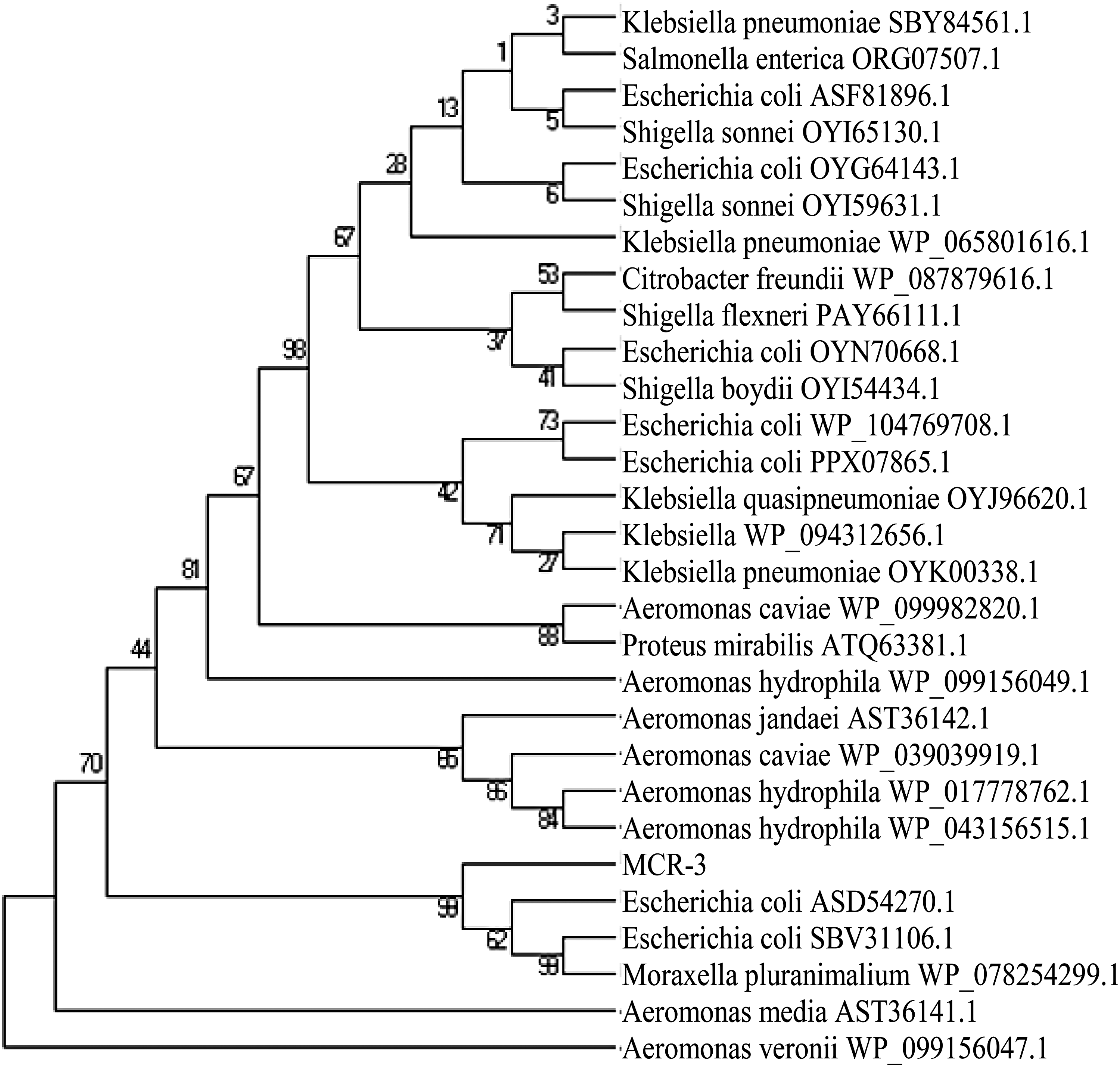
Phylogenetic analysis of the colistin resistance gene mcr-3. The nucleotide sequence of mcr-3 (1,626 bp) identified in this study was compared, using the neighbor-joining method, with representative other sequences obtained from the National Center for Biotechnology Information. The percentages of replicate trees in which the associated taxa clustered together in the bootstrap test are shown next to the branches. MEGA version 6 was used to conduct the evolutionary analysis.
In conclusion, in this study, we describe the genetic characteristics of the mcr-3 gene in an E. coli strain isolated from swine in South Korea. ST3-IncHI2 plasmids co-harboring mcr genes and other diverse important antimicrobial resistance genes have been increasing among E. coli strains from food-producing animals. Therefore, care when applying colistin for therapeutic and prophylactic purposes has to be encouraged to limit the further spread of plasmid-mediated colistin resistance in Enterobacteriaceae. Importantly, one crucial concern is the potential for an isolate to acquire resistance to various antimicrobial agents that are used in human and veterinary medicines. Moreover, we recommend continuous and regular WGS-based surveillance to provide early detection of mcr-3 genes, and to describe novel mcr genes.
Nucleotide Sequence Accession Number
The complete nucleotide sequence reported in this work for plasmid p17S-208 has been deposited in GenBank under accession no. MH077952.
Footnotes
Acknowledgments
This study was supported by the “Cooperative research program for agriculture science and technology development (project No. PJ00897001),” RDA, strategic Inititative for Microbiomes in Agriculture and Food, Ministry of Agriculture, Food and Rural Affairs (918020-4), the Research Institute of Veterinary Science, and the BK21 PLUS program, Seoul National University, Republic of Korea.
Disclosure Statement
No competing financial interests exist.