




Abstract
Aims:
The high prevalence of multidrug resistance (MDR) and extended-spectrum β-lactamase (ESBL)-producing Klebsiella pneumoniae associated with nosocomial infections has caused serious therapeutic challenges. The objectives of this study were to determine the genotypic and phenotypic characteristics of K. pneumoniae strains isolated from Malaysian swine farms and the transferability of ESBL genes by plasmids.
Results:
A total of 50 K. pneumoniae strains were isolated from 389 samples, which were collected from healthy and unhealthy pigs (swine rectum and oral cavities), healthy farmers (human rectum, urine, and nasal cavities), farm's environment, and animal feeds from seven Malaysian swine farms. Antimicrobial susceptibility analysis of these 50 K. pneumoniae strains showed that the majority (86%) were resistant to tetracycline, while 44% and 36% of these strains were MDR and ESBL producers, respectively. PCR and DNA sequencing of the amplicons showed the occurrence of blaTEM (15/18), blaSHV (15/18), blaCTX-M-1 group (7/18), and blaCTX-M-2 group (2/18), while only class 1 integron-encoded integrase was detected. Conjugation experiments and plasmid analysis indicated that the majority of the ESBL genes were plasmid encoded and the plasmids in 11 strains were conjugative. Genotyping by pulsed-field gel electrophoresis and repetitive extragenic palindrome-polymerase chain reaction (REP-PCR) showed that these 50 strains were genetically diverse with 44 pulsotypes and 43 REP-PCR subtypes.
Conclusions:
ESBL-producing K. pneumoniae strains showed high resistance to tetracycline as this antibiotic is used for prophylaxis and therapeutic purposes at the swine farms. The findings in this study have drawn attention to the issue of increasing MDR in animal husbandry and it should be taken seriously to prevent the spread and treatment failure due to antimicrobial resistance.
Introduction
The emergence of multidrug resistance (MDR) among pathogenic bacteria such as Klebsiella pneumoniae is an important public health problem in human medicine, animal husbandry, veterinary medicine, and livestock management.1,2 K. pneumoniae is associated with a wide range of infections such as pneumonia, urinary tract infections, septicemia, and soft tissue infections in humans.3,4 It also causes infections in cats, dogs, birds, horses, monkeys, pigs, rats, elephants, and seals. 5
In Malaysia, antimicrobials play important roles in prophylaxis, treatment, and growth promotion in food animals. Hence, the use of antimicrobial agents has become an indisputable part of modernized food animal production. Antimicrobial supplements are applied in different doses to all food-producing animals ranging from “subtherapeutic concentrations” to full therapeutic doses. A therapeutic dose may be up to 10–100 times greater than a dose used in growth promotion. 6
According to the National Pharmaceutical Control Bureau of the Ministry of Health, Malaysia, there are currently 97 different antimicrobials registered for use in animals and humans. The antibiotics used in animal husbandry and veterinary medicine are frequently the same classes as those used in human medicine such as the third- and fourth-generation cephalosporins and sulfonamides. 6 Most of these registered drugs are used in poultry and pig farms, and less in cattle and goat farms.
Extended-spectrum β-lactamases (ESBLs) are enzymes produced by Gram-negative bacteria, which are resistant to aminopenicillins, first-, second-, and third-generation cephalosporins, and aztreonam. However, their activity is inhibited by clavulanic acid.7,8 ESBLs are generally found in Enterobacteriaceae and Pseudomonas. The first report of ESBL-producing K. pneumoniae was done in 1983 in Germany, followed by reports of several K. pneumoniae outbreaks worldwide.9–14 Most ESBLs are mutants of the TEM or SHV enzymes. The CTX-M-type lactamases, which hydrolyze ceftriaxone and cefotaxime, but weakly active against ceftazidime, are originated from the β-lactamases found in environmental species of the genus Kluyvera. 10 Resistance to β-lactam antibiotics is mostly plasmid mediated and some plasmids carry genes that encode resistance to other classes of antibiotics such as aminoglycoside and fluoroquinolones. 15
Food-producing animals may play an important role in the transfer of antibacterial resistance among farmers, livestock, and the farm environment, and several studies have focused on this possible transmission.16–18 The transmission of MDR strains from animals to humans can occur through direct (direct contact with farmers and veterinarians) or indirect (through consumption of contaminated food of animal origin, contaminated ground water or surfaces, and animal waste handling) routes. 19 Studies on the presence of ESBL-producing and antimicrobial-resistant K. pneumoniae from pigs are still lacking in Malaysia. Therefore, the objectives of this study were to determine the antimicrobial susceptibility, resistance genes, integron genes, plasmids, and genetic diversity of K. pneumoniae isolated from healthy and unhealthy pigs, healthy farmers, and farm environment in Malaysia. The transferability of the ESBL genes by plasmid was also determined by conjugation experiment.
Materials and Methods
This study was approved by the Animal Care and Use Committee (ACUC), Faculty of Veterinary Medicine UPM (UPM/IACUC/FYP-AUP-T006/2013). The human sample collection was approved by the Medical Ethics Committee, University Malaya Medical Centre (Ethics committee/IRB Reference Number: 1010.41), with written informed consent from the human subjects.
Sampling
Samples were collected during 2013–2015 from seven Malaysian swine farms (A–G), environment (n = 27), healthy farmers (n = 57), and healthy and unhealthy pigs (n = 305) for monitoring vehicle transmission of pathogen and resistance rates (Table 1). The selected farms are in high-density pig farming areas. Farms A–E are located in Penang and farms F and G are located in Selangor. We collected samples from the same breed pigs, which were originally sourced from different suppliers. The pigs were not shared between farms as each farm has its own livestock and each farmer worked in only one farm. The sample collection from pigs was performed under supervision of a veterinarian. A total of 131 pigs and 18 farmers were randomly selected for sample collection. From the 131 pigs, 122 oral swabs and 183 rectal swabs were collected (43 samples were from farm A, 38 from farm B, 31 from farm C, 38 from farm D, 36 from farm E, 52 from farm F, and 67 from farm G). Eighteen nasal swabs, 18 urine samples, and 21 rectal samples were collected from the farmers (7 samples were from farm A, 9 from farm B, 7 from farm C, 11 from farm D, 14 from farm E, 5 from farm F, and 4 from farm G) as an indicator to assess the hygiene practice in the farms. Environmental samples (n = 27), including 13 swabs of the pens, 5 water samples, and 9 feed samples, were also collected (4 samples were from farms A, 6 from farm B, 8 from farm C, 5 from farm D, 2 from farm E, 1 from farm F, and 1 from farm G). Nasal swabs, urine, and rectal samples were collected by the human subjects themselves following the standard sample collection procedure. In this study, the pigs collected from the same farm were epidemiologically related, as the livestock were handled/managed in the same procedures, with the same source of water and feed supply. All swabs were collected by using Transwab® Amies Charcoal, MW171 (Medical Wire and Equipment Co, Corsham, United Kingdom). All the samples were transported on ice, stored at 4°C, and processed within 24 hr of collection.
Background Information of All Fifty Klebsiella pneumoniae Strains in This Study
Bacterial isolation and identification
CHROMagar Orientation (CHROMagar Company, Paris, France) was used as the selective agar for isolation. All swabs, except rectal swabs, were enriched in Brain Heart Infusion medium and streaked onto CHROMagar Orientation. For fecal samples, ∼1 g of stools was suspended in 0.85% saline and 10 μL of suspension was used to streak onto the CHROMagar Orientation plates. The plates were incubated at 37°C for 18–24 hr and presumptive colonies with metallic blue color were selected according to manufacturer's guidelines. K. pneumoniae ATCC 13883 was used as the control strain. Vitek-Mass Spectrometry (Vitek-MS) was used for species confirmation. To perform Vitek-MS, the pure culture from non-selective agar was picked by using a sterile toothpick and applied as a thin film onto the Vitek-MS target slide (Biomérieux, Marcy I'Etoile, France) following the protocol as recommended by the manufacturer. The bacterial film was then covered with 1 μL of Vitek MS CHCA (Biomérieux) matrix solution and left to dry at room temperature. The target slide was then placed into the Vitek-MS machine (Biomérieux) for bacterial identification. Escherichia coli ATCC 8739 was used as the control strain.
Klebsiella pneumoniae species were also confirmed by PCR targeting mdh, a housekeeping gene used in the MLST database. * All the strains were confirmed as K. pneumoniae based on the presence of the 477 bp DNA band of the mdh gene and the identity of the amplicon was validated by DNA sequencing analyses (accession number; NC_016845). The background information of the strains are shown in Table 1.
Antimicrobial susceptibility
The susceptibility of K. pneumoniae to 16 antimicrobials (Oxoid, Thermo Scientific, Basingstoke, United Kingdom) was determined by using standard disk diffusion method. The antimicrobials included cefoperazone (30 μg), ciprofloxacin (5 μg), aztreonam (30 μg), ampicillin (10 μg), tazobactam (10 μg), amikacin (30 μg), nalidixic acid (30 μg), imipenem (10 μg), ceftazidime (30 μg), colistin (10 μg), tetracycline (30 μg), gentamicin (10 μg), cefotaxime (30 μg), amoxicillin-clavulanate (20/10 μg), meropenem (10 μg), and cefixime (5 μg). Antimicrobial susceptibility test was performed according to the Clinical and Laboratory Standard Institute (CLSI) guidelines. 20
ESBL production was confirmed using the disk diffusion method as described in the CLSI guideline. 20 E. coli strain ATCC 25922 and K. pneumoniae strain ATCC 700603 were used as quality control. 20
Modified Hodge Test (MHT) was carried out to detect carbapenemase production in K. pneumoniae strains according to the CLSI guideline. 20 K. pneumoniae strains ATCC BBA1705 and ATCC BBA1706 were used as positive and negative quality controls, respectively. 20
Detection of resistance genes and integron-associated genes
Genomic DNAs of all MDR K. pneumoniae strains extracted by using the genomic DNA extraction kit (YEASTERN Biotech Co. Ltd.) were used for PCR detection of β-lactamase genes (blaTEM, blaSHV, blaCTXM-1 group, blaCTXM-2 group, blaCTXM-9 group, blaOXA-1, blaOXA-9, blaKPC, blaNDM, blaVIM, blaIMP, and blaOXA-48)21–24 as well as class 1, 2, and 3 integron-encoded integrase genes and class 1 integron gene cassettes (5′CS/3′CS). 25 All PCR products were submitted to a commercial company for DNA sequencing to validate their identity and the strains with the confirmed amplicons were used as positive controls for subsequent PCR analysis.
Plasmid analysis and conjugation tests
Plasmid DNA from ESBL-producing K. pneumoniae strains were extracted using the alkaline lysis method, 26 followed by electrophoresis on a 0.8% agarose gel for 4.5 hr at 100 V. A 1 kb DNA ladder and lambda DNA/HindIII (Promega, Madison, WI) were used as DNA markers. The plasmid linearization was performed by S1 nuclease-pulsed-field gel electrophoresis (PFGE) and E. coli V517 strain was used as the standard size reference. 27 PCR detection of selected β-lactamase genes (blaSHV, blaTEM, blaCTXM-1 group, and blaCTXM-2 group) was performed using extracted plasmid DNA.21–24 The PCR products were sequenced to confirm their identity.
Transfer of resistance genes by conjugation was performed in Luria–Bertani broth using nalidixic acid-resistant E.coli DH5α as the recipient strain. Transconjugants were selected on Luria–Bertani agar supplemented with nalidixic acid (100 mg/mL) and cefotaxime (2 mg/L; Sigma Aldrich). 27 The presence of plasmids in the transconjugants was confirmed by agarose gel electrophoresis. PCR detection of selected β-lactamase genes (blaSHV, blaTEM, blaCTXM-1 group, and blaCTXM-2 group) was performed using plasmid DNA extracted from the transconjugants. The plasmid linearization was performed by S1 nuclease-PFGE and E. coli V517 strain was used as the standard size reference. 27
Genotyping of K. pneumoniae strains by PFGE
The PFGE was performed as described previously with minor modification. 28 In brief, the standardized cell suspensions (OD610 = 0.6) were prepared and mixed thoroughly with an equal volume of 1% Seakem Gold agarose and allowed to solidify into agarose plugs. The plugs were lysed with cell lysis buffer (50 mM Tris, 50 mM ethylenediaminetetraaceticacid [pH = 8]), 1% Sacrosine, and 1 mg/mL proteinase K [Promega]) and incubated for 4 hr at 54°C. The lysed plugs were washed twice with sterile deionized water and then six times with TE buffer. Then, the DNA plugs were digested with 10 U of XbaI (Promega) for at least 4 hr at 37°C. The restricted DNA fragments were separated by using a CHEF-DR III with pulse times of 2.25–54.2 sec at 200 V for 24 hr and gels were viewed under UV light after staining with Gel-Red. 29 Analysis of the PFGE banding patterns based on the unweighted pair group method was carried out using the BioNumerics 6.0 software (Applied Maths, Ghent, Belgium) with arithmetic averages with 1.5 position tolerance.
Genotyping by repetitive extragenic palindromic polymerase chain reaction
Repetitive extragenic palindrome-polymerase chain reaction (REP-PCR) was performed by using single REP oligonucleotides (GTG)5 as described previously. 30 PCR reaction was carried out in a total volume of 25 μL containing Taq DNA polymerase (1 U; Promega), MgCl2 (1 μM), Go Taq buffers (1 × ), dNTs (80 μM), selected primer (5 mM), and DNA template (∼83 ng/μL). PCR conditions used are as follows: 1 cycle of 7 min at 94°C; 30 cycles of 30 sec at 94°C, 8 min at 44°C, 8 sec at 72°C, and 1 cycle 16 min at 65°C. The PCR products were separated on a 0.8% agarose gel by using electrophoresis at 100 V for 6 hr, and a 1 kb DNA ladder was used as the DNA marker. Analysis of the REP-PCR banding patterns was performed by using the BioNumerics 6.0 software with arithmetic averages with 1.5 position tolerance.
Results
Bacterial isolation and identification
Only 50 out of 389 samples had K. pneumoniae based on microbiological culture method and identification using Vitek-MS system. These strains were confirmed by PCR and DNA sequencing of the amplicons. We collected 1–4 samples from each pig and farmer, but only one strain collected per positive sample was further analyzed.
Among the 50 strains, 38 were isolated from pigs (swine rectum, n = 27, and swine oral cavities, n = 11), while another 9 strains were isolated from human samples (rectum, n = 4, urine, n = 1, and nasal cavities, n = 4). The remaining strains were isolated from the farm environment, which included two strains from the pen swabs and one strain from the animal feed (Table 1).
Antibiograms
The percentages of antibiotic resistance for K. pneumoniae strains are shown in Fig. 1. High levels of antimicrobial resistance were observed for tetracycline (86%), whereas only 6% resistance to imipenem was found among these K. pneumoniae strains. Twenty-two (44%) strains were MDR as they showed resistance to more than three categories of antibiotics. Among these, 20 were from swine, 1 from a farmer, and 1 from an environmental swab. Eighteen (36%) K. pneumoniae strains were detected as ESBL producers based on the disk diffusion test, of which 11 strains were from swine rectal swabs, 6 from swine oral, and 1 from the farm environment (fence). No carbapenemase-producing strains were found according to MHT among these K. pneumoniae strains.
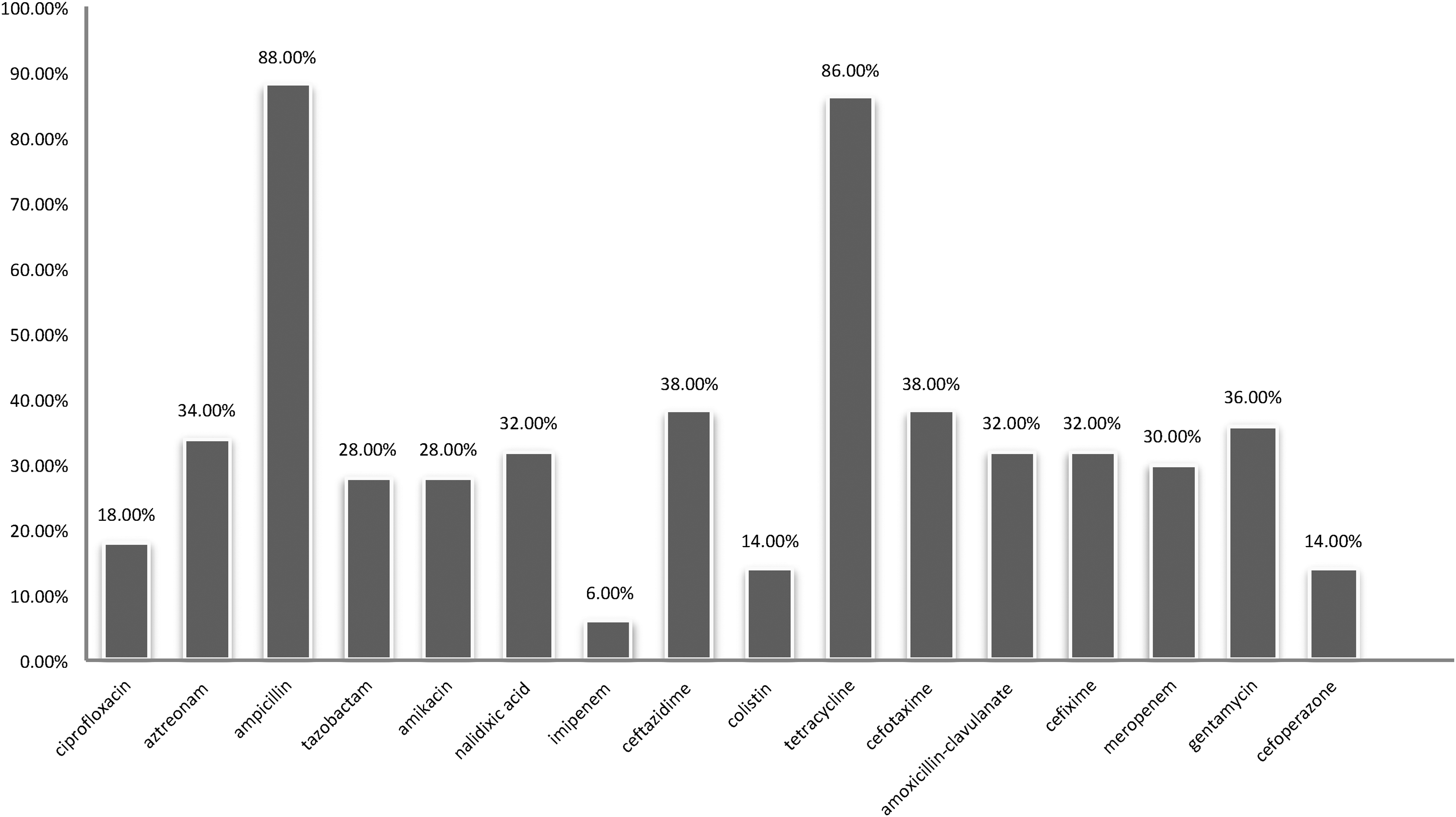
Percentage of antimicrobial resistance of all 50 Klebsiella pneumoniae strains in this study. The y-axis indicates the percentage of antimicrobial resistance.
Presence of ESBL genes and integron-associated genes
Established primers21–24 were used to detect the ESBL-encoding genes in the 18 ESBL-producing K. pneumoniae strains. Analysis of the DNA sequences of all the amplicons identified 15 blaTEM-positive strains, each harboring blaTEM-1 gene; hence, these strains are classified as class 2b beta-lactamase producer, which has a broad spectrum of activity, hydrolyzing penicillins and early cephalosporins. On the other hand, among the 15 blaSHV-positive strains, 4 strains were identified as ESBL variant (blaSHV-12; class 2be β-lactamase), while 8 strains were identified as blaSHV-11 and 3 as blaSHV-61, which are classified as class 2b beta-lactamase producer. blaCTXM-1 group was detected in 7 strains, including 5 as blaCTX-M-15 and 2 as blaCTX-M-1. blaCTX-M-2 group was identified in 2 strains in which both were blaCTX-M-2. No blaKPC, blaNDM, blaVIM, blaIMP, and blaOXA-48, blaCTXM-9, blaOXA-1, and blaOXA-9 was detected. Similarly, sequence analyses of the PCR amplicons for blaTEM-1, blaSHV-11, blaSHV-12, blaCTXM-1, blaCTXM-15, and blaCTXM-2 had 100% identity, while blaSHV-61 had 98% identity to their respective gene sequences in the NCBI database (accession numbers according to https://www.lahey.org; J01749, X98101, AJ920369, X92506, AY044436, X92507 and AJ866284).
Class 1 integron-encoded intI1 integrases were detected in all 18 ESBL-producing K. pneumoniae strains, whereas no class 2 and 3 integron-encoded integrase was present (accession number, ABY64756). In 9 of the 18 K. pneumoniae int1-positive strains, the class 1 integron gene cassettes were of different sizes. Four types of gene cassettes were detected: aadA1-dfrA12 (n = 4), aadA2-dfrA14 (n = 3), aadA1 (n = 1), and aadA2 (n = 2). Two types of aadA (aadA1 and aadA2), which are associated with resistance to aminoglycoside, were found (accession numbers; JQ414041 and JQ364967). Similarly, two types of dfrA (dfrA12 and dfrA14) encoding the dihydrofolate reductase, which confers resistance to trimethoprim (accession numbers: AB571791 and DQ388123), were detected. All nine K. pneumoniae int1-positive strains that harbored aad genes were resistant to aminoglycoside antibiotics (gentamicin and amikacin).
Plasmid analysis and transconjugants
Plasmid analysis results showed that 83% of the 18 ESBL-producing K. pneumoniae strains harbored plasmids. The size of the plasmids ranged from 2 to 20 kbp (Table 2). PCR detection of selected β-lactamase genes (blaSHV, blaTEM, blaCTXM-1, and blaCTXM-2) using plasmid DNA as PCR templates showed that 13 strains harbored blaTEM, followed by 9 and 5 strains of blaSHV and blaCTXM-1, respectively. Sequenced data of these PCR amplicons confirmed the identity of these genes.
Characterization of Eighteen Extended-Spectrum β-Lactamase-producing Klebsiella pneumoniae Strains in This Study
AST, antimicrobial susceptibility test; PFGE, pulsed-field gel electrophoresis; REP-PCR, repetitive extragenic palindrome-polymerase chain reaction.
Conjugation was carried out for the cefotaxime-resistant and nalidixic acid-sensitive ESBL-producing K. pneumoniae strains using nalidixic acid-resistant E. coli DH5α as the recipient. Eleven strains successfully transferred their plasmids by conjugation to E. coli DH5α. The detailed information of these 11 conjugative strains are shown in Table 2. All the 11 transconjugants received the 20 kbp plasmid. Five of these transconjugants received an additional smaller sized plasmid (Table 2). PCR detection of selected β-lactamase genes using plasmid DNA extracted from these transconjugants showed that blaTEM-1, blaSHV-11, blaSHV-61, and blaCTXM-15 were successfully transferred in plasmids from the donors to the recipient strain (Table 2).
Genetic relationship of K. pneumoniae based on PFGE and REP-PCR
PFGE analyses of XbaI-digested genomic DNA of 50 K. pneumoniae is shown in Fig. 2. K. pneumoniae strains were subtyped into 44 distinct PFGE profiles (pulsotypes) comprising 14–25 restriction fragments. The genetic similarity of the strains ranged from 55.2% to 100%. The discriminatory power of PFGE was 0.983 (Simpson's Index of Diversity).
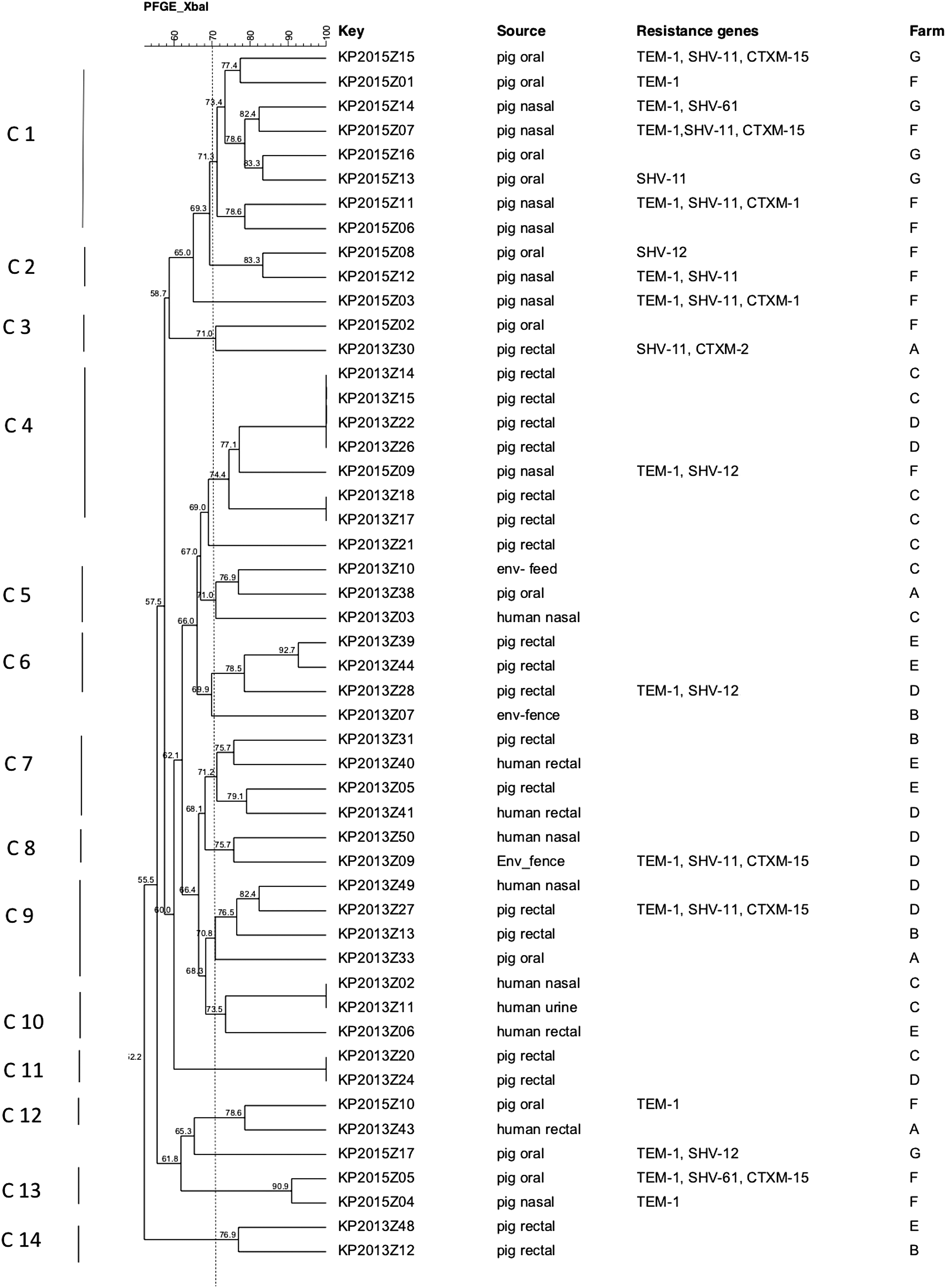
Dendrogram based on PFGE profiles of 50 K. pneumoniae strains studied. PFGE, pulsed-field gel electrophoresis.
The PFGE dendrogram showed 14 main clusters and four unique pulsotypes at 70% similarity cutoff (Fig. 2). There was no association of PFGE clusters with source of isolation and farms. Some of the K. pneumoniae strains from the same farm shared an indistinguishable pulsotype as shown in clusters C2, C8, and C12. However, there were also some strains from different farms sharing an identical pulsotype, as was observed in clusters C4 and C11. For example, four strains, KP2013Z14 and KP2013Z15 isolated from farm C showed 100% similarity to KP2013Z22 and KP2013Z26 from farm D and all of these four strains were from swine rectal swabs. Similarly, there was no direct association of PFGE clusters with antibiotic resistance profiling. The strains in clusters C2, C3, C5, C7, C10, C11, C13, and C14 showed diverse antimicrobial susceptibility profiles. On the other hand, strains in clusters C1, C4, C6, C8, C9, and C12, which were isolated from different farms, had the same antibiograms.
REP-PCR subtyped the 50 K. pneumoniae strains into 43 different REP-PCR profiles (Fig. 3). Based on 70% similarity, strains were grouped into eight clusters and five unique subtypes. Some strains in clusters C3, C7, and C8 from the same farms showed 100% similarity to each other. Some strains isolated from the different farms exhibited 100% similarity to each other, as was observed in clusters C3 and C4. Overall, strains from pigs and farmers from different farms were distinct, although there were some exceptions. For example, in cluster C5, a human strain KP2013Z43 showed 90% similarity to a swine strain KP2013Z38. In cluster C8, a human strain KP2013Z41 showed 92.3% similarity to KP2013Z48, a swine rectal strain.
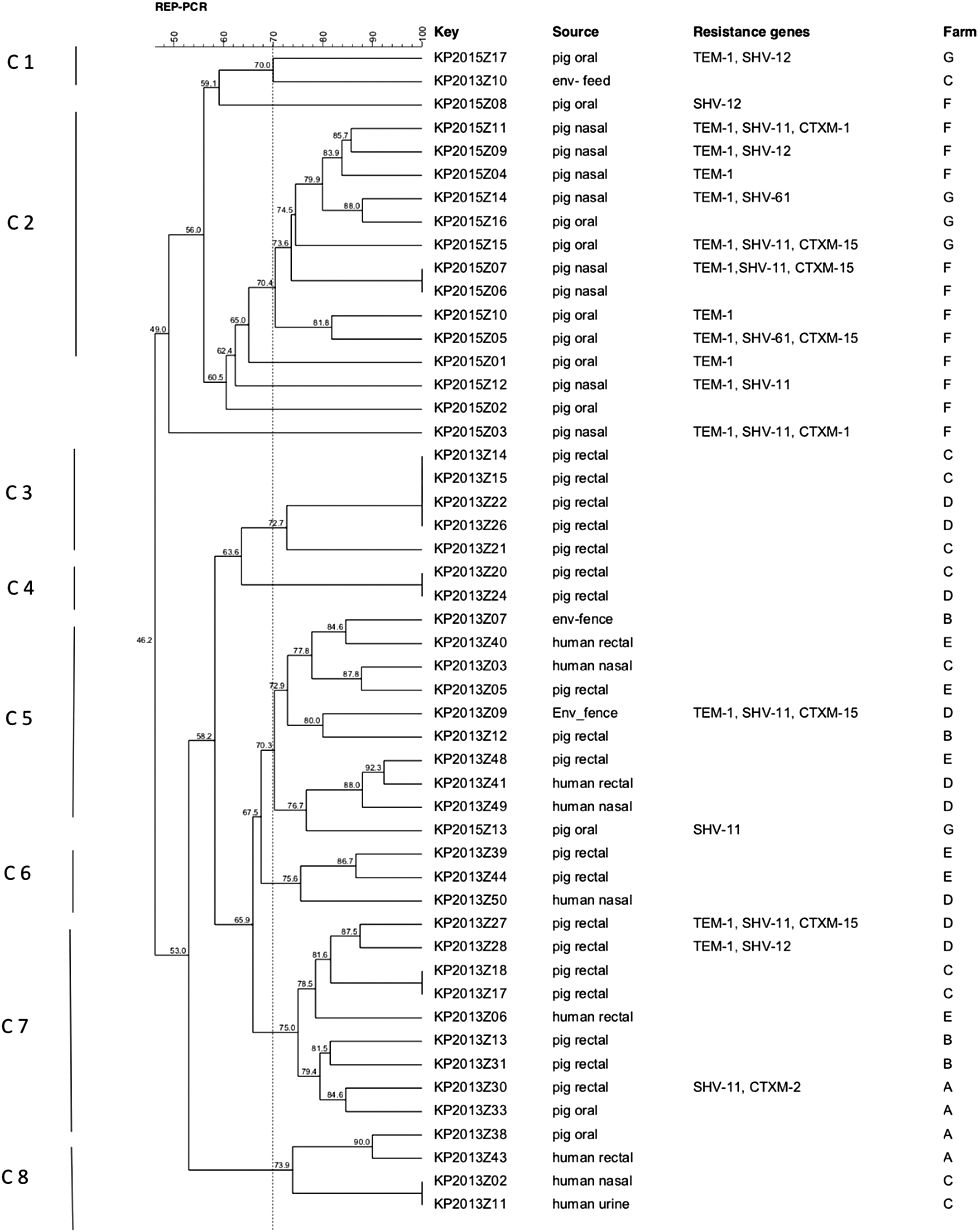
Dendrogram based on REP-PCR of 50 K. pneumoniae strains studied. REP-PCR, repetitive extragenic palindrome-polymerase chain reaction.
The 18 beta-lactamase producers identified in this study were genetically diverse according to PFGE and REP-PCR subtyping. Ten of ESBL-producing strains were from pigs in farm F, four strains from pigs in farm G, two strains from pigs and one strain from the fence in farm D, and one strain from a pig in farm A. Each of these strains showed unique pulsotype.
Discussion
Klebsiella pneumoniae is an opportunistic pathogen in humans and animals, which is responsible for a wide range of infections, such as urinary tract infections, pneumonia, wound infections, and septicemia.3,4 K. pneumoniae causes mastitis, lung infection, and septicemia in pigs and can be fatal to piglets. K. pneumoniae is also highly resistant to multiple antibiotics and harbors many resistance determinants such as β-lactamases or ESBLs, including TEM, SHV, CTX-M, and GES type.3–5
Klebsiella species are intrinsically resistant to penicillins and can acquire resistance toward third- and fourth-generation cephalosporins by producing ESBLs. A similar study in Cameroon reported that all K. pneumoniae isolated from swine and humans showed reduced susceptibility to the amino-penicillins, cephalosporins, and trimethoprim. 31 Our study showed that 18% and 36% of the strains were resistant to ciprofloxacin and gentamicin, respectively. In another study reported by Founou et al., 14% and 71% of resistance to ciprofloxacin and gentamicin, respectively, were detected. 31 In this study, most of the strains from both pigs and humans were resistant to at least one non-β-lactam antibiotics (tetracycline and gentamicin), which are used in disease prophylaxis and therapeutics in food animals. Twenty-two (44%) strains in this study were considered MDR, which showed resistance to more than three categories of antibiotics. All the strains from farm environment and pigs showed resistance to tetracycline, which is used widely in feed supplements.6,32
Members of TEM, SHV, and CTX-M family of beta-lactamase are found in Enterobacteriaceae; MDR K. pneumoniae, which produce ESBLs, mostly harbor TEM, SHV, and CTX-M types.7,8,33–35 CTX-M-type beta-lactamase has been reported as the predominant ESBL-encoding gene, and other ESBLs such as SHV and TEM have also been reported in many countries.36–38 In this study, TEM was the most common β-lactamase enzyme detected in 15/18 ESBL-producing K. pneumoniae strains, all of which were identified as TEM-1. TEM-1 hydrolyzes penicillin and early cephalosporin and is known as class 2b β-lactamase, but is not able to hydrolyze extended-spectrum cephalosporins or aztreonam significantly. 13 In previous studies, TEM-1 was reported to have a higher prevalence in K. pneumoniae and E. coli isolated from animals.39,40 SHV, a common ESBL enzyme among Malaysian clinical K. pneumoniae strains, 28 was detected in 15/18 ESBL-producing K. pneumoniae strains in this study and were identified as SHV-11, SHV-12, and SHV-61. SHV-11 and SHV-61 are known as class 2b β-lactamase, while SHV-12 is known as ESBL enzyme (class 2be β-lactamase). 13 CTX-M-1 group was detected in 7/18 of ESBL-producing strains, which was identified as CTX-M-1 and CTX-M-15. CTX-M-2 group was found in two K. pneumoniae strains isolated from a swine and the environment. CTX-M-1, CTXM-3, CTX-M-14, CTX-M-24, and CTX-M-32 are the most common CTX-M-type ESBL enzymes in pigs. 41 CTX-M appears to be the predominant ESBL enzyme worldwide. 13 The CTX-M-15 is one of the most common CTX-M-type ESBLs among Enterobacteriaceae family. Nosocomial infections caused CTX-M-15-producing K. pneumoniae have dramatically increased in recent years.42,43 In Asian countries, CTX-M-15 is the major ESBL enzyme reported.28,44–46 Other tested resistance genes (blaKPC, blaNDM, blaVIM, blaIMP and blaOXA-48, blaCTXM-9, blaOXA-1, and blaOXA-9) were not detected in our strains. No carbapenemase-producing strain was found among these K. pneumoniae strains based on MHT and none of the tested resistance genes was detected. So far, in Malaysia, no carbapenemase-producing K. pneumoniae strain has been reported in pigs, although it is reported in several clinical studies.47–49 Carbapenemase-producing K. pneumoniae strain was reported in swine farms in Germany and elsewhere around the world.50–52
Detection of integron-encoded integrase genes showed that class 1 integron is the main integron class among the Malaysian swine strains. Class 2 and class 3 integron-encoded integrases were not detected, similar to previous reports.28,53 Two types of aadA (aadA1 aadA2), which are associated with resistance to aminoglycoside, were found in the nine K. pneumoniae int1-positive strains, which were resistant to aminoglycoside antibiotics (gentamicin and amikacin).
Plasmid analysis and transconjugation experimental results showed that most of the integrons and some of the ESBL-encoding genes were plasmid encoded and 11 strains had conjugative plasmids.28,54 These results concurred with previous studies on clinical K. pneumoniae, in which ESBL-encoding genes carried on plasmids are transmissible.55,56 Plasmid is one of the ways for the spread of ESBLs and other antibiotic resistance genes.
The genetic relationship of the 50 K. pneumoniae strains was assessed by both PFGE and REP-PCR analysis. Based on the cluster analysis, these strains were genetically diverse and heterogeneous. This is in concordance with previous studies that showed high genetic diversity among K. pneumoniae strains from animals and humans.11,28,57,58 This finding is not surprising as the strains were from different pigs, humans, farms, and years.
Generally, strains of human origins were genetically diverse, except for two human strains from farm C, which shared indistinguishable pulsotype (cluster C10). This similarity maybe related to personal hygiene practice or condition of the farms that they work in. Most of the swine strains that were isolated from the same farms showed higher similarity compared to strains from other farms. However, one exceptional observation was two groups of swine strains, which were isolated from different farms, showed indistinguishable fingerprints (cluster C4 and C11). These farms are located near to each other and the same contamination source could explain this similarity.
In general, MDR and ESBL-producing K. pneumoniae are becoming a serious issue in humans and animals, with increasing resistance to most available antibiotics. This study showed that 22 K. pneumoniae strains were MDR and 18 strains were ESBL producers. All the ESBL producers carried ESBL-encoding genes such as blaSHV-11, blaSHV-12, blaSHV-61, blaCTX-M-1, blaCTX-M-15, and blaCTX-M-2. Class 1 integron-encoded intI1 integrases were found in all ESBL-producing K. pneumoniae strains, which cause resistance to aminoglycoside and trimethoprim. DNA fingerprinting of K. pneumoniae strains by PFGE and REP-PCR showed that these strains were very heterogenous. There was no direct correlation between genotypes of strains with source of isolation, antibiograms, and resistance genes.
Footnotes
Acknowledgments
We thank University of Malaya for financial support and facilities. This work was supported by University of Malaya Postgraduate Research Grant (PG072-2014B) and High Impact Research (HIR) Grant (UM.C/625/1/HIR/MOHE/CHAN/11/02). We also thank Hun Loong Koh for helping in the isolates confirmation.
Disclosure Statement
No competing financial interests exist.
