




Abstract
Background:
Fifty isolates of Klebsiella pneumoniae isolated from clinical samples between 2012 and 2016 that were found to be resistant to carbapenems were included in this study.
Materials and Methods:
Resistance genes were investigated by performing PCR. Plasmid typing was performed using PCR-based replicon typing. The clonal relationships between the strains were investigated using pulsed-field gel electrophoresis (PFGE).
Results:
OXA-48-type carbapenemase genes were detected in 86% (n = 43/50) of K. pneumoniae isolates, whereas NDM-type carbapenemase genes were detected in 14% (n = 7/50) of the isolates. blaTEM was detected 60% (n = 30) of the strains, blaSHV in 78% (n = 39), blaCTX-M-1 in 48% (n = 24), and blaCTX-M-2-type β-lactamase in 10% (n = 5). blaCTX-M-1 and blaSHV were concomitantly distributed in 40% (n = 20) of the strains, blaTEM and blaSHV in 54% (n = 27), blaTEM, blaSHV, and blaCTX-M-1 in 32% (n = 16) and blaCTX-M-1 and blaCTX-M-2 in 10% (n = 5). Strain numbers 66, 69, 76, 77, and 78 coproduced carbapenemases, blaCTX-M-1 and blaCTX-M-2 in addition to blaOXA-48 or blaNDM-1 that were described as hybrid strains. IncR-type replicon was found in 50% (n = 25) of 50 isolates with plasmid typing, whereas IncA/C-type replicon was detected in 40% (n = 20) and IncFIIK-type replicon in 18% (n = 9) of the isolates. Outcomes of the transformation experiments showed that the OXA-48 gene was carried to the receiver cell on FII plasmids. No dominant epidemic clone was detected through PFGE.
Conclusion:
OXA-48 carbapenemase was found to be the most prevalent type of enzyme in our hospital, and the presence of NDM-1-type carbapenemase-carrying strain and an increase in their rate were detected.
Introduction
Carbapenems have been used as a treatment option in infections caused by extended-spectrum β-lactamase-producing Enterobacteriaceae (ESBL-E). Unfortunately, the increasing number of carbapenem-resistant Enterobacteriaceae (CRE) has become a public health problem worldwide, threatening patient life.1,2 CRE are defined as any Enterobacteriaceae that are resistant to any carbapenem antimicrobial or are documented to produce a carbapenemase. 3 Susceptibility to carbapenems has been observed for producers of any type of carbapenemases. 4 Klebsiella pneumoniae is an emerging nosocomial pathogen, a member of the Enterobacteriaceae family. Infections caused by carbapenem-resistant Klebsiella pneumoniae (CRKP) are associated with high mortality rates and exposure to β-lactams and β-lactamase inhibitor combinations, cephalosporins, fluoroquinolones, intensive care unit (ICU) stay, and indwelling urethral catheter tubes were identified as risk factors for acquiring CRKP isolates.5,6 However, the uncontrolled use of antibiotics, poor compliance with hygiene rules, and the ever-increasing intercity travel rates between countries are important for transmission of CRKP infections.7,8
There is a need for extensive work because this life-threatening microorganism has transferable resistance genes and causes the rapid spread of resistant strains among patients in hospitals and even countries, especially in patients in ICUs, immunosuppressed patients, surgical patients, and transplant patients.9–11 However, it is noteworthy that resistant genes are mostly carried on mobile genetic elements such as plasmids, transposons, or insertion sequence (IS) elements. Plasmids are extrachromosomal DNA molecules capable of autonomous replication, which carry resistance genes to confer resistance to the major classes of antimicrobials, and they promote the horizontal transfer of resistance determinants among bacteria of different species. 12 In 2005, Carattoli et al. developed a PCR-based replicon typing (PBRT) method, an efficient method for plasmid identification and typing that is able to detect 18 replicons in eight multiplex PCR reactions. Recently, it was revised for the detection of 28 replicons in eight multiplex PCR reactions.13,14
The lack of adequate molecular epidemiologic studies on carbapenemases is why their prevalence is uncertain in many countries. The aim of this study was to evaluate the distribution of intrinsic plasmid replicate genes and their association with genes responsible for carbapenemase enzyme production, and to investigate clonal associations of 50 CRKP isolates obtained between 2013 and 2016 at Istanbul University, Istanbul Medical Faculty, Istanbul, Turkey.
This study was presented in part at the 27th European Congress of Clinical Microbiology and Infection Disease (ECCMID) in Vienna, Austria, from April 22 to 25, 2017 (PO268).
Materials and Methods
Strains and antibiotic susceptibility testing
Fifty CRKP isolates obtained from various clinical samples between 2012 and 2016 at Istanbul University, Istanbul Medical Faculty, that were found to be resistant to ertapenem, meropenem, or imipenem using disc diffusion assays were included in the study. The strains were not consecutive because carbapenem resistance is rarely seen in our hospital. However, none of the strains were isolated from the same patient/s. Minimum inhibitory concentration (MIC) values of cabapenems were confirmed with microdilution and gradient test methods. Results were interpreted according to the Clinical Laboratory Standards Institute (CLSI) clinical breakpoint guidelines.15,16
Determination of antibiotic resistance genes
Class A (blaKPC and blaGES), class B carbapenemases (blaIMP, blaVIM, blaNDM, blaSPM, and blaSIM), class D carbapenemases OXA β-lactamase genes (blaOXA-23, blaOXA-24, blaOXA-51, blaOXA-58, and blaOXA-48), and blaCTX-M, blaTEM and blaSHV β-lactamases were investigated using PCR with specific primers that have been previously published. 17 Genes responsible for the reproduction of the acquired AmpC β-lactamase enzymes (DHA, ACC, FOX, MOX, CIT, and EBC) were investigated using multiplex PCR. Amplification products were separated on 1% agarose gels stained with ethidium bromide and visualized under ultraviolet light. X174 HaeIII fragments were used to assess PCR product size (MBI Fermentas, St. Leon-Rot, Germany).17–21
Plasmid analysis and transformation
Plasmid typing was performed using PBRT and simplex PCR as previously described. 13 A novel PBRT kit was used for the identification of 25 different replicons (HI1, HI2, I1, I2, X1, X2, L/M, N, FIA, FIB, FIC, FII, FIIS, FIIK, W, Y, P, A/C, T, K, U, R, B/O, HIB-M, and FIB-M) in eight multiplex PCRs following the manufacturer's instructions to determine plasmid replicon types in all K. pneumoniae strains (DIATHEVA, Fano PU, Italy). Amplification products were resolved on 2.5% agarose gel, stained with GelRed Nucleic Acid Gel Stain (Biotium, Fremont, CA) and visualized using the Gel Doc 2000 system (Bio-Rad, Hercules, CA). 13 For transformation, plasmid DNA was purified with the Qiagen Plasmid Midi Kit (Qiagen, Inc., Milan, Italy). Escherichia coli DH5α cells (MAX Efficiency DH5α chemically competent cells; Invitrogen, Milan, Italy) were used as recipient cells for transformation. Selection of transformants was performed on luria broth agar plates containing ampicillin (100 μg/mL). Replicons in the transformant cells were determined using PBRT. 22
Determination of genetic relatedness
The genetic relatedness of all K. pneumoniae strains was determined using pulsed-field gel electrophoresis (PFGE) analysis. PFGE was performed as previously described. 23 DNA embedded in agarose was digested with XbaI (Takara Bio, Inc., Japan) and chromosomal restriction fragments were visualized using Carestream 212 PRO GEL IMAGING SYSTEM and compared using GelCompar II software (Applied Maths, Sint-Martens-Latem, Belgium). A similarity matrix was calculated using the Dice coefficient 1, and cluster analysis was performed using the unweighted pair group method with arithmetic algorithm. 24 A pandrug-resistant K. pneumoniae strain was determined by multilocus sequence typing (MLST) performed on the rpoB, gapA, mdh, pgi, phoE, infB, and tonB genes, as previously described. Sequence types were assigned at http://bigsdb.web.pasteur.fr/klebsiella/klebsiella.html web site. 25
Results
Antibiotic susceptibilities
The MIC values of carbapenems were as follows: 2 to >32 mg/L for ertapenem, 0.5 to >32 mg/L for meropenem, 0.5 to >32 mg/L for imipenem, and 0.5 to >32 mg/L for doripenem. Microdilution showed that 92% of the strains presented multidrug resistance and 8% were moderately susceptible to ertapenem; 68% were resistant, and 10% were moderately susceptible to meropenem. Imipenem resistance was 90% and doripenem resistance was 74%. According to these results, the most effective carbapenem was observed to be meropenem, followed by doripenem, imipenem, and ertapenem (Table 1).
Carbapenem Minimum Inhibitory Concentration Values, Resistance Genes, Replicon Types, and Pulsed-Field Gel Electrophoresis Profiles of Klebsiella pneumoniae Isolates
E, ertapenem; M, meropenem; I, imipenem; D, doripenem; MIC, minimum inhibitory concentration; PFGE, pulsed-field gel electrophoresis.
Presence of resistance genes
OXA-48-type carbapenemase genes were detected in 86% (n = 43/50) of K. pneumoniae isolates, whereas NDM-type carbapenemase genes were detected in 14% (n = 7/50) of the isolates. No other genes responsible for carbapenem resistance were detected. blaTEM was detected in 60% (n = 30) of the strains, blaSHV in 78% (n = 39), blaCTXM-1 in 48% (n = 24), and blaCTXM-2-type β-lactamase in 10% (n = 5). blaCTXM-1 and blaSHV were found to be concomitantly distributed in 40% (n = 20) of the strains, blaTEM and blaSHV in 54% (n = 27), blaTEM, blaSHV, and blaCTXM-1 in 32% (n = 16), and blaCTXM-1 and blaCTXM-2 in 10% (n = 5). Strain numbers 66, 69, 76, 77, and 78 coproduced carbapenemases, blaCTXM-1 and blaCTXM-2 in addition to blaOXA-48 or blaNDM-1 that were described as hybrid strains. No plasmidic AmpC genes (FOX, CIT, MOX, DHA, ACC, and EBC) were detected in multiplex PCR (Table 1).
Plasmid analysis and transformation
IncR-type replicon was detected in 50% (n = 25) of 50 isolates with plasmid typing, whereas IncA/C-type replicon in 40% (n = 20), and IncFIIK-type replicon was detected in 18% (n = 9) of the isolates. Ten strains could not be classified in any type. Outcomes of the transformation experiments showed that OXA-48 gene was carried to the receiver cell on FII plasmids, and plasmid R did not transfer the OXA-48 gene (Table 1 and Fig. 1).

OXA-48 PCR images of transformant cells. C1, marker; C2,3,5, OXA-48-negative transformants obtained from strain 30; C4,6,7, OXA-48-positive transformants obtained from strains 2 and 30; C8,9, OXA-48-positive genomic DNAs of strains 2 and 30; C10,11, OXA-48-positive plasmid DNAs of strains 2 and 30; C12, negative control.
Epidemiology and genetic relatedness of carbapenem-resistant K. pneumoniae isolates
Ten different groups and 46 different genotypes were detected through the PFGE results of the isolates. No dominant epidemic clones were detected. Two strains in group D and two strains in group F were found to be clonally related (Fig. 2). NDM-carrying isolates were compared among themselves and two clusters of five different genotypes were identified in these isolates. Strains 69 and 70 (NDM-positive) isolates in cluster A were clonally associated and identified as A1 genotype. These strains were isolated from the internal medicine emergency department (Fig. 3). Outcomes of MLST analysis showed that the strain was a sequence-type ST14 strain.
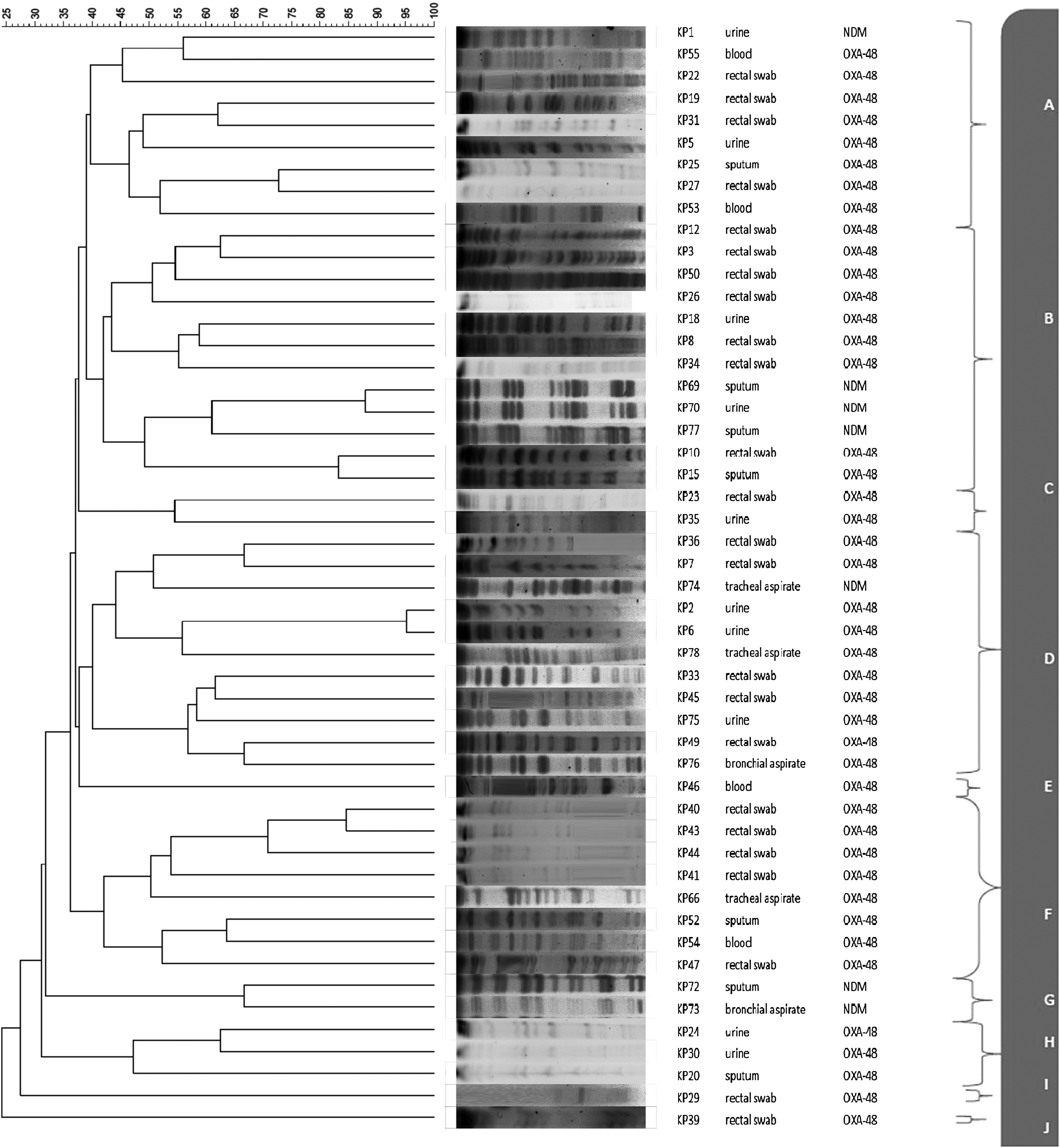
PFGE banding patterns after XbaI digestion of OXA-48 carbapenemase-producing Klebsiella pneumoniae isolates (n = 50). Ten different groups

PFGE banding patterns after XbaI digestion of NDM carbapenemase-producing K. pneumoniae isolates (n = 7).
Discussion
The development of antibiotic resistance in the Enterobacteriaceae family is an important global public health issue. 26 In addition to ESBL production and loss of porin proteins, molecular class B (IMP, VIM, and NDM), class A (KPC), and class D (OXA-23 and OXA-48) carbapenemases are important problems for the development of antibiotic resistance in the Enterobacteriaceae family. 27 These resistance genes are usually carried on mobile elements such as plasmids, transposons, and IS elements, and they exhibit epidemiologic spreading properties because of their ability to transfer these genes to other bacterial strains. PCR-based replicon typing targeting major plasmid families (HI2, HI1, I1γ, X, L/M, N, FIA, FIB, FIC, W, Y, P, A/C, T, K, and B/O) has been used since 2005. 13
OXA-48 and its variants are endemic in Mediterranean countries, and this situation is thought to be associated with various epidemiologic factors including the international transfer of patients coming from endemic areas. 28 The first ever report of K. pneumoniae carrying the OXA-48 carbapenemase gene was published in 2003 in a single patient from our hospital. 29 Over the past 13 years, OXA-48 enzymes have become endemic in our country possibly because of the lack of adequate infectious control measures. 15 The first outbreak of OXA-48-carrying K. pneumoniae strains occurred in our hospital and was reported in 2008 by Carrer et al.30–32 The New Delhi metallo-β-lactamase (NDM-1) strain was first reported in 2008 in an Indian patient. 33 In Turkey, NDM-1 was first reported in an immigrant patient from Iraq. 34 Further outbreaks have been reported since then.35,36
Studies show that OXA-48-type carbapenemase is mostly carried on the IncL/M type plasmid in Turkey and elsewhere in the world. 37 Interestingly, Inc L/M-type replicons were not detected in our study. Molecular epidemiologic studies have reported that IncA/C-type plasmids are responsible for the horizontal spread of NDM-type carbapenemase. Other types of plasmids responsible for NDM-type carbapenemase spread are IncFIIK, IncL/M, and IncH1. 38 R-type replicon was detected in 50% (n = 25) of 50 isolates with plasmid typing, whereas IncA/C-type replicon was detected in 40% (n = 20) and IncFIIK-type replicon in 18% (n = 9) of the isolates. IncR-type and IncA/C-type replicons were either detected in 46.5% of OXA-48-type carbapenemase-producing strains followed by IncFIIK-type replicon with 20.9%. IncR-type was detected in 71.4% of NDM-type carbapenemase-producing strains.
IncFII replicon is the most frequent replicon described in Klebsiella spp. in the National Center for Biotechnology Information (NCBI) database. 39 In this study, the IncFIIK-type replicon was found to be responsible for the transmission of the OXA-48 carbapenemase gene according to transformation studies. The IncI1-type plasmid was identified in this study by the K. pneumoniae isolate (KP 69) carrying CTXM-1, CTXM-2, SHV, and NDM resistance genes at the same time. The IncI1-type plasmid was reported in an ESBL-positive E. coli strain in 2016 and was shown to be responsible for CTXM-8 transfer using Southern blot hybridization. 40
The worldwide spread of multidrug-resistant K. pneumoniae strains is an important public health problem. ST11, ST14, ST147, ST340, ST149, and ST231 are the K. pneumoniae sequence types associated with NDM carbapenemase. 41 According to the European Survey on Carbapenemase-Producing Enterobacteriaceae (EuSCAPE) study in which 36 countries participated, K. pneumoniae was the most frequent multidrug-resistant bacteria in the Enterobacteriaceae family and the most frequently detected carbapenemases were KPC enzymes followed by OXA-48-like, NDM, and VIM in K. pneumoniae. 42
The first epidemic outbreak of OXA-48-type carbapenemases was reported in an Istanbul Medical Faculty in 2008 with two different clones. 32 According to recent studies and our study, the presence of different clonal groups in dendrograms obtained with PFGE profiles shows that resistance genes spread rapidly among the clones by moving elements such as transposons and plasmids. 43 On the contrary, NDM-type carbapenemases are reported to be increasing in number both in Turkey and around the world. Eight NDM-1-positive isolates were reported to be the same clone according to PFGE results in a recent study. 35 We see that there are five different genotypes of seven NDM-1-positive isolates according to PFGE results in our study. This is thought to be because of the fact that our hospital is quite open to health tourism and the NDM-1 gene is transported to different clones by plasmids. 44
Conclusion
OXA-48 carbapenemase was detected as the most prevalent type of enzyme in our hospital, and transformation studies proved that OXA-48 and NDM-1-type carbapenemases were carried on plasmids. Our study, in line with other previous reports, confirms that CRKP can spread rapidly and easily, highlighting the need for implementation or strengthening of infection-control measures. However, there is also a need for long-term multicentered molecular epidemiologic studies.
Footnotes
Acknowledgments
This research was supported by the Istanbul University Scientific Research Projects as a thesis project. We wish to acknowledge Alessandra Carattoli and her research team for their help and provision of standard strains.
Disclosure Statement
No competing financial interests exist.