




Abstract
Acinetobacter baumannii is considered an important pathogen of clinical significance that is responsible for a wide range of nosocomial infections. Carbapenem resistance among A. baumannii isolates has increased dramatically in the Past years because of the emergence and dissemination of specific epidemic clones. We aimed to characterize the population structure of A. baumannii isolates from Porto Alegre city, Southern Brazil, in two distinct periods: during the first carbapenem-resistant A. baumannii (CRAB) outbreak (2007–2008) and 5 years later when the CRAB reached endemic levels (2013–2014). The study included 49 CRAB isolates collected in two periods: 2007–2008 (31 isolates) and 2013–2014 (18 isolates). Multilocus sequence typing (MLST) was performed according to Institute Pasteur, followed by eBURST analysis. PCR was used to detect integrase gene, blaNDM, and oxacillinase genes, and also to detect the ISAba1 element upstream blaOXA-23. The eBURST analysis identified the clonal complexes (CCs) CC15, CC32, CC79, CC216, CC221, and CC464 in the first period (2007–2008) and CC1, CC2, CC15, CC79, and CC162 during the endemic period (2013–2014). Molecular analysis by MLST identified 13 new sequence types. As we found A. baumannii with the blaOXA-23 gene of several CCs, it can be concluded that the increase of CRAB infections are not related to a specific clone. Furthermore, the high-risk CC15 and CC79 were related to the first CRAB outbreak and these CCs persisted up to 2014 in Porto Alegre city. The international clones CC1 and CC2 were observed for the first time in only the second period (2013–2014), alerting to the emergence of these clones in Southern Brazil.
Introduction
A
Materials and Methods
During the first CRAB outbreak in Porto Alegre (between 2007 and 2008), a total of 239 carbapenem-resistant isolates, from 5 hospitals, were submitted to macrorestriction analysis followed by pulsed field gel electrophoresis (PFGE) and separated in distinct clonal groups. 4 From these 239 isolates, we selected 31 CRAB isolates representing different PFGE types and different institutions for this study. For the second period of the study (2013–2014), 554 CRAB isolates obtained from four hospitals in Porto Alegre were evaluated by repetitive element palindromic (REP)-PCR. 6 A total of 18 isolates from different REP-PCR types were selected for this study.
Only one isolate per patient in each period was included in this study and most isolates were obtained from the respiratory tract, blood, wound secretions, and urine. Identification as Acinetobacter spp. was established by the Vitek-2 (bioMérieux, Marcy-l'Etoile, France) and identification to species level was achieved by a gyrB multiplex PCR. 7 Susceptibility to meropenem and imipenem was performed by the disk diffusion method on Mueller–Hinton agar (bioMérieux) and interpreted according to CLSI (Clinical and Laboratory Standards Institute). 8
The isolates were screened for oxacillinase genes (blaOXA-23, blaOXA-24/40, blaOXA-51, blaOXA-58, and blaOXA-143) by multiplex PCR. 9 To establish whether ISAba1 was present upstream of blaOXA-23 gene, a PCR using ISAba1 forward/OXA-23 reverse primers (ISAba1F/OXA-23R PCR) was performed. 10 Class 1 and 2 integrons were identified by PCR using primers for the integrase gene. 11 The blaNDM gene was screened in all isolates by PCR.
The population structure of CRAB in the two periods of study (2007–2008 and 2013–2014) was evaluated by MLST according to Institute Pasteur scheme by DNA sequencing of internal regions of seven housekeeping genes (cpn60, fusA, gltA, pyrG, recA, rplB, and rpoB). Analyses of the allele sequences and sequence type (ST) were performed by the A. baumannii MLST website. The relationship among the new and existing STs was surveyed by the use of the eBURST program.
Results
All 49 strains were identified as A. baumannii and proved to be resistant to both carbapenems. The vast majority of strains (48 isolates, 98%) harbored the blaOXA-23 gene and one (2%) harbored the blaOXA-24 gene. ISAba1/blaOXA-23 was present in 44 of the 49 strains. Classes 1 and 2 integrons were found in 5 (10.2%) and 32 (65.3%) of strains, respectively. Both integrons were found simultaneously in eight (16.3%) CRAB isolates (Table 1).
CC, clonal complex; ST, sequence type.
MLST analysis indicated that all 49 strains belonged to 22 STs (Table 1). Noteworthy, a total of 13 new STs were identified and deposited in the MLST database (ST883, ST884, ST885, ST886, ST887, ST888, ST889, ST892, ST899, ST902, ST903, ST904, and ST905) (Fig. 1). In the first period of the study (outbreak period), the ST79 and ST180 were the most prevalent (38.7% and 16.1%, respectively), whereas during the second (endemic) period a more heterogeneous distribution of STs was observed. Analysis by eBURST showed the presence of 8 CCs: CC1, CC2, CC15, CC32, CC79, CC162, CC221, and CC464 among all 49 strains. The temporal analysis of A. baumannii STs indicated a continuous persistence of ST79 (CC79) and ST180 (CC15) in both periods and all hospitals of the study (Table 1). Noteworthy, CC1 and CC2 were not observed during the first CRAB outbreak period (2007–2008); however, six isolates of the second period (2013–2014) belonged to these CCs.
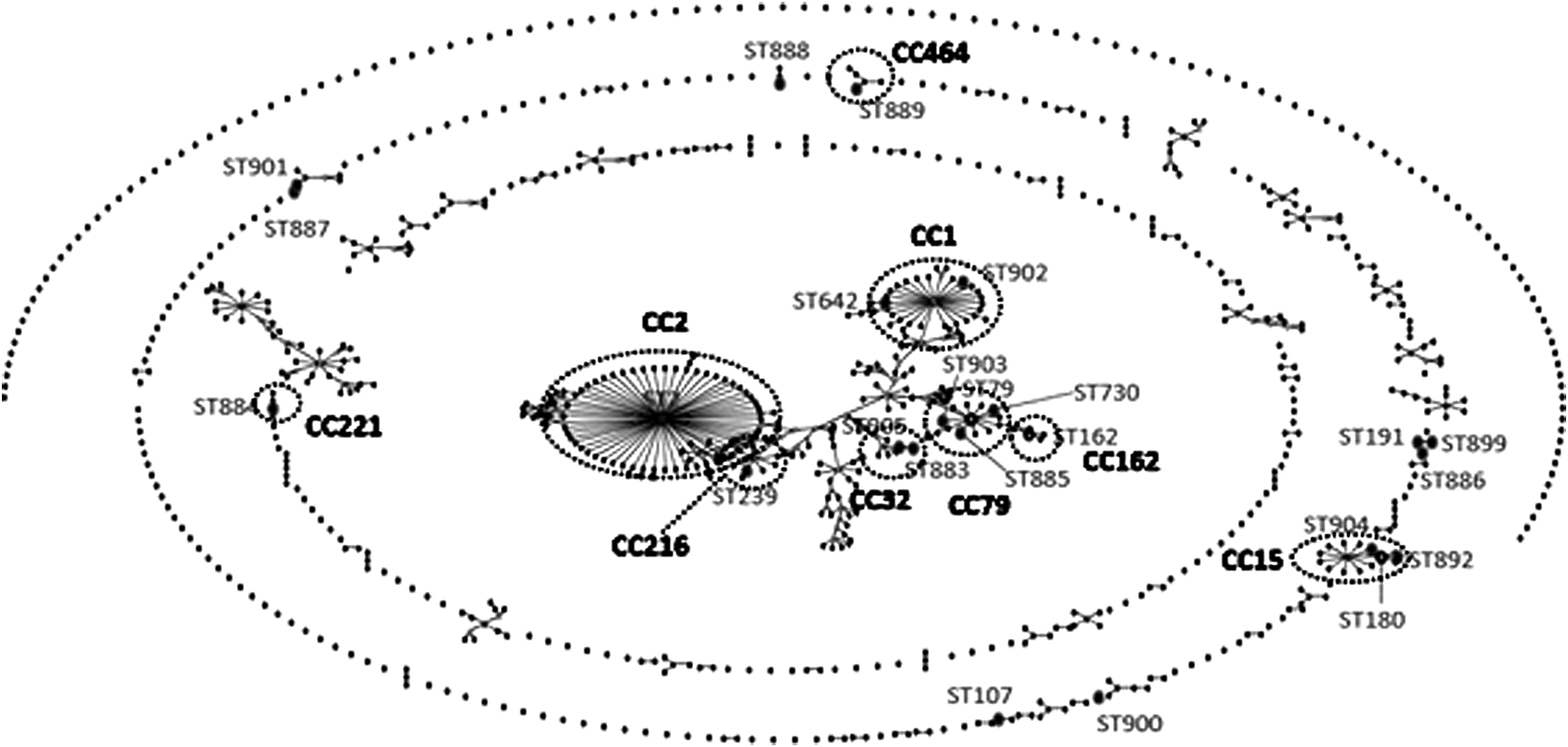
Snapshot of 905 Acinetobacter baumannii STs by eBURST with MLST profiles representing the isolates from the Institute Pasteur database (data accessed on August 5, 2016). STs and CCs determined for strains of this study are in light gray and dark gray, respectively. MLST, multilocus sequence typing; CC, clonal complex; ST, sequence type.
Discussion
Clonal lineages of A. baumannii have long been associated with multidrug resistance, and this feature might confer a selective advantage for their expansion. 2 Brazil has continental proportions and is the biggest country in South America. In face of these characteristics, it is important to be aware of the heterogeneity of the resistant clones circulating in many regions of our country. In this study, we aimed to compare and describe the clonal diversity of CRAB isolates from Porto Alegre city in two different periods: during the first CRAB outbreak (2007–2008) and 5 years later during the endemic period (2013–2014).
The oxacillinase blaOXA-23 has been demonstrated to play an important role in A. baumannii carbapenem-resistant isolates worldwide.2,3 In our study, this gene was observed in all described CCs, demonstrating that blaOXA-23 mobility is not clonal related. This characteristic contrasts with other important carbapanemases, such as KPC in K. pneumoniae isolates that has been associated to a single clonal complex (CC11).
Previous studies reported the dissemination of two major CCs, CC15 and CC79, of multidrug-resistant A. baumannii in different Brazilian states harboring blaOXA-23 gene.5,12 In this study, the predominance of these two clones was corroborated as they were identified in the two periods and in all hospitals evaluated. These data demonstrate not only the capacity of these highly successful clones to play a leading role in the increasing global occurrence of A. baumannii infections, but also to remain in the hospital settings for long periods.
Furthermore, we also identified the high prevalence of CC79 carrying class 2 integrons, as already demonstrated in another Brazilian study. 13 These data corroborate the hypothesis of Martins et al. that indicated the high prevalence of int2 in South America, where CC79 predominates.13–15
Several studies have shown that the international clones I, II, and III (CC1, CC2, and CC3) are spread worldwide, and mainly in Europe and Asia.16,17 In fact, CC1 presents a broad international distribution among 31 countries. 2 In Brazil, a high prevalence of CC1 in the states of São Paulo, Rio de Janeiro, Santa Catarina and Minas Gerais have already been described.12,16 In this study, we identified three strains that belonged to this CC (ST642 and the new ST902), which confirms that CC1 is also disseminated in different regions of our country.
International clone II (CC2) is considered the most marked example of success of the worldwide dissemination of A. baumannii. This clonal complex is extensively identified in outbreaks and among multidrug-resistant isolates in Europe; however, CC2 is less frequent or sporadic in South America. 2 The ST2 (CC2) was reported for the first time in South America in a study by Martins et al. that evaluated isolates from Brazil in 2003. These authors proposed that CC2 was short lived and was replaced by other CCs. 17 Conversely, in our study, CC2 was observed among isolates recovered between 2013 and 2014 (endemic period) that indicated that this CC has been resurged and may become a well-established epidemic clone in Brazil and even in South America.
Finally, we describe that CC15 and CC79 were responsible for the first CRAB outbreak in Porto Alegre city. Furthermore, we could observe the persistence of these CCs from 2007 to 2014. To the best of our knowledge, this is the first study in Brazil, analyzing the population dynamics of A. baumannii clones collected in different periods of time. The results presented call attention to the emergence of CC2 in Southern Brazil, besides the description of novel STs belonging to epidemic CCs, such as ST902 (CC1), STs 885 and 903 (CC79), STs 892 and 904 (CC15) during the past years.
Footnotes
Disclosure Statement
The study was financially supported by CAPES Foundation, Ministry of Education of Brazil, Brasília, Brazil and FIPE/HCPA (Research and Events Support Fund at Hospital de Clínicas de Porto Alegre). A.L.B. and A.F.M. are research fellows from the CNPq, Ministry of Science and Technology, Brazil (458489/2014-0). No competing financial interests exist for other authors.