




Abstract
Efflux-mediated drug resistance in bacterial strains is regarded as a major cause of drug resistance. In this study, we aimed to evaluate the expression of some major facilitator superfamily class efflux pump genes (EPGs) in the presence of ZnO nanoparticles (NPs) conjugated to thiosemicarbazide (TSC) under amine functionalization by glutamic acid (ZnO@Glu–TSC) as well as ciprofloxacin (CIP) among multiple drug-resistant Staphylococcus aureus. Synthesized NPs were characterized by ultraviolet–visible spectroscopy, X-ray diffraction pattern, and transmission electron microscopy. Antibiogram and ethidium bromide agar cartwheel method were used to determine the efflux-mediated multidrug-resistant phenotype of clinical strains. Then, expression of EPGs, including norA, norB, norC, and tet38 among the strains, exposed to ZnO@Glu–TSC and CIP was evaluated using quantitative real-time PCR (qPCR). According to the results, the strains resistant to CIP showed minimum inhibitory concentration (MIC) values ranging from 256 to 1,024 μg/mL, while ZnO@Glu–TSC NPs showed MICs from 8 to 256 μg/mL against bacterial strains, which indicates stronger antibacterial activity of NPs (2-8-fold) compared to CIP. ZnO@Glu–TSC NPs showed a good bacterial inhibitory potential with average inhibition zones of 11, 15, and 20 mm for concentrations of 50, 100, and 150 μg/mL, respectively. Moreover, simultaneous use of ZnO@Glu–TSC NPs (1/2 MIC) in combination with CIP (1/2 MIC) significantly reduced the expression of norA, norB, norC, and tet38 by 5.4-, 3.8-, 2.1-, and 3.4-fold, respectively, compared to the CIP alone. Therefore, ZnO@Glu–TSC NPs with their potent antimicrobial effects could be used as an antimicrobial agent against S. aureus for preventive and/or therapeutic approaches.
Introduction
Extrusion of antimicrobial compounds is one of the major mechanisms used by S. aureus to minimize toxic effects of antimicrobial agents. 1 Efflux pump genes (EPGs) have been found in several life-threatening pathogenic bacteria, including S. aureus, which are associated to multiple drug resistance (MDR) phenotype. 2 In this regard, several EPGs with chromosomal and plasmid origin have been found in S. aureus. 3 Among them, norA, norB, norC, and tet38 are important EPGs associated to MDR. 4 Although the efflux pumps exhibit different specificity to the antimicrobial compounds, but most of them are able to extrude the antimicrobial compounds from different chemical classes. 4 Such features demonstrate the widespread role of the efflux pumps in MDR phenotype. 5
Nevertheless, several studies have been concentrated on the effects of efflux pump inhibitors (EPIs) against bacterial resistance. 5 Various EPIs belonging to the different kinds of chemical classes, including natural and synthetic ones, have been identified. 6 In terms of chemical, among heterocyclic compounds, the indole scaffold is typical of some potent NorA inhibitors such as the alkaloid reserpine, 5-nitro-2-phenyl-1H-indole (INF55), 7 analogs, 8 aldonitrones, 9 hexahydroquinoline derivative, 10 and indole-based NorA inhibitors. 11 These components could eliminate drug resistance in combined mode by increasing the antimicrobial activity of the agents. 12
ZnO nanoparticles (NPs) are one of the foremost NPs used in biological applications, especially because of their potential antibacterial effects. 13 In nanoscale form, ZnO has strong toxicity toward a wide-range of microorganisms, including bacteria, fungi, and microalgae. Antibacterial potential of ZnO has been reported to be mainly associated to the induction of oxidative stress by generation of reactive oxygen species (ROS), which disrupts cellular functions.14–16 Similarly, it has also been demonstrated that thiosemicarbazide (TSC) has numerous biological and pharmacological applications in treatment of central nervous system disorder, bacterial infections as well as analgesic and antiallergic agent. 17 Antibacterial activity of TSC is considered to be mainly due to its ability to form chelates with essential metal ions on the bacterial cell surface which alters bacterial selective permeability. Owing to the contribution of EPs to the MDR phenotype and their clinical consequences, in this study, we synthesized and conjugated TSC with ZnO NPs (to increase the antimicrobial properties of ZnO NPs) and evaluated the effect of ZnO@Glu–TSC in different subinhibitory concentrations on the expression of several EPGs of MDR S. aureus clinical isolates.
Materials and Methods
Synthesis and functionalization of ZnO NPs
The bare ZnO NPs were synthesized by modification of the procedure described by Raoufi.
18
In brief, 20 mL aqueous solution of ammonia (0.1 M) was added to a solution of ZnCl2
ZnO NPs were functionalized by glutamic acid (Glu) via cocondensation reaction. In brief, aqueous solution of ammonia (0.1 M) was added to a solution of ZnCl2
Characterization techniques
XRD, TEM, and UV-Vis
The crystal structure of the prepared ZnO NPs was investigated using powder X-ray diffraction (XRD) (Philips, PW1800), at 50 kV and 40 mA, wavelength of 1.6407 Å in wide angle region from 10° to 80° on 2-Theta-Scale. Transmission Electron Microscopy (TEM) (Zeiss, model EM10C, Germany) images were recorded by sonicating (Misonix S-3000) synthesized ZnO@Glu–TSC NPs in distilled water and carefully put a drop of diluted water containing ZnO@Glu–TSC solution on a formvar carbon-coated grid Cu Mesh 300, and the particle sizes were specified. UV-Vis spectroscopy (Lambda 25; Perkin-ELMER) was used to determine optical properties of the TSC and ZnO@Glu–TSC NPs.
Bacterial strains and antibiotic susceptibility profile
A total number of 42 clinical isolates of S. aureus were collected from different specimens, including blood, sputum, cyst (ovarian, scalp), and urine, from August to October, 2017, in clinical laboratories of Rasht city, Iran. The isolates were identified based on colony morphology and standard biochemical tests. In addition, S. aureus ATCC 25923 was used as standard strains in the experiments. Antibiotic susceptibility profile of the isolates was determined according to the clinical and laboratory standards institute (CLSI) guidelines. 19 Different classes of antibiotics, including ciprofloxacin (CIP), penicillin (P), gentamicin (GM), chloramphenicol (C), erythromycin (E), and tetracycline (TE) were used to obtain a drug resistance pattern of the isolated strains. For further investigation, bacterial strains, which showed resistance to at least three antimicrobial classes, were regarded as MDR strain.
Evaluation of efflux activity by cartwheel assay
All the MDR isolates were evaluated by the EtBr-agar cartwheel assay (EtBrCW) using previously published procedure.
20
Initially, bacterial strains were grown in Tryptic Soy Broth (TSB) until they reached to an optical density of 0.2 at 600 nm. The OD of each bacterial culture was adjusted with phosphate-buffered saline (pH 7.1) to the 0.5 McFarland standard solution. Agar plates containing EtBr with concentrations ranging from 0 to 2 mg/L were prepared. Bacterial cells were swabbed on EtBr-agar plates. The plates were then incubated at 37°C for 16 hr and examined under of UV light. The minimum concentration of EtBr (MICEtBr) with fluorescence emission (FE) from the bacterial mass was recorded, and the index was interpreted as follows:
Minimum inhibitory concentration assay
Minimum inhibitory concentrations (MICs) were determined by the broth microdilution method according the CLSI guideline. 19 In brief, a gradient concentration of different agents, including CIP, ZnO NPs, and ZnO@Glu–TSC in a range of 2–1,024 μg/mL was prepared in 96-well plates and inoculated with 100 μL of the fresh bacterial suspensions with the population of 1.5 × 10 6 CFU/mL. The plates were then incubated at 37°C for 24 hr and the lowest concentration of compound that inhibited visible growth was recorded as MIC. The assay was carried out in triplicates for each bacterial strain.
Antibacterial assay
Antimicrobial properties of the synthesized ZnO NPs and ZnO@Glu–TSC NPs were evaluated against MDR bacteria by agar well-diffusion method. In brief, fresh bacterial cell suspensions with approximate population of 1.5 × 10 8 CFU/mL were inoculated uniformly on the surface of Mueller–Hinton agar plates. Then, wells with ∼6 mm in diameter were prepared and the NPs (dispersed in DMSO 10%) with different concentrations 50, 100, and 150 μg/well were added. The plates were incubated at 37°C for 24 hr. The diameter of the inhibition zone (ZOI) formed around each well was determined. CIP disc (5 μg) and DMSO 10% were used as positive and negative controls, respectively.
RNA extraction and cDNA synthesis
The clinical strains of S. aureus were selected for molecular investigation based on their MDR phenotype, CIP resistance as well as EtBr (2 mg/L) extrusion potential. Fresh Bacterial strains were grown at 37°C in presence of subinhibitory concentrations (1/2, 1/4 and 1/8 MICs) of ZnO@Glu–TSC NPs and constant concentration of CIP (1/2 MIC). For control treatments, the cultures containing CIP alone (1/2 MIC), ZnO NPs alone (1/2 MIC), as well as the culture without any antibacterial agent were prepared. RNA extraction from bacterial cells was performed using the High Pure RNA Isolation Kit AccuZol™ (Bioneer Co., Germany) according to the manufacturer's instruction.
The cDNA was synthesized using SinaClon Kit (CinnaGen™ Co., Iran) according to the manufacturer's protocol. The master-mix containing 1 × buffer, RiboLock RTRNase inhibitor (20 U/μL), 1 mM dNTP mixture, 1 μL Random Hexamer Primers (0.2 μg/μL), and M-MuLV reverse transcriptase (200 U/μL) with 12 μL nuclease-free water were used in a final reaction volume of 20 μL. The microtubes were incubated at 65°C for 5 min, 25°C for 10 min, 45°C for 60 min, and the final elongation at 85°C for 5 min.
Quantitative polymerase chain reaction
Quantitative polymerase chain reaction (qPCR) was conducted in an optical 96-well plate with a BIO-RAD iQ5 real-time PCR system (BIO-RAD). 21 In this regard, the effect of sub-MICs (1/2, 1/4 and 1/8) of ZnO@Glu–TSC NPs and 1/2 CIP (in constant concentration) on the expression of EPGs (norA, norB, norC, and tet38) were evaluated with three technical replicates. The 16s rRNA gene was used as internal control to normalize qPCR data. The qPCR mixture, including 7.5 μL of SYBR Green I/ROX qPCR master mix (Fermentas Co., Germany), 1 μL of each forward and reverse primer (Table 1), 4.5 μL of nuclease-free water, and 2 μL of cDNA were used for each reaction. The thermal cycling conditions were as follows: 50°C for 2 min, 95°C for 4 min, then followed by 45 cycles of denaturation at 94°C for 30 sec, annealing at 59°C for 30 sec, and extension at 72°C for 30 sec. For qPCR data processing, Pfaffl model was performed. 22
Primers Used in This Study
Statistical analysis
One-way ANOVA (Tukey) was used to determine the statistical significance of the data (SPSS. version 18). The p values of 0.05 and 0.01 were considered significant.
Results and Discussion
Synthesis of the NPs
UV-Vis, XRD, and TEM showed the typical characteristics of the synthesized ZnO@Glu–TSC NPs (Fig. 1). TSC and ZnO@Glu–TSC NPs were found to display equivalent absorption peak in about 200–250 nm, which is dedicated to charge-transfer crossing of TSC moiety. ZnO NPs showed a single electronic absorption peak in 350–400 nm, which is considered as the peak belonging to the zinc oxide NPs. The XRD pattern showed that the usual reflective designs (100), (002), (101), (102), (110), (103), (200), (112), (201), and (202) that indicate the wurtzite-type structure of ZnO NPs. 27 Approximate size of conjugated ZnO by TSC under Glu-mediated was evaluated and TEM image demonstrated typical sizes of the ∼100 ± 30. Result indicated that the average diameter obtained from TEM images and XRD pattern agree well.
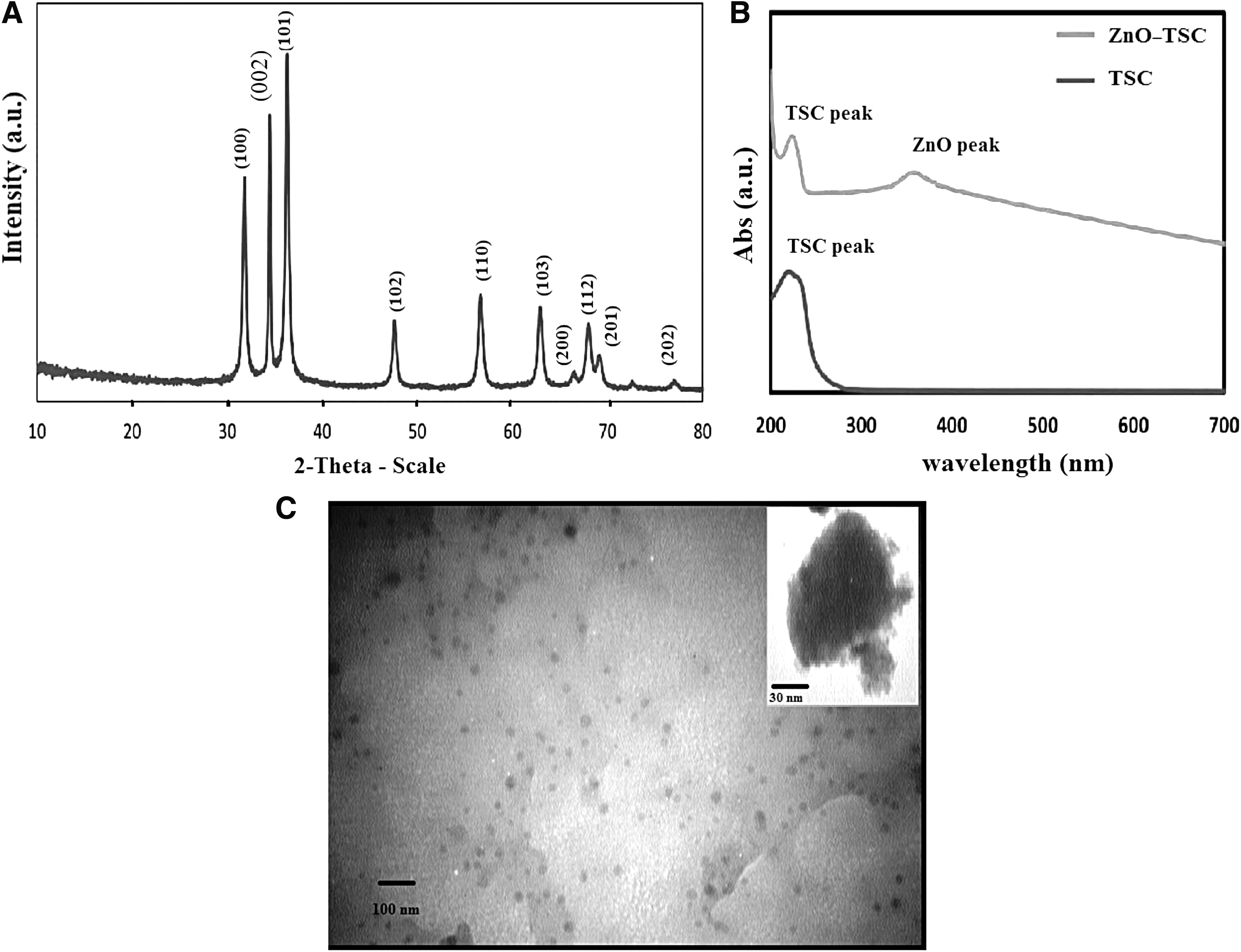
Synthesized ZnO@Glu–TSC NPs
Antimicrobial susceptibility profile and efflux pumps activity
In a preliminary experiment, antimicrobial susceptibility of isolated strains was evaluated, and results indicated that the majority of isolates were resistant to CIP (61.5%), erythromycin (59.1%), tetracycline (92.1%), oxacillin (50%), penicillin (100%), chloramphenicol (38.1%), and gentamycin (54.1%). According to the results, 26 strains (61.1%) showed MDR phenotype (data not shown). To determine the role of efflux activity in resistance to antibiotics, efflux activity was determined in the strains with MDR phenotype and correlated with increased resistance to the antibiotics. In the following, all the MDR isolates were evaluated by the ethidium bromide-agar cartwheel method (EtBrCW) for finding appropriate strains with active efflux system. The result showed that fluorescence of clinical strains SA.B9, SA.B13, and SA.B14 (isolated from blood) and SA.U5 and SA.U6 (isolated from urine) had higher efflux activity compared to the reference strain (Fig. 2). The strains with the highest efflux pump activity were found from blood and urine from intensive care units (ICUs), which could be attributed to the high usage of antimicrobials agents in ICUs. Based on the antibiotic susceptibility profile and efflux pump activity, 14 clinical strains and a reference strain (S. aureus ATCC 25923) were selected for further investigation (Table 2).
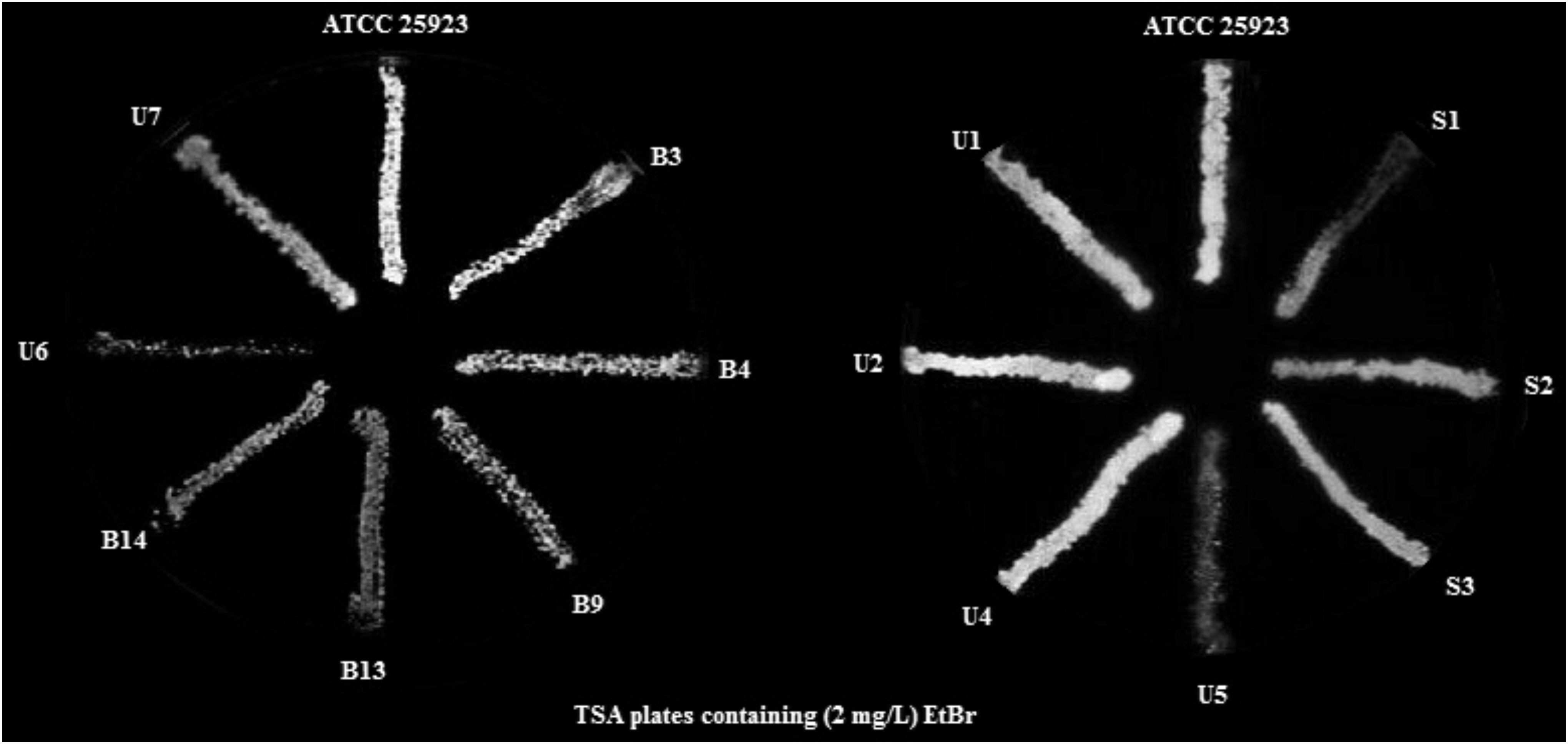
Fluorescence of Staphylococcus aureus strains on TSA plates containing 2 mg/L of EtBr. TSA, Tryptic soy agar.
Antibiotic Susceptibility Profile of the Strains Used in This Study
R, resistant; I, intermediate; S, susceptible; SA, Staphylococcus aureus; B, blood; U, urine, S, skin; MDR, multidrug-resistant; ++, high-level resistance; +, intermediate resistance; −, low resistance.
MDR phenotype was screened according to the antibiotic susceptibility profile.
MIC determination
The Minimum inhibitory concentrations (MIC) of antimicrobial agents (CIP, ZnO NPs, and ZnO@Glu–TSC NPs) were evaluated in the concentrations ranging from 2 to 1,024 μg/mL using 96-well microdilution plates. According to the results, all the clinical strains resistant to CIP showed the MIC values ranging from 256 to 1,024 μg/mL, which indicates high resistance to CIP. In addition, MIC values in a range of 128–1024 μg/mL were recorded for ZnO NPs against bacterial strains. On the contrary, ZnO@Glu–TSC NPs showed potent antimicrobial effects against all strains with MIC values of 8 to 256 mg/L. Our result indicated that TSC conjugated to ZnO NPs enhanced antibacterial activity of ZnO NPs, which significantly reduced the MICs values by 2-16-fold in comparison with ZnO NPs (Table 3).
Determination of Efflux Activity at Different Concentration of EtBr and Minimum Inhibitory Concentration of Multidrug-Resistant Staphylococcus aureus
CIP, ciprofloxacin; SA, S. aureus; MIC, minimum inhibitory concentration.
Bacterial inhibition assay
The average diameter of ZOIs of different agents is displayed in Figure 3. These values indicated that the ZOI increases with increase of the concentration of NPs, while the negative control (10% DMSO), did not form zone of inhibition against bacterial strains. According to the results, the ZnO@Glu–TSC NPs showed higher antibacterial activity compared with the ZnO NPs. Thus, a synergistic activity of TSC and ZnO against bacterial strains was observed, which could be associated to the increased bacterial membrane permeability and facilitated internalization of the NPs into the bacterial cells. TSC is regarded as a chelating agent that reacts as a chemical ligand with conduction metallic ions by coupling via sulfur and hydrazinic nitrogen atoms. Antibacterial activity of TSC could be attributed to the chelation of essential ions such as Mg+2, Ca+2, and Fe+2, which are present on the outer surface of the bacterial membrane. These metal ions provide an electrostatic network around coating individual bacterial cells that associates with many cellular functions, including repression of bacterial autolytic enzymes as well as maintaining the integrity of cell membrane, disruption of the cell membrane, and subsequently causing cell wall permeability with approach of release intracellular content. However, antibacterial activity of ZnO NPs has been reported to be associated to the cell membrane damages via direct or electrostatic interactions with bacterial cell surface that affects permeability of cell membrane and results in cellular internalization of ZnO NPs. Inside the cells, ZnO NPs could generate ROS and thus induce oxidative stress. 28
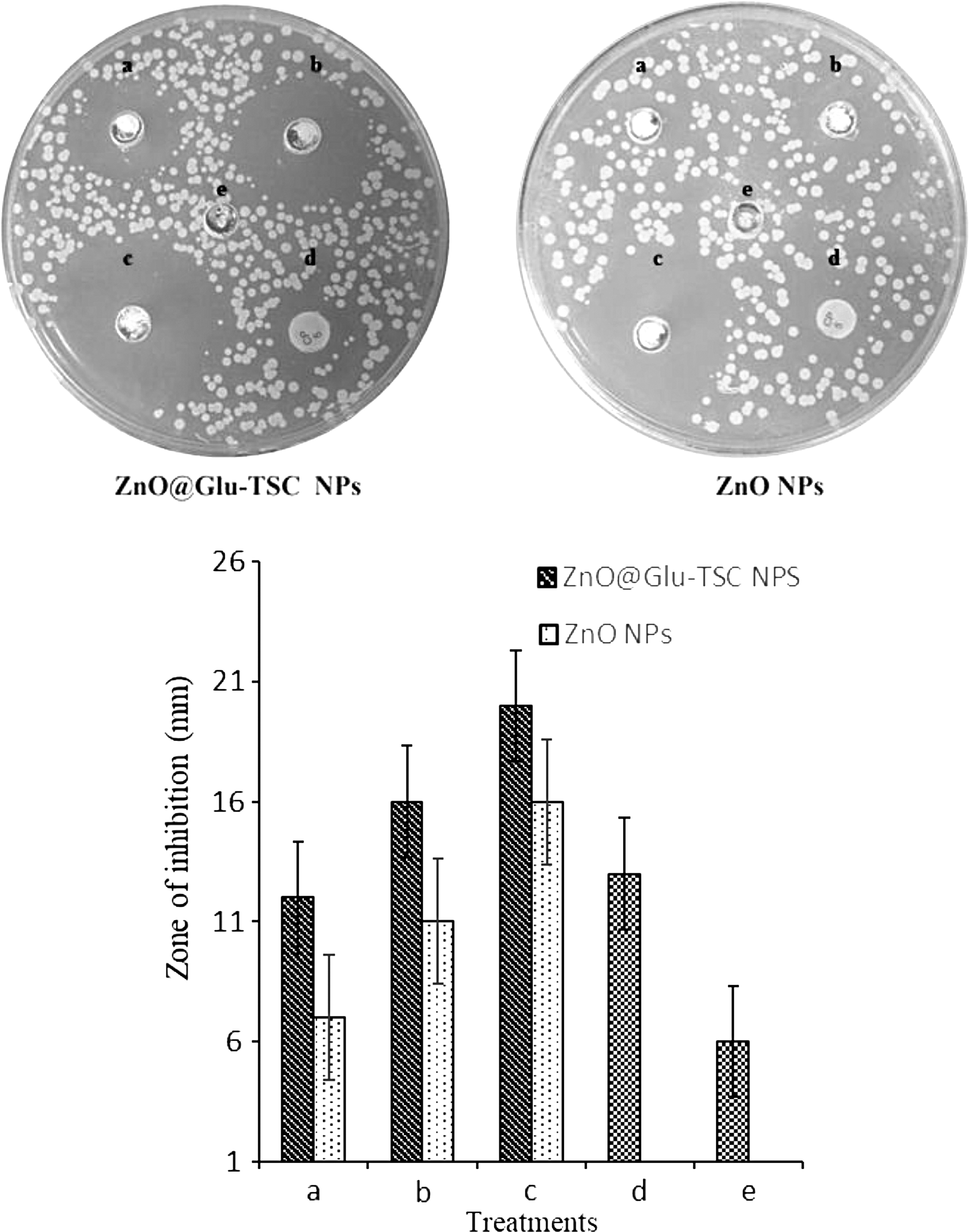
Antimicrobial potential of different concentrations of ZnO@Glu–TSC and ZnO NPs against S. aureus strains. (a) 50 μg/well, (b) 100 μg/well, (c) 150 μg/well, (d) positive standard (ciprofloxacin 5 μg), and (e) DMSO 10% solution (negative control). Zones of inhibition is sum of inhibition halos + well diameter (6 mm). NP, nanoparticle.
Effects of ZnO@Glu–TSC NPs on expression of EPGs
The relative expression of norA, norB, norC, and tet38 EPGs was investigated in S. aureus cultures treated with CIP (1/2 MIC) plus ZnO@Glu–TSC NPs (1/8, 1/4 and 1/2 MIC) and was compared with untreated cells as well as the cultures exposed to CIP or ZnO NPs alone (Fig. 4). Simultaneous exposure of bacteria to CIP at the concentration of 1/2 MIC and ZnO@Glu–TSC NPs (1/4 and 1/2 MIC) significantly reduced the expression of norA, norB, and tet38 EPs genes, while the presence of the NPs at the concentration of 1/8 MIC did not affect expression of all EPGs. Expression of norA, norB, and tet38 reduced by 5.4-, 3.8-, and 3.4-fold, respectively, when bacterial cells were exposed to CIP and ZnO@Glu–TSC NPs at the concentration of 1/2 MIC for either agents (p values < 0.01) compared with the cells exposed to CIP alone. In addition, expression of norC significantly reduced by 2.1 in the presence of CIP and ZnO@Glu–TSC NPs at concentration of 1/2 MICs (p values < 0.05) compared with the cells exposed to CIP alone. However, conversely to other EPGs, expression of norC was not significantly affected by ZnO@Glu–TSC NPs at the concentration of 1/4 MIC. Expression of norA, norB, norC, and tet38 increased to 5.3, 5.0, 4.1, and 5.4, respectively, among the cells exposed to CIP alone, while no significant change was observed for expression of all mentioned genes among the cells treated with ZnO NPs alone. Thus, ZnO@Glu–TSC NPs could inhibit overexpression of EPGs and extrusion of antibiotic among CIP-treated cells, which shows EPI potential of ZnO@Glu–TSC NPs. Thus, a synergism of ZnO@Glu–TSC NPs with CIP against CIP-resistant S. aureus strains was observed by attenuation of EPGs, which could potentially be used for combinatory therapy.

Relative expression of norA, norB, norC, and tet38 EPGs in treated strains. The qPCRs were normalized to 16s rRNA as a reference gene for all comparisons. p values of 0.05 and 0.01 were considered significant with * and **, respectively. Un-T, untreated cells; (A) 1/2 MIC CIP +1/8 MIC ZnO@Glu–TSC NPs; (B) 1/2 MIC CIP +1/4 MIC ZnO@Glu–TSC NPs; (C) 1/2 MIC CIP +1/2 MIC ZnO@Glu–TSC NPs; (D) 1/2 MIC CIP (alone); and (E) 1/2 MIC ZnO@Glu–TSC NPs. CIP, ciprofloxacin; MIC, minimum inhibitory concentration; EPG, efflux pump gene.
Reduction of the expression of EPGs could be associated to the inhibition of transcription of bacterial genes by ROS and/or direct interaction of the NPs with the transcription factors involved with expression of EPGs. 29 It has been demonstrated that some transcription factor genes could be downregulated by ZnO NPs and its derivatives in bacterial cells. 30 Thus, expression of EPGs by ZnO@Glu–TSC NPs seems to be downregulated in a general and/or nonspecific way, which describes similar pattern of reduction observed for all studied EPGs. Inside the cells, ZnO could cause oxidative stress by generation of ROS. The oxidative molecules could interact with different cellular components specially proteins that cause interruption of cellular functions, including transcription and translation. 29 With such an approach, the MDR bacteria, with active efflux pumps, could not extrude the antimicrobial compounds (antibiotics) from the cytoplasm to the extracellular environment. Consequently, the antimicrobial agents inside the bacterial cell could attack their target sites and destroy the bacterial cell.
EPI potential of metal NPs in combination with antibiotics has been reported previously. Copper NPs has been reported to inhibit efflux pump-mediated resistance in S. aureus strains, which reduced the MIC value for CIP by four-fold. 31 In addition, synergistic effect of derivatives of ZnO NPs with antibiotics against bacterial pathogens has been reported. 32 In a study, novel analogs of piperine were evaluated as inhibitor of EPs in a study of Kumar et al. This study indicated that some kind of compounds such as piperine were able to inhibit NorA in S. aureus strains. 33 As a result in our study, synthesized NPs (ZnO@Glu–TSC) with an approximately size of ∼100 ± 30 nm could pass through the cell membrane and enter into the cytoplasm of bacterial with diameter ∼0.5 to 1.5 μm. 34
Conclusion
In conclusion, ZnO@Glu–TSC NPs showed a synergistic antimicrobial potential with ciprofloxacin against MDR S. aureus via attenuation of EPGs and could be regarded as a novel and promising antimicrobial agent in preventive and therapeutic approaches.
Footnotes
Acknowledgments
The authors thank the university of Guilan and Islamic Azad University (Rasht branch) for providing facilities to carry out this work.
This research did not receive any specific grant from funding agencies in the public, commercial, or not-for-profit sectors.
Disclosure Statement
All of the authors have declared that no competing interests exist.