




Abstract
There is an urgent need to be able to identify carbapenemase-producing Enterobacterales. In this study we aimed to compare the performance of the MALDI Biotyper Selective Testing of Antibiotic Resistance-βLactamase (MBT STAR-BL) test with the in-house Carba NP test in their ability to rapidly detect carbapenemase production in Escherichia coli and Klebsiella pneumoniae strains. MBT STAR-BL and Carba NP testing were performed in parallel. One hundred sixty-nine isolates in total were tested. K. pneumoniae (n = 139) and E. coli (n = 14) strains with previously characterized carbapenemase types, and non-carbapenemase-producing strains of K. pneumoniae (n = 8) and E. coli (n = 8), were included in the study. When the results of the ertapenem and meropenem hydrolysis assays were evaluated together, MBT STAR-BL correctly identified 151 out of 153 (99%) carbapenemase producers as positive, while giving false-negative results for OXA-48 and OXA-48+NDM-1 producers in two K. pneumoniae isolates. The specificity and sensitivity of MBT STAR-BL were 100% and 98.69%, respectively. For the Carba NP test we confirmed 100% specificity, but sensitivity was 96.7%, although increasing to 100% when using prolonged incubation timing (4 hours). False-negative results were associated with enzymes with low carbapenemase activity, particularly OXA producers, which are common in Enterobacterales.
Introduction
Carbapenemase-producing Enterobacterales (CPE) are an important and increasing threat to global health. Both clonal spread and plasmid-mediated transmission contribute to the ongoing rise in the incidence of these bacterial types. 1 Therefore, the rapid detection of CPE in routine microbiology laboratories is a key task. Since phenotypic tests are time-consuming and molecular methods are currently insufficient due to the increasing number of new carbapenemases, it is not a trivial matter to be able to detect carbapenem resistance. 2 Carbapenem resistance is mediated by two main processes: (1) the association of decreased outer membrane permeability with plasmid-encoded or chromosome-encoded cephalosporinases and/or Extended-Spectrum beta-lactamases (ESBLs) and (2) the production of carbapenem-hydrolyzing enzymes (i.e., carbapenemases). 3 In two separate studies conducted in 2011, it was demonstrated that MALDI-TOF MS can detect carbapenemase activity, based on mass spectral profiles obtained from carbapenem molecules.4,5 The rise of carbapenem resistance in Enterobacterales is due, in particular, to the dissemination of carbapenemase producers, which are resistant to a majority of antimicrobial molecules. The early detection of such CPE assumes great importance in the prevention of their further dissemination. 6
Unfortunately, neither antibiotic susceptibility testing by disk diffusion methods nor automated systems are sufficiently successful at present in the detection of CPEs. 6 Approximately 20% of CPEs escape detection, especially the OXA-48 producers. 7 Therefore, simple and reliable confirmatory tests are required. 8 The detection of carbapenemases by their hydrolytic activity is currently the best method for detecting all types of carbapenemases, including those considered to be rare, and therefore carbapenemase identification is not included in the commercially available molecular-type tests.9,10 There may be other methods suitable, such as MALDI-TOF MS techniques, the Carba NP test, and its derivatives. Recently, Bruker Daltonik has launched a software module, the MALDI Biotyper Selective Testing of Antibiotic Resistance-βLactamase (MBT STAR-BL) assay, which measures β-lactamase activity by analyzing the hydrolysis of β-lactam antibiotics, providing results within a few hours. 11
Although some previous studies have described the usefulness of β-lactamase activity detection using MALDI-TOF MS, its performance has not been systematically evaluated. 12 The other method under consideration, the Carba NP test, is a biochemical method for the detection of carbapenemase activity in Enterobacterales, Pseudomonas, and Acinetobacter spp.13,14 This test is based on a decrease in pH, resulting from the hydrolysis of the β-lactam ring of carbapenem molecules, which is detected using phenol red as a pH indicator. The aim of this study was to evaluate the performances of MBT STAR-BL assay and the in-house Carba NP test in detecting carbapenem resistance in Escherichia coli and Klebsiella pneumoniae strains.
Materials and Methods
Bacterial strains
A total of 169 clinical carbapenem-resistant and -susceptible K. pneumoniae (n = 147) and E. coli (n = 22) isolates from the collection at Acibadem Labmed Medical Laboratories were included in the study. Duplicate patient samples were not included in the study. Positive control strains harboring carbapenemase genes (blaOXA-48, blaNDM-1, blaKPC, blaIMP, and blaVIM) and negative control strains lacking any carbapenemase gene but harboring genes for extended spectrum beta-lactamase (blaTEM, blaSHV, and blaCTXM) and Amp C beta-lactamase production were also included.
Species identification and antimicrobial susceptibility testing
Initial antimicrobial susceptibility testing had been performed using the VITEK 2 instrument (bioMérieux, France). Strains resistant to at least one of the antibiotics, ertapenem (ETP) or meropenem (MEM), by Vitek 2 according to Clinical & Laboratory Standards Institute (CLSI) criteria were included in the study. All isolates were stored at −80°C in cryopreservation vials (Salubris, Turkey). Frozen stock cultures were used to inoculate subcultures, which were routinely grown on Columbia agar with 5% sheep blood (bioMérieux) and incubated at 37°C. For species identification, MALDI-TOF MS (Bruker Daltonics, Germany) was used. For the isolates tested, ETP (Merck, France) and MEM (Kocak Pharmaceuticals, Turkey) minimum inhibitory concentration (MICs) were determined by reference broth microdilution method according to the CLSI guidelines, using polystyrene microtiter plates (Greiner Bio-One). 15
Carbapenemase detection by in-house multiplex PCR assay
The carbapenemase genes (blaOXA-48, blaNDM-1, blaKPC, blaIMP, and blaVIM) were investigated via an in-house multiplex PCR test. Bacterial DNA was extracted using a boiling method that has been previously reported. 16 The PCR cycles were as follows: 10 minutes at 94°C, then 35 cycles consisting of 30 seconds at 94°C, 40 seconds at 56°C, 50 seconds at 72°C, and 5 minutes at 72°C on the thermal cycler (Applied Biosystems ProFlex PCR System, Thermo Fisher Scientific). 17 For the visualization of PCR products obtained, 2% agarose gel stained with SYBR gold was used and monitoring was performed using an ORTE device (Salubris Technica, Istanbul, Turkey).
MBT STAR-BL assay
The MBT STAR-BL assay, including the calibration step, was performed according to the manufacturer's instructions. The bacteria were cultured overnight at 37°C on 5% sheep blood agar. A full loop of bacteria was suspended in 50 μL of solution (10 mM NH4HCO3, 10 μg/mL ZnCl2, pH 8) containing the respective antibiotic [1 mg/mL MEM (Kocak Pharmaceuticals) or 0.1 mg/mL ETP (Merck)]. The prepared solution was then incubated at 37°C for 2–4 hours with agitation at 900 rpm, and afterward centrifuged for 2 minutes at 2000 rpm. The supernatant (1 μL) was transferred onto the MALDI target plate. Duplicate testing was done for each specimen. After drying, the spots were overlaid with 1 μL of matrix solution (consisting of 10 mg/mL α-cyano-4 hydroxy-cinnamic acid in 50% acetonitrile and 0.1% trifluoroacetic acid). The dried spots were analyzed with the Microflex LT (Bruker Daltonics) instrument with flexControl 3.4 (Bruker Daltonics). Each spot was analyzed four times. The spectra were analyzed using MBT Compass software with the STAR-BL module (Bruker Daltonics), which automatically performed the subsequent processing. The mass ranges of the non-hydrolyzed and hydrolyzed forms of the antibiotic were automatically searched for, looking for their respective signal peaks. 11
The intensities of the respective peaks were used to calculate the logRQ value (a measure of hydrolysis efficiency), which is the logarithm of the ratio of the summed intensity of the decarboxylated hydrolyzed form at 358 m/z and hydrolyzed form at 402 m/z to the summed intensity of the non-hydrolyzed form (peaks of [M+H]+ at 384 m/z and the sodium adduct [M+Na]+ at 406 m/z). A product of 380 m/z also can be detected in case of HCCA matrix masked by the alpha-cyano-4-hydroxycinnamic acid (HCCA) matrix double-charged ion, which is a sodium salt of the decarboxylated product. Higher logRQ values indicated a higher degree of antibiotic hydrolysis. LogRQ values were normalized using negative and positive controls. Normalized logRQ values >0.4 or <0.2 indicated positive or negative results for β-lactam hydrolysis, respectively. Values between 0.2 and 0.4 were considered indeterminate. 18
In-house Carba NP test
The Carba NP test was performed according to CLSI recommendations. For each strain, two microcentrifuge tubes (1.5 mL), labeled “a” and “b,” were used. The bacterial colonies grown on 5% sheep blood agar were collected after 24 hours and a loopful of bacteria (∼10 μL) was added into 100 μL of bacterial protein extraction reagent (BPERII; Thermo Scientific, Pierce) and stirred for 5 seconds. From solutions A (containing zinc sulfate and phenol red, pH 7.8 ± 0.1) and B (containing solution A and 6 mg/mL imipenem; Merck), 100 μL solution was added to the a and b tubes, respectively, which were then incubated at 35°C ± 2°C for up to 2 hours. The results were interpreted according to the color changes occurring within the tubes. The carbapenemase-producing ATCC BAA 1705 K. pneumoniae was used as a positive control, and ATCC BAA 1706 K. pneumoniae was used as a negative control. Microcentrifuge tubes containing bacterial protein extraction reagents alone were prepared as a reagent control. If imipenem had been hydrolyzed, the color of the tube's contents turned from red to orange, or yellow, which was interpreted as a positive Carba NP test, whereas the tubes containing bacterial extracts of isolates with no carbapenemase activity remained red. 12 In cases where false-negative results occurred, we made two modifications to the procedure (i.e., we increased the amount of bacteria tested and lengthened the incubation time). 19
Results
According to the PCR assay, 153 (consisting of 14 E. coli, 139 K. pneumoniae strains) of the 169 isolates were positive for carbapenemase genes, and 16 (8 E. coli, 8 K. pneumoniae) were negative. For the strains tested, the results of MBT STAR-BL, the in-house Carba NP test, and the MIC ranges are shown in Table 1. False-positive results were not detected among non-carbapenemase producers with either of the methods. However, two false-negative results were given by MBT STAR-BL for two of the K. pneumoniae isolates: one isolate harbored OXA-48; the other one harbored OXA-48+NDM. These isolates were positive by PCR. For these isolates both PCR and STAR-BL testing were performed twice. PCR was performed using both multiplex and separate primers (OXA-48, NDM-1, IMP, VIM, and KPC).
Results of BMD, MALDI STAR-BL, and In-House Carba NP
The time of ETP hydrolysis incubation was 4 hours for Oxa 48 strains and 2 hours for the others.
The time of MEM hydrolysis incubation was 2 hours for all strains.
Hydrolysis of at least one carbapenem used in the test was interpreted as positive.
Non-hydrolysis of ETP and MEM was interpereted as negative.
Color changing from red to yellow interpreted as positive.
Color remaining in as red was interpereted as negative.
BMD, broth microdilution; ETP, ertapenem; MBT STAR-BL, MALDI Biotyper Selective Testing of Antibiotic Resistance-βLactamase; MEM, meropenem; MIC, minimum inhibitory concentration.
Five Oxa-48 producer isolates were detected as negative by Carba NP. All the control strains gave the expected results (Fig. 1). The specificity and sensitivity of MBT STAR-BL were 100% and 98.7%, respectively. For the Carba NP test, 100% specificity was achieved, while the sensitivity was initially 96.7%, but increased to 100% using prolonged incubation timings, such as from 2 to 4 hours.
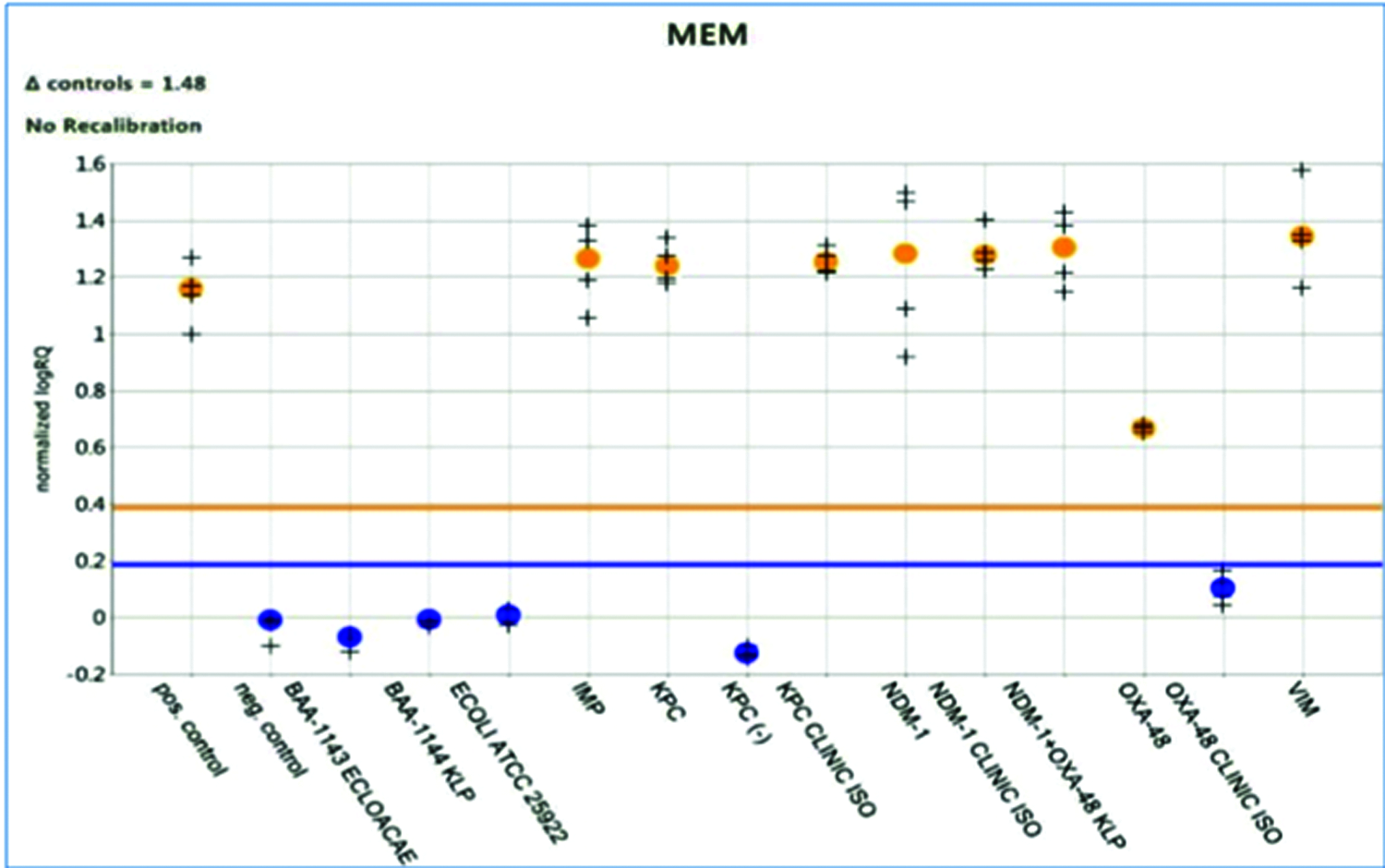
Exemplary study results obtained by the STAR-BL test for both clinical and reference isolates with MEM. Isolates below the blue bar are negative for MEM hydrolysis; isolates above the orange bar are positive for MEM hydrolysis according to the interpretation of MBT STAR-BL software. MBT STAR-BL, MALDI Biotyper Selective Testing of Antibiotic Resistance-βLactamase; MEM, meropenem. Color images are available online.
Discussion
In most previous studies involving MALDI-TOF MS technology, there was no hydrolysis step and no special software was used. Accordingly, such study results revealed low sensitivity. Studies of previous in-house methods developed on the basis of MALDI-TOF have reported a lack of sensitivity with respect to the detection of OXA-48-like carbapenemases.20,21 The addition of bicarbonate has, however, improved the detection of OXA-48. 22 The MBT STAR-BL test was developed by Bruker Daltonics using MALDI-TOF MS technology for carbapenemase detection via special software. In the MBT STAR-BL study, ammonium bicarbonate was added, which could explain the higher number of positive results seen in the study.
In this study we also performed the Carba NP test, which is recommended by CLSI for use concurrently with other methods. In countries where OXA-48 is common, such as in Turkey, rapid Carba NP tests are not fully satisfactory due to the low hydrolytic activity of such strains. A common observation from earlier studies was the limited ability of the Carba NP test to detect isolates producing OXA-48 or certain weak carbapenemases. 23 Accordingly, we tried to use a more reliable method for the rapid detection of carbapenemase and compared MALDI STAR-BL study results with in-house CARBA NP testing.
Our results conformed to our expectation: more satisfactory results with MBT STAR-BL for OXA-48 carbapenemase producers were achievable. Due to local epidemiological factors, one limitation of our study was that it was based on an atypical collection of strains (i.e., one containing a large number of OXA-48). However, our results do show that the MBT STAR-BL test discriminates between carbapenemase producers (including OXA-48 isolates) and non-carbapenemase producers with high levels of sensitivity and specificity.
There have been a few similar studies; for example, in a study by Papagiannitsis et al. the MALDI-TOF MS–based MBT STAR-BL assay and Carba NP test performed well, exhibiting excellent specificity (100%). The sensitivity of MBT STAR-BL and Carba NP were 98% and 76%, respectively. The Carba NP test had a lower sensitivity due to false-negatives obtained with OXA-48-type producers. 22 Knox et al. compared the diagnostic accuracy of the Carba NP test with that of a straightforward MALDI-TOF MS method in detecting CPE. Using PCR as the reference method, both tests had a sensitivity of 87% and a specificity of 100%. 24
In our study, we evaluated the Carba NP test and the MALDI-TOF MS–based MBT STAR-BL assay. The sensitivity, specificity, positive predictive value, and negative predictive value for Carba NP were 96.7%, 100%, 100%, and 76.1%, respectively. The sensitivity, specificity, positive predictive value, and negative predictive value for MBT STAR-BL were 98.7%, 100%, 100%, and 88.9%, respectively. As a result, MALDI-TOF–based MBT STAR-BL results were better than those obtained with Carba NP, and similar among studies.
In the MBT STAR-BL study, the incubation period for ETP hydrolysis of the OXA-48-positive strains was extended from 2 to 4 hours, in line with the manufacturer's recommendations. 11 When we analyzed the hydrolysis results, 92% of all OXA-48 were positive for ETP hydrolysis, while 87% were positive for MEM. However, using the criterion that hydrolysis of any one antibiotic is admissible evidence, 99% of all OXA-48 strains were detectable by MBT STAR-BL. Only one of the OXA-48 strains gave a negative hydrolysis result with both ETP and MEM. The ETP and MEM MIC results of this strain were 2 and 4 mg/L, respectively. Our study also indicated that the MBT STAR-BL assay enabled the detection of OXA-48 CPE strains, regardless of MIC value. In total, 97 out of 98 (98.9%) OXA-48 producers were correctly identified as positive, even those exhibiting a low MIC for ETP and/or MEM. Similarly, in OXA-48+NDM-1 strains, when we evaluated the hydrolysis results separately, 97% of those strains were positive for ETP hydrolysis and 91% of them were positive for MEM hydrolysis. With regard to the positivity of hydrolysis of at least one of the two antibiotics, 97% of the carbapenemase activity of the OXA-48+NDM-1 strains were detectable by MBT STAR-BL. Only one OXA-48+NDM-1 strain gave a false-negative result by MBT STAR-BL. The ETP and MEM MICs were both high (64 mg/L). Carbapenemase production by all carbapenemase-positive strains, besides OXA-48 and OXA-48+NDM-1, was detected by MBT STAR-BL with 100% sensitivity and specificity. Recently, the addition of ammonium bicarbonate to the reaction buffer for the MALDI-TOF MS assay dramatically improved its sensitivity (to 98%) as was shown via automatic interpretation by the MBT STAR-BL program. 20
Overall, the Carba NP method was easy to perform, inexpensive, and, in most cases, easy to interpret, especially on KPC and NDM producers (the color indicator turned yellow within 30 minutes). We could only include one KPC, while admittedly several such strains have been found in Turkey. Carbapenemase production by this strain was detected as positive by both methods. Due to the extremely rapid hydrolysis by KPC, we could detect positive carbapenemase activity in the Carba NP test within the first 5 minutes. Nevertheless, the results were less than optimal with some strains that harbored OXA-48. Five OXA-48 strains gave false-negative results with the Carba NP test. For these isolates, the ranges of ETP and MEM MICs were 1–4 and 0.25–1 mg/L, respectively.
Tijet et al. evaluated the Carba NP test against a panel of 244 carbapenemase-producing and non-carbapenemase-producing Pseudomonas aeruginosa isolates. They confirmed 100% specificity and positive predictive value of the test, but the sensitivity and negative predictive values were 72.5% and 69.2%, respectively, which increased to 80% and 77.3%, respectively, when using a more concentrated bacterial extract. In that case, 15 initially false-negative OXA-48 producers were able to be counted as positive. False-negative results were associated with mucoid strains or linked to enzymes with low carbapenemase activity, particularly OXA-48 and the like, which has emerged globally in Enterobacterales. 19
Similarly, we tried some modifications to exclude weak lysis as a factor and thus obtain improved results. We performed a second study extending the incubation period (from 2 to 4 hours) and involving a more concentrated extract (in this case, three loopfuls rather than one) for the Carba NP test and achieved more satisfactory results correspondingly. Five initially false-negative OXA-48 producers could be counted as positive, and in this way the sensitivity, specificity, positive, and negative predictive values increased to 100% for the Carba NP test.
In total, some 16 strains, which were confirmed by PCR as lacking the carbapenemase genes, were identified as negative by each of the methods used. Thus, both tests showed a specificity of 100%, which implies the suitability of either or both screening methods. The STAR-BL module integrated into the MALDI-TOF MS system produced highly accurate results for the isolates tested. For clinical laboratories, the MALDI-TOF MS–based MBT STAR-BL program can easily be implemented as a solution and offers an alternative to the Carba NP test. According to the results of the present study, the main advantage of MALDI-TOF MS is the possibility of better detection of OXA-48 producers. The main disadvantage of MALDI-TOF MS is the extra time required for incubation (4 vs. 2 hours).
In conclusion, both the Carba NP and MBT STAR-BL tests performed well. In particular, in developing countries where OXA-48 strains are common or, indeed, endemic, either Carba NP or MBT STAR-BL may be useful in the widespread screening of carbapenemase activity. For laboratories that already possess a MALDI-TOF MS instrument, the MBT STAR-BL test offers an option for rapidly detecting this highly important mechanism of resistance.
Footnotes
Disclosure Statement
No competing financial interests exist.