




Abstract
Antimicrobial resistance (AMR) is a global health issue, particularly when it affects critically important antimicrobials such as third-generation cephalosporins (3GC). The objective of this study was to characterize Escherichia coli isolates from healthy chickens in Québec in farms where ceftiofur has been administered to chickens in ovo over a long period with regard to their AMR, multidrug resistance (MDR), potential virulence, clonality, and possession of plasmids of the incompatibility groups carrying extended-spectrum beta-lactamases (ESBLs)/AmpC genes. More than 62% of indicator isolates were MDR with resistance observed for each of the nine classes of antimicrobials tested by disk diffusion. 3GC resistance was encoded by the blaCMY-2 gene (26.7% in indicator isolates), whereas blaCTX-M was only detected in isolates selected after supplementation with ceftriaxone (3 blaCTX-M-1 isolates). Examination of blaCMY-2-positive isolates by pulsed-field gel electrophoresis showed clustering of isolates originating from different floors of the livestock building within farms. The blaCMY-2 gene was carried on replicon plasmids FIB, I1, K/B, and B/O, whereas blaCTX-M-1 gene was located on I1 as demonstrated by transformation experiments; some of these plasmids cotransferred nonsusceptibility against tetracycline or sulfonamides. In addition, six isolates, of which three were AmpC-producers, were defined as potential human extraintestinal pathogenic E. coli. In summary, this study showed that ESBLs/AmpC-producing E. coli isolates from apparently healthy chickens in Québec, Canada predominantly possess blaCMY-2 rather than blaCTX-M maybe because of the in ovo use of ceftiofur to prevent omphalitis and may be spread through clones or plasmids, and that some of these isolates could be capable of infecting humans.
Introduction
Escherichia coli is a part of the normal intestinal microflora of animals and humans; however, some strains are able to cause intestinal and extraintestinal infections in their hosts. Extraintestinal pathogenic E. coli (ExPEC) consists of strains possessing virulence factors allowing them to cause extraintestinal infections. ExPEC are subgrouped as human pathogenic strains, namely uropathogenic E. coli, neonatal meningitis E. coli, and sepsis-associated E. coli that causes urinary tract infections, neonatal meningitis, and sepsis infections, respectively; and avian pathogenic E. coli (APEC), the etiological agents of avian colibacillosis. APEC is responsible for major economic losses because of morbidity, mortality, and carcass condemnations worldwide. 1
Several virulence factors are associated with APEC isolated from chickens with colibacillosis including adhesins (F1- and P-fimbriae), iron acquisition systems (aerobactin and yersiniabactin), hemolysins (hemolysinE/F and temperature-sensitive hemagglutinin), resistance to the bactericidal effects of serum and phagocytosis (outer membrane protein, iss protein, lipopolysaccharide, capsule and colicin production).2,3
Isolates associated with avian colibacillosis mostly belong to serogroups O1, O2, O5, O8, O18, and O78. 4 Increasing infection pressure in the environment, infection with Newcastle virus or Mycoplasma, and excess of ammonia or dust in the environment are factors that predispose birds to develop colibacillosis. 5 Studies based on genetic similarities 6 or animal models of human infection 7 have suggested that certain ExPECs found in the digestive tract of the chicken may also cause human infections.
Spread of antimicrobial-resistant (AMR) E. coli from chickens to humans has been documented.8,9 In enterobacteria, AMR mainly occurs as a result of the oral use of antimicrobials. These bacteria acquire resistance genes and/or mutations in their chromosomal DNA to survive and maintain their microbial homeostasis in the host intestinal tract. 10 AMR in avian E. coli has reached high levels, affecting antimicrobials critically important in human health, such as third-generation cephalosporins (3GC) and fluoroquinolones. The most common mechanism of resistance to 3GC is the production of extended-spectrum beta-lactamases (ESBLs) and AmpC-beta-lactamases. E. coli producing these enzymes, namely ESBL type CTX-M and AmpC type CMY-2, were first reported in chickens by Brinas et al. 11 before their detection worldwide.
Ceftiofur, a 3GC, has been administered in ovo for a long time in Canada in broiler chickens to prevent omphalitis. However, ceftiofur was voluntarily withdrawn in 2005 before its partial reinstitution in broiler chickens in mid-2007. 12 This preventive use of ceftiofur in hatcheries has been definitely banned since May 201413; prevalence of ceftiofur resistance in E. coli isolated from chickens in Québec was 20% in 2016. 14 This in ovo use has been associated with an increase in ceftriaxone resistance in E. coli and Salmonella enterica serovar Heidelberg in both chicken and humans. 15 However, little is known about the relative role of clones and plasmids in the spreading of AMR and the association of these clones and plasmids with virulence.
Our hypothesis is that, because of the systematic in ovo use of ceftiofur, ESBLs/AmpC genes are highly prevalent among E. coli isolated from chickens in Québec and that certain plasmids and clones are involved in 3GC resistance and bacterial virulence. The objective of this study was to characterize E. coli isolates from healthy chickens in Québec in farms where ceftiofur has been administered to chickens in ovo over a long period with regard to their AMR, multidrug resistance (MDR), virulence, clonality, and possession of replicon plasmids carrying ESBLs/AmpC genes.
Materials and Methods
Sampling method
Chicken fecal samples collected from June 2011 to February 2012 in a previous study were used. 16 These samples originated from chicken houses practicing thinning (i.e., partial depopulation of a flock over the course of raising to optimize space when producing heavy birds) and located in the region of Saint-Hyacinthe, Québec, Canada. A list of farms practicing thinning was obtained from the Québec association of chicken farmers. The first 12 farmers who agree to participate were recruited.
Study farms housed 20,000–30,000 chickens aged from 35 to 40 days at the time of sampling. These farms were all family businesses; the chicks came from three hatcheries and were supplied by three different mills.
A total of 35 fresh fecal samples from the pen floor, each consisting of 5 samples taken in different parts of the house, were collected just before thinning and transported in a cooler at the OIE reference laboratory for E. coli (EcL) and stored at −70°C before processing.
Isolation of E. coli and establishment of E. coli collections
Each pooled fecal sample was homogenized 1/10 (weight/volume), after thawing, in buffered peptone water, filtrated and the filtrate streaked on MacConkey plates and incubated overnight at 37°C to obtain E. coli primary cultures. We used 29 samples from the 7 farms that were studied previously7,16 to establish the following three collections of isolates (Supplementary Fig. S1).
Indicator E. coli collection
Four morphologically different lactose-positive isolates on MacConkey agar, that were positive for the uidA gene encoding β-glucuronidase, a housekeeping gene in E. coli, were selected. Polymerase chain reaction (PCR) conditions used to detect uidA gene included initial denaturation (95°C, 2 min), 24 cycles of denaturation (94°C, 30 sec), annealing (65°C, 30 sec), extension (72°C, 30 sec), and final extension (4°C).
Specific collections
Potential ExPEC collection
A pool of five lactose-positive isolates on MacConkey agar was screened by PCR for each of the 29 samples for the presence of iucD, tsh, and papC virulence genes. When the pool was positive for at least one of these virulence genes, each isolate was individually tested for the same virulence genes. Positive isolates were selected, tested for uidA gene, and considered as potential ExPEC isolates. 7
Potential ESBL/AmpC-producer collection
We used the protocol described previously by Agersø et al. 17 with some modifications. In brief, 50 μL of the culture stored at −80°C was inoculated in 5 mL of peptone water. After 30 min of incubation at 37°C, 20 μL of the broth was streaked on MacConkey agar supplemented with 1 mg/L of ceftriaxone. After overnight incubation at 37°C, four lactose-positive colonies per sample, when available, were selected and confirmed as E. coli by the presence of the uidA gene.
Characterization of E. coli isolates
Antimicrobial susceptibility test
All isolates from the indicator E. coli, potential ExPEC and potential ESBL/AmpC collections were tested against 14 antimicrobials of 9 classes using the disk diffusion (Kirby–Bauer) assay as previously described.18–20 The antimicrobials tested were those used in the Canadian Integrated Program for AMR Surveillance. 21 The E. coli ATCC 25922 was used as quality control strain. Isolates nonsusceptible (intermediate or resistant) to three or more classes of antimicrobials were considered to be MDR. 22 In addition, the potential ESBL/AmpC collection was used to classify isolates as presumptive ESBL or presumptive AmpC using the European Food Safety Authority's criteria. 23
AMR genes
Seventy-one randomly selected indicator E. coli isolates and 45 potential ExPEC isolates (representing the different virulence profiles in each sample) were examined for 13 AMR genes. These AMR genes included those encoding resistance against streptomycin (aadA1), tetracycline (tetA, tetB, and tetC), trimethoprim (dfrA1, dfrA5, and dfrA7), quinolones (qnrB), and β-lactams (blaTEM, blaSHV, blaOXA-1, blaCTX-M, and blaCMY-2). In addition, 59 isolates were selected among the 99 potential ESBL/AmpC isolates that were resistant or intermediate to at least one cephalosporin and tested for the presence of beta-lactamase genes (blaTEM, blaSHV, blaOXA-1, blaCTX-M, and blaCMY-2). All these tests were performed by PCR as described previously. 24
Virulence genes and phylogenetic groups
All isolates from the indicator E. coli and potential ExPEC collections tested above for AMR genes, in addition to some potential ESBL/AmpC that were positive to the blaCTX-M or blaCMY-2 gene, were examined by PCR for the presence of 10 virulence genes encoding for siderophores (iucD and iroN), toxins (hlyF), adhesins (papC, tsh, afa, and sfa), and protectins (kpsMII, ompT, and iss). Each isolate was also tested to be assigned to one of the seven phylogenetic groups A, B1, B2, C, D, E, and F. 25
All primers used in this study were summarized in our previous study. 24
Serotyping
Thirty-eight blaCMY-2-producing isolates randomly selected and three blaCTX-M-positive isolates were tested for 86 O-serogroups by standard agglutination methods as previously described.26,*
Pulsed-field gel electrophoresis
To estimate their clonal relationship, the 38 blaCMY-2-producer isolates were subtyped by pulsed-field gel electrophoresis (PFGE) using XbaI restriction enzyme as described previously. 27 The similarities of profiles were compared using a Dice coefficient at 1% tolerance and 0.5% optimization, and a dendrogram was generated in BioNumerics (Applied Maths) software (v. 6.6) with the unweighted pair-group method and arithmetic average (UPGMA) clustering method. Clusters were defined as isolates sharing at least 60% of similarity (cutoff value) 28 as estimated by BioNumerics from the dendogram. PFGE groups were defined as isolates sharing at least 80% of similarity and pulsotypes as isolates sharing 100% identity. 29
Plasmid characterization
Plasmid PCR-based replicon typing (PBRT) was performed in isolates serotyped for identification of 21 replicon plasmids as previously described.30,31 Plasmids were purified in wild-type isolates using the QiaFilter Midi kit (Qiagen, Inc.), following the manufacturer's instructions. Purified plasmid DNA of 30 blaCMY-2 and three blaCTX-M-producing isolates was used to examine transferability of plasmids carrying ESBL/AmpC genes into E. coli DH10B Electromax™ competent cells (Invitrogen, Calsbad, CA) using electroporation.
Transformants were selected on Mueller Hinton agar supplemented with ceftriaxone 2 μg/mL as described by Mnif et al. 32 Up to five transformants per transformation experiment, when available, were screened by PCR for the presence of replicon plasmids and ESBL/AmpC genes. Selected transformants were thereafter tested for their susceptibility to the 14 antimicrobials using the disk diffusion method as described previously.
Statistical analysis
Prevalence of AMR by antimicrobials was estimated at the isolate and farm levels. At the isolate level, prevalence estimates were adjusted for clustering by farms and presented by type of samples. Prevalence with 95% confidence intervals of potential virulent APEC, potential ExPEC, and ESBL/AmpC genes in subcollection isolates was also estimated at the isolate and farm levels.
At the isolate level, estimates were adjusted for clustering by farms and sampling weights when applicable; the weights were computed as the inverse of the number of isolates selected in a sample over the total number of isolates from the sample (without consideration of the morphology of isolates). Prevalence estimates were carried out using the freq or surveyfreq procedure of SAS software version 9.4. For estimation at farm level, a farm was considered positive when at least one isolate nonsusceptible to antimicrobials, defined as MDR, potential virulent APEC or positive for AMR gene, virulence gene, and so on was detected.
Results
Isolate collections
In the indicator E. coli collection, four morphologically different isolates were obtained from each sample except for five samples from which only two lactose-uidA-positive isolates were obtained and seven from which three isolates were obtained, giving a total of 99 indicator E. coli isolates recovered from the 29 samples (Supplementary Fig. S1). In the potential ExPEC collection, after testing 5 isolates per sample, 1–3 isolates per sample positive for at least 1 of the 3 virulence genes iucD, tsh, and papC were obtained, resulting in 69 potential ExPEC isolates recovered from 28 samples. Finally, in the potential ESBL/AmpC collection, 21 samples each yielded 4 morphologically different isolates and the eight others each provided 3 isolates, resulting in 108 potential ESBL/AmpC isolates.
Prevalence of antimicrobial nonsusceptibility in isolates and farms
At the isolate level, the highest level of nonsusceptibility was observed for tetracycline, followed by streptomycin, sulfisoxazole, ampicillin, and trimethoprim–sulfamethoxazole. The lowest level of nonsusceptibility was observed for ciprofloxacin, nalidixic acid, chloramphenicol and kanamycin (Table 1).
Prevalence in Isolates and Farms of Nonsusceptibility in Indicator Escherichia coli Isolates from Healthy Broiler Chickens in Saint-Hyacinthe Region, Quebec, Canada
Category of human antimicrobials importance according to the World Health Organization (WHO) 57 : (I) Very High Importance, (II) High Importance, (III) Moderate Importance.
Antimicrobial classes: (FLQ) Fluoroquinolones; (PEN/I) Penicillin+β-Lactamase inhibitors; (CPS) Cephalosporines; (PEN) Penicillin; (CPM) Cephamycin; (AMG) Aminoglycosides; (FOL) Folate inhibitors; (PHE) Phenicols; (TET) Tetracyclines.
Antimicrobials: NAL, Nalidixic acid; CIP, Ciprofloxacin; AMC, Amoxicillin/clavulanic acid; TIO, Ceftiofur; CRO, Ceftriaxone; AMP, Ampicillin; FOX, Cefoxitin; GEN, Gentamicin; KAN, Kanamycin; STR, Streptomycin; SXT, Trimethoprim-sulphamethoxazole; SSS, Sulfisoxazole; CHL, Chloramphenicol; TET, Tetracycline.
Of the 29 samples, 4 (13.8%) had indicator isolates with the same antimicrobial susceptibility pattern, 9 (31.0%) had isolates with 2 profiles, 11 (37.9%) with 3 profiles and 5 (17.2%) with 4 different profiles. Sixty-two (62.6%) indicator E. coli isolates were nonsusceptible to at least one antimicrobial in at least three classes of antimicrobials, thus classified as MDR. Multidrug resistance against three or six antimicrobial classes (MDR3 or MDR6) was more frequently observed in isolates (19.2% each) followed by MDR4 (14.1%); extensively drug-resistant (XDR) isolates (i.e., extensively drug resistant, isolates that remain susceptible to a maximum of two categories) was also observed (Fig. 1).

Multidrug resistance prevalence in indicator Escherichia coli (n = 99 isolates), potential ExPEC (ExPEC, n = 69), and potential ESBL/AmpC (ESBL/AmpC, n = 108) E. coli isolated from seven broiler chickens farms in Saint-Hyacinthe region, Québec, Canada, according to nonsusceptibility profiles. Susceptible: susceptible to all classes of antimicrobials; nonsusceptible 1–9: nonsusceptible to 1 up to 9 classes of antimicrobials; isolates nonsusceptible to 3 up to 7 antimicrobials were considered to be multidrug resistant, isolates nonsusceptible to 8 or 9 antimicrobials were considered to be possibly extensively drug resistant. ExPEC, extraintestinal pathogenic E. coli; ESBL, extended-spectrum beta-lactamases.
In the specific collections, the prevalence of MDR isolates was as high as 100%, especially in the potential ESBL/AmpC collection, with a significant increase in possible XDR (Fig. 1). Using the ECDC criteria, 23 presumptive ESBL/AmpC-producer isolates were detected in 100% (95% confidence interval [CI] = 59.0–100) of farms and in 90.7% (95% CI = 84.0–97.5) of potential ESBL/AmpC isolates. At the farm level, the highest prevalence of farms with at least one nonsusceptible isolate was observed for streptomycin, sulfisoxazole, and tetracycline and the lowest prevalence was observed for ciprofloxacin (Table 1).
Prevalence of AMR genes
In all, 48 (67.6%) of the indicator E. coli isolates were positive for at least 1 AMR gene. Of the 13 AMR genes investigated, 9 were detected, with aadA1, tetA, dfrA7, tetB, and blaCMY-2 the most frequently detected (Table 2). Of the 19 blaCMY-2-positive indicator E. coli isolates, 17 originating from seven farms, belonged to the single phylogenetic group B1, whereas the remaining two belonged to phylogroups A and C.
Prevalence of Antimicrobial Resistance Genes in 71 Indicator Escherichia coli Isolates from Healthy Broiler Chickens in Saint-Hyacinthe Region, Quebec, Canada
qnrB, blaOXA-1, blaCTX-M and tetC genes were not detected in any isolate.
CI, confidence interval.
Following selective enrichment, 54 (91.5%; 95% CI = 82.7–100) potential ESBL/AmpC isolates were blaCMY-2 positive and 3 (5.1%; 95% CI = 0.0–14.7) were blaCTX-M positive. The blaCMY-2-positive isolates were found in the seven farms, whereas blaCTX-M-positive isolates were from two farms. Sequencing of these blaCTX-M genes showed that they were all of the genotype blaCTX-M-1. In the potential ExPEC collection, 15 (33.3%; 95% CI = 6.6–60.0) of the tested isolates were blaCMY-2-positive and none were blaCTX-M positive.
Distribution of virulence genes and phylogroups
Indicator E. coli isolates belonged to phylogroups A [31 (43.7%; 95% CI = 17.4–69.9)], B1 [35 (49.3%; 95% CI = 23.7–74.9), B2 [1 (1.4%; 95% CI = 0.0–5.1)], C [3 (4.2; 95% CI = 0.0–9.7)], and D [1 (1.4%; 95% CI = 0.0–5.1)]. Seven of the 11 virulence genes examined were detected with 65 (91.5%; 95% CI = 85.2–97.8) isolates harboring at least one virulence gene; the maximum being six. The most prevalent virulence genes were hlyF [47 (66.2%; 95% CI = 33.1–99.3)], iss [46 (64.8%; 95% CI = 24.0–100)], iroN [36 (50.7%; 95% CI = 13.8–87.6)], ompT [36 (50.7%; 95% CI = 24.1–77.3)], and iucD [34 (47.9%; 95% CI = 12.7–83.1)]. The other virulence genes that were also detected were tsh [13 (18.3%; 95% CI = 6.8–29.7)] and kpsMII [1 (1.4%; 95% CI = 0.0–5.4)].
Sixty-five (91.5%; 95% CI = 85.2–97.8) isolates were carriers of one or more virulence genes defined as minimal predictors of APEC isolates 33 of which 26 (representing 36.6% [95% CI = 0.0–76.9] of all tested indicator E. coli isolates) belonging to the three phylogroups possessed four or five virulence genes and were defined as potential highly virulent isolates. 24 Based on virulence criteria, 34 1 (1.4%; 95% CI = 0.0–5.4) indicator E. coli isolate of phylogroup A and 2 (4.4%; 95% CI = 0.0–12.8) isolates from the potential ExPEC collection, belonging to phylogroups D or B2 and originating from two farms, were classified as potential human ExPEC. In addition, three potential ESBL/AmpC isolates (ECL23314-phylogroup B1, ECL23259-phylogroup A, and ECL23257-phylogroup F, each from a different farm; Fig. 2), all possessing blaCMY-2 in association with other AMR genes, were also defined as potential human ExPEC.
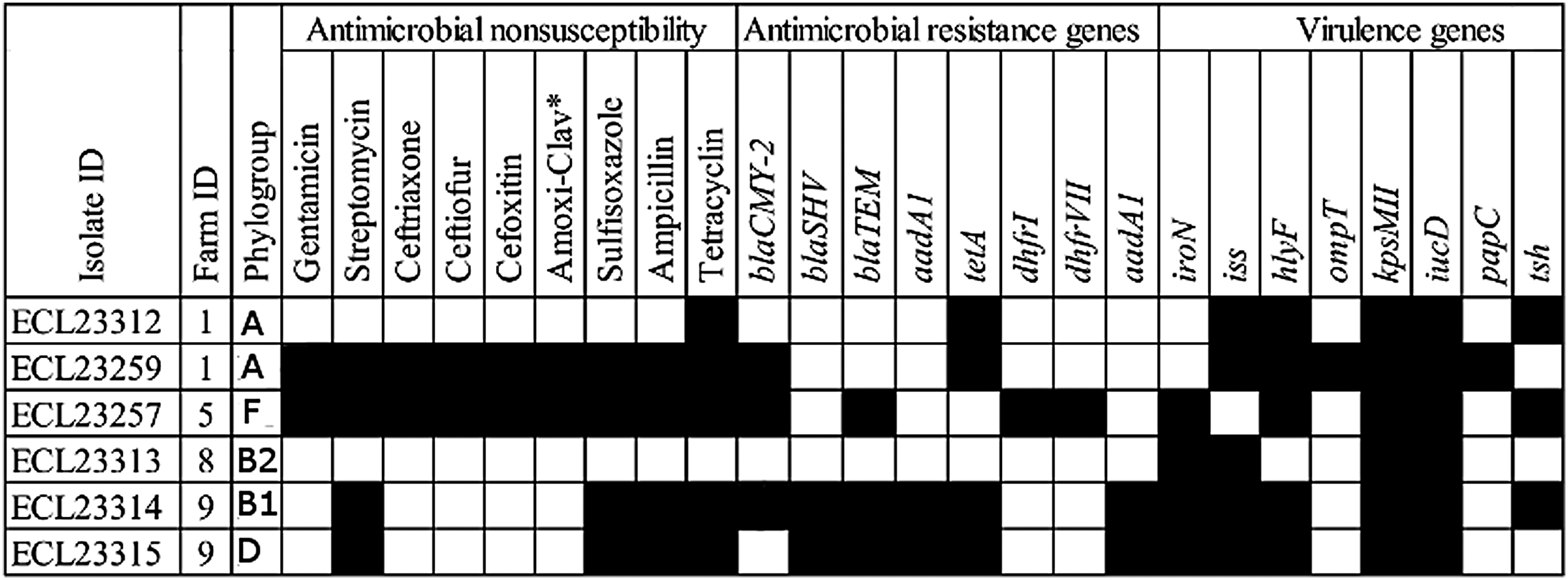
Virulence and AMR profiles of potential human ExPEC isolated from healthy broiler chickens in Saint-Hyacinthe region, Québec, Canada. Amoxi/clav, amoxicillin/clavulanic acid; Trimeth-sulf, Trimethoprim–sulfamethoxazole.
Clonal relationship among blaCMY-2-positive isolates
Among the 38 blaCMY-2-positive isolates, 24 could be assigned to an O serogroup, with 10 different serogroups detected (Fig. 3). Serogroups O9 (10 isolates), O78 (3 isolates), and O75, O101, O45 (2 isolates each) were frequently observed; the other serogroups being each detected in one isolate. Clustering based on PFGE profiles showed that isolates were polyclonal, with 15 clusters (I–XV) observed based on ≥60% similarity between isolates (Fig. 3). Nine of these clusters consisted of at least two isolates and the remaining six only comprised one isolate each. The cluster number IV with 11 isolates was the major one followed by clusters IX (4 isolates) and XII (3 isolates). Within the clusters, 27 PFGE groups (1–27) were observed when the similarity was set at ≥80% (Fig. 3) and of these, 7 included at least 2 isolates.
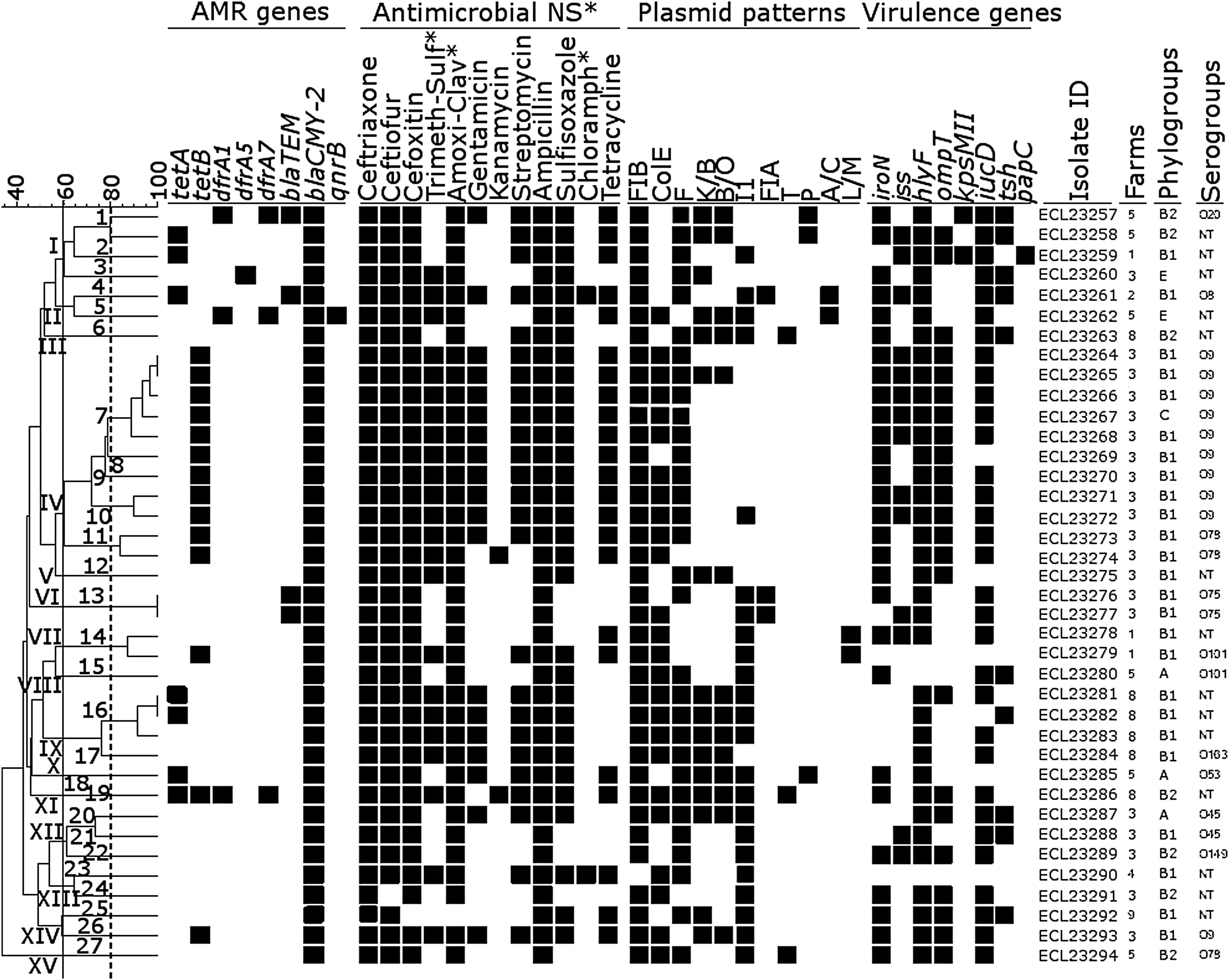
Clustering analysis of genetic variation among 38 blaCMY-2-positive Escherichia coli isolates in Saint-Hyacinthe region, Québec, Canada. The dendrogram was generated using Dice coefficient and the UPGMA. Based on a similarity index of ≥60% (continuous line), 15 majors clusters (I–XV) were found inside which 27 PFGE groups (in Arabic numerals) were identified when the similarity was set at 80% (discontinued line). AMR, antimicrobial resistance; antimicrobial NS*, antimicrobial nonsusceptibility; CRO, ceftriaxone; TIO, ceftiofur; FOX, cefoxitin; SXT, trimethoprim–sulfamethoxazole; AMC, amoxicillin–clavulanic acid; GEN, gentamicin; KAN, kanamycin; STR, streptomycin; AMP, ampicillin; SSS, sulfisoxazole; CHL, chloramphenicol; TET, tetracycline. None of the ESBL/AmpC-producing isolates were positive to AMR genes blaOXA-1, blaSHV, aadA1, and tetC and none was carrier of virulence genes sfa or afa, then these genes were removed from the dendrogram. PFGE, pulsed-field gel electrophoresis.
The cluster IV was divided into five PFGE groups of which three included two or more isolates: the PFGE group 7 including 4 isolates belonging to phylogroup B1 and serogroup O9 (group B1-O9), the PFGE group 10 that includes two B1-O9 isolates and the PFGE group 11 consisting of two isolates of group B1-O78. PFGE groups 7, 13, and 16 even included pulsotypes (isolates sharing 100% similarity). Isolates of cluster IV were all MDR8 and almost all were also carriers of at least four of the APEC virulence markers and thus, were defined as potential highly virulent APEC.
All B1-O9- and B1-O78 isolates of the cluster IV were from the same farm but from samples collected at different floors and locations on the farm. Each of the PFGE groups 13 (group B1-O75) and 16 (phylogroup B1 but nontypeable with our antisera) were also each from a single farm but different floors. Isolates of PFGE group 13 were MDR4 and those of PFGE group 16 were MDR7 with a nonsusceptibility profile identical to that of B1-O9 isolates mentioned previously in cluster IV (Fig. 3). Nevertheless, isolates of both PFGE groups 13 and 16 were less often carriers of virulence genes compared with other PFGE groups.
Prevalence of plasmid markers and transferability of plasmids among blaCMY-2-positive isolates
The 38 blaCMY-2-positive isolates were each carrier of at least 2 replicon plasmids with a maximum of 7. Eleven plasmids among the 21 screened were detected. The most prevalent incompatibility groups were FIB [37 (97.3%; 95% CI = 89.5–100)], F [30 (78.9%; 95% CI = 64.7–93.2)], colE [26 (68.4%; 95% CI = 58.7–78.1)], I1 [23 (60.5%; 95% CI = 28.8–92.2)], K/B [16 (42.1%; 95% CI = 5.2–79.1)], and B/O [14 (36.8%; 95% CI = 0.0–75.3)] (Fig. 3). The other replicon plasmids were FIA [3 (7.9%; 95% CI = 0.0–16.5)], T [3 (7.8%; 95% CI = 0.0–23.7)], P [(3 (7.8%; 95% CI = 0.0–28.9)], A/C [2 (5.2%; 95% CI = 0.0–16.5)], and L/M [2 (5.2%; 95% CI = 0.0–20.4)].
The transfer of ESBL/AmpC genes was successful for 19 of the 30 tested blaCMY-2-positive and 2 of the 3 tested blaCTX-M-positive isolates. The beta-lactam nonsusceptibility profiles of transformants were identical to those of the wild-type strains; being nonsusceptible to ceftiofur, ceftriaxone, amoxicillin/clavulanic acid, cefoxitin and ampicillin for blaCMY-2-positive transformants and to ceftiofur, ceftriaxone, and ampicillin for blaCTX-M-positive transformants. The blaCMY-2 genes was carried on FIB (4 isolates of which 3 cotransferred tetracycline nonsusceptibility), I1 (9 isolates), K/B (5 isolates), and B/O (1 isolate), whereas blaCTX-M genes were located on I1 (n = 2, both cotransferred nonsusceptibility to sulfisoxazole and tetracycline) (Table 3). Among wild-type carriers of blaCMY-2, three were also positive for blaTEM but none of their transformants were found to be positive to blaTEM. In addition, FIB, I1, and K/B carriers of ESBL/AmpC were each found in at least two farms.
Characteristics of Escherichia coli Isolates from Healthy Broiler Chickens in Quebec Carrying Extended-Spectrum Beta-Lactamases/AmpC Genes That Were Transferred to Recipient Strains
All transformant carrying blaCTX-M-1 were resistant to ampicillin, ceftiofur, and ceftriaxone and those carrying blaCMY-2were resistant to ampicillin, ceftiofur, ceftriaxone, and amoxicillin–clavulanic acid.
GEN, gentamicin; STR, streptomycin, SSS, sulfisoxazole; SXT, trimethoprim-sulfamethoxazole; TET, tetracycline; KAN, kanamycin; CHL, chloramphenicol; ND, nondetermined; ESBL, extended-spectrum beta-lactamases; PFGE, pulsed-field gel electrophoresis.
Discussion
This study showed a high prevalence of MDR (62.6%) in indicator E. coli isolated from seven chicken farms practicing thinning in Saint-Hyacinthe region in Québec. This prevalence is higher than the prevalence of 46% reported in clinical cases in chickens in Ontario, 35 but similar to that of 66% for MDR isolates reported by another study in commercial flocks from Ontario. 36 Whereas prevalence of nonsusceptibility to quinolones at both farm and sample levels was very low, nonsusceptibility to 3GC was at a much higher level (31.3%) in indicator isolates.
The very low prevalence of nonsusceptibility against quinolones is in accordance with the low prevalence reported for ciprofloxacin (0.068% in both commercial and smallholder chicken flocks in Ontario). 36 The likely explanation for this low prevalence is that this antimicrobial is not used in poultry production in Canada. 37 The high prevalence of nonsusceptibility against cephalosporins was confirmed by a similar prevalence of blaCMY-2 gene encoding ceftiofur resistance in indicator E. coli isolates (26.7%) and in specific isolates (91.5%), in addition to the presence of other beta-lactamases genes such as blaCTX-M, blaTEM, or blaSHV. In fact, three isolates were blaCTX-M-1. Chalmers et al. 12 also reported in their study of clinical E. coli from broiler chickens with colibacillosis in Québec that blaCTX-M gene was of genotype CTX-M-1.
Ceftiofur was still systematically used at the hatchery to prevent omphalitis in broiler chicken farms during the period of our sample collection, which could therefore explain the high prevalence of cephalosporin nonsusceptibility, as demonstrated by a previous study from France. 38 Our results are also in line with those of a previous study carried out in Québec, which reported a relationship between ceftiofur use and resistance to this antimicrobial, 13 as we demonstrate the ubiquity of ceftiofur nonsusceptibility and the predominance of blaCMY-2 gene over blaCTX-M in 3GC-resistant E. coli isolates.
However, Baron et al. 38 reported in their study that 3GC-resistant E. coli isolated from 1-week-old chicks from eggs injected in ovo with ceftiofur were predominantly positive for blaCTX-M rather than for blaCMY-2. It is possible that long-term in ovo extra-labeled use of ceftiofur as practiced in Québec could have promoted the predominance of blaCMY-2. The difference in relative predominance of the blaCTX-M and blaCMY-2 genes could also be explained in part by differences in geographical distribution of these genes. 38 For instance, we found both genes in almost similar proportions in 3GC-resistant E. coli isolates from healthy broiler chickens in both Vietnam and Senegal (unpublished results).
Other AMR genes found in high proportions in our study were those encoding resistance to tetracyclines (tetA and tetB) and aminoglycosides (aadA1) reinforcing the finding of previous studies that these genes are widely distributed among animal enterobacteria.39–41 In addition, the high prevalence of these resistance genes could be explained by the fact that these antimicrobials are registered for use in poultry in Canada and mostly, these drugs have been used for a long time in animals. **
However, gentamicin nonsusceptibility was highly prevalent although it is not used in poultry in Québec. Agunos et al. 42 also reported in Ontario an increase in prevalence of gentamicin resistance in E. coli isolates from broiler chickens. This high prevalence may be because of a co-selection through the use of other antimicrobials. Indeed, it has been suggested that the use of spectinomycin–lincomycin as a replacement for ceftiofur in Québec chickens could have selected resistance to gentamicin. 12 These authors also observed that the aadA and blaCMY genes were regularly co-located on the plasmid A/C, although this was not observed in this study.
The finding that almost all indicator E. coli isolates carrying the blaCMY-2 gene (17/19) belonged to the single phylogroup B1 suggests that these isolates of phylogroup B1 could have another attribute allowing them to acquire blaCMY-2 gene and predominate under selection pressure because of ceftiofur use. In fact, most of these isolates were positive for the ompT gene that was considered as a putative fitness gene allowing the pandemic clone ST131 to predominate, 43 although further studies are needed to elucidate why our indicator E. coli isolates producing blaCMY-2 are all phylogroup B1.
The study of clonal relationship between isolates did not demonstrate any evidence of clones circulating between the farms studied. However, related isolates, including clones, were found within farms, at separate locations on different floors of the poultry house, suggesting these clonal isolates have disseminated on farm or originated from the same source. This dissemination could result from the movement of chickens and workers, through contaminated feed or even through ambient air as previously reported.44,45 When collecting the samples on the farms, a questionnaire was administered to the farmers, revealing a great variability in the respect of the biosecurity measures. 16 Strict enforcement of biosecurity measures was observed on some farms, whereas biosecurity measures were nonexistent on others, other bird species being present nearby.
The lack of biosecurity in some farms could explain the possible dissemination of these clonal isolates. ESBL/AmpC-producing strains may have also been transmitted vertically from breeding flocks to chicks and established in the poultry environment. Of importance, we found that the most prevalent incompatibility groups among the plasmids carrying ESBL/AmpC genes were FIB, F, colE, I1, K/B, and B/O, as we also observed in our studies of E. coli derived from healthy chickens in Senegal and Vietnam (unpublished data), and was also reported in a previous study on APEC in China. 46 Because of their high prevalence, these plasmids may have contributed in the dissemination ESBL/AmpC genes in farms. The presence of these various plasmids, often mediating resistance to several antimicrobials, could also explain the high prevalence of MDR mentioned previously.
Transformation experiments demonstrated that, although selected isolates were of different PFGE groups and farms, the blaCTX-M-1 gene was located on plasmids of the I1 incompatibility group, whereas blaCMY-2 was carried by I1, K/B, FIB, and B/O plasmids. The plasmids harboring blaCTX-M-1 or blaCMY-2 were found on different farms. Similarly, we found that the blaCTX-M-1 and blaCMY-2 genes were located on I1, B/O, or K/B in E. coli isolated from healthy chickens in Senegal and Vietnam (unpublished data). The presence of the I1 incompatibility groups should be monitored because it is one of the plasmids with the ability to spread on a large scale.47,48 The presence of blaCTX-M-1 on I1 and of blaCMY-2 on I1 and B/O has also been reported in clinical E. coli isolates from chickens in Québec. 12 Similarly, a Colombian study identified blaCMY-2 on incompatibility plasmids K/B, I1, A/C, and B/O. 49
Although our isolates of serogroup O9 were not classified as potential human ExPEC based on their virulence genes, E. coli belonging to this serogroup have been isolated from acquired urinary tract infections in humans and avian cellulitis,50,51 underlining their potential to be pathogenic for both humans and birds. Isolates of PFGE group 7/serogroup O9 were present at different locations on one farm, suggesting their ability to disseminate on the same farm and possibly to other farms in the presence of appropriate vectors. These isolates of serogroup O9 may also come from same sources such as chicks, food, water, and so on.
In addition to these O9 isolates, some potential human ExPEC, belonging to phylogroups A, B1, B2, D, and F were found in different farms. These potential ExPEC could constitute a threat to humans. E. coli of phylogroups B2 and D are associated with disease in humans 25 and some E. coli isolates of phylogroup A have also been classified as potential human ExPEC in another study. 52 It should be noted that some of the potential human ExPEC isolates originated from farms mentioned previously that did not comply with biosecurity measures, which implies a higher risk of dissemination of these isolates.
Isolates of serogroups O45, O75, and O78 were also frequently observed. O78, with O1 and O2, are the most frequently identified serogroups among APEC isolates worldwide. 53 In addition, E. coli of serogroups O45 have been isolated from both human urinary tract infections and chickens with colibacillosis, 54 and isolates of serogroup O75 have been associated with human sepsis. 55 All these findings suggest that healthy chickens in the region of Québec, Canada, may act as reservoir for pathogenic E. coli in humans as previously reported by other studies.50,56
Although we have examined a large number of isolates obtained by different selection techniques, the inference of our results at the farm level is limited by the small number of farms (n = 7) sampled, which were all located in the same area. The fact that in a sample, isolates with different morphologies were targeted without being considered in the calculation of sampling weights could bias the estimated prevalences. This approach, however, maximized the probability of detecting the presence of isolates with less frequent profiles or genes at the farm level.
Moreover, all examined farms were practicing thinning, which might have increased their risk of carrying pathogenic strains because of the presence of a catching team travelling from farm to farm, and so on. This study is therefore preliminary to a large-scale study that could include more farms from different regions of Québec and could be conducted using more sophisticated tools such as whole-genome sequencing.
In summary, this study showed a high prevalence of MDR E. coli isolated from apparently healthy chickens in Québec. In view of the absolute predominance of the AmpC blaCMY-2 over the ESBL blaCTX-M, there is strong evidence that the nonsusceptibility to 3GC observed in this study is due, at least partly, to the in ovo use of ceftiofur during the period of data collection. Clonally related blaCMY-2-positive isolates were found in different floors of farms suggesting their spread on farm. In addition, the ESBL/AmpC genes were located on plasmids that have contributed to spreading of AMR. Furthermore, potential human ExPEC isolates showing MDR were detected. These results suggest that E. coli isolated from healthy chickens are reservoir for AMR and virulence capable of being spread to humans.
Footnotes
Acknowledgments
The authors thank Dr. Martine Boulianne and Dr. Benoît Lanthier for providing the samples from chickens. The authors also thank Dr. Ghyslaine Vanier and Mr. Gabriel Desmarais (OIE Reference Laboratory for E. coli, Université de Montreal, Canada) for their excellent technical assistance.
This work was supported in part by a grant from the following:
Fonds de Recherche du Québec—Nature et Technologies [CRIP Regroupements strategiques 111946], which financially supports the Centre de recherche en infectiologie porcine et aviaire (CRIPA) of the Université de Montréal, Groupe de Recherche en Zoonoses et Santé Publique (GREZOSP) of the Université de Montréal.
Disclosure Statement
J.M.F. is co-founder of Prevtec Microbia, Inc. (Saint-Hyacinthe, QC, Canada). All other authors: no competing financial interests exist.

References
Supplementary Material
Please find the following supplemental material available below.
For Open Access articles published under a Creative Commons License, all supplemental material carries the same license as the article it is associated with.
For non-Open Access articles published, all supplemental material carries a non-exclusive license, and permission requests for re-use of supplemental material or any part of supplemental material shall be sent directly to the copyright owner as specified in the copyright notice associated with the article.
